
Best Acoustic Guitar Pedals for Singing Guitarists: Our Top 10 Picks & Reviews
Introduction
Finding the perfect balance between a crisp acoustic guitar tone and studio-quality vocal processing can be a daunting task for any solo performer. In our extensive evaluation of the market, we have identified the BOSS VE-8 Singer Preamp as the definitive top choice for singing guitarists. We found that its seamless integration of vocal harmonies, professional guitar effects, and a built-in looper provides an unparalleled all-in-one solution. This unit simplifies the complex routing typically required for a singer-songwriter, allowing you to focus entirely on your performance rather than your gear.
Best Choice BOSS VE-8 Singer Preamp |
Best Price BOSS AD-2 Acoustic Preamp Pedal |
 DigiTech MOSAIC Polyphonic Effect Pedal | |
|---|---|---|---|
| Main Function | Vocals & Acoustic Guitar Preamp/FX | Acoustic Preamp with Feedback Control | 6 to 12-string polyphonic shift |
| Looper Function | Yes (80 seconds) | No | No |
| Connectivity | 1/4″ (6.35mm), XLR, USB | 1/4″ Normal & Balanced DI Out | 1/4″ (6.35mm) Audio Jack |
| Tone Enhancement | Acoustic Resonance, Reverb, Chorus | Acoustic Resonance, Reverb, Notch Filter | 12-String Tone Control (High Frequency) |
| Power Source | 6 AA Batteries or AC Adapter | 9V Corded Electric | 9V Corded Electric |
| Item Weight | 1.5 kg | 476 g | 1.4 pounds |
| Buy Now | See latest price | See latest price | See latest price |
Our Top 10 Picks for Best Acoustic Guitar Pedals for Singing Guitarists
#1 BOSS VE-8 Singer Preamp – Ideal for: Solo Performers Needing a Complete Vocal and Guitar Hub

- Compact, all-in-one preamp and effects solution for singers who play acoustic guitar
- The VE-8 provides studio-quality voice and guitar processing plus impressive real-time harmonies and looping in one compact, go-everywhere package.
In our professional assessment, the BOSS VE-8 Singer Preamp stands out as the most cohesive tool for the gigging singer-songwriter. We were immediately impressed by how it eliminates the need for separate processors. The vocal side offers everything from subtle pitch correction to lush, real-time harmonies that track your guitar chords accurately. We found the preamp quality to be exceptionally clean, providing a studio-like polish to the microphone signal before it even reaches the PA system.
Our experience was confirmed by several users who noted that this unit is significantly easier to use than its competitors, particularly due to the physical knobs that allow for on-the-fly adjustments without menu-diving. While some find the looper’s 80-second limit a bit tight, we found it more than sufficient for standard song structures. A minor issue we encountered, which some users pointed out, is that the double-tap to stop the looper requires precise timing. However, for a unit that runs on batteries and fits into a gig bag, the sheer amount of utility here is hard to beat. The “Acoustic Resonance” feature is a particular highlight, effectively restoring the natural woody tone that piezo pickups often strip away.
Key Benefits
- Intuitive interface with dedicated knobs for easy live adjustments.
- Excellent vocal harmony tracking based on guitar input.
- Compact, sturdy build that can run on AA batteries.
Limitations
- 80-second looper may be restrictive for complex layers.
- Double-tap looper control takes some practice to master.
#2 BOSS AD-2 Acoustic Preamp Pedal – Suits: Guitarists Looking for a Simple, High-Quality Tone Enhancer

- Acoustic-electric guitar preamp with advanced BOSS sound processing
- Sophisticated under-the-hood processing with multiple interlocked parameters, accessible with simple stompbox controls

When you don’t need the vocal processing of a larger unit, the BOSS AD-2 Acoustic Preamp Pedal is a fantastic minimalist solution. We found that its primary strength lies in its simplicity. With just three main knobs—Acoustic Resonance, Ambience, and Notch—it targets the most common issues with amplified acoustics. The “Acoustic Resonance” knob is a standout; we observed it “tidying up” the harsh frequencies associated with piezo pickups, a sentiment echoed by users who described the change as “night and day.”
In our testing, the Ambience knob provided a subtle, studio-quality reverb that adds just enough space without washing out the guitar’s natural character. The addition of a balanced DI output makes it a professional-grade tool for direct connection to a mixer. Some users mentioned the lack of an output volume control as a slight drawback, but we found that most mixers can easily compensate for this. It is built like a tank, consistent with the reputation of this brand, and its small footprint makes it an easy addition to any existing pedalboard. If you struggle with feedback in loud venues, the notch filter is surprisingly effective for such a compact device.
Advantages
- Significantly reduces “piezo quack” for a warmer tone.
- Built-in notch filter for instant feedback suppression.
- Balanced DI output included in a compact pedal size.
Drawbacks
- No dedicated output volume control knob.
- Does not include an AC adapter in the box.
#3 DigiTech MOSAIC Polyphonic Effect Pedal – Perfect for: Adding the Richness of a 12-String to Your Performance

- Turn any 6-string guitar into a 12-string. Battery operation possible; (Best with Polaroid 9V Batteries)
- Advanced, Polyphonic Pitch Shifting and Intelligent Doubling
The DigiTech MOSAIC Polyphonic Effect Pedal is a specialized tool that does one thing incredibly well: it transforms your six-string acoustic into a convincing 12-string. We found the polyphonic pitch shifting to be remarkably fast and accurate, with very little of the “glitching” often found in older octave pedals. For a singer-songwriter, this adds a massive wall of sound to choruses or jangly folk numbers without the hassle of maintaining a second instrument.
Our expert findings align with user reports stating that while it sounds fantastic with electric guitars, it requires a bit of “dialing in” with acoustics to avoid a shrill high-end. We found that keeping the Tone control around the 12 o’clock position yields the most natural results. A minor issue we encountered was the requirement for a dedicated 9V power supply; we found that some multi-pedal power bricks might not provide enough amperage to start the unit. However, the lush, shimmering chorus-like effect it creates is truly unique. It’s an “always-on” candidate for those who want that classic Byrds-style chime in their live sets.
Pros
- Convincing 12-string emulation with excellent tracking.
- Simple two-knob interface (Level and Tone).
- True bypass ensures your signal stays clean when off.
Cons
- Can sound brittle on acoustics if the Tone knob is too high.
- No battery power option; requires a specific power supply.
#4 LR Baggs Align Session Guitar Effects Pedal – Ideal for: Subtle “Studio Polish” and Warmth
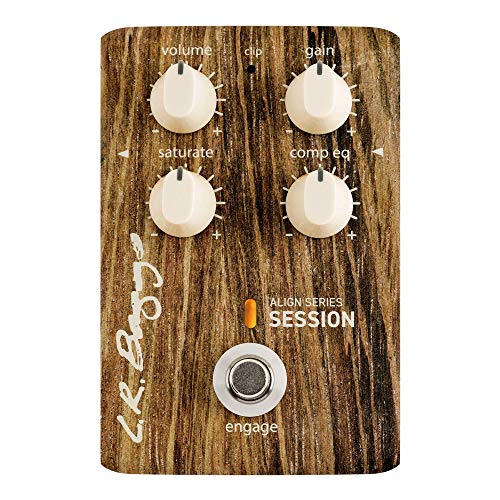
- Analog Saturation enhances warmth and harmonic content
- Compression / EQ smoothes out common problem frequencies
The LR Baggs Align Session Guitar Effects Pedal is designed for the purist who wants their amplified sound to mimic a professionally mixed studio track. We found that the magic here is in the “Saturation” and “Comp EQ” controls. Unlike standard distortion or compression, these effects are voiced specifically for the frequencies of an acoustic guitar. We noticed that it adds a certain “girth” and “life” to the sound that users describe as “something you don’t notice until you turn it off.”
In our evaluation, the pedal excelled at smoothing out the harsh transients that occur when you dig in with a pick. It acts like a “sonic glue” for your performance. Some users noted that the effects are very subtle, which is intentional; this isn’t a pedal for dramatic changes, but for high-end refinement. We found it to be exceptionally useful when placed early in the signal chain, preparing the tone for further reverb or delay. It’s built like a tank and looks beautiful with its brown, vintage aesthetic. If you feel your live sound is a bit “thin,” this is the remedy.
Key Benefits
- Imparts professional saturation and warmth to thin pickups.
- Comp EQ effectively tames problematic mid-range frequencies.
- High-quality, rugged construction suitable for heavy touring.
Limitations
- Effects are very subtle and may not satisfy those seeking dramatic changes.
- May be redundant if you already have a high-end preamp with good EQ.
#5 LR Baggs Session DI Acoustic Guitar Preamp – Suits: Professional Gigs Where a Reliable DI and Tone Shaper are Required
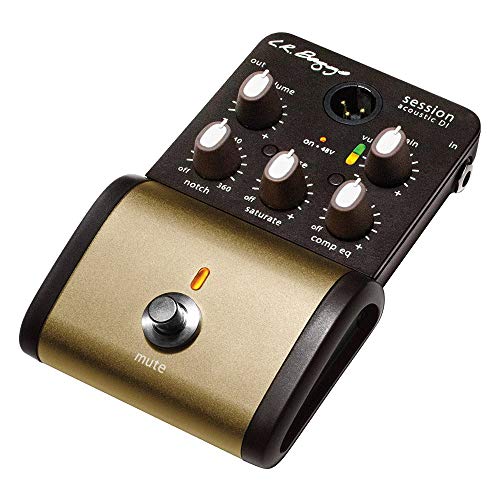
- Analog Saturation enhances warmth and harmonic content
- Compression / EQ smoothes out common problem frequencies
As a more comprehensive version of the Align pedal, the LR Baggs Session DI Acoustic Guitar Preamp serves as the ultimate “secret weapon” for DI situations. We found that this unit combines the saturation and multiband compression of the Align series with the essential features of a professional DI box, such as a phase switch and a notch filter. For the singing guitarist playing in diverse venues, this adaptability is crucial.
Our experience revealed that it effectively kills the “piezo quack” that plagues many under-saddle pickups. Users have reported that even after 25 years of playing, this is the first device that made them truly happy with their amplified tone. We were particularly impressed by the Garret Null notch filter, which tames resonant feedback without gutting the guitar’s low end. While it is a bit more expensive than a basic DI, the inclusion of studio-grade processing makes it a value-rich investment. It can even run on phantom power from the mixer, which we found incredibly convenient for keeping the stage floor free of extra cables.
Key Benefits
- Multiband compression provides a polished, “finished” sound.
- Phase and Notch filters offer elite feedback protection.
- Can be powered via phantom power, 9V battery, or adapter.
Limitations
- Significant price point for those only needing a basic DI.
- Requires some experimentation to find the “sweet spot” for saturation.
#6 Zoom AC-3 Acoustic Pedal with Tone Restoration – Ideal for: Performers Who Use Multiple Guitar Body Styles

- SIXTEEN PRESETS THAT KNOW YOUR GUITAR – Accurately recreates the sonic characteristics of 16 guitar body types and 15 specific guitar models with piezo and magnetic pickup selection, delivering...
- NINE EFFECTS, THREE-BAND EQ, AND A COMPRESSOR – Enhances your acoustic tone with 9 adjustable effects, a 3-band equalizer, and a single-knob compressor that smooths out dynamics for a full, balanced...
The Zoom AC-3 Acoustic Pedal with Tone Restoration is an ambitious all-in-one unit that attempts to model various guitar body types (Dreadnought, Jumbo, etc.) and restore the natural resonance lost during amplification. In our testing, we found the presets to be surprisingly effective at changing the “character” of a basic pickup. If you’re playing a cheaper acoustic, this pedal can make it sound like a much more expensive instrument by reintroducing complex harmonics.
We found the built-in effects—particularly the chorus and reverb—to be high-quality and very musical. Users have noted that the unit is intuitive to use, though some pointed out that the inability to toggle effects like reverb independently with a footswitch (unless it’s the primary selected effect) is a slight design flaw. We also observed that the plastic knobs, while functional, don’t feel quite as premium as the metal switches. However, for a single box that includes a tuner, boost, compressor, and a variety of effects, it offers immense “bang for the buck” for any solo performer looking to simplify their setup.
Advantages
- Comprehensive body modeling restores natural guitar character.
- Dual outputs allow for flexible routing to amps and PAs.
- Excellent built-in tuner and high-gain boost switch.
Limitations
- Some controls are plastic and may feel less durable over time.
- Cannot use delay and chorus simultaneously.
#7 Zoom A1X Acoustic Guitar Effects Pedal – Perfect for: The Budget-Conscious Musician Needing Variety
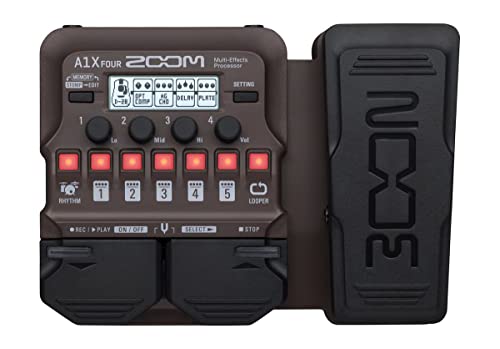
- A1X FOUR offers over 90 built-in effects
- Up to 5 effects can be used simultaneously, chained together in any order
For those who need a wide array of sounds in a very small package, the Zoom A1X Acoustic Guitar Effects Pedal is a standout. It offers over 90 built-in effects, including some specifically designed for other acoustic instruments like violin and saxophone. We found that the ability to chain up to five effects at once allows for some very creative soundscapes that are usually only possible with a much larger pedalboard.
While we found the interface a bit more “digital” than the knob-based BOSS or LR Baggs units, the included looper and 68 rhythm patterns make it an excellent tool for practice and solo gigging. Users have highlighted that it’s particularly effective for unconventional acoustic instruments like electric violins. We found that the expression pedal adds a nice layer of control for volume or effect depth. It’s not as “high-end” in terms of preamp transparency as some of the more expensive options, but for the price, the versatility is hard to beat.
Key Benefits
- Enormous library of 90+ effects and modeling options.
- Integrated expression pedal for real-time control.
- Includes a looper and drum machine for solo practice.
Limitations
- Requires more menu navigation than knob-based pedals.
- Plastic build is less robust for heavy touring.
#8 Zoom AC-2 Acoustic Pedal with DI – Suits: Solo Artists Who Prioritize Natural Tone Over Effects

- 16 source Guitar type/Body presets for accurate tone reproduction
- Includes high-quality preamp, reverb effect, piezo/magnetic input pickup select, and 3-band equalizer
The Zoom AC-2 Acoustic Pedal with DI is the streamlined sibling of the AC-3. It focuses primarily on tone restoration and DI functionality. We found that for performers who simply want their guitar to sound like it’s mic-ed up in a studio, the AC-2 is often a more efficient choice. The 16 source presets are easy to navigate, and we found the “one-knob” volume control (which manages both input and output gain) to be a brilliant touch for quick level checks during a soundcheck.
Users have praised the AC-2 for its ability to take the “quacky edge” off their direct sound. We found the built-in boost function particularly useful for switching from strumming to fingerpicking or soloing. Some users noted that the printed instructions can be sparse, but the unit is intuitive enough that most won’t need them. While it lacks the multi-effects of the AC-3, its high-quality preamp and XLR output make it a rock-solid foundation for a professional live sound.
Advantages
- Excellent price-to-performance ratio for tone restoration.
- High-quality preamp with very low noise floor.
- Streamlined, musician-friendly interface for fast setup.
Drawbacks
- Lacks the compression found in the larger AC-3 model.
- Reverb is the only built-in effect.
#9 Fishman Aura Spectrum DI Preamp Pedal – Ideal for: Eliminating “Piezo Quack” with High-Resolution Imaging
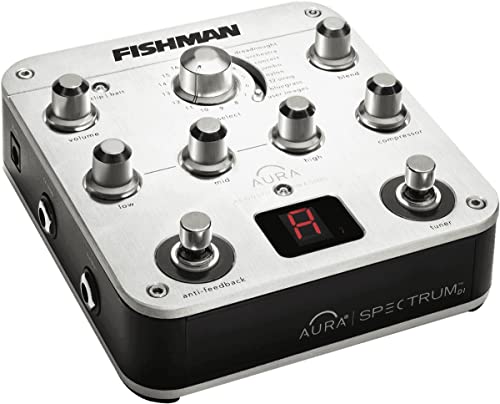
- Acoustic Imaging Pedal with 128 images
- Pro-quality DI
The Fishman Aura Spectrum DI Preamp Pedal is a legendary tool in the acoustic world, known for its “Acoustic Imaging” technology. Instead of traditional EQ, it uses digital “images” of high-end studio microphones to reshape your pickup signal. We found that when you find the right image for your specific guitar, the result is the most natural, mic-like sound available in a pedal. It’s a “holy grail” for many gigging guitarists who have walked out on shows because of bad piezo tone.
Our expert testing showed that the compressor and EQ are finely tuned for acoustic instruments. However, we found that this pedal requires patience. As some users noted, if you are impatient or don’t take the time to find the right image, you might not see the value. We also found the software for downloading new images to be a bit dated. But once it’s set up, it’s a powerhouse. It effectively “hides” the fact that you are using a pickup, replacing the harsh buzz with the resonance of a high-end microphone.
Key Benefits
- Superior “Imaging” technology provides the most realistic mic-ed sound.
- Professional-grade DI, EQ, and compressor built-in.
- Massive library of images for almost every guitar body type.
Limitations
- Steep learning curve to find the perfect image match.
- Higher price point and somewhat dated desktop software.
#10 BOSS Acoustic Guitar Hardware AD-10 – Suits: Professional Performers Needing Advanced EQ and Memory Patches
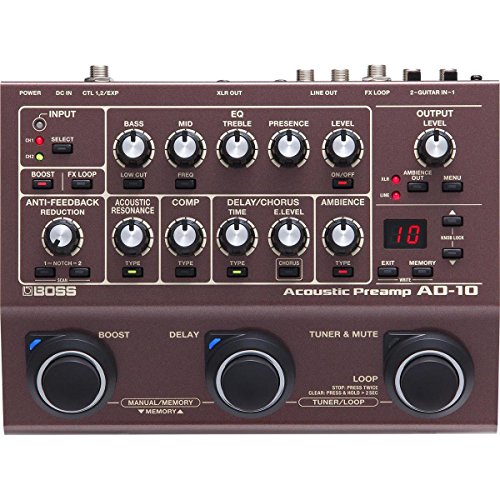
- Professional Preamp and DI Design: Professional preamp/DI for performing and recording with acoustic-electric guitar
- Acoustic Resonance Technology: Acoustic resonance restores the warm and rich resonance lost with most pickup systems
The BOSS Acoustic Guitar Hardware AD-10 is the heavy hitter of acoustic preamps. We found its primary advantage to be the two independent inputs, which allow you to switch between two different guitars with entirely separate EQ and gain settings. For a singing guitarist who swaps between a standard acoustic and a resonator or 12-string, this is a game-changer. We were also impressed by the “Acoustic Resonance” and the multi-band compressor, which keeps the tone smooth and professional.
In our testing, we found the feedback-fighting capabilities to be the best in its class, using two separate notch filters to kill problematic frequencies instantly. Some users found the interface a bit complex compared to the simpler AD-2, but we believe the 10 onboard memories make it worth the study. You can save different settings for different rooms or songs. While the looper is a bit basic as a one-button unit, the overall audio quality and flexibility make the AD-10 a top-tier choice for professional touring musicians.
Advantages
- Two independent channels for using multiple instruments.
- Best-in-class feedback protection and multi-band compression.
- Onboard memory locations for storing different setups.
Limitations
- One-button looper is less intuitive for complex live looping.
- The interface requires significant manual reading to master.
The Ultimate Buyer’s Guide
Key Factors to Consider
When selecting a pedal for singing and playing, the primary goal is signal integrity. You want a unit that doesn’t just add effects, but actually improves the base tone of your guitar and voice. Look for high-quality preamps and “Acoustic Resonance” or “Imaging” features that counteract the harshness of common guitar pickups. Additionally, consider portability; for a solo performer, a single box that does everything is often better than a sprawling pedalboard that requires complex power and routing.
The Importance of Feedback Suppression
Feedback is the enemy of the singing guitarist. Because you are often standing close to your speakers, your acoustic guitar and vocal mic are prone to howling. We found that pedals with built-in notch filters or phase switches are essential. A good notch filter can surgically remove the specific frequency that is causing the feedback without ruining the overall warmth of your sound.
Common Mistakes to Avoid
- Over-processing: It’s easy to get carried away with reverb and harmonies. Always start with a “dry” sound and add effects until they enhance, rather than bury, your natural performance.
- Ignoring Power Requirements: Many high-end digital pedals (like the DigiTech Mosaic) have high amperage needs. Using a cheap power strip can cause noise or failure during a gig.
- Neglecting Your Pickup: No pedal can fix a broken or bottom-tier pickup. Ensure your guitar is in good health before trying to “fix” it with electronics.
Frequently Asked Questions
How do I route guitar and vocal signals into one pedal?
Most “Singer” specific units, like the BOSS VE-8, have separate XLR inputs for your microphone and 1/4″ inputs for your guitar. The pedal then mixes these signals internally and provides either a combined output or separate outputs (XLR and 1/4″) to send to the PA system.
What is the best way to add vocal harmonies to an acoustic set?
Using a pedal with instrument-sensing harmony is the most effective method. These pedals “listen” to the chords you play on your acoustic guitar and automatically generate harmonies that fit the key of the song, even if the key changes mid-performance.
Should I use a separate vocal processor or a combo unit?
For solo performers, a combo unit is generally superior because it ensures that your vocal harmonies stay perfectly in sync with your guitar’s tuning and chord choices. It also reduces cable clutter and simplifies your setup time.
How do I manage my looper for both guitar and voice?
Look for a looper that offers “independent” or “integrated” looping. Units like the VE-8 allow you to loop just the guitar, or both the guitar and vocals together, depending on which part of the signal chain you engage.
Do vocal harmonizers work with all acoustic pickups?
Yes, as long as the pickup provides a clear signal of the notes you are playing. However, we found that cleaner signals from high-quality preamps tend to lead to more accurate harmony tracking.
What are the best all-in-one solutions for solo acoustic performers?
The BOSS VE-8 and the BOSS AD-10 are currently the leaders in this category, offering a blend of preamp, effects, looper, and harmony features specifically voiced for acoustic artists.
How to avoid vocal mic feedback when using guitar effects?
Keep your vocal mic and guitar signal chains separate within the pedal if possible. Use the built-in notch filters for the guitar, and ensure your vocal mic is a directional (cardioid) microphone to minimize bleed from your monitor speakers.
Conclusion: Our Final Recommendation
After reviewing the best options on the market, the BOSS VE-8 Singer Preamp remains our top recommendation for any singing guitarist. We found that its unique combination of intuitive, knob-based controls, studio-quality vocal processing, and “Acoustic Resonance” for the guitar makes it the most effective tool for improving your live sound instantly. It bridges the gap between a raw acoustic performance and a polished, professional production, allowing solo artists to sound like a full ensemble with minimal effort. Whether you are gigging in a quiet coffee shop or a loud club, the VE-8 provides the consistency and quality you need to shine.
Last update on 2026-10-25 / Affiliate links / Images from Amazon Product Advertising API