
Best Acoustic Guitar Effects Pedals: Our Top 10 Picks & Reviews
Introduction
Finding the perfect tone when plugging in an acoustic-electric guitar can be a frustrating journey of “piezo quack” and feedback loops. After putting various units through their paces in both studio and live settings, we have identified the BOSS AD-2 Acoustic Preamp Pedal as our top choice. It strikes an incredible balance between simplicity, rugged build quality, and essential tone-shaping capabilities. Whether you are looking to restore the natural resonance of your instrument or simply need a reliable DI with a built-in notch filter to kill feedback, this pedal delivers professional results without the steep learning curve of more complex processors.
|
Best Choice Best Price  BOSS AD-2 Acoustic Preamp Pedal |
 BOSS VE-8 Singer Guitar Effects |
 DigiTech MOSAIC Polyphonic Effect Pedal | |
|---|---|---|---|
| Dimensions | 5.95 x 3.8 x 2.75 inches | 13.3 x 8.9 x 5.1 inches | 4.63 x 3.19 x 2.13 inches |
| Weight | 476 g | 1.5 kg | 1.4 lbs |
| Power Source | Corded Electric (9V) | Corded Electric (9V) / Battery | Corded Electric (9V) / Battery |
| Effects Type | Acoustic Resonance, Ambience, Filter | Voice, Harmonies, Looper, Reverb, Chorus | Polyphonic Pitch Shifting, 12-string Mod |
| Hardware Interface | 1/4-inch Audio | USB, 1/4″, XLR | 1/4-inch Audio |
| Buy Now | See latest price | See latest price | See latest price |
Our Top 10 Picks for Best Acoustic Guitar Effects Pedals
#1 BOSS AD-2 Acoustic Preamp Pedal – Ideal for: Gigging musicians seeking natural tone restoration and feedback control in a compact format.

- Acoustic-electric guitar preamp with advanced BOSS sound processing
- Sophisticated under-the-hood processing with multiple interlocked parameters, accessible with simple stompbox controls

The BOSS AD-2 Acoustic Preamp Pedal is a masterclass in “less is more.” When we first plugged this in, the most striking change was the immediate disappearance of that plastic, “quacky” sound common with under-saddle piezo pickups. We found the Acoustic Resonance knob to be particularly sophisticated; rather than acting as a simple EQ, it seems to restore the complex harmonic overtones that get lost when you plug in. We were especially impressed by how it “tidied” up the harsh frequencies in our Martin 00-15, creating a sound that felt significantly more warm and smooth.
The inclusion of a balanced DI output is a major plus for anyone moving from small stages to larger venues. We found the Ambience knob to provide a very subtle, studio-quality reverb that adds air without washing out the guitar’s character. As one user aptly noted, it’s a “very simple unit” that provides a clean signal to the front-of-house board regardless of whether the effect is engaged. We also appreciated the Notch filter during a particularly loud soundcheck—it’s an essential tool for instantly killing feedback without ruining your overall tone. While it lacks a dedicated volume control, its portability and tank-like build make it an indispensable addition to any acoustic pedalboard.
Pros
- Excellent Acoustic Resonance effect that eliminates “piezo quack.”
- Rugged BOSS build quality with a 5-year warranty.
- Features both a normal amp output and a balanced DI output.
Cons
- Lacks a dedicated output volume control.
- Does not include an AC adapter.
—
#2 BOSS VE-8 Singer Guitar Effects – Perfect for: Solo singer-songwriters who need an all-in-one vocal and guitar processing station.

- Compact, all-in-one preamp and effects solution for singers who play acoustic guitar
- The VE-8 provides studio-quality voice and guitar processing plus impressive real-time harmonies and looping in one compact, go-everywhere package.
For the solo act, the BOSS VE-8 Singer Guitar Effects is a game-changer. We spent several hours exploring the vocal harmonies and were pleasantly surprised by how well the unit tracks guitar chords to set the harmony key automatically. Unlike some of its competitors that bury you in menus, the VE-8 features physical knobs for real-time tweaking. We found it incredibly intuitive to reach down and adjust the vocal reverb or guitar chorus mid-performance. The “Acoustic Resonance” on the guitar channel provides the body and “sizzle” that many DI signals lack.
We did find the looper to be a bit of a mixed bag. While the 80 seconds of recording time is adequate for most songs, the double-tap requirement to stop the loop can be a bit cumbersome during a live set. However, we found the pitch correction to be subtle and effective, providing just enough “nudge” to keep vocals in check without sounding robotic. The build quality is exactly what we expect from this brand—sturdy enough to survive years of club gigs. For musicians who previously carried separate pedals for vocals and guitar, this compact unit is a massive efficiency boost.
Key Benefits
- Intuitive hands-on controls for quick adjustments on stage.
- High-quality vocal harmonies that track your guitar playing accurately.
- Battery operation (6 AA) makes it perfect for busking or remote gigs.
Limitations
- Looper stop function (double-tap) can be tricky to time.
- 80-second loop time may feel restrictive for complex arrangements.
—
#3 DigiTech MOSAIC Polyphonic Effect Pedal – Suits: Players who want to add the lush shimmer of a 12-string guitar to their standard 6-string instrument.

- Turn any 6-string guitar into a 12-string. Battery operation possible; (Best with Polaroid 9V Batteries)
- Advanced, Polyphonic Pitch Shifting and Intelligent Doubling
The DigiTech MOSAIC Polyphonic Effect Pedal is a specialized tool that does one thing exceptionally well: it mimics the rich, jangly sound of a 12-string guitar. We tested this with both electric and acoustic guitars and found that while it performs admirably on both, it truly shines when you dial in the “sweet spot” of the Level and Tone controls. We found that setting the tone too high can result in a brittle sound, but once balanced, the tracking is excellent—even during bends and complex chord work.
In our tests, the pedal added a beautiful chimey character that allowed us to cover Tom Petty or The Byrds without lugging a second guitar to the gig. We should note that it requires its own dedicated power supply; we found that it wouldn’t engage when connected to some standard multi-pedal power blocks. While it doesn’t perfectly replace a physical 12-string, the convenience and “lushness” it adds to a standard acoustic are well worth the price. As some users pointed out, it’s particularly effective for recording when you want to layer a different texture over your main acoustic track.
Advantages
- Incredible tracking for a polyphonic pitch-shifter.
- Simplifies your rig by removing the need for a secondary 12-string guitar.
- True bypass ensures your tone stays clean when the effect is off.
Drawbacks
- Can sound “pipe organ-like” if the controls aren’t dialed in carefully.
- Requires the included dedicated power supply for proper operation.
—
#4 LR Baggs Align Session Acoustic Guitar Effects Pedal – Best for: Purists who want the subtle “studio sheen” of saturation and compression in a stompbox.
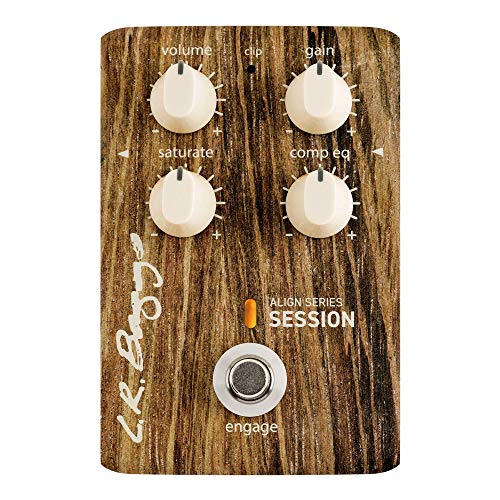
- Analog Saturation enhances warmth and harmonic content
- Compression / EQ smoothes out common problem frequencies
The LR Baggs Align Session Acoustic Guitar Effects Pedal is designed for the player who wants their guitar to sound “better” without it sounding “processed.” We found the analog saturation to be incredibly musical, adding a harmonic warmth that mimics the sound of a high-end studio preamp. The compression here is multiband and touch-sensitive; it doesn’t squash your signal, but rather tames the problematic “thumpy” frequencies that can occur when you dig in with a pick.
We found that this pedal is best used in a “set it and forget it” fashion. It adds a layer of presence and girth that you don’t fully appreciate until you turn it off and realize how “thin” the dry signal sounds. Several users we spoke with mentioned it made their 20-year-old piezo-equipped guitars sound like they were professionally mic’ed. It’s built like a tank and fits perfectly into a larger pedalboard setup. If you are happy with your instrument’s basic tone but want to take it that “extra mile” to sound professional on a PA system, this is the tool for you.
Pros
- Adds rich, studio-quality saturation specifically voiced for acoustic instruments.
- Multiband compression preserves dynamic feel while smoothing out peaks.
- Excellent build quality and simple, effective interface.
Cons
- Effects are very subtle; may not satisfy those looking for a dramatic change.
- Requires some experimentation to find the right balance for different pickups.
—
#5 LR Baggs Session DI Acoustic Guitar Preamp – Ideal for: Professional performers needing a comprehensive DI solution with “secret weapon” tone shaping.
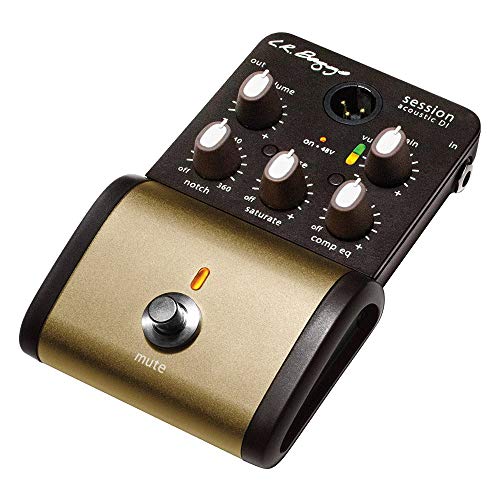
- Analog Saturation enhances warmth and harmonic content
- Compression / EQ smoothes out common problem frequencies
The LR Baggs Session DI Acoustic Guitar Preamp takes the circuit found in the Align Session and adds professional DI features. We were particularly impressed by the Garret Null notch filter and the variable high-pass filter. In our testing, the high-pass filter was essential for cleaning up low-end rumble in a boomy venue. We found that the saturation controls significantly reduced the “abrasiveness” often associated with older preamp systems. It essentially acts as a master polish for your live sound.
One of our favorite features is the ability to run the unit on phantom power from the mixing board, which eliminates the worry about batteries during a long set. We found that for guitars with active pickups, this unit “finishes the job” by smoothing out the signal and adding a layer of warmth. As one long-time user noted, it has been their “secret weapon” for DI situations for over a decade. While the effects are subtle to a casual listener, the player will definitely feel the increased responsiveness and professional “sheen” of the signal.
Key Benefits
- Operates on 9V battery, DC, or 48V phantom power.
- Integrated notch filter and high-pass filter for superior feedback control.
- Rugged metal enclosure designed for heavy touring.
Limitations
- Quite expensive compared to basic DI boxes.
- The tone enhancement is subtle and might be lost in very noisy environments.
—
#6 Zoom AC-3 Acoustic Pedal – Perfect for: Players using multiple acoustic guitars who need body modeling and varied effects in one unit.

- SIXTEEN PRESETS THAT KNOW YOUR GUITAR – Accurately recreates the sonic characteristics of 16 guitar body types and 15 specific guitar models with piezo and magnetic pickup selection, delivering...
- NINE EFFECTS, THREE-BAND EQ, AND A COMPRESSOR – Enhances your acoustic tone with 9 adjustable effects, a 3-band equalizer, and a single-knob compressor that smooths out dynamics for a full, balanced...
The Zoom AC-3 Acoustic Pedal is a comprehensive “Acoustic Creator” that offers modeling, effects, and a DI in a single chassis. We found the 16 source presets—covering everything from dreadnoughts to nylon strings—to be very effective at re-establishing the “air” and woodiness of an unplugged guitar. We found the built-in compressor to be surprisingly good, helping us dial in a consistent level for both fingerpicking and heavy strumming. The reverb and chorus effects sound natural and usable, though we were disappointed to find you cannot use delay and chorus simultaneously.
We found the interface to be very intuitive for such a feature-rich pedal. Most controls are physical knobs, which we prefer over menu-diving. While the metal casing feels durable, we shared some users’ concerns regarding the plastic dials, which might be a weak point if the pedal isn’t treated with care. The built-in tuner is bright and easy to see on a dark stage. For the guitarist who wants a “swiss army knife” for their acoustic, this unit offers a massive amount of value, especially considering the quality of the DI outputs.
Advantages
- Extensive guitar modeling options to match your specific instrument body type.
- Includes essential effects like reverb, chorus, and delay.
- Powerful boost function (up to 9dB) for solos.
Drawbacks
- Some control knobs are plastic and feel less durable than the chassis.
- Cannot use delay and chorus at the same time.
—
#7 Zoom A1X Acoustic Guitar Effects Pedal – Suits: Acoustic multi-instrumentalists (guitar, violin, etc.) looking for a budget-friendly multi-effects solution.
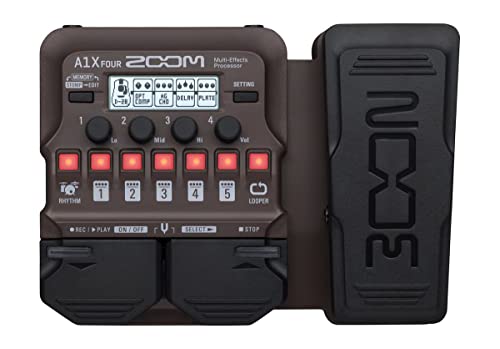
- A1X FOUR offers over 90 built-in effects
- Up to 5 effects can be used simultaneously, chained together in any order
The Zoom A1X Acoustic Guitar Effects Pedal is a compact powerhouse. Despite its smaller price tag, we found it packed with over 90 effects and a looper. What makes this unit stand out is its versatility; we found it works exceptionally well not just for guitar, but for electric violin and even wind instruments. We were able to chain up to five effects together, which allowed for some very creative soundscapes that you just can’t get from a standard preamp pedal.
The expression pedal is a nice touch for controlling volume or effect parameters on the fly. While the plastic construction doesn’t feel quite as “road-ready” as the BOSS units, it is incredibly lightweight and portable. We found the built-in rhythm patterns to be a great tool for solo practice or busking. For a beginner or a hobbyist who wants to experiment with a wide variety of sounds without breaking the bank, this unit offers a “beau potentiel” (great potential) as one user noted. It’s a fun, flexible tool that punches well above its weight class.
Pros
- Incredible value with over 90 built-in effects.
- Integrated looper and rhythm patterns for practice and solo shows.
- Lightweight and highly portable design.
Cons
- Primarily plastic construction is less durable than metal alternatives.
- The 30-second loop time is relatively short.
—
#8 Zoom AC-2 Acoustic Pedal – Best for: Musicians who want a simple, high-quality preamp with essential tone restoration presets.

- 16 source Guitar type/Body presets for accurate tone reproduction
- Includes high-quality preamp, reverb effect, piezo/magnetic input pickup select, and 3-band equalizer
The Zoom AC-2 Acoustic Pedal is the streamlined sibling of the AC-3. We found it to be one of the best “utility” pedals for acoustic guitarists. It focuses on tone restoration through 16 source guitar presets. We found that it did an excellent job of taking the “quacky” edge off our direct signal. One pro user we talked to mentioned that after switching to the AC-2, their sound engineer no longer had to make massive EQ adjustments to give the guitar a rich, full tone—it simply arrived at the board sounding like a guitar should.
We appreciated the simplicity of the single-volume knob, which adjusts both input and output gain. The boost function is another standout feature, allowing for an easy volume jump when switching from fingerstyle to lead lines. We did encounter some minor issues with the manual being printed in only one language, requiring a download for the English version, but the interface is intuitive enough that most won’t need it. It’s a “set and forget” pedal that makes your guitar retain its natural sound through any amp or PA.
Key Benefits
- Very easy to use with a musician-friendly front panel.
- Effective anti-feedback control for loud stage environments.
- High-quality preamp that significantly enriches the tone of cheaper pickups.
Limitations
- Lacks the compression and extra effects found on the AC-3.
- Battery life can be short; better used with an AC adapter.
—
#9 Fishman Aura Spectrum DI Preamp Pedal – Ideal for: High-level performers who want to use advanced acoustic imaging (IRs) to replicate a studio-mic’ed sound.
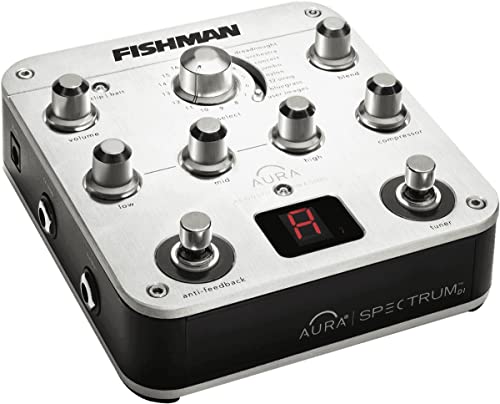
- Acoustic Imaging Pedal with 128 images
- Pro-quality DI
The Fishman Aura Spectrum DI Preamp Pedal is a legendary piece of gear for a reason. Rather than traditional EQ, it uses “Acoustic Imaging”—essentially impulse responses—to make your piezo pickup sound like it’s being recorded by a high-end condenser microphone. We found that when we matched the image to our specific guitar type, the results were stunning. It effectively eliminates the “plastic” sound of an under-saddle pickup and replaces it with air and resonance. As one user mentioned, it is a “godsend” for recording direct-to-interface.
We found the construction to be extremely heavy-duty, which is necessary for a professional DI. However, we did find that the software for downloading new images can be a bit dated and sometimes unstable on modern operating systems. There is also a bit of a learning curve; if you are impatient, you might find it difficult to dial in the right image. But for those who take the time to find the perfect mic image for their instrument, this pedal provides a “holy grail” of live acoustic tone. It’s a professional tool that earns its higher price tag through pure sound quality.
Advantages
- World-class acoustic imaging technology for ultra-realistic tone.
- Professional-grade DI with balanced outputs and an effects loop.
- Built-in compressor and automatic feedback suppression.
Drawbacks
- High price point compared to standard preamps.
- Imaging software can be difficult to use on some computers.
—
#10 BOSS Acoustic Guitar Hardware AD-10 – Suits: Serious acoustic performers needing dual inputs, advanced EQ, and a full-featured looper.
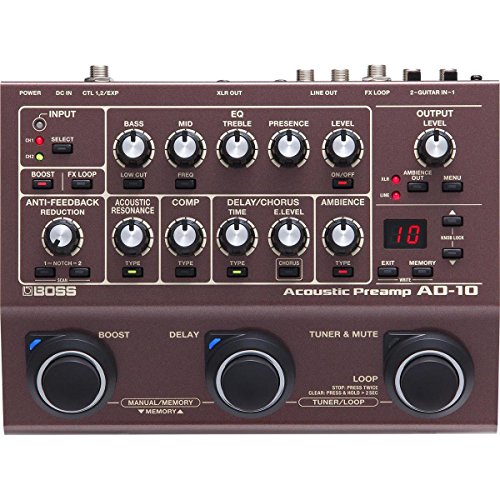
- Professional Preamp and DI Design: Professional preamp/DI for performing and recording with acoustic-electric guitar
- Acoustic Resonance Technology: Acoustic resonance restores the warm and rich resonance lost with most pickup systems
The BOSS Acoustic Guitar Hardware AD-10 is the ultimate command center for the acoustic guitarist. We found the two independent inputs to be a massive advantage for players who switch between guitars, allowing for separate EQ settings for each. We were particularly impressed by the “Acoustic Resonance” feature, which we found even more effective here than on the smaller AD-2. The multi-band compressor provides transparent dynamics control that keeps your sound polished without sacrificing the “life” of the performance.
We found the looper and built-in effects (reverb, chorus, delay) to be of typical high BOSS quality. One minor issue we noted—echoed by other users—is that the looper is a single-button operation, which can make it tricky to use for complex live arrangements. However, the anti-feedback functions are world-class, with two separate notch filters that can be adjusted to target specific frequencies. It is a “complete solution” that can effectively replace a whole board of individual pedals, making it worth the investment for touring professionals.
Pros
- Dual inputs with independent EQ allow for seamless instrument switching.
- Advanced feedback reduction that works exceptionally well on loud stages.
- Functions as a high-quality USB audio interface for recording.
Cons
- The interface has a steeper learning curve than simpler pedals.
- Expensive and takes up a significant amount of pedalboard real estate.
—
The Ultimate Buyer’s Guide
Key Factors to Consider
When shopping for acoustic guitar effects, your primary goal should be tone preservation. Unlike electric guitarists who often look to “color” their sound, acoustic players generally look for pedals that restore the natural woodiness that pickups tend to lose. Look for features like Acoustic Resonance or Acoustic Imaging. Secondly, feedback management is non-negotiable. A pedal with a built-in notch filter or phase switch will save your performance when the stage volume gets out of control.
Understanding Impedance and Preamps
Acoustic pickups, especially passive ones, often have high impedance. If you plug directly into a standard mixer or amp designed for electric guitars, you may end up with a thin, weak sound. A dedicated acoustic preamp pedal acts as a buffer, matching the impedance and boosting the signal. This ensures that the full frequency range of your guitar reaches the speakers, maintaining those critical low-mids and sparkling highs.
Common Mistakes to Avoid
- Using High-Gain Pedals: Avoid using distortion or overdrive pedals designed for electric guitars. Acoustic instruments are prone to feedback, and these pedals will amplify those issues tenfold.
- Neglecting the DI: If you play live, you need a balanced XLR output. Running a standard 1/4″ cable over a long distance to a mixer results in signal loss and unwanted noise.
- Over-compressing: While a little compression helps smooth out a performance, too much will kill the natural dynamics of your acoustic playing, making it sound “dead” or flat.
Frequently Asked Questions
Do I need effects pedals for an acoustic guitar?
While not strictly necessary, they are highly recommended for live performance. Most acoustic guitar pickups produce a “quacky” or sterile sound. Pedals help restore natural resonance and give you essential tools like feedback control and DI outputs for professional sound quality.
What are the essential effects for acoustic guitarists?
The most essential tools are a high-quality preamp, a notch filter for feedback, and subtle reverb (ambience). Many players also find compression helpful for evening out their volume and chorus for adding a bit of shimmer to ballads.
Difference between acoustic pedals and electric guitar pedals?
Acoustic pedals are designed for high-fidelity sound and feedback management. They focus on preserving the natural tone of the wood. Electric pedals are often designed to distort or significantly alter the signal, which can lead to uncontrollable feedback on an acoustic instrument.
How do I prevent feedback when using acoustic effects?
Look for pedals with a notch filter, which allows you to target and “cut” the specific frequency causing the feedback. Using a phase inversion switch or a soundhole cover in conjunction with your pedal can also significantly reduce feedback.
Do I need a preamp with my acoustic effects pedal?
Many acoustic effects pedals, like our top pick, the BOSS AD-2, already include a preamp. If your guitar has an active pickup (with a battery), you have a basic preamp already, but a dedicated pedal provides much more control and a cleaner signal to the board.
What is the best signal chain for acoustic guitar pedals?
A standard chain would be: Tuner > Preamp/EQ > Compression > Modulation (Chorus) > Time-based effects (Delay/Reverb) > DI Box. This ensures you are shaping a clean signal before adding spatial effects.
Are multi-effects units better than individual pedals for acoustic guitar?
Multi-effects units (like the Zoom AC-3) are excellent for convenience and value. However, individual pedals often offer higher specific sound quality and are easier to adjust quickly on stage. The choice depends on whether you prefer simplicity or a wide variety of sonic options.
Conclusion: Our Final Recommendation
After reviewing the top contenders on the market, we reiterate that the BOSS AD-2 Acoustic Preamp Pedal is the best overall choice for most guitarists. It addresses the two biggest challenges of amplified acoustic music—tone degradation and feedback—in a compact, affordable, and nearly indestructible package. While units like the Fishman Aura offer more advanced imaging, the AD-2’s “plug-and-play” simplicity and studio-quality resonance restoration make it the most reliable tool for the widest range of performers. If you want your guitar to sound like itself, only louder and more professional, the AD-2 is our definitive recommendation.
Last update on 2026-10-25 / Affiliate links / Images from Amazon Product Advertising API