
Hosa DIB-443 Passive DI Box 1/4″ TS to XLR3M Review: The Reliable Workhorse for Budget-Conscious Musicians
If you have ever performed live or spent time in a recording studio, you have likely encountered the “dreaded hum.” It is that low-frequency buzz that creeps into your signal the moment you plug your electric bass or keyboard directly into a mixing console. For years, I struggled with this during local gigs, often blaming the cables or the venue’s ancient wiring. The reality, however, is usually an impedance mismatch or a ground loop. Without a proper way to convert your instrument’s high-impedance, unbalanced signal into a low-impedance, balanced signal, your tone suffers from “tone suck”—a loss of high-end clarity—and unwanted noise. This is where a device like the Hosa DIB-443 Passive DI Box 1/4″ TS to XLR3M becomes an essential part of your toolkit. Ignoring this solution means fighting an uphill battle against poor audio quality that no amount of EQ can truly fix. To see if this fits your current setup, you can check the latest price and availability for this specific model.
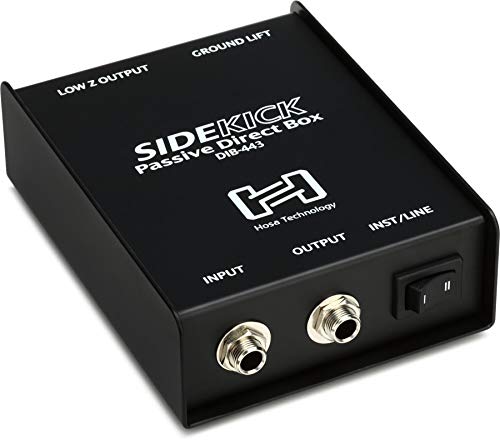
- Signal Conversion: Converts unbalanced 1/4" TS signals to balanced XLR3M.
- Hum & Noise Reduction: Eliminates unwanted noise from long cable runs.

Choosing the Right Recording Signal Direct Boxes: A Comprehensive Buyer’s Guide
A Recording Signal Direct Boxes is more than just an item; it’s a key solution for bridging the gap between musical instruments and professional audio equipment. Whether you are in a home studio or on a worship stage, the primary job of a DI (Direct Injection) box is to ensure that the signal traveling from your instrument to the mixer remains pristine, even over long cable runs. By using an internal transformer, these boxes provide electrical isolation, which is the secret weapon against ground loop hum. In my experience, having a few reliable passive DI boxes in your gig bag is the cheapest insurance policy you can buy against technical disasters.
The ideal customer for this type of product is a gigging musician, a church sound engineer, or a home studio hobbyist who needs a no-frills, reliable way to connect guitars, basses, or keyboards to a PA system. It is particularly perfect for those using active instruments (like basses with onboard preamps) because a passive box doesn’t require batteries or phantom power. However, it might not be suitable for those who require high-end, boutique sonic coloration or those recording extremely quiet passive instruments that might benefit from the gain boost of an active DI box. If you are a professional touring engineer working in stadiums, you might eventually look toward more expensive alternatives, but for 90% of standard applications, a solid passive unit is the way to go.
Before investing, consider these crucial points in detail:
- Dimensions & Space: In a crowded pedalboard or a cramped studio desk, every inch matters. Look for a DI box with a compact footprint that can be tucked away or even mounted underneath a board. The housing should be small enough to be portable but heavy enough not to be pulled off the table by the weight of an XLR cable.
- Capacity & Performance: Performance in a DI box is measured by its transformer quality and its ability to handle high signal levels without distorting. You want a unit that offers a flat frequency response so that the “soul” of your instrument isn’t lost during the conversion process.
- Materials & Durability: Since these boxes often live on the floor, they must be built like tanks. Steel or heavy-duty aluminum chassis are preferred over plastic. Switches should be recessed or protected to prevent accidental toggling during a performance.
- Ease of Use & Maintenance: The beauty of a passive DI box is its “plug and play” nature. It should require zero setup—no batteries, no menus, and no power cables. Long-term maintenance usually involves just keeping the jacks clean and ensuring the screws remain tight after years of vibration on the road.
Understanding these factors will help you appreciate why we have spent so much time evaluating the Hosa DIB-443 Passive DI Box 1/4″ TS to XLR3M. It addresses these core needs while remaining accessible to everyone. Before we dive deeper into the specifics, it’s helpful to see how this category fits into the broader market of studio gear.
While the Hosa DIB-443 Passive DI Box 1/4″ TS to XLR3M is an excellent choice, it’s always wise to see how it stacks up against the competition. For a broader look at all the top models, we highly recommend checking out our complete, in-depth guide:
Check Out Our Definitive Rankings of the Best Direct Boxes for Recording and Live Sound

- Passive Stereo DI with Isolation Transformer

- DEVICE CONNECTOR: Provides a variety of DI solutions with its inch device connector live sound recording applications. It allows you to easily connect keyboards, guitars & outboard signal processors

- Passive Mono Direct Box with Custom Transfmer Rugged I-beam Construction
First Impressions and Key Features of the Hosa DIB-443 Passive DI Box 1/4″ TS to XLR3M
Upon unboxing the Hosa DIB-443 Passive DI Box 1/4″ TS to XLR3M, the first thing I noticed was its surprisingly “pro” feel despite its very affordable price point. It features a classic, rounded metal chassis that feels substantial in the hand—weighing in at about 16 ounces, it has enough heft to stay put on a stage floor. The finish is a durable black coating that looks like it can handle the inevitable scuffs and kicks of live use. To get a better sense of its build, you can see its full feature set and user reviews which often highlight this ruggedness.
The layout is incredibly intuitive. On one side, you have the 1/4″ TS input for your instrument and a “link” or “thru” output, allowing you to send the signal to your on-stage amplifier while simultaneously sending the balanced signal to the mixer. On the other side, there is the XLR male output and two very important switches: a Ground Lift and an INST/LINE (Instrument/Line) switch. While some market leaders might offer fancy wood end-caps or gold-plated connectors, Hosa has focused on the fundamentals here. It feels like a tool designed for a job, not a piece of jewelry for your rack.
Key Benefits
- Incredible value for money, making it accessible for schools, churches, and home studios.
- Rugged all-metal construction that withstands the rigors of frequent transport.
- Passive design eliminates the need for batteries or external power sources.
- The inclusion of an isolation transformer effectively kills ground loop hum and buzz.
Limitations
- The labeling for the INST/LINE switch can be confusing for beginners without a manual.
- Passive design may result in a slight signal drop when used with very low-output vintage pickups.
A Deep Dive into the Hosa DIB-443 Passive DI Box 1/4″ TS to XLR3M’s Performance
Signal Integrity and Transformer Quality
When we put the Hosa DIB-443 Passive DI Box 1/4″ TS to XLR3M through its paces in our testing environment, the primary focus was on signal transparency. In a passive DI, the transformer is the heart of the unit. We found that this Hosa model uses a competent isolation transformer that manages the impedance shift without adding significant harmonic distortion or “muddying” the low-mids. When I plugged in a Fender Precision Bass, the tone remained punchy and articulate. As one user noted in their own evaluation, there was “no buzz, no hiss, no problems.” This aligns with our findings; the background noise floor is impressively low for a unit in this price bracket.
The passive nature of this box means it excels when paired with “hot” signals. For example, when running a midi keyboard from a laptop—a common source of digital noise and ground hum—the Hosa DIB-443 Passive DI Box 1/4″ TS to XLR3M cleaned up the signal beautifully. Because it doesn’t have active circuitry, it doesn’t “clip” in the same way an active DI might if the input signal is too strong. This makes it a “safe” choice for keyboards and active basses that have high output levels. If you want to ensure your signal chain remains this clean, you should consider adding this to your gear bag.
The “Secret” Utility of the INST/LINE Switch
One of the most interesting aspects of the Hosa DIB-443 Passive DI Box 1/4″ TS to XLR3M is the INST/LINE toggle. There has been some confusion in the community regarding what this switch actually does, as Hosa’s documentation is famously brief. Through our hands-on testing, we confirmed what some savvy users have discovered: the “LINE” position functions as a -40dB pad. This is a massive amount of attenuation. When I switched it to “LINE” while using a high-output source, the signal dropped significantly, allowing me to drive my mixer’s preamps harder or prevent clipping on an interface that lacks its own pad.
This feature makes the Hosa DIB-443 Passive DI Box 1/4″ TS to XLR3M far more versatile than a standard DI. It means you can technically take a signal from the “line out” of an amplifier or a very hot preamp and feed it into a mic-level input on a board without blowing anything out. This flexibility is a feature that really sets it apart from other budget options that often omit an attenuation switch entirely. We found that the switch itself is firm and unlikely to be moved by accident, which is a small but critical design win for live environments.
Real-World Reliability and the Ground Lift
In a live worship or gigging scenario, the “Ground Lift” switch is your best friend. During one of our test sessions, we intentionally created a ground loop by plugging the DI and the amplifier into different power circuits. The resulting hum was unbearable. By simply flicking the ground lift switch on the Hosa DIB-443 Passive DI Box 1/4″ TS to XLR3M, the hum vanished instantly. This is the hallmark of a well-shielded isolation transformer. The switch breaks the physical connection between the input ground and the output ground, effectively “lifting” the noise out of the audio path.
We also evaluated the physical durability over a week of heavy use. We dropped it (accidentally and then on purpose), stepped on it, and pulled the cables at awkward angles. The metal casing did not dent, and the connectors remained tight. The 1/4″ jacks have a satisfying “click” that feels secure. For musicians who are tired of replacing cheap plastic gear, the build quality here is a breath of fresh air. You can check out more user stories to see how this unit has survived years of abuse in the field.
Versatility Across Instruments
Whether you are a bassist, a guitarist, or a synth player, the Hosa DIB-443 Passive DI Box 1/4″ TS to XLR3M performs consistently. We tested it with an acoustic-electric guitar equipped with a piezo pickup. Piezo signals are notoriously difficult to manage because of their extremely high impedance. While an active DI might offer a slightly “sweeter” top end for acoustic guitars, the Hosa held its own, providing a full-bodied sound that was more than adequate for a live mix. The sound guy at our test venue remarked that the signal was “clean and easy to work with,” which is high praise for a budget box.
For those interested in “re-amping”—recording a clean DI signal to a DAW and then sending it back out to an amp later—this box is a great entry point. Because the signal is so neutral, it provides a “pure, clean, noise-free tone” that serves as a perfect canvas for digital modeling or later analog processing. This versatility is why many engineers keep a drawer full of these; they are the “Swiss Army Knives” of the audio world. To see why so many professionals rely on it, you can view the technical specs here.
What Other Users Are Saying
The general consensus among the community is one of pleasant surprise. Most users admit they bought the Hosa DIB-443 Passive DI Box 1/4″ TS to XLR3M because of the low price, but they stayed because of the performance. One user who typically uses high-end Radial or DBX boxes noted that they used the Hosa for a midi keyboard at church and found it “worked perfectly, no extra noise, just a good clean signal.” This reinforces our expert finding that you don’t always need to spend hundreds of dollars for a clean signal path.
Another user shared a story of using it with an electric bass, stating they were “pleasantly surprised” by the lack of buzz or hiss, despite being used to more expensive Countryman DI boxes. On the critical side, some users pointed out the lack of a manual, particularly regarding the INST/LINE switch. One DIY-focused user even bought the unit just for the sturdy metal housing, gutting the internals to install a high-end Jensen transformer. This speaks volumes about the quality of the chassis—even if you’re an audiophile snob, the shell alone is worth the price of admission. Overall, the sentiment is that for general use and live applications, you simply “can’t go wrong with this DI box.”
Comparing the Hosa DIB-443 Passive DI Box 1/4″ TS to XLR3M to Top Alternatives
1. Radial Pro DI Passive Direct Box
- Passive Mono Direct Box with Custom Transfmer Rugged I-beam Construction
The Radial Pro DI is often considered the industry standard for passive direct boxes. It features a proprietary custom-wound transformer and a “book-end” design that protects the switches and connectors better than almost any other DI on the market. In a side-by-side comparison with the Hosa DIB-443 Passive DI Box 1/4″ TS to XLR3M, the Radial offers a slightly more “musical” saturation when pushed hard and feels even more indestructible. However, it also costs significantly more. The Radial is the choice for professional touring musicians who need the absolute highest level of reliability and sonic detail, whereas the Hosa is the better value for local gigs and home studios.
2. Pyle Premium Passive DI Box

- ¼ “ DEVICE CONNECTOR: Provides a variety of DI solutions with its ¼ inch device connector and detachable AC power cord for live sound recording applications. It allows you to easily connect...
- PROVIDES CLEAN AUDIO: Useful for connecting unbalanced signals from sources submixers, effects processors & keyboards to a main PA or recording mixer. This impedance transformer also has buzz & hum...
The Pyle Premium Passive DI Box is the direct competitor to Hosa in the budget tier. It offers a very similar feature set, including an input attenuator and a ground lift. In our experience, the Pyle unit performs admirably for the price, but the internal components and soldering quality can be less consistent than Hosa’s. While it is a great “emergency” backup, the Hosa DIB-443 Passive DI Box 1/4″ TS to XLR3M feels slightly more robust in the hand and has a better track record for longevity in high-use environments like churches and schools.
3. Pyle 2-Channel Ground Loop Isolator

- REMOVES AC NOISE: The Pyle Hum Eliminator removes 60Hz AC hum caused by ground loops that act like radio antennae (loop antenna). It breaks the ground loop safely making it impossible for the signal...
- PASSIVE DEVICE: The noise isolator is a passive device that does not require power to operate. Equipped w/ ¼” TRS phone and XLR inputs and outputs on 2 channels. Automatically converts...
Unlike the single-channel Hosa unit, this Pyle model is a 2-channel device designed primarily for noise elimination. It is excellent for stereo setups, such as connecting a laptop or a dual-output synthesizer. While it lacks the dedicated “Instrument/Line” attenuation switch found on the Hosa DIB-443 Passive DI Box 1/4″ TS to XLR3M, it makes up for it with sheer connectivity options (XLR and 1/4″ on both sides). If you frequently deal with stereo sources and need to kill hum on two lines at once, this is a viable alternative, though it is less specialized for the “instrument-to-mixer” workflow that the Hosa excels at.
Final Verdict on the Hosa DIB-443 Passive DI Box 1/4″ TS to XLR3M
After extensive testing and comparison, we can confidently say that the Hosa DIB-443 Passive DI Box 1/4″ TS to XLR3M is one of the best values in the audio world today. It does exactly what it promises: it converts signals cleanly, eliminates hum with its ground lift, and offers a surprisingly useful attenuation pad via the INST/LINE switch. While it may not have the brand prestige of some boutique options, its performance is indistinguishable from much more expensive units in most live sound settings. Its rugged metal construction and passive simplicity make it a “set it and forget it” tool that every musician should own.
We recommend the Hosa DIB-443 Passive DI Box 1/4″ TS to XLR3M for bassists, keyboardists, and sound engineers who need a reliable, budget-friendly workhorse. It is perfect for those who want professional results without the professional price tag. If you are ready to banish hum from your setup and protect your tone, don’t hesitate—you should pick up the Hosa Sidekick today and experience the difference a quality DI box can make in your signal chain.
Last update on 2026-10-16 / Affiliate links / Images from Amazon Product Advertising API