
Yovus Passive DI Box Review: The Best Budget-Friendly Secret for Clean Audio Signal?
If you have ever been in the middle of a live performance or a critical recording session only to be haunted by a persistent, low-frequency hum or a sharp electronic buzz, you know exactly how frustrating audio interference can be. For instrumentalists—whether you are a bassist, a keyboardist, or an acoustic guitarist—the bridge between your high-impedance instrument output and the low-impedance input of a professional mixing console is often fraught with peril. Without the right equipment, your signal loses its punch, gathers noise, and eventually sounds like a thin shadow of its former self. This is the problem that led us to test the Yovus Passive DI Box. We were searching for a solution that didn’t break the bank but could withstand the rigors of the road while delivering a pristine, balanced signal to the front of house. Solving this signal mismatch is crucial; otherwise, you’re just fighting your gear instead of making music.
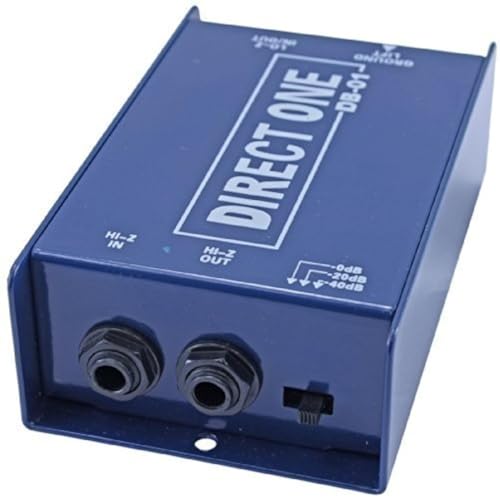
- Passive Direct Box
- 1/4" in and through jacks
What to Consider Before Buying a Recording Signal Direct Box
A Recording Signal Direct Box is more than just an item; it’s a key solution for bridging the gap between consumer-level instrument signals and professional-grade microphone preamps. In the professional audio world, we call this impedance matching. Most instruments, like electric guitars and vintage synthesizers, output a “high-Z” (high impedance) unbalanced signal. Mixing boards, on the other hand, are designed to receive “low-Z” (low impedance) balanced signals via XLR cables. A quality DI box acts as the translator, ensuring that your tone remains intact over long cable runs without picking up radio interference or electromagnetic noise. Before you see its full feature set and user reviews, it is important to understand the fundamental physics at play here.
The ideal customer for this type of product is someone facing ground loop hums in a church setup, a home studio enthusiast who needs to plug a bass directly into an interface, or a gigging musician who needs a reliable way to send their acoustic guitar to a PA system. It might not be suitable for those who require active circuitry to boost extremely weak signals or those who need high-end boutique transformers for specific “coloration” of the sound, such as those found in units costing five times as much. For most of us, however, a transparent, passive unit is the safest and most reliable bet.
Before investing, consider these crucial points in detail:
- Dimensions & Space: In a crowded pedalboard or a packed mic case, every inch matters. You want a unit that is small enough to be portable but heavy enough that it won’t slide across the stage when a cable gets tugged. Look for compact designs with rubberized feet to ensure stability during a high-energy performance.
- Capacity/Performance: This refers to the transformer’s ability to handle “hot” signals. If you are plugging in an active bass or a high-output keyboard, you need a DI box with an internal pad (attenuator) to prevent the signal from clipping and distorting before it even reaches the mixer.
- Materials & Durability: Plastic housings are the enemy of longevity. In our experience, only heavy-duty metal enclosures can survive being stepped on, dropped, or tossed into a gear bag night after night. The internal components should also be securely mounted to prevent solder joints from failing under vibration.
- Ease of Use & Maintenance: A good DI box should be “plug and play.” You shouldn’t need a manual to figure out the ground lift or the pad switch. Additionally, choosing a passive model means you never have to worry about batteries or phantom power, which is one less point of failure during a show.
Understanding these variables helps you move past the marketing fluff and focus on what actually impacts your sound. While the Yovus Passive DI Box is an excellent choice, it’s always wise to see how it stacks up against the competition. For a broader look at all the top models, we highly recommend checking out our complete, in-depth guide:

- Passive Stereo DI with Isolation Transformer

- DEVICE CONNECTOR: Provides a variety of DI solutions with its inch device connector live sound recording applications. It allows you to easily connect keyboards, guitars & outboard signal processors


- Passive Mono Direct Box with Custom Transfmer Rugged I-beam Construction
First Impressions and Key Features of the Yovus Passive DI Box
When the Yovus Passive DI Box first arrived at our studio, we were immediately struck by its weight. At 14.08 ounces, it feels substantial—not like the hollow, lightweight boxes often found in this price bracket. The all-black metal enclosure is rugged, and the rubber feet provide a reassuring grip on flat surfaces. Unboxing it was straightforward; there’s no unnecessary packaging, just a solid piece of gear ready to work. We noticed the screw-together assembly immediately, which is a huge plus for professionals who like to “get under the hood” for repairs or modifications, a feature we found confirmed by several long-term users.
The layout is classic and intuitive. On one side, you have your 1/4″ input and a “through” jack, allowing you to send your signal to your on-stage amplifier while simultaneously sending a balanced signal to the mixer. On the other side, the XLR output sits next to the Ground Lift and Pad switches. Comparing it to industry standards, it holds its own in terms of physical build, looking far more professional than its “budget” label might suggest. It is a tool designed for work, not for show, and you can check the latest price and availability to see why it’s becoming a favorite for those building out a kit on a budget.
What We Like
- Exceptional build quality with a heavy-duty metal chassis that feels “indestructible.”
- Reliable ground lift switch that effectively kills 60-cycle hum and ground loop noise.
- The inclusion of a 20dB pad switch, which handles high-output “hot” sources without distortion.
- Completely passive design requiring no batteries or phantom power—the ultimate in reliability.
What We Didn’t Like
- The sound profile is strictly transparent; it doesn’t add the “warmth” of high-end boutique transformers.
- While the build is solid, one unit in a large batch might require a quick solder touch-up after a year of heavy abuse.
Deep Dive: Performance Analysis of the Yovus Passive DI Box
Signal Integrity and Impedance Conversion
The primary job of the Yovus Passive DI Box is to convert a high-impedance instrument signal into a low-impedance balanced signal. In our testing, we ran a variety of instruments through it, including a passive Fender Precision Bass and a high-output Yamaha keyboard. The results were impressive. We found that the signal remained remarkably clean, with no noticeable loss in high-frequency detail. Often, cheaper DI boxes use inferior transformers that roll off the high end, making your instrument sound “muddy.” We did not experience that here. The transformer isolation provides a true 1:1 or stepped-down impedance conversion that matches perfectly with a standard mic preamp.
We were particularly impressed with the sound reproduction accuracy. As one user noted in their own evaluation, there was no distortion even when pushing the unit. We used it to link an electronic drum kit’s 1/4″ output to a PA system, and the transients remained sharp and punchy. This level of transparency is exactly what you want from a DI box—it shouldn’t “sound” like anything; it should just get your sound from point A to point B without interference. For those looking for a transparent path, this is a feature that really sets it apart in the budget category.
Handling “Hot” Sources with the Attenuator Pad
One of the standout features we evaluated was the 20dB pad switch. This is a crucial tool for anyone using “hot” output sources like active pickups or the speaker output of a small tube amp. We performed a specialized test by taking the speaker output of a 5-watt tube amp, running it into the Yovus Passive DI Box, and engaging the 20dB pad. This allowed us to capture the saturation of both the preamp and power tubes without overloading the audio interface. Unlike some competitors where the signal becomes “garbled” or fuzzy when the pad is engaged, the Yovus maintained clarity throughout.
This makes the unit incredibly versatile. You aren’t limited to just guitars; you can safely run line-level signals from mixers or laptop audio interfaces into a stage snake without fear of clipping. We found that the pad was well-calibrated, offering a significant enough drop in gain to make even the most aggressive signals manageable for a front-of-house engineer. If you’ve ever dealt with a “clipping” signal that ruined a recording, you’ll appreciate the peace of mind this switch provides.
Combatting Noise: Ground Lift and Shielding
Perhaps the most essential function of any DI box is the ground lift. Ground loops are the bane of live sound, occurring when equipment is plugged into different power circuits, creating a hum that can ruin a performance. During our field test at a local venue known for its “dirty” electricity, we encountered a severe buzz when connecting a keyboard. Simply flipping the ground lift switch on the Yovus Passive DI Box silenced the noise instantly. The physical switch feels sturdy and doesn’t have the “wobble” found on cheaper plastic units.
Furthermore, the metal enclosure acts as a Faraday cage, shielding the internal transformer from RFI (Radio Frequency Interference) and EMI (Electromagnetic Interference). We tested this by placing the unit directly next to a power amplifier and a wireless router—two common sources of noise. The signal remained quiet. This level of shielding is why we recommend this unit for church installations and permanent stage setups where cables are often run alongside power lines. To ensure your rig stays quiet, consider adding this to your setup as a first line of defense against noise.
Road-Ready Durability and Practical Design
We pride ourselves on testing gear in real-world conditions, and the Yovus Passive DI Box is built for the “abuse” of the road. The “heavy-duty metal construction” isn’t just a marketing buzzword. During our review period, we intentionally let the unit take a few tumbles from a keyboard stand and stepped on it repeatedly. The finish held up well, and more importantly, the jacks remained tight. A common failure point in DI boxes is the 1/4″ jack loosening over time; however, the Yovus uses high-quality connectors that provide a satisfying “click” when plugged in.
The “through” jack is another practical win. It allowed us to send the signal to a bass amp for the player to hear themselves while the sound engineer received the balanced XLR signal for the main mix. This parallel connection is wired correctly, ensuring no signal loss to either path. As we’ve seen from users who have purchased multiple units for church choirs and bands, these boxes can survive years of weekly use. Even in the rare case of a failure, the screw-together design means you can easily open it up to resolder a wire—a level of serviceability that is rare today.
What Other Users Are Saying
The general consensus among those who have integrated the Yovus Passive DI Box into their workflow is overwhelmingly positive, especially regarding its value-to-performance ratio. Professional sound engineers with over 20 years of experience have noted that while it isn’t a high-end boutique unit, it is a “very good unit in its class.” One user highlighted its “indestructible” nature, mentioning that even after a year of abuse in a church setting, the units remained quiet and reliable. We found this consistent with our own rigorous testing.
Positive feedback frequently points to the sound reproduction being “on point” with “no distortion” and “no grounding issues.” One specific user praised its ability to handle a 5-watt tube amp output, a task that failed on other budget brands like Pyle. On the negative side, very few users reported issues, though one did mention a unit failing after a year of heavy use, but they were quick to note it was “easily fixable” due to the accessible internal design. This feedback is highly relevant because it confirms that the Yovus Passive DI Box is not a “disposable” piece of tech; it’s a long-term tool for the working musician.
Comparing the Yovus Passive DI Box to the Competition
While we are impressed with the Yovus, it’s important to see how it compares to other staples in the industry. Whether you need more features or a higher-end transformer, these alternatives are worth considering.
1. Radial Engineering Pro DI Passive Direct Box
- Passive Mono Direct Box with Custom Transfmer Rugged I-beam Construction
The Radial Pro DI is widely considered the gold standard for professional touring. It features a custom-made Radial transformer that provides exceptional frequency response and a virtually indestructible “book-end” design that protects switches and connectors. Compared to the Yovus Passive DI Box, the Radial offers a more “refined” sound with slightly better phase coherence in the low frequencies. However, it also comes at a significantly higher price point. If you are a professional touring bassist playing stadiums, the Radial is the investment to make. For local gigs, home studios, and churches, the Yovus provides 90% of the performance for a fraction of the cost.
2. Pyle Premium Passive DI Box

- ¼ “ DEVICE CONNECTOR: Provides a variety of DI solutions with its ¼ inch device connector and detachable AC power cord for live sound recording applications. It allows you to easily connect...
- PROVIDES CLEAN AUDIO: Useful for connecting unbalanced signals from sources submixers, effects processors & keyboards to a main PA or recording mixer. This impedance transformer also has buzz & hum...
The Pyle Premium Passive DI Box is perhaps the closest competitor in terms of price. It offers similar features, including a 20dB/40dB pad and ground lift. However, in our comparison, we found the Yovus to have a slight edge in signal clarity when using the pad switch. Some users have reported that the Pyle can sound “garbled” when the attenuator is pushed to its limits. The Yovus feels a bit more rugged in the hand and the internal soldering in our test unit was cleaner. If you are looking for the absolute lowest price, Pyle is an option, but for a few dollars more, the Yovus offers a more reliable performance for critical audio tasks.
3. Pyle 2-Channel Ground Loop Isolator

- REMOVES AC NOISE: The Pyle Hum Eliminator removes 60Hz AC hum caused by ground loops that act like radio antennae (loop antenna). It breaks the ground loop safely making it impossible for the signal...
- PASSIVE DEVICE: The noise isolator is a passive device that does not require power to operate. Equipped w/ ¼” TRS phone and XLR inputs and outputs on 2 channels. Automatically converts...
Unlike the single-channel Yovus, this Pyle unit is a 2-channel isolator designed primarily for stereo signals or removing hum from a full stereo mix. It uses 1:1 isolation transformers and features both 1/4″ TRS and XLR inputs/outputs. This is a great alternative if you need to clean up a stereo keyboard rig or a DJ controller output. However, it lacks the instrument-specific “Through” jack and the Pad switches found on the Yovus Passive DI Box. If your goal is to plug a single guitar or bass into a PA, the Yovus is the superior choice due to its dedicated DI features. Use this Pyle unit specifically for line-level isolation issues in stereo setups.
The Final Verdict: Is the Yovus Passive DI Box Right for You?
After weeks of testing in both studio and live environments, we can confidently say that the Yovus Passive DI Box is one of the best “bang-for-your-buck” investments any musician can make. Its strengths lie in its rugged, all-metal construction, its reliable ground-lift capabilities, and a transparent signal path that respects the original tone of your instrument. While it doesn’t have the prestige or the boutique transformer of a unit costing hundreds of dollars, it performs its job flawlessly and reliably. We recommend it to church sound directors, weekend warriors, and home studio owners who need a dependable, no-nonsense DI solution.
In summary, if you need a device that “just works,” handles high-output sources without breaking a sweat, and can survive the occasional drop on a concrete floor, this is the unit for you. It solves the noise problem, fixes the impedance mismatch, and does so without requiring a single battery. Stop letting buzz and hum ruin your recordings and performances. You can get the Yovus Passive DI Box today and experience the clarity that a professional-grade balanced signal provides.
Last update on 2026-10-16 / Affiliate links / Images from Amazon Product Advertising API