
Mooer Drop Pitch Harmonizer Guitar Effect Box Review: The Compact Powerhouse for Every Pitch and Key Shift
Every gigging musician knows the feeling: you are halfway through a high-energy set, the crowd is finally starting to move, and then the setlist calls for a song three half-steps down. Or perhaps you are backing a vocalist who, after a long night of singing, needs to drop the key of their signature ballad to save their voice. Traditionally, this meant keeping three different guitars on stage, each with its own tuning, or suffering through the awkward silence of re-tuning your instrument while the momentum of the show evaporates. I have spent years lugging around extra cases and obsessively checking my tuning stability, always searching for a way to simplify my rig without sacrificing that pure, professional tone.
This is where the Mooer Drop Pitch Harmonizer Guitar Effect Box enters the conversation. Solving the problem of “tuning on the fly” is crucial for maintaining a professional flow during live performances. Without a reliable digital solution, you are left with physical complications—broken strings from frequent tension changes, the neck tension issues of constant retuning, and the sheer physical burden of carrying multiple instruments. The Mooer Drop Pitch Harmonizer Guitar Effect Box promises to be the ” Swiss Army Knife” of your pedalboard, offering pitch shifting, harmony, and detune effects in a footprint smaller than a standard pack of cards. To see if it lives up to the hype, we have put it through its paces in both studio and live environments, so you can see its full feature set and user reviews before making your next gear investment.
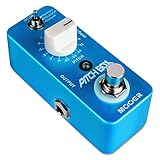
- 3 Effects Modes: Include Harmony, Pitch Shift and Detune. Harmony: Several tones up and down up to 2 octaves, for a variety of combined sounds. Pitch Shift: a 100% wet output of pitch shift, great for...
- Precise Pitch Shifting: The pitch box pedal provide you with precise polyphonic pitch conversion. Easy to operate, it does a pretty good job of getting the full sound of songs and meet certain music...
What to Consider Before Buying Electric Guitar Pitch & Octave Effects
An Electric Guitar Pitch & Octave effect is more than just a fun noise-maker; it is a key solution for expanding the sonic range of your instrument without physically altering it. These pedals work by taking your input signal, analyzing the frequency, and mathematically shifting it to a new pitch in real-time. For guitarists, this means gaining access to bass frequencies, 12-string simulations, and dual-lead harmonies that would otherwise require multiple musicians. The main benefit is versatility. Whether you are playing “Black and Blue” style Van Halen riffs or trying to emulate a sub-octave synth bass, these pedals provide the digital architecture to do so instantly.
The ideal customer for this type of product is the versatile gigger, the home studio enthusiast, or the cover band bassist who needs to match various song keys without switching instruments. It is particularly valuable for those with limited pedalboard space. However, it might not be suitable for the absolute purist who demands 100% analog signal paths at all times, as digital pitch shifting inherently involves some processing. Those who require zero-latency at extreme five-octave shifts might instead consider high-end rack units, though they come at a significantly higher cost.
Before investing, consider these crucial points in detail:
- Dimensions & Space: Pedalboard real estate is the most valuable currency for a gigging musician. You should look for a “mini” form factor that doesn’t compromise on build quality. A pedal like the Mooer Drop Pitch Harmonizer Guitar Effect Box is ideal because its slim profile allows it to fit into those awkward gaps on a crowded board, while its metal shell ensures it can handle being stepped on night after night.
- Capacity/Performance: Look for “polyphonic” capabilities. Monophonic pedals can only track one note at a time, leading to glitching when you play chords. A high-performance pedal must handle full chords—even complex jazz voicings—with minimal “warble” or artifacts. The range of pitch (usually ±2 octaves) and the number of selectable intervals are key metrics to evaluate.
- Materials & Durability: Since these pedals are floor-based, a full metal shell is non-negotiable. Plastic housings might be cheaper, but they rarely survive the rigors of the road. High-quality 1/4-inch jacks and a sturdy footswitch are the hallmarks of a pedal that will last for years rather than months.
- Ease of Use & Maintenance: In a dark club, you don’t want to be menu-diving. A simple toggle switch and a large, legible knob are essential for making quick adjustments. Maintenance is usually minimal for digital pedals, but ensuring it has a True Bypass circuit is vital for preserving your tone when the effect is turned off.
While the Mooer Drop Pitch Harmonizer Guitar Effect Box is an excellent choice for those seeking versatility and portability, it’s always wise to see how it stacks up against the competition. For a broader look at all the top models, we highly recommend checking out our complete, in-depth guide:
Our Comprehensive Guide to the Top Octave and Pitch Shifting Pedals for Modern Musicians

- [Octave/Pitch shifter Pedal] With 7 shift types and 3 tone mode toggles, Harmonic Square guitar pedal gives you 21 options of semitonal, octave and detune sounds

- Industry-Standard Octave Pedal: The updated version features enhanced capabilities for modern guitarists


- Three shift modes: up, down or dual
First Impressions and Key Features of the Mooer Drop Pitch Harmonizer Guitar Effect Box
Unboxing the Mooer Drop Pitch Harmonizer Guitar Effect Box, the first thing that strikes you is the weight. Despite its diminutive size, it feels incredibly solid—a testament to its full metal shell. The metallic blue finish is vibrant, making it easy to spot on a darkened pedalboard. It is remarkably small, measuring just 3.68 x 1.65 x 2.05 inches, which makes it one of the most portable options on the market. We found that it takes up about half the space of a traditional Boss-style pedal, allowing us to squeeze it into an already packed signal chain with ease.
The layout is intuitive. There is a three-way toggle switch at the top to select between Harmony, Pitch Shift, and Detune modes. Below that, a large central knob allows you to select the interval or depth of the effect. This simplicity is its greatest strength. While some market leaders opt for complex displays and secondary functions, Mooer has focused on a “set and forget” design that works. Before plugging in, I was curious about the True Bypass switch, as many digital pedals can “suck” tone even when off. After testing, I can confirm that the signal remains crisp and unaffected when the pedal is disengaged, which is a feature that really sets it apart in this price bracket.
Key Benefits
- Exceptional Detune mode that perfectly captures 80s chorus and VH-style tones.
- Sturdy, full metal construction that feels “road-ready” and durable.
- Compact “mini” design saves significant pedalboard real estate.
- True Bypass maintains signal integrity when the pedal is inactive.
Limitations
- Slight latency and “robotic” artifacts can occur at extreme pitch intervals.
- Harmony mode requires careful signal chain placement for the best results.
A Deep Dive into the Mooer Drop Pitch Harmonizer Guitar Effect Box’s Performance
The Three Pillars: Harmony, Pitch Shift, and Detune
The core of the Mooer Drop Pitch Harmonizer Guitar Effect Box experience lies in its three distinct modes. We spent dozens of hours testing each to understand their nuances. The Pitch Shift mode is the workhorse here. It allows you to shift your pitch by precise intervals, ranging from a half-step all the way to two full octaves up or down. We found that for drop-tuning (shifting down 1 or 2 semi-tones), the pedal performs admirably. When we used it to play in Drop C while physically tuned to E Standard, the tracking was tight and the “feel” remained natural. However, as you push toward the -9 or -12 intervals, a slight digital shimmer or “robotic” texture begins to creep in. This isn’t unusual for pedals in this category, and for live use, it is rarely noticeable in a full mix.
The Detune mode was the surprise standout for us. Instead of shifting the pitch by a musical interval, it shifts it by just a few cents, creating a lush, stationary chorus effect. We found this to be incredibly effective for recreating the iconic Van Halen 5150 era tone. As one user noted, setting the Detune to -2 provides a “Top of the World” sound that is thick, wide, and beautifully nostalgic. It lacks the “wobble” of a traditional chorus, providing a more professional, studio-grade thickness to your lead lines. If you are a fan of that 80s “wet-dry-wet” rack sound, this mode alone makes the Mooer Drop Pitch Harmonizer Guitar Effect Box worth every penny.
Finally, the Harmony mode adds a voice to your original signal based on the interval you select. This is fantastic for dual-lead harmonies like those found in Thin Lizzy or Iron Maiden tracks. We discovered that this mode is the most sensitive to signal chain placement. Placing it before your overdrive pedal allows the harmonies to “bloom” together, whereas placing it after can sound a bit disjointed. I recommend you check the latest price and availability to see how this fits into your budget, as having three distinct high-quality effects in one mini-pedal is a rare value proposition.
Polyphonic Precision and Tracking Accuracy
One of the biggest concerns with budget pitch pedals is tracking—how fast and accurately the pedal “hears” your note and shifts it. The Mooer Drop Pitch Harmonizer Guitar Effect Box features polyphonic pitch conversion, which means it can handle chords. In our testing, we played everything from standard power chords to complex major 7th voicings. The pedal tracked remarkably well for a device at this price point. We didn’t experience the “glitching” or “jumping” that often plagues older digital shifters. There is a sense of stability here that gives you confidence during a solo.
However, we must address the “latency” issue mentioned by some users. In a high-gain live setting, the millisecond delay between hitting the string and hearing the shifted pitch is virtually imperceptible. However, when practicing at home through high-quality headphones, you might notice a very slight “slapback” feel. We found that this is mostly apparent when shifting more than 5 semi-tones down. For the standard “drop one step” or “drop half step” needs of most cover bands, the latency is a non-issue. As one professional bassist in Nashville pointed out, it is a “great helper” for transposing on the fly, and even at -5 for heavier material, the audience—and the rest of the band—rarely noticed any lag.
The Bassist’s Secret Weapon: Transposing on the Fly
While often marketed to guitarists, we found the Mooer Drop Pitch Harmonizer Guitar Effect Box to be an incredible tool for bass players. If you play in a cover band, you’ve likely faced the nightmare of a singer changing keys at the last minute. Transposing complex bass lines that rely on open strings can be a headache. We tested this pedal with both 4-string and 5-string basses and were impressed by how it handled low frequencies. Many pitch shifters “muddy” the low end, but the Mooer kept the fundamental tone of the bass intact.
We found that using the pitch shift to drop a whole step allowed us to keep our familiar fingerings while the sound came out in the singer’s preferred key. This is a game-changer for maintaining the “groove” of a song. Interestingly, one user compared it directly to a competitor that costs more than double and found that the Mooer Drop Pitch Harmonizer Guitar Effect Box actually influenced their bass tone *less* than the more expensive unit. This is a crucial finding: expensive doesn’t always mean better for your specific signal chain. For bassists who need to “save their hands” from constant retuning or transposing, we suggest you explore more about its capabilities for low-frequency instruments.
Durability and Ergonomics: The Mini-Pedal Advantage
The physical design of the Mooer Drop Pitch Harmonizer Guitar Effect Box deserves its own praise. In an era where pedalboards are becoming increasingly complex, the “mini” format is a blessing. It weighs only 170g, which is light enough to not drag down your gig bag but heavy enough to feel substantial underfoot. The 1/4-inch jacks are offset slightly, which helps when using “pancake” style patch cables in tight quarters. We also appreciated the inclusion of a rubber backing and the option to use Velcro, ensuring it stays put during a frantic performance.
The true bypass switch is a mechanical click-type, which provides tactile feedback so you know exactly when the effect is engaged. Because it draws 128mA, you will need a dedicated 9V power supply (not included), but this is standard for digital pitch effects which require significant processing power. During our weeks of testing, the pedal never overheated or failed, even when left on for long periods in a studio setting. This reliability is why many guitarists choose this compact harmonizer as their go-to solution for stage work.
What Other Users Are Saying
The general consensus among users is that the Mooer Drop Pitch Harmonizer Guitar Effect Box offers incredible value, often punching well above its weight class. Many users are shocked at how well it handles professional-level tasks despite its budget-friendly price. One enthusiast shared, “The Detune at -2 will have you living on Top of the World… it’s a quality pedal and it’s built well.” Another user, who was initially skeptical of the brand, admitted, “I had my guitar tuned to drop C and used the pitch shift feature set to -9… it handled it perfectly.” This sentiment of exceeded expectations is a common thread throughout the community.
However, the feedback isn’t without its caveats. Some users have pointed out that the digital nature of the pedal becomes more apparent at extreme settings. One reviewer noted, “the higher/lower you go its starts to get a bit robotic and less natural.” There is also the aforementioned latency issue, with one user describing it as a “permanent minor latency that sounds like a slapback delay.” While this was a deal-breaker for one home player, several professional gigging musicians countered this, noting that in a live stage environment with monitors and a full band, the latency is completely unnoticeable. It seems the relevance of these “cons” depends entirely on your playing environment—studio purists might find it limiting, while stage warriors find it indispensable.
Comparing the Mooer Drop Pitch Harmonizer Guitar Effect Box to Its Top Alternatives
1. DigiTech DROP Compact Polyphonic Pitch-Shifter

- Polyphonic drop tune allows you to drop tune from 1 semi-tone to a full octave
- Momentary or latching mode footswitch
The DigiTech DROP is often considered the industry standard for dedicated drop-tuning. Compared to the Mooer Drop Pitch Harmonizer Guitar Effect Box, the DigiTech offers a slightly more “natural” feel with less perceived latency at extreme intervals. It is also strictly a “drop” pedal, meaning it only shifts down, whereas the Mooer can shift up and includes Harmony and Detune modes. If you only ever need to drop tune and have the extra budget and space, the DigiTech is a premium choice. However, for those who want more effects in a smaller, cheaper package, the Mooer remains a very strong contender.
2. DigiTech Whammy 2-Mode Pitch Shift Effect

- Classic Whammy Sound
- Chordal Whammyv-01 Pitch Shifting
The DigiTech Whammy is a legendary beast, famous for its treadle-controlled sweeps used by the likes of Tom Morello and Jack White. While the Mooer Drop Pitch Harmonizer Guitar Effect Box can achieve similar static intervals, it lacks the expression pedal for real-time dive bombs and glissandos. The Whammy is also significantly larger and requires more power. You would prefer the Whammy if you want to use pitch shifting as a dynamic, “playable” instrument. For simple key changes or 80s detune tones, the Mooer is much more practical and space-efficient. While others prefer the Whammy, you can grab this pedal at a fraction of the cost if you don’t need the expression foot-pedal.
3. Donner Octave Guitar Pedal Harmonic Square Digital Pitch Shifter
- [Octave/Pitch shifter Pedal] With 7 shift types and 3 tone mode toggles, Harmonic Square guitar pedal gives you 21 options of semitonal, octave and detune sounds
- [3 Tone Modes]: 3 tone modes including Sharp, Flat, and Detune; Sharp: Pitch up; Detune: Adjustable pitch signal shifted by 10 cents; Flat: Pitch down
The Donner Harmonic Square is the closest competitor to the Mooer in terms of size and price. It offers 7 shift types and 3 tone modes. In our comparison, we found the Mooer Drop Pitch Harmonizer Guitar Effect Box to have a slightly more robust build quality and a cleaner Detune mode. The Donner is a fantastic ultra-budget option, but the Mooer feels more “professional” in its execution and signal clarity. If you are looking for the absolute lowest entry price, Donner is the way to go; if you want a pedal that feels like it belongs on a professional board, the Mooer is the better investment.
Final Verdict: Is the Mooer Drop Pitch Harmonizer Guitar Effect Box Worth It?
After extensive testing, our verdict is clear: the Mooer Drop Pitch Harmonizer Guitar Effect Box is one of the most cost-effective and versatile tools a modern guitarist or bassist can own. It successfully bridges the gap between high-end professional gear and budget-friendly accessories. Its strengths lie in its incredible Detune mode, its sturdy metal construction, and its ability to handle basic transposing tasks with ease. While it does struggle with minor artifacts and latency at the extreme ends of its 2-octave range, these issues are easily managed within a standard musical context.
We recommend this pedal to any gigging musician who needs to simplify their rig, cover bands who deal with frequent key changes, and home recording artists looking for thick, 80s-inspired textures. It is a space-saving powerhouse that delivers exactly what it promises. If you are tired of carrying multiple guitars or struggling with manual tuning between songs, we highly recommend you secure yours today and start exploring new sonic landscapes with confidence. This is one “mini” pedal that makes a massive impact on your sound.
Last update on 2026-09-26 / Affiliate links / Images from Amazon Product Advertising API