
PJB 2×2′ Near Field Personal Bass Monitor Review: The Ultimate Solution for Onstage Articulation and Clarity
If you have ever stood on a stage next to a heavy-hitting drummer or a guitarist with a penchant for “cranking it to eleven,” you know the specific frustration of the “volume war.” As bassists, we often find ourselves in a lose-lose situation: we either turn our amplifiers up so loud that we wash out the front-of-house mix and irritate our bandmates, or we keep our volume “polite” and spend the entire set guessing our intonation because all we can hear is a muddy, low-frequency rumble. This lack of definition doesn’t just hurt our performance; it leads to fatigue and, eventually, hearing loss from years of compensating with raw decibels. We need a way to hear the nuances—the “ping” of the string, the “growl” of the fretboard, and the exact pitch of our notes—without destroying the stage’s sonic ecosystem. This is exactly where the PJB 2×2′ Near Field Personal Bass Monitor enters the picture, promising a surgical solution to a blunt-force problem.
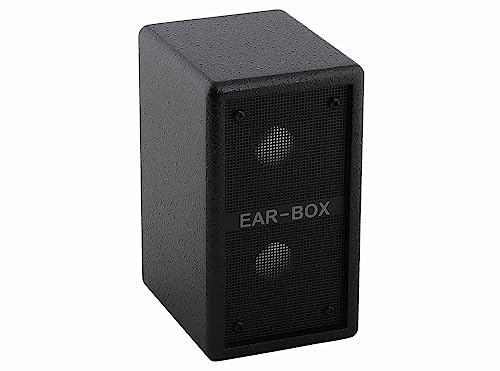
- Compact Bass Speaker with 2 x 2.5" Neodymium Magnet Drivers
- 5/8" Mic Attachment Point
What to Consider Before Investing in Stage Monitors
A Stage Monitors is more than just an item; it’s a key solution for any performing artist who needs to maintain a consistent, high-quality performance regardless of the room’s acoustics or the stage’s volume levels. In the world of bass, traditional monitors often fail because they are designed for vocals or general frequency ranges, failing to reproduce the fast transients and complex overtones of a bass guitar. A dedicated personal monitor provides the “missing link” between feeling the bass in your chest and hearing it in your ears.
The ideal customer for this type of product is someone facing high stage volumes or difficult acoustic environments, such as upright bassists in big bands or electric players in rock trios. It is particularly valuable for older musicians who may have experienced some frequency-specific hearing loss and need that extra “top-end” articulation to stay in the pocket. However, it might not be suitable for those who prefer the physical sensation of air moving from a massive 8×10 cabinet or those who are perfectly comfortable with high-end in-ear monitor (IEM) systems, which offer a completely different monitoring philosophy.
Before investing, consider these crucial points in detail:
- Dimensions & Space: On a crowded stage, every square inch matters. You want a monitor that can be positioned strategically without becoming a trip hazard or blocking sightlines. The PJB 2×2′ Near Field Personal Bass Monitor is designed specifically for a small footprint, often mounting directly to a microphone stand to keep the floor clear.
- Capacity/Performance: In the context of a personal monitor, performance isn’t just about wattage; it’s about clarity and impedance. You need a device that doesn’t place a heavy load on your existing amplifier but still provides enough “near-field” volume to cut through the ambient noise of a drum kit.
- Materials & Durability: Stage gear takes a beating. Look for enclosures made of high-quality metals like stainless steel or heavy-duty polymers. The drivers should utilize neodymium magnets, which offer superior power-to-weight ratios and better magnetic flux for faster, cleaner response times.
- Ease of Use & Maintenance: The best gear is the gear you actually use. Look for “plug-and-play” connectivity, such as Neutrik connectors, and mounting points that utilize standard hardware (like 5/8″ mic threads). Maintenance should be minimal, requiring only occasional cleaning of the enclosure and checking of the cable connections.
Understanding these factors is the first step in moving away from a “more volume” mindset and toward a “better monitoring” strategy. While the PJB 2×2′ Near Field Personal Bass Monitor is an excellent choice, it’s always wise to see how it stacks up against the competition. For a broader look at all the top models, we highly recommend checking out our complete, in-depth guide:


- Model #: SA-10MT (Set of 2)


First Impressions: Unboxing the PJB 2×2′ Near Field Personal Bass Monitor
When we first got our hands on the PJB 2×2′ Near Field Personal Bass Monitor, the first thing that struck us was its incredibly robust build quality. It doesn’t feel like a typical consumer-grade speaker; the stainless steel enclosure gives it a professional, “tank-like” heft despite its diminutive size. Weighing in at just 2.4 pounds, it is incredibly portable, yet it feels substantial enough to survive a tumble off a mic stand. You can see its full feature set and user reviews to understand just how much technology Phil Jones has packed into this small frame.
Setting it up was a breeze. We simply mounted it to a standard microphone stand using the 5/8″ attachment point and positioned it about 12 to 18 inches from the ear. The Neutrik NL 4 connector provided a secure, professional-grade connection that inspired confidence. Unlike other monitors that require a separate power source, the PJB 2×2′ Near Field Personal Bass Monitor is a high-impedance device that connects in parallel with your main cabinet, essentially “stealing” just a tiny fraction of the signal to provide you with a dedicated ear-level reference.
Key Benefits
- Incredible articulation and high-end clarity for bass frequencies.
- High-impedance design allows it to work with almost any amplifier without overloading it.
- Compact, lightweight stainless steel build is perfect for touring professionals.
- Easy mounting via standard 5/8″ mic stand adapters.
Limitations
- Requires very close proximity (near-field) to be truly effective.
- May feel “quiet” to those used to traditional loud floor wedges.
A Deep Dive into the Performance of the PJB 2×2′ Near Field Personal Bass Monitor
The Science of High-Impedance Monitoring
One of the most misunderstood aspects of the PJB 2×2′ Near Field Personal Bass Monitor is its high-impedance design. Most speakers operate at 4 or 8 ohms, drawing significant power from the amplifier. However, this monitor is designed with a much higher impedance (effectively over 200 ohms in its internal crossover logic). This is a stroke of genius by Phil Jones. Because the impedance is so high, you can connect it in parallel with your existing 4-ohm or 8-ohm bass cabinet without significantly changing the overall load on your amplifier. This means you don’t need a second amp or a complicated crossover; you just tap into your existing signal chain.
During our testing, we found that this design allows the PJB 2×2′ Near Field Personal Bass Monitor to act as a “passive” window into your sound. It isn’t there to provide the “thump”—your main cabinet still does that—but it provides the “definition.” We found that even with high-powered heads like a Quilter or an Ampeg SVT, the monitor integrated seamlessly. It’s a feature that really sets it apart from traditional active monitors that require extra power cables and signal splitters. You can check the latest price and availability to see how this fits into your current rig setup.
Near-Field Articulation: Hearing the “Note”
The core philosophy of the PJB 2×2′ Near Field Personal Bass Monitor is “near-field” monitoring. In a typical stage setup, the sound from your bass cabinet travels past your legs, hits the floor, and bounces around the room before it ever reaches your ears. By the time it gets to you, the high frequencies—the ones that define the “pitch” and “attack”—are often lost. By placing the PJB 2×2′ Near Field Personal Bass Monitor on a mic stand just a foot or two from your ear, those high frequencies reach you directly and instantly.
We found this to be a revelation, especially for upright bass players. In a loud big band environment, where the acoustic bass is often buried by brass and drums, this monitor allowed our testers to maintain perfect intonation. We could hear the subtle fingerboard noise and the “air” around the notes that is usually lost in the mix. While some users have noted that you have to be very close to the speaker to hear it clearly, we argue that this is actually the product’s greatest strength. It provides a private, focused soundstage that doesn’t add to the overall stage volume. If you are looking for that surgical precision, you should examine its dynamic driver specifications closer.
Build Quality and Stage Ergonomics
Phil Jones Bass products are known for their “over-engineered” approach, and the PJB 2×2′ Near Field Personal Bass Monitor is no exception. The 2 x 2.5″ neodymium magnet drivers are custom-designed to handle the transients of a bass guitar. Neodymium is a lighter, stronger magnetic material than standard ferrite, allowing for faster cone movement. This results in a “faster” sound—meaning the monitor can keep up with rapid-fire slap bass or intricate jazz walking lines without blurring the notes together.
On stage, the ergonomics are fantastic. The compact design means you can tuck it right next to your music stand or vocal mic. We also appreciated the inclusion of the 5/8″ mic attachment point. In our experience, many “personal monitors” require proprietary mounting hardware that is easily lost or broken. By using a standard mic thread, PJB ensures that you can always find a way to mount it, even if you’re using house gear. The stainless steel enclosure also acts as a natural heat sink, ensuring the components stay cool during long, high-energy sets. For those who travel light, the 2.4-pound weight is a dream. To see how it looks in a professional setup, view the product images and dimensions here.
The “Ear-Box” Experience in Real-World Scenarios
We put the PJB 2×2′ Near Field Personal Bass Monitor through its paces in several environments: a small club date with a loud drummer, a jazz trio rehearsal, and even as a desktop practice monitor. In the loud club, it was a lifesaver. We were able to keep our 4×10 cabinet at a reasonable volume for the room while still hearing our articulations perfectly through the “Ear-Box.” It felt like having a pair of high-end headphones on, but without the isolation from the rest of the band.
For practice, it’s an underrated tool. Connected to a small desktop amp, it provides a much more accurate representation of your tone than small computer speakers or cheap headphones. It forces you to play cleaner because you can hear every ghost note and every slightly buzzed fret. While it’s marketed as a stage monitor, we found it to be one of the best “honesty” speakers for developing technique. Before you make a final decision, read more about its technical compatibility with various devices.
What Other Users Are Saying
The general consensus among the bass community is that the PJB 2×2′ Near Field Personal Bass Monitor is a “niche but necessary” tool. One lifetime musician who suffers from some hearing loss described it as “absolutely PERFECT,” noting that it provides the articulations needed without the “every man for himself” volume battles on stage. Another user, an upright bass player in a big band, credited the monitor with keeping his intonation clean and accurate, thanking Phil Jones for solving a problem that has plagued upright players for decades.
However, the feedback isn’t universally positive, and that’s usually down to a misunderstanding of the “near-field” concept. One user found it impractical because they had to place it within 12 inches of their ear to hear it clearly. This is a valid observation—if you expect this to behave like a standard floor wedge that you can stand five feet away from, you will be disappointed. It is designed to be a “personal” monitor in the truest sense of the word. Most users, however, find that once they dial in the positioning, they can’t imagine playing a gig without it. The community feedback on this device highlights its specialized nature as a tool for precision.
Comparing the PJB 2×2′ Near Field Personal Bass Monitor to Alternatives
1. HWWR Portable Karaoke Machine with 2 Wireless Mics
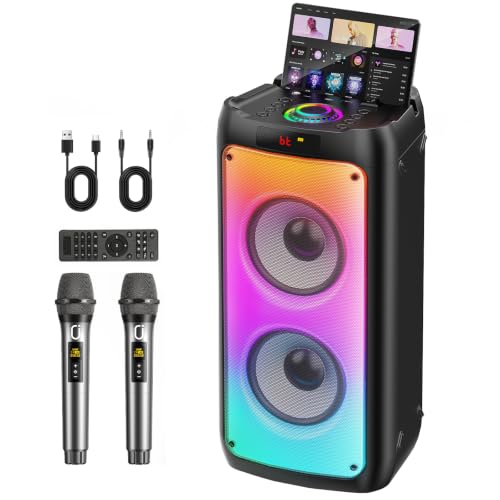
- 【Wide-Coverage with Dual 6.5" Woofers for Bigger Parties & Events】Built with dual 6.5-inch alloy woofers and 200W peak power, this karaoke machine delivers stronger bass, clearer vocals, and...
- 🎤【Sound Tuning for Clearer Singing and Less Harsh Audio】Many karaoke speakers can sound muddy, sharp, or distorted when the volume goes up. The T10-T karaoke machine uses AI sound tuning and a...
Comparing a PJB monitor to the HWWR Portable Karaoke Machine is essentially comparing a surgical scalpel to a party popper. While the HWWR is marketed as a “stage monitor” in some contexts, it is a consumer-level PA system designed for singing along to tracks at a barbecue. It lacks the frequency response, the high-impedance input, and the professional-grade drivers required for bass monitoring. Someone might prefer this only if they are looking for a cheap, all-in-one entertainment system for backyard gatherings, but for a serious bassist, it offers zero utility. The PJB 2×2′ Near Field Personal Bass Monitor is a professional tool; the HWWR is a toy.
2. Roland PM-100 Electronic Drum Set
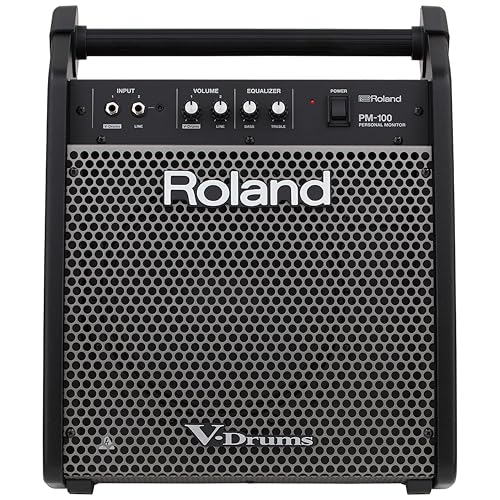
- Premium All-in-One Monitor: Designed specifically for use with V-Drums electronic percussion products to deliver professional sound quality
- Powerful Full-Range Audio System: Features 80 watts of power with a custom 10-inch speaker and tweeter for rich, dynamic sound reproduction
The Roland PM-100 is a dedicated monitor for electronic drums. It is a much larger, 80-watt active unit. It’s excellent for what it does—reproducing the full frequency range of a drum kit—but it is bulky and requires its own power source and signal feed. A bassist might prefer the Roland if they wanted a dedicated floor wedge that can also handle auxiliary tracks or if they don’t mind hauling a 30-pound speaker to every gig. However, for those seeking the portability and “mic-stand mounting” convenience of the PJB 2×2′ Near Field Personal Bass Monitor, the Roland is simply too much equipment for the specific task of personal monitoring.
3. Seismic Audio Passive Floor Monitors
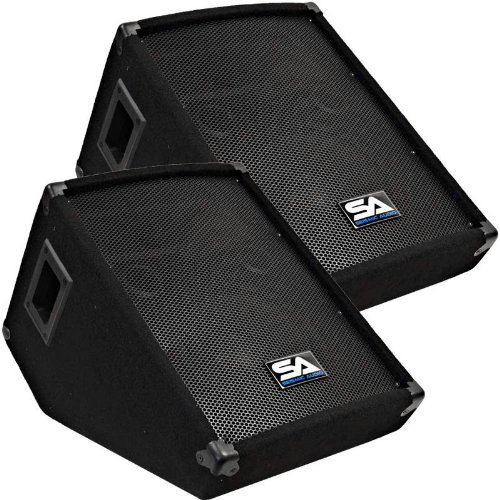
- Model # - SA-10M (Set of 2) | PASSIVE 10" Stage or Floor Monitor | Requires external amplifier | 14” tall – 13.25” wide – 21” deep
- Woofer - 10” 2 way crossover w/ a 40 oz magnet & 2” voice coil. 100 Watts RMS – 200 Peak.
The Seismic Audio Passive Floor Monitors are traditional 10″ wedge monitors. They are affordable and work well as general-purpose PA monitors for vocals or guitars. However, they lack the specific “near-field” focus of the PJB. To hear a Seismic wedge clearly, you generally have to push quite a bit of volume, which contributes to the very stage noise the PJB is designed to eliminate. If you have plenty of stage space and need a budget-friendly way to hear the whole band, the Seismic wedges are a decent choice. But if you want a dedicated, high-definition monitor specifically for your bass’s intonation and clarity, the PJB 2×2′ Near Field Personal Bass Monitor is the superior professional choice.
The Final Verdict: Is the PJB 2×2′ Near Field Personal Bass Monitor Worth It?
After extensive testing and analyzing the feedback from touring professionals, our verdict on the PJB 2×2′ Near Field Personal Bass Monitor is a resounding “Yes,” with one caveat: you must use it as intended. This is not a replacement for your 8×10 stack, nor is it a traditional floor wedge. It is a high-definition reference point that sits right at your ear, providing the clarity and articulation that usually gets lost in a loud room. Its stainless steel construction, clever high-impedance circuitry, and neodymium drivers make it a premium piece of kit that solves a very specific, very frustrating problem for bassists.
We recommend the PJB 2×2′ Near Field Personal Bass Monitor to any serious bassist—electric or upright—who is tired of “guessing” their notes on stage. It is an investment in your performance and your long-term hearing health. If you are ready to stop the volume wars and start hearing your bass with studio-like precision, we strongly suggest you grab your PJB 2×2′ Near Field Personal Bass Monitor today and experience the difference for yourself.
Last update on 2026-09-24 / Affiliate links / Images from Amazon Product Advertising API