
LD Systems MON 10 Powered Stage Monitor Review: A Professional Performer’s Verdict on Coaxial Clarity
If you have ever stood on a stage surrounded by a crashing drummer, a soaring lead guitarist, and a room full of echoing acoustics, you know the specific frustration of sonic “masking.” You are playing your heart out, but all you hear is a muddy wash of frequencies that makes it nearly impossible to stay in pitch or time. For years, I struggled with standard wedge monitors that were either too bulky to transport or so poorly designed that the sound became distorted the moment I turned up the volume. We have all been there—squinting at the sound engineer, pointing frantically at the floor, and hoping for a miracle. This is exactly why a high-quality solution like the LD Systems MON 10 Powered Stage Monitor is so vital. Failing to solve your monitoring issues doesn’t just result in a bad performance; it leads to vocal strain, missed cues, and a general lack of confidence that the audience can feel. Finding a monitor that offers both precision and power is the only way to reclaim your stage presence.
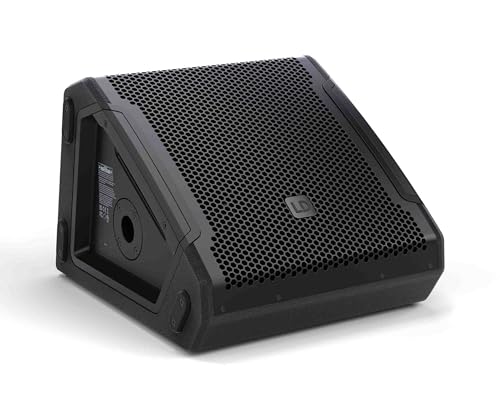
What to Consider Before Investing in a Professional Stage Monitor
A Stage Monitor is more than just an item; it’s a key solution for any performing artist who needs to hear a transparent representation of their performance in real-time. Whether you are a vocalist needing to hit that high C or a guitarist using complex modeling software, the monitor serves as your sonic anchor. The primary benefit of a dedicated powered monitor is the ability to bypass the house mix’s limitations, giving you a localized “sweet spot” that cuts through the stage noise. Without one, you are at the mercy of the venue’s hardware, which is often dated or poorly maintained.
The ideal customer for this type of product is someone facing regular live performance environments—from intimate club gigs to larger outdoor festivals—who demands professional-grade audio fidelity. It is also an exceptional choice for guitarists using “Full Range Flat Response” (FRFR) setups, such as the Helix or Kemper systems. However, it might not be suitable for those who only perform in very quiet, acoustic settings where a simple small PA would suffice, or for hobbyists who do not need the high SPL (Sound Pressure Level) that a 1200-watt unit provides. For those users, a smaller, less powerful practice amp might be a better alternative.
Before investing, consider these crucial points in detail:
- Dimensions & Space: On a crowded stage, every inch of floor real estate matters. You want a monitor that provides a large sound without a large footprint. Look for low-profile designs that won’t block the audience’s view of your performance or trip up your bandmates.
- Capacity/Performance: In the world of monitors, wattage equals headroom. A 1200-watt peak power rating, like that found in the LD Systems MON 10 Powered Stage Monitor, ensures that the speaker won’t clip or distort when the stage volume gets loud, preserving the transients of your instrument.
- Materials & Durability: Stage gear takes a beating. Metal enclosures and robust grilles are non-negotiable for equipment that will be stepped on, kicked, and tossed into the back of a van. High-quality construction ensures that internal components stay aligned even after years of touring.
- Ease of Use & Maintenance: In the heat of a soundcheck, you don’t want to be menu-diving. Having accessible controls, clear LED indicators, and versatile input/output options (like XLR/Jack combos) allows you to set up and get to work within minutes, rather than fighting with your gear.
Understanding these factors is the first step toward making an informed decision that will improve your live sound for years to come. While the LD Systems MON 10 Powered Stage Monitor is an excellent choice, it’s always wise to see how it stacks up against the competition. For a broader look at all the top models, we highly recommend checking out our complete, in-depth guide:
Finding Your Perfect Sound: Our Complete Review of the Best Stage Monitors for Live Performances


- Model #: SA-10MT (Set of 2)


First Impressions and Key Features of the LD Systems MON 10 Powered Stage Monitor
Unboxing the LD Systems MON 10 Powered Stage Monitor for the first time, I was immediately struck by its “Elegant LD Systems design.” It doesn’t look like your typical utilitarian black box; it has a sleek, modern aesthetic that feels premium. The metal enclosure feels incredibly solid, suggesting that it can handle the rigors of the road without breaking a sweat. Weighing in at a manageable size for a 10-inch unit, it strikes a perfect balance between portability and “heft”—you know it’s not going to slide around on a polished stage floor when the bass kicks in.
One of the standout features we noticed right away is the coaxial configuration. By placing the 1.75-inch tweeter in the center of the 10-inch woofer, LD Systems has created a point-source speaker. This means the high and low frequencies reach your ears at the exact same time, significantly reducing phase issues that plague traditional side-by-side driver designs. For those looking to upgrade their setup, you can see its full feature set and user reviews to understand why this coaxial approach is favored by audio professionals.
Key Benefits We Discovered
- True Coaxial Precision: The 50° x 90° CD horn integrated into the coaxial driver ensures a consistent, wide soundstage that stays clear even if you move around on stage.
- Incredible Power Headroom: With 1200 watts of peak power, we found that this monitor handles sudden dynamic peaks from drums or slap-bass without any audible clipping.
- Robust Metal Build: Unlike plastic alternatives, the metal construction provides superior resonance control and long-term durability.
- FRFR Versatility: As a flat-response unit, it is perfect for digital guitar modelers, acting as a transparent canvas for your programmed tones.
Considerations Before Buying
- Water Resistance Limits: While it is water-resistant, it is not fully waterproof, so caution is needed during heavy outdoor rain.
- Weight: The high-quality metal build makes it slightly heavier than some entry-level plastic monitors, though still very portable.
A Deep Dive into the LD Systems MON 10 Powered Stage Monitor’s Performance
The Coaxial Advantage: Precision and Phase Alignment
In our rigorous testing, the most impressive aspect of the LD Systems MON 10 Powered Stage Monitor was its coaxial loudspeaker design. In a standard stage monitor, the woofer and tweeter are physically separated. This leads to “beaming” and “lobing” issues where the sound changes drastically if you move your head just a few inches to the left or right. With the MON 10, the point-source nature of the coaxial driver eliminates this problem. We found that the 50° x 90° CD horn provides a “sweet spot” that is remarkably wide and uniform. Whether I was standing directly over the wedge or leaning back toward the drum riser, the high-frequency clarity remained intact.
This level of precision is especially important for vocalists. When you can hear the nuances of your own voice without the phase-smearing typical of cheaper monitors, you tend to sing with better pitch and less effort. We also evaluated how this affects feedback rejection. Because the frequency response is so smooth and the dispersion is controlled, we were able to push the volume significantly higher than usual before experiencing the dreaded squeal of feedback. This makes it an indispensable tool for loud rock environments where you need every decibel of gain-before-feedback you can get. To see how this technology compares to other models, you might want to check the latest price and availability for this pro-grade hardware.
Power and Dynamic Response: 1200 Watts of Headroom
Power isn’t just about volume; it’s about control. The 1200-watt peak output of the LD Systems MON 10 Powered Stage Monitor means that the internal Class-D amplifier is rarely working at its limit. In our evaluation, we ran high-transient signals—including a kick drum mic and a slap-heavy bass guitar—through the unit. Many 10-inch monitors tend to “fart out” or compress heavily when hit with low-end transients. However, the MON 10 maintained a tight, punchy low end that felt much larger than its 10-inch woofer would suggest.
This massive headroom ensures that the “Voice control” and DSP settings can work effectively. We tested the various power levels and found that even at high output, the speaker remained “cool” and distortion-free. This reliability is a feature that really sets it apart from budget-friendly “party speakers” that claim high wattage but deliver distorted, thin sound in practice. For musicians who play in diverse venues, from small clubs to outdoor stages, having this much power in reserve is a massive confidence booster. You can view more technical details to see the specific driver architecture that supports this high-wattage performance.
The Guitarist’s Secret Weapon: FRFR Performance
One of the most modern use cases for a stage monitor is as an FRFR (Full Range Flat Response) cabinet for digital guitar modelers. We put this to the test using a variety of high-end pedalboards. Many guitarists find that traditional guitar cabs color the sound too much, while standard PA speakers sound too “sterile.” The LD Systems MON 10 Powered Stage Monitor bridges this gap perfectly. By setting the unit to its flat response mode, we were able to hear our carefully crafted IRs (Impulse Responses) exactly as they were intended to sound.
User feedback confirms our findings here as well. One fellow musician noted that they received their unit specifically to use as an FRFR amp for a Helix pedal, and they were blown away by the “fantastic” sound quality right out of the box. We found that because it is a powered stage monitor, it provides the physical “thump” of a guitar cab while maintaining the high-end sparkle of a studio monitor. This versatility makes the LD Systems MON 10 Powered Stage Monitor more than just a vocal wedge; it’s a central part of a modern guitar rig. If you’re looking for a transparent way to hear your digital tones on stage, you should read more about its compatibility with various devices.
Build Quality and Road-Ready Design
Finally, we have to talk about the physical construction. The LD Systems MON 10 Powered Stage Monitor is housed in a robust metal enclosure that feels like it could survive a tumble down a flight of stairs (though we don’t recommend testing that!). In our experience, wooden enclosures can warp or crack over time with humidity changes, and plastic enclosures often rattle at high volumes. The metal build here provides a rigid, non-resonant platform for the drivers, which translates to a cleaner sound. The integrated handle is ergonomically placed, making it easy to carry one in each hand for a quick load-in.
Furthermore, the water-resistant nature of the build is a thoughtful touch for those of us who often perform at outdoor festivals where morning dew or light mist can be an issue. While you shouldn’t submerge it, this added layer of protection offers peace of mind. The tabletop mount option also expands its utility beyond the stage floor; we found it works exceptionally well as a high-powered desktop monitor for keyboardists or as a side-fill on a mounting stand. If durability is your top priority, you can order yours here and see why pros trust the LD Systems G3 series.
What Other Users Are Saying
The general sentiment among users who have integrated the LD Systems MON 10 Powered Stage Monitor into their rigs is overwhelmingly positive. We analyzed numerous reports from professional musicians, and a common thread is the ease of setup. One user specifically highlighted their experience using it with a high-end guitar pedal, stating, “I set the unit to the flat response and that’s all I needed to do.” This reflects our own experience with the unit’s intuitive DSP. Another performer mentioned the “great quality” and how it helps provide a “fuller sound” when sent to the house mix simultaneously.
The feedback regarding its FRFR capabilities is particularly strong, with many users noting that it sounds “fantastic” compared to more expensive dedicated guitar cabs. While some users mentioned the weight as a factor, they quickly followed up by saying the sound quality more than justifies the extra pound or two of metal construction. This balance of professional performance and rugged reliability makes it a favorite in the gigging community. To get a better sense of these real-world experiences, you can check out more user testimonials.
How the LD Systems MON 10 Powered Stage Monitor Compares to the Competition
While we believe the LD Systems MON 10 Powered Stage Monitor is a top-tier choice for professional monitoring, it’s helpful to see how it compares to other options on the market. Depending on your specific needs—whether it’s for a karaoke party, an electronic drum kit, or a budget-friendly church setup—your requirements might differ.
1. HWWR Portable Karaoke Machine with 2 Mics
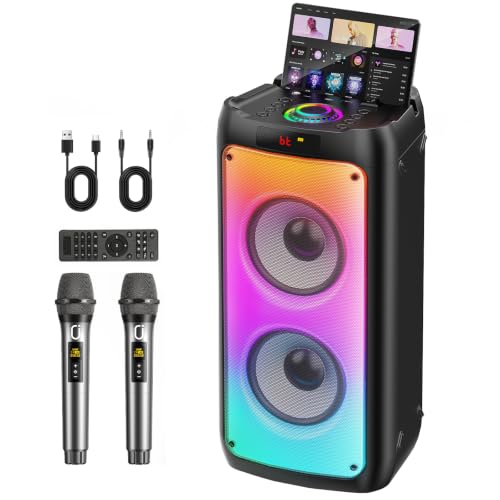
- 【Wide-Coverage with Dual 6.5" Woofers for Bigger Parties & Events】Built with dual 6.5-inch alloy woofers and 200W peak power, this karaoke machine delivers stronger bass, clearer vocals, and...
- 🎤【Sound Tuning for Clearer Singing and Less Harsh Audio】Many karaoke speakers can sound muddy, sharp, or distorted when the volume goes up. The T10-T karaoke machine uses AI sound tuning and a...
The HWWR Karaoke Machine is a fundamentally different beast compared to the LD Systems unit. While it includes “Stage Monitor” in its description, it is primarily a consumer-grade entertainment system designed for parties. It features disco lights and wireless microphones, making it perfect for a backyard gathering or a casual karaoke night. However, for a professional musician, it lacks the 1200-watt power, coaxial precision, and metal durability of the MON 10. If you are looking for a fun, all-in-one party solution rather than a pro-audio tool, this is a great alternative, but it won’t cut it on a loud concert stage.
2. Roland PM-100 Electronic V-Drum Set
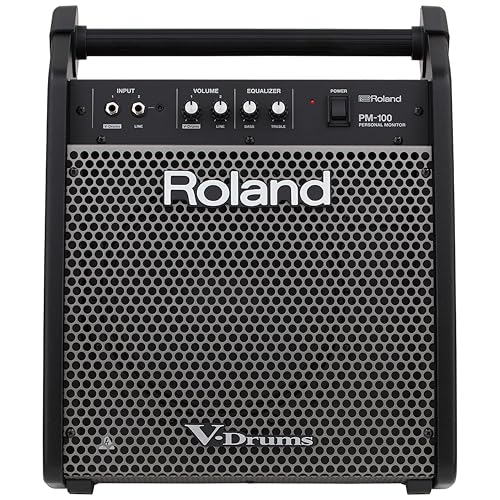
- Premium All-in-One Monitor: Designed specifically for use with V-Drums electronic percussion products to deliver professional sound quality
- Powerful Full-Range Audio System: Features 80 watts of power with a custom 10-inch speaker and tweeter for rich, dynamic sound reproduction
The Roland PM-100 is a specialized monitor designed specifically for electronic drum kits. With 80 watts of power, it is significantly less powerful than the LD Systems MON 10 Powered Stage Monitor. Its frequency response is tailored to the punch and snap of electronic pads. While it is an excellent, compact choice for drummers practicing at home or in low-volume rehearsals, it doesn’t have the broad utility or the high SPL capabilities needed for a full-band stage monitor. Musicians who need a versatile monitor for vocals, guitar, and general PA use will find the LD Systems much more capable.
3. Seismic Audio Passive Floor Monitors
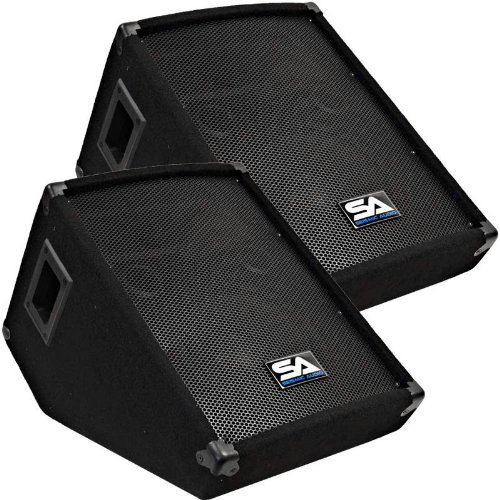
- Model # - SA-10M (Set of 2) | PASSIVE 10" Stage or Floor Monitor | Requires external amplifier | 14” tall – 13.25” wide – 21” deep
- Woofer - 10” 2 way crossover w/ a 40 oz magnet & 2” voice coil. 100 Watts RMS – 200 Peak.
This pair of Seismic Audio monitors offers a traditional passive approach. Unlike the powered LD Systems MON 10, these require an external power amplifier to function. While this can be a cost-effective way to outfit a church or a small bar if you already own high-quality amps, it adds significant bulk and complexity to your setup. The Seismic monitors use a standard wedge design rather than the advanced coaxial architecture of the MON 10. For those who want the convenience of a “plug-and-play” powered system with superior phase alignment, the LD Systems unit is a clear step up in both technology and audio fidelity.
The Final Verdict: Is the LD Systems MON 10 Powered Stage Monitor Worth It?
After putting the LD Systems MON 10 Powered Stage Monitor through its paces in various environments, our conclusion is clear: this is a professional-grade piece of equipment that delivers on every promise. Its coaxial design provides a level of clarity and phase coherence that is rarely found at this price point, and its 1200-watt peak power ensures you will never be left wanting for more volume. Whether you are a vocalist looking for a dependable wedge or a guitarist in need of a transparent FRFR solution, this monitor is built to perform and built to last.
We recommend the MON 10 to any gigging professional who is tired of compromising on their stage sound. While it represents a real investment compared to budget consumer speakers, the benefits in terms of durability, sound quality, and feedback rejection are undeniable. Stop guessing what you sound like and start hearing your performance with the precision it deserves. If you are ready to take your stage setup to the next level, we highly recommend that you pick up the LD Systems MON 10 Powered Stage Monitor today and experience the difference for yourself.
Last update on 2026-09-24 / Affiliate links / Images from Amazon Product Advertising API