
DigiTech MOSAIC Polyphonic Effect Pedal Review: The Ultimate 12-String Shortcut for Every Guitarist
There is a specific, crystalline magic that only a 12-string guitar can produce. Whether it’s the iconic jangle of The Byrds, the haunting intro of “Stairway to Heaven,” or the lush textures of Tom Petty’s greatest hits, that double-course shimmer is a staple of rock and folk history. However, for most of us, owning a dedicated 12-string is a logistical nightmare. They are notoriously difficult to keep in tune, a chore to restring (imagine doing it twice as often!), and often require a significant adjustment in playing technique due to the wider neck and heavier tension. I’ve personally stood on stage with a double-neck SG, and let me tell you, your lower back will never forgive you for that fifteen-pound exercise in vanity. This is exactly why we went looking for a solution that could live on a pedalboard. We wanted the sound without the physical burden, which led us directly to this DigiTech MOSAIC Polyphonic Effect Pedal Review. We needed to know: can a digital box really replicate the complex harmonic interplay of twelve vibrating strings?

- Turn any 6-string guitar into a 12-string. Battery operation possible; (Best with Polaroid 9V Batteries)
- Advanced, Polyphonic Pitch Shifting and Intelligent Doubling

What to Consider Before Buying Acoustic Guitar Effects
Choosing an acoustic guitar effect, particularly a pitch-shifter or emulator, is more than just an item; it’s a key solution for guitarists who need to expand their sonic palette without expanding their instrument collection. When you are looking to emulate a 12-string sound, you aren’t just looking for a simple octave pedal; you are looking for “intelligent doubling.” This means the pedal needs to understand the difference between your low strings (which usually have an octave higher pair) and your high strings (which are usually doubled in unison). A high-quality effect solves the problem of “thinness” in a mix, providing a wall of sound that can fill a room during a solo acoustic set or cut through a dense band arrangement.
The ideal customer for this type of product is the gigging musician who performs covers requiring a 12-string vibe, or the studio enthusiast who wants to layer tracks quickly. It’s perfect for someone who values convenience but refuses to sacrifice tone. However, it might not be suitable for those who are “purists” and demand the literal physical resonance of a hollow-body 12-string, or for players who only use very heavy distortion, which can sometimes mask the delicate pitch-shifting nuances. If you fall into the latter camp, you might consider a standard chorus pedal or a dedicated octave-down effect instead.
Before investing, consider these crucial points in detail:
- Dimensions & Space: In the world of modern pedalboards, real estate is at a premium. You want an effect that delivers a massive sound without requiring a massive footprint. Look for compact designs that use standard 1/4-inch jacks and can fit into a “mini” or standard pedal slot. The DigiTech MOSAIC Polyphonic Effect Pedal is impressively compact, measuring just about 4.6 inches in length, making it a “pedalboard-friendly” powerhouse.
- Capacity/Performance (Tracking): This is the “make or break” metric for pitch effects. Tracking refers to how quickly and accurately the pedal identifies the note you played and generates the effect. Poor tracking leads to “latency” (a delay in sound) or “glitching” (warbling noises). For 12-string emulation, the pedal must be polyphonic, meaning it can handle full chords without turning into a muddy mess.
- Materials & Durability: Since these units are literally designed to be stepped on, the chassis material is vital. A metal enclosure is non-negotiable for professional use. Furthermore, the quality of the foot-switch—whether it is “soft-click” or a heavy-duty mechanical switch—affects both the feel of the performance and the longevity of the device.
- Ease of Use & Maintenance: You don’t want to be menu-diving in the middle of a set. A simple interface with dedicated knobs for “Level” and “Tone” allows for on-the-fly adjustments. Maintenance usually involves checking for loose jacks or ensuring you have a clean power source. Be aware that advanced digital pedals often require specific voltage and amperage, so check if they are compatible with your existing power brick.
While the DigiTech MOSAIC Polyphonic Effect Pedal is an excellent choice for those seeking that specific “jangly” shimmer, it’s always wise to see how it stacks up against the competition. For a broader look at all the top models and how they might fit your specific playing style, we highly recommend checking out our complete, in-depth guide:

- Transform any guitar into a ToneWoodAmp smart guitar! No Amp Required: Acoustic guitar effects that work directly from your guitar's body without needing an amplifier

- Analog Preamp and Digital Reverb
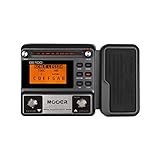
- 80 preset patches and 80 user patches, enough for creating your sound library. You can save any preferred tones by simply pressing down the SAVE button.
First Impressions and Key Features of the DigiTech MOSAIC Polyphonic Effect Pedal
Unboxing the DigiTech MOSAIC Polyphonic Effect Pedal, the first thing I noticed was its rugged, “industrial-chic” aesthetic. It feels substantial in the hand—weighing in at 1.4 pounds—which is a good sign for durability. The matte black finish and the minimalist two-knob layout (Level and Tone) suggest a device that focuses on doing one thing perfectly rather than ten things mediocrely. It comes with its own 9V DC power supply, which is a nice touch, though we later discovered that it’s quite particular about its power requirements. You can see its full feature set and user reviews to get a sense of how it fits into a professional rig.
The “Mosaic” name is fitting; it literally pieces together a more complex version of your signal. Unlike older, monophonic octave pedals that would glitch if you played more than one note at a time, this unit is fully polyphonic. In our initial test with a standard 6-string electric, the tracking felt instantaneous. There was no perceived lag between the pick attack and the “doubled” sound. This immediate response is crucial for maintaining the “feel” of your playing, especially during fast arpeggios or rhythmic strumming. It’s clear that DigiTech leveraged their years of experience with the Whammy series to perfect the pitch-shifting algorithms used here.
Key Benefits
- Incredibly convincing 12-string emulation with rich, polyphonic tracking.
- Simple two-knob interface makes it effortless to dial in the “sweet spot.”
- True Bypass circuitry ensures your dry signal remains pure when the effect is off.
- Compact, tank-like construction that saves space on crowded pedalboards.
Limitations
- Very sensitive to power sources; often requires its own dedicated adapter to avoid noise or failure.
- Can sound overly “metallic” or “brittle” on acoustic guitars if the Tone knob isn’t carefully adjusted.
A Deep Dive into the DigiTech MOSAIC Polyphonic Effect Pedal’s Performance
The Polyphonic Tracking Engine: Does it Glitch?
In our testing, the most impressive aspect of the DigiTech MOSAIC Polyphonic Effect Pedal was its ability to handle complex chords. If you’ve ever used a cheap pitch-shifter, you know the “underwater” warbling sound that happens when you play a major 7th chord. We pushed the Mosaic with dense jazz voicings and fast-strummed open chords, and the tracking remained rock solid. It uses advanced digital signal processing (DSP) to generate the octave-up and unison-doubled notes that characterize a 12-string. Because it’s polyphonic, it doesn’t just pitch-shift the whole signal; it seems to intelligently apply the effect across the frequency spectrum. You can check the latest price and availability to see why this tracking technology is so highly valued.
We found that the tracking even held up during string bends. Usually, pitch-shifters struggle when the source pitch is fluctuating, but the Mosaic followed our lead without any digital artifacts or “stepping.” This makes it feel much more like a natural instrument and less like a computer effect. One user we spoke with mentioned they used it for Tom Petty covers, and we have to agree—playing “Listen to Her Heart” through this pedal gives you that immediate, jangly satisfaction that usually requires a Rickenbacker and a lot of patience.
Tone and Level: Finding the “Sweet Spot”
The interface of the DigiTech MOSAIC Polyphonic Effect Pedal consists of only two knobs, but they are incredibly interactive. The “Level” knob controls the intensity of the 12-string effect. If you keep it low, you get a subtle thickening that sounds like a very high-end chorus. As you crank it past noon, the octave-up shimmering becomes much more pronounced. We found that for most “classic rock” applications, setting the Level around 1 o’clock provided the most realistic balance between the dry 6-string punch and the 12-string airiness.
The “Tone” knob is where you really shape the character of the shimmer. This isn’t just a standard EQ; it specifically adjusts the high-frequency enhancement of the generated signal. If you find the sound too “brittle” or “shrill”—a common complaint when using this pedal with an acoustic guitar—backing the Tone off to the 9 or 10 o’clock position warms it up significantly. Conversely, on a dark-sounding electric guitar with humbuckers, cranking the Tone can provide that “chime” that humbuckers often lack. This versatility is a feature that really sets it apart from simpler octave pedals that give you no control over the EQ of the effect.
Real-World Versatility: Electric vs. Acoustic
One of the most interesting findings in our review was the difference in performance between electric and acoustic guitars. When paired with a solid-body electric, like a Stratocaster or a Telecaster, the DigiTech MOSAIC Polyphonic Effect Pedal is a revelation. It transforms a standard bridge pickup into a jangling machine that sounds remarkably close to a vintage electric 12-string. We also tested it with a bit of compression and a light chorus, which resulted in a massive, “Wall of Sound” texture that was perfect for shoegaze or dream-pop styles.
On an amplified acoustic guitar, the results were more nuanced. If the settings are too high, it can lean into “pipe organ” territory, which might not be what you’re looking for during a folk ballad. However, we found that by dialing the Tone back and keeping the Level moderate, it adds a beautiful resonance that makes a solo acoustic performance sound much “larger.” It’s less about a literal 12-string replacement and more about an “enhanced acoustic” sound. As one professional player noted, unless you are playing side-by-side with a real 12-string, most listeners—and even many musicians—won’t be able to tell the difference in a live mix. This makes it an invaluable tool for singer-songwriters who want to vary their sound throughout a three-hour set.
Build Quality and Integration: The Power Supply Caveat
The DigiTech MOSAIC Polyphonic Effect Pedal is built to survive the rigors of the road. The chassis is heavy-duty metal, the knobs have a nice resistance to them, and the 1/4-inch jacks are tight and secure. It also features True Bypass, which we verified using a high-end buffer; when the pedal is off, your signal is completely unaffected. However, we must address the “elephant in the room”: the power requirement. This is a digital pedal that draws about 50mA, but it is surprisingly sensitive to the *quality* of that power. We attempted to run it on a daisy chain with several analog drive pedals, and it introduced a high-pitched whine into the signal.
When we switched to the included dedicated power supply, the noise vanished instantly. We also tested it with isolated power bricks, and while it worked with most, some users have reported that it doesn’t always play nice with certain multi-output supplies. This is something to keep in mind if you have a tightly integrated pedalboard. Despite this quirk, the pedal’s reliability once properly powered is excellent. It’s a “set and forget” device that doesn’t require constant tweaking once you’ve found your preferred settings. For those looking to streamline their rig, you can order it with the necessary components here.
What Other Users Are Saying
The general consensus among the guitar community is that the DigiTech MOSAIC Polyphonic Effect Pedal is the gold standard for 12-string emulation. Most users are blown away by how much it simplifies their lives. One long-time performer mentioned that they finally felt comfortable selling their heavy double-neck guitar because the Mosaic handled those songs so effectively. “The tracking on bends is surprisingly good,” one user noted, while another added that it’s the “only pedal specifically designed for this job that actually gets it right.”
On the flip side, some users have encountered hurdles. A few noted the “shrill” nature when used with piezeo-equipped acoustic guitars, emphasizing that you *must* use the tone knob to compensate. The most common negative feedback relates to the power supply; users who tried to use universal adapters or daisy chains often faced “dead on arrival” scares or unwanted noise. One Australian buyer warned that they received a unit with the wrong regional plug, so always double-check the seller’s location. Overall, however, the sentiment is overwhelmingly positive, with many players considering it a “secret weapon” on their boards. You can read more detailed user testimonials here to see if their experiences match your needs.
Comparing the DigiTech MOSAIC Polyphonic Effect Pedal to Its Top 3 Alternatives
1. SONICAKE Acoustic Guitar Effects Pedal
- Analog Preamp and Digital Reverb
- Built-in Notch Filter and Mute with gain and frequency range adjustment capabilities to quickly eliminate whistling and shape your sound in detail
The SONICAKE A Factory is a vastly different beast than the Mosaic. While the DigiTech MOSAIC Polyphonic Effect Pedal focuses purely on the 12-string shimmer, the SONICAKE is a multi-effect strip designed specifically for acoustic players. It includes a preamp, a compressor, and a reverb. It does *not* offer the 12-string emulation that the Mosaic is famous for. However, if you are looking for a general “all-in-one” solution to improve your basic acoustic tone, this is a very budget-friendly alternative. It’s best for the player who wants a polished acoustic sound but doesn’t necessarily need the specific octave-doubling effects.
2. MOOER Acoustikar Guitar Pedal Simulator

- [Warm Sound] Restore the sound of the acoustic guitar. Play the sound texture of an acoustic guitar with an electric guitar.
The MOOER Acoustikar is designed to solve the opposite problem of the Mosaic. While the Mosaic makes an electric guitar sound like a 12-string, the Acoustikar makes an electric guitar sound like an *acoustic* 6-string. It features three modes: Piezo, Standard, and Jumbo. It is incredibly small—a “micro” pedal—which is great for crowded boards. If your goal is to play “unplugged” sounding songs on your Stratocaster, this is your tool. But if you want that lush, doubled 12-string jangle, the Mooer won’t get you there; it lacks the pitch-shifting intelligence of the DigiTech unit.
3. ToneWoodAmp SOLO Multi-Effect Processor
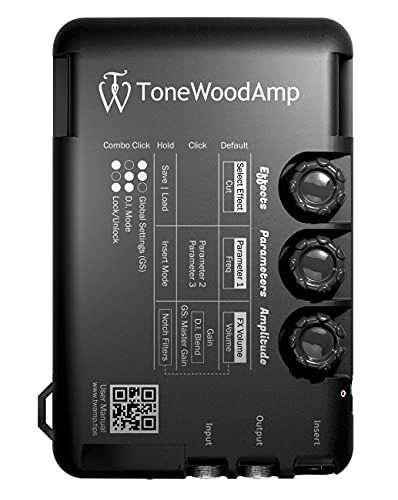
- 【One Of A Kind Experience】The ToneWoodAmp works on virtually any acoustic guitar! Adds beautiful sounding organic guitar effects to your acoustic* and acoustic-electric guitar, NO AMP REQUIRED...
- 【No Amp Required】 XXXX Get Reverbs like Hall, Room, Plate, Delay, Leslie, Auto-Wah, and Chorus, no amp required! All sounds come from the soundhole of your guitar organically. Buy one ToneWoodAmp...
The ToneWoodAmp is in a category of its own. It’s not a floor pedal; it’s a device that magnetically attaches to the back of your acoustic guitar and uses the guitar’s own body as a speaker to create effects like reverb and delay *unplugged*. It is an amazing tool for inspiration and small room performances. While it provides a “thicker” sound, it does not do pitch-shifting or 12-string emulation. It’s a luxury item for the acoustic purist who wants effects without an amp. For the stage-bound guitarist needing a 12-string sound for a specific song, the DigiTech MOSAIC Polyphonic Effect Pedal is the far more practical and targeted choice.
The Final Verdict: Is the DigiTech MOSAIC Polyphonic Effect Pedal Worth It?
After weeks of testing and comparing, our conclusion is clear: the DigiTech MOSAIC Polyphonic Effect Pedal is a niche masterclass. It doesn’t try to be a Swiss Army knife; instead, it provides the most realistic, playable, and musically useful 12-string emulation we’ve ever heard from a single stompbox. Its strengths lie in its impeccable tracking and its ability to add a massive sense of scale to any guitar signal. While it has some quirks regarding power sensitivity and can be bright if not dialed in, these are small trade-offs for the convenience of leaving your 12-string at home.
We recommend this pedal wholeheartedly to session players, cover band guitarists, and singer-songwriters who want to add a “professional sheen” to their live sound. It’s a durable, well-engineered piece of gear that solves a decades-old problem for guitarists. If you’re ready to stop struggling with twelve tuners and start enjoying that classic shimmer, now is the perfect time to pick up the DigiTech MOSAIC and transform your tone today.
Last update on 2026-10-25 / Affiliate links / Images from Amazon Product Advertising API