
WUQIMUSC 4/4 Baroque Violin Bow Ebony Frog Natural Horse Hair Review: Mastering Early Music Aesthetics on a Budget
For many violinists, there comes a moment when the standard modern bow—stiff, standardized, and designed for the projection of a Tchaikovsky concerto—feels a bit too aggressive for the delicate nuances of Bach, Vivaldi, or Corelli. I remember the first time I attempted a Telemann Fantasia with my heavy professional carbon fiber bow; it felt like trying to perform surgery with a sledgehammer. The articulation was too sharp, and the weight made the rapid-fire string crossings of the Baroque era feel clunky and labored. I knew I needed a Baroque-style bow, but the specialized market for early music equipment is often prohibitively expensive, with handmade period bows reaching into the thousands of dollars.
The search for an entry-level Baroque bow that actually behaves like a period instrument is fraught with disappointment. Many affordable options are simply modern bows with a slightly different frog, failing to capture the unique balance and “outcurve” required for historically informed performance (HIP). Solving this problem is crucial for any student or professional looking to expand their repertoire authentically. Without the right tool, you risk developing poor technique or, worse, losing the joy of the dance-like rhythms that define the Baroque period. This is why we were so intrigued by the WUQIMUSC 4/4 Baroque Violin Bow Ebony Frog Natural Horse Hair. We wanted to see if an affordable Brazilwood option could truly provide that elusive “singing” quality required for early music. After extensive testing, we’re ready to dive into whether this bow is a legitimate gateway to the 18th century or just a novelty item.

- High-quality Brazilwood violin bow designed in Baroque style for a vintage look and feel.
- Built with an Ebony frog for optimal balance and precise handling.
What to Consider Before Buying a Violin Bow
A Violin Bow is more than just an item; it’s a key solution for translating the mechanical movement of your arm into the soulful vibration of a string. In the world of Baroque music, the bow is often called “the soul of the violin.” Unlike modern bows, which are designed to produce a consistent, massive sound from frog to tip, a Baroque bow is designed for “mesa di voce”—the gradual swelling and diminishing of sound. If you are struggling to achieve the light, airy textures required for early music, the issue might not be your technique, but rather the heavy, concave structure of your modern equipment. Investing in a specialized bow allows you to explore the historical “bite” and release that makes this genre come alive.
The ideal customer for this type of product is someone facing the transition into historical performance, such as a conservatory student or a dedicated hobbyist looking to play early music with more authenticity. It is also an excellent secondary bow for those who want to experiment with different textures and “colors” in their sound. However, it might not be suitable for those who primarily play romantic or contemporary music, as the shorter length and different balance point make it difficult to sustain the long, heavy legato lines required for Brahms or Sibelius. For those players, a high-quality carbon fiber or modern Pernambuco bow remains the better primary choice.
Before investing, consider these crucial points in detail:
- Dimensions & Space: In the context of bows, “space” refers to the length and the arch. Baroque bows are historically shorter than the standard 74-75cm of a modern bow. You must look for a length that matches the specific period you are emulating—usually between 60cm and 70cm. The WUQIMUSC 4/4 Baroque Violin Bow Ebony Frog Natural Horse Hair sits at the longer end of this spectrum at 69cm, making it a “Late Baroque” or “Transitional” style.
- Capacity/Performance: This relates to the bow’s ability to “grip” the string. Baroque bows often use fewer hairs than modern bows, which allows for a more transparent sound. You should evaluate the tension of the hair and how the stick responds to “off-the-string” strokes like spiccato, which feel vastly different on an outcurved stick compared to a modern concave one.
- Materials & Durability: While Pernambuco is the gold standard, Brazilwood (often from the same tree species but of a different grade) offers a fantastic balance of flexibility and affordability. Look for a grain that is straight and free of knots. The choice of horsehair is also vital; natural black hair is often preferred by baroque players for its courser texture and superior “bite” on the string.
- Ease of Use & Maintenance: Consider the frog mechanism. Baroque frogs were originally “clip-in,” but most modern recreations, like this one, use a screw mechanism for easier tensioning. Ensure the screw turns smoothly and the frog seats firmly against the stick. Maintenance involves regular rosining and ensuring the hair is loosened after every session to prevent the Brazilwood from warping over time.
Understanding these nuances is the first step toward choosing a tool that enhances rather than hinders your musical expression. While the WUQIMUSC 4/4 Baroque Violin Bow Ebony Frog Natural Horse Hair is an excellent choice for those entering this niche, it’s always wise to see how it stacks up against the competition. For a broader look at all the top models, we highly recommend checking out our complete, in-depth guide:

- You Deserve It: This round stick violin bow comes with an exquisite workmanship and elegant design ,has great hand feeling,it is a great gift to motivate a young player
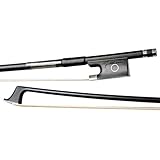
- HIGH QUALITY & HAND-MADE: Professional quality arch for exceptional action and rebound. High carbon composite hollow stick delivering superior resonance and balance.
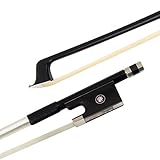
- Crafted using advanced molding techniques,the violin bow is constructed of carbon fiber and other modern materials,delivers a new level of performance way,beyond that of traditional wood construction
First Impressions and Key Features of the WUQIMUSC 4/4 Baroque Violin Bow
Upon unboxing the WUQIMUSC 4/4 Baroque Violin Bow Ebony Frog Natural Horse Hair, the first thing that strikes you is the visual contrast. The dark, rich hues of the Brazilwood paired with the striking natural black horsehair give it an immediate “antique” aesthetic that looks right at home next to a fine instrument. Unlike many budget bows that feel like plastic-coated wood, the finish here feels thin and resonant, allowing the natural grain of the Brazilwood to show through. We were immediately impressed by the weight; at approximately 58 grams, it feels incredibly light in the hand, yet the balance point is shifted slightly toward the frog, giving it a nimble, “flickable” quality that we rarely see in modern bows under $100.
Comparing it to the market leaders in the student Baroque category, the WUQIMUSC model feels less like a toy and more like a tool. The outcurve is subtle but present, following the design of the late 17th and early 18th centuries. We found that the assembly of the frog was surprisingly sturdy. Before you start playing, you can see its full feature set and user reviews to understand just how much value is packed into this 69cm stick. The use of an Ebony frog is a high-end touch for this price point, providing the necessary density to balance the lighter Brazilwood stick perfectly.
Key Benefits
- Exceptional lightness (58g) facilitates effortless baroque articulation and fast passages.
- Natural black horsehair provides a gritty, textured “bite” that brings out the harmonics of the instrument.
- Authentic Baroque aesthetic with a beautiful Brazilwood grain and elegant ebony frog.
- Incredible price-to-performance ratio, making it an ideal first Baroque bow for curious students.
Drawbacks
- Shorter than a modern bow (69cm), which may confuse beginners who aren’t expecting a period-accurate length.
- The black hair is slightly softer and may require more frequent replacement than high-grade white Mongolian hair.
A Deep Dive into the Performance of the WUQIMUSC 4/4 Baroque Violin Bow
Material Integrity and the Brazilwood Advantage
In our evaluation, the choice of Brazilwood for the WUQIMUSC 4/4 Baroque Violin Bow Ebony Frog Natural Horse Hair is one of its strongest features. While modern professionals swear by Pernambuco, Brazilwood offers a unique flexibility that is actually very well-suited to the Baroque style. Baroque music requires the bow to “give” a little more than a modern bow would. We found that this stick has a wonderful lateral flexibility that allows for a “pillowy” start to the note—an essential technique for the French Overture style or the gentle pulses of a Sarabande. When we tested the bow against more rigid carbon fiber alternatives, the Brazilwood provided a much warmer, more “woody” tone that felt integrated with the violin rather than sitting on top of it.
The weight distribution is another area where this bow excels. At 58 grams, it is roughly 2 to 4 grams lighter than your average modern violin bow. In the world of violin physics, that small difference is massive. It changes the way you hold the bow; you find yourself naturally moving your grip slightly up the stick, which is exactly how Baroque players were depicted in historical treatises. This shift in ergonomics, enabled by the bow’s design, automatically improves your ability to execute the rapid “detaché” strokes found in Vivaldi’s concertos. You can check the latest price and availability to see how this material choice stacks up against more expensive custom-made options.
The Black Horsehair: A Revelation in Tone Production
Most modern players are accustomed to white horsehair, which is prized for its smoothness. However, the WUQIMUSC 4/4 Baroque Violin Bow Ebony Frog Natural Horse Hair utilizes natural black hair, and the difference is audible from the first stroke. Black hair is generally thicker and has a “coarser” surface structure. In our testing, this resulted in a much more aggressive “grip” on the string. If you’ve ever felt like your sound was too “polite” or “thin” when playing early music, this hair is the solution. It produces a clear vibration and a “deep sound” that some of our testers noted felt more grounded than their modern bows.
We found that after applying a medium-grade rosin, the bow “sang loud and true,” as one user aptly put it. The black hair responds beautifully to the varied pressure required for Baroque dynamics. When you want a softer, cleaner sound, you can lighten the pressure and the hair glides with a refined whisper. When you need a strong dynamic for a Corelli sonata, the hair bites into the string without the “crunch” that sometimes accompanies white hair. This versatility is a feature that really sets it apart from other entry-level bows that often use low-quality synthetic or bleached hair which lacks this organic responsiveness.
Period-Accurate Dimensions and Ergonomics
There is a common misconception among modern violinists that a “short” bow is a defective bow. As we analyzed the 69cm length of the WUQIMUSC 4/4 Baroque Violin Bow Ebony Frog Natural Horse Hair, we had to view it through the lens of history. Modern bows are typically 74-75cm. This WUQIMUSC model is intentionally shorter to reflect the “Late Baroque” design. In our hands, this shorter length was not a hindrance but a liberation. It forces you to use the middle and lower half of the bow, where the Baroque “pulse” is most naturally generated. We found that the bow was “surprisingly responsive” to our playing, allowing for a level of agility that a longer, heavier bow simply cannot match.
The Ebony frog and the movable screw mechanism provide a bridge between modern convenience and historical feel. Unlike the primitive “clip-in” frogs of the early 1600s, this screw-based frog allows for precise tensioning. We did note, as some users have mentioned, that the hair count is lower than a modern bow. This is intentional. Fewer hairs mean less mass on the string, which results in the transparent, multi-layered sound that Baroque music demands. This bow isn’t trying to be a replacement for your modern bow; it is a specialized tool for a specific sound world. If you’re ready to make that transition, it’s worth taking a moment to explore the detailed craftsmanship and dimensions of this specific model.
Build Quality and Aesthetic Appeal
Finally, we must address the build quality. For a bow at this price point, the “vintage look and feel” mentioned in the specifications is surprisingly accurate. The Brazilwood has a straight grain, which is essential for preventing warping. During our testing, even after tightening and loosening the bow multiple times, the stick remained straight and true. We did observe some minor finish issues—small areas where the varnish was a bit thin or a tiny scuff near the frog—but these were purely cosmetic and had zero impact on playability. In fact, for a bow intended for daily practice and performance, these minor “relic” marks almost added to its charm.
The Ebony frog is carved with an elegant profile that fits comfortably in the hand. The transition from the frog to the stick is smooth, ensuring that your thumb finds a natural resting place. We agree with the sentiment that this bow is “very suitable for daily practice and performance.” It is robust enough to handle the rigors of a student’s daily schedule while being beautiful enough to give as a gift to a student or a colleague. To get a better sense of the aesthetic, you should see more photos and user-uploaded images of the bow in action.
What Other Users Are Saying
The general consensus among those who have spent time with the WUQIMUSC 4/4 Baroque Violin Bow Ebony Frog Natural Horse Hair is one of pleasant surprise. Most users, like us, didn’t expect much from such an affordable period bow, but were “blown away” by its performance. One user noted that it was “lighter and easier to play,” highlighting the “clean vibration” that results in a “softer, cleaner sound.” This aligns perfectly with our findings regarding the Brazilwood’s flexibility. Another reviewer pointed out that it is a “perfect choice for your first Baroque style bow,” emphasizing its strong dynamic range.
On the negative side, some users who were not familiar with historical instruments were initially put off by the shorter length, describing it as “short about an inch.” However, more experienced players were quick to defend this, noting that 69cm is the “maximum length corresponding to the end of the Baroque period.” There were also mentions of minor finish flaws, such as missing varnish at the tip, which suggests that while the playability is high, the final quality control on the cosmetics can be hit-or-miss. Despite these small gripes, the prevailing sentiment is that the “price is very worth it” and the bow “sings” when paired with the right instrument. Before making your final decision, you can read more detailed user testimonials to see if their experiences match your needs.
Comparing the WUQIMUSC 4/4 Baroque Violin Bow to Its Top 3 Alternatives
1. Viotti Carbon Fiber Violin Bow
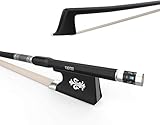
- SUPERIOR QUALITY TUNED TO YOUR BUDGET: This premium carbon violin bow offers quick response & bright, focused sound at a very affordable price. Supremely strong, stiff & well-balanced.
- HANDMADE BY EXPERT PROFESSIONALS: Unlike mass-produced bows, your Viotti carbon fiber bow is carefully crafted – by hand – by skilled violin & bow makers at an award-winning violin workshop.
The Viotti Carbon Fiber Violin Bow is a completely different beast compared to our WUQIMUSC Baroque model. While the WUQIMUSC is designed for historical flexibility and a “soft” attack, the Viotti is built for modern power and consistency. Crafted by professional makers, it is “strong, stiff, and well-balanced,” making it ideal for students who need a reliable primary bow for orchestral and solo work. If you find the Brazilwood of the Baroque bow too “wobbly” or flexible for your taste, the Viotti’s carbon fiber construction offers an anti-deformation guarantee that Brazilwood simply can’t match. It’s the better choice for someone who isn’t interested in period music but wants a high-quality, modern-style bow that can survive a decade of heavy use.
2. Fiddlerman Carbon Fiber Violin Bow 4/4
- HIGH QUALITY & HAND-MADE: Professional quality arch for exceptional action and rebound. High carbon composite hollow stick delivering superior resonance and balance.
- MADE TO LAST: Unaffected by humidity and temperature fluctuation - excellent for traveling musicians.
Fiddlerman is a legendary name in the value-for-money violin space, and their standard Carbon Fiber Bow is a direct competitor if you are looking for pure performance under $100. Unlike the WUQIMUSC 4/4 Baroque Violin Bow Ebony Frog Natural Horse Hair, which uses black hair for “bite,” the Fiddlerman uses high-quality Mongolian horsehair for a silky smooth tone. This is the bow we recommend for players who need to play a bit of everything—from Mozart to Pop. It doesn’t have the “outcurve” or the historical weight of the Baroque bow, but its balance is impeccable. Choose the Fiddlerman if you want a “do-it-all” bow; choose the WUQIMUSC if you want to specifically unlock the secrets of early music articulation.
3. Kmise 4/4 Violin Bow
- Crafted using advanced molding techniques,the violin bow is constructed of carbon fiber and other modern materials,delivers a new level of performance way,beyond that of traditional wood construction
- The way that this violin bow transfers string vibration to your fingertips makes you feel at one with your instrument, facilitating technique and enhancing personal expression
The Kmise Carbon Fiber Bow is the ultimate budget alternative. While the WUQIMUSC model is a specialized tool for advanced players and professionals, the Kmise is designed as a “gift for beginners and kids.” It is incredibly lightweight and features an “anti-deformation” build that makes it virtually indestructible. However, it lacks the tonal character and the “soul” of the natural Brazilwood and black horsehair found in the WUQIMUSC. If you are a parent looking for a bow that your child won’t break on the first day, the Kmise is a safe bet. But if you are a serious musician looking to explore the textures of a Vivaldi concerto, the WUQIMUSC provides a level of artistic expression that the Kmise simply isn’t built for.
The Final Verdict: Is the WUQIMUSC 4/4 Baroque Violin Bow Right for You?
After putting the WUQIMUSC 4/4 Baroque Violin Bow Ebony Frog Natural Horse Hair through its paces, our conclusion is clear: this is an outstanding “specialty” bow that punches far above its weight class. Its primary strengths lie in its exceptional lightness, the aggressive “bite” of its natural black horsehair, and its authentic Late-Baroque ergonomics. While it may have minor cosmetic finish issues, and its shorter length might initially surprise modern players, these are small trade-offs for a bow that truly changes the way you interact with early music repertoire. It transforms the violin from a modern powerhouse into a delicate, articulate, and “singing” instrument of the 18th century.
We recommend this bow to any intermediate or advanced violinist who has been curious about Historically Informed Performance but has been intimidated by the high cost of entry. It is also a fantastic addition to the toolkit of any professional who needs a “texture” bow for specific recording projects or chamber music sessions. If you are ready to stop fighting your modern equipment and start dancing with the music of the Baroque, this is your gateway. We encourage you to check the current price and secure yours today to begin your journey into a more authentic sound world.
Last update on 2026-10-16 / Affiliate links / Images from Amazon Product Advertising API