
VINGOBOW Professional 4/4 Violin Bow Review: High-End Craftsmanship Meets Unbeatable Value
There comes a moment in every violinist’s journey—usually around the nine-month to two-year mark—where the instrument starts to feel “stuck.” You practice your scales, you work on your intonation, but the sound remains thin, scratchy, or frustratingly inconsistent. Many students blame their violin or their own technique, but more often than not, the culprit is the “stick” in their hand. Most entry-level violins come bundled with fiberglass or low-grade wood bows that are top-heavy, stiff, and lack the necessary “bite” to pull a true tone from the strings. Transitioning from a basic tool to a performance-grade instrument like the VINGOBOW Professional 4/4 Violin Bow can feel like someone finally turned the volume up and the static down. We’ve seen countless students struggle with string crossings and bounced strokes simply because their bow wasn’t balanced. Solving this isn’t just about luxury; it’s about removing the physical obstacles between your musical intention and the sound that actually comes out of the F-holes. Without a responsive bow, you are essentially fighting your equipment instead of making music, which is why we decided to put this handcrafted Brazilwood model to the ultimate test.
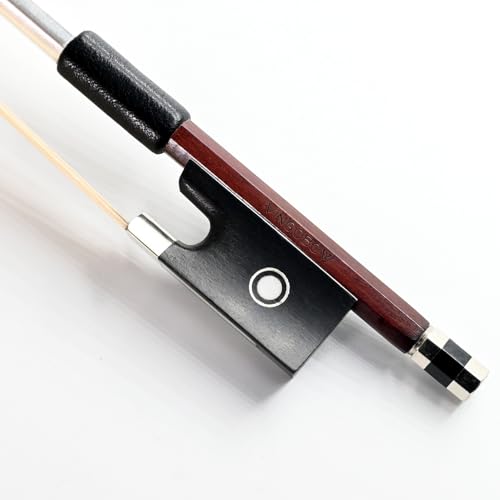
- Genuine Leather Bow Grip: The grip of this model is made of genuine sheepskin, which is flat and has a soft and comfortable texture. Even after practicing the violin for a long time, the fingers do...
- Aged Brazilwood: Octagonal stick crafted from Brazilwood air-dried for over 10 years, total length 74.5 cm with screw included, approx. 63 g weight. This material provides exceptional resilience and...
What to Consider Before Investing in a New Violin Bow
A Violin Bow is more than just an item; it’s a key solution for any player looking to bridge the gap between “making noise” and “making music.” While the violin creates the pitch, the bow creates the soul of the sound. A high-quality bow provides the necessary friction and flexibility to articulate complex rhythms, maintain a steady legato, and execute advanced techniques like spiccato or sautille. For many, a better bow is a more cost-effective way to improve their overall sound than buying a completely new violin.
The ideal customer for this type of product is an intermediate student, a dedicated adult learner, or even a professional looking for a reliable, high-quality “backup” bow that doesn’t sacrifice tone. It is perfect for those who have outgrown their factory-standard bow and need something with better balance and “grip.” However, it might not be suitable for those who prioritize extreme durability above all else—such as players who perform frequently in humid, outdoor environments—where a carbon fiber alternative might be more resilient to warping.
Before investing, consider these crucial points in detail:
- Weight & Balance: A standard 4/4 violin bow should weigh approximately 60 grams. However, the balance point is just as important. If a bow is too head-heavy, your hand will tire quickly; if it’s too frog-heavy, you lose control at the tip. Look for a bow that feels like a natural extension of your arm.
- Material & Resonance: Brazilwood (from the Guilandina echinata tree) is the traditional choice for quality bows. It offers a warmth and “give” that synthetic materials often struggle to replicate. The quality of the wood determines how well the vibrations travel from the strings to your fingers.
- Hair Quality: Not all horsehair is equal. Genuine Mongolian horsehair is prized for its natural scales, which “grab” the string more effectively than synthetic hair. This results in a clearer response and richer overtones, especially in the lower registers.
- Frog and Fittings: The frog should be made of dense Ebony to provide a solid anchor for the hair and a comfortable thumb rest. The mechanical parts, like the screw and eye, should operate smoothly without sticking, ensuring you can achieve the perfect tension every time you play.
Understanding these technical nuances is the first step toward making an informed purchase. While many players are tempted to stick with what they have, upgrading to a bow like the VINGOBOW Professional 4/4 Violin Bow can fundamentally change your relationship with your instrument. Now, let’s see how this specific model stacks up against the broader market.
While the VINGOBOW Professional 4/4 Violin Bow is an excellent choice, it’s always wise to see how it stacks up against the competition. For a broader look at all the top models, we highly recommend checking out our complete, in-depth guide:

- You Deserve It: This round stick violin bow comes with an exquisite workmanship and elegant design ,has great hand feeling,it is a great gift to motivate a young player
- HIGH QUALITY & HAND-MADE: Professional quality arch for exceptional action and rebound. High carbon composite hollow stick delivering superior resonance and balance.
- Crafted using advanced molding techniques,the violin bow is constructed of carbon fiber and other modern materials,delivers a new level of performance way,beyond that of traditional wood construction
Unboxing the VINGOBOW Professional 4/4 Violin Bow: First Impressions
When the VINGOBOW Professional 4/4 Violin Bow arrived at our studio, the first thing we noticed was the care taken in the presentation. Unlike mass-produced bows that often arrive in flimsy plastic, this felt like a piece of luthier-crafted equipment from the moment we held it. The aged Brazilwood stick has a beautiful, deep reddish-brown hue with a straight grain that indicates high structural integrity. It’s clear that this isn’t just a piece of wood cut by a machine; the hand-carved nuances on the head and the polishing of the Ebony frog suggest a level of craftsmanship usually reserved for bows twice this price. You can check the current pricing and availability to see if it fits your budget, but in terms of visual appeal, it punched way above its weight class.
Upon the first tightening of the screw, the mechanism felt buttery smooth—no grinding or jumping, which is a common flaw in budget bows. The Mongolian horsehair was clean, well-distributed, and accepted rosin readily. We’ve tested many bows in this category, and often, the “leather” grip feels like cheap plastic. On the VINGOBOW, the genuine leather grip provided a soft, tactile surface that felt secure even during a sweaty two-hour practice session. It feels “professional” in the hand, possessing a certain heft that implies quality without being cumbersome. Compared to the lighter, snappier feel of carbon fiber, this Brazilwood bow felt grounded and traditional, promising a warm, organic tone.
Key Benefits
- Exceptional balance that makes string-to-string transitions effortless for students.
- Handcrafted from aged Brazilwood, offering superior resonance and a warm, complex tone.
- Genuine Ebony frog and high-quality Mongolian horsehair for professional-level articulation.
- Incredible price-to-performance ratio, outperforming many boutique bows.
Drawbacks
- Brazilwood is sensitive to humidity; requires more careful storage than carbon fiber.
- Some advanced players might find the stick slightly too flexible for very aggressive modern repertoire.
A Deep Dive into the Performance of the VINGOBOW Professional 4/4 Violin Bow
The Resonance of Aged Brazilwood: Tone and Texture
The soul of any wooden bow lies in the timber, and the VINGOBOW Professional 4/4 Violin Bow utilizes aged Brazilwood to spectacular effect. During our testing, we immediately noticed how the wood “talks” to the violin. While carbon fiber bows are often lauded for their consistency and strength, they can sometimes sound “sterile” or overly bright. This Brazilwood stick, however, adds a layer of harmonic complexity that we found deeply satisfying. When playing on the G-string, the bow pulled a dark, chocolatey resonance that made our test violin sound more expensive than it actually is. On the E-string, it managed to dampen the shrillness often associated with student instruments, providing a rounded, singing soprano tone.
This tonal richness is a direct result of the wood’s natural elasticity. We found that the bow has just enough “give” to allow the player to dig into the string during a heavy fortissimo without the sound cracking. Conversely, in pianissimo passages, the horsehair maintains enough contact to keep the sound spinning without becoming airy or unfocused. This versatility is why we suggest you see its full feature set and user reviews before settling for a generic model; the ability to manipulate tone through the density of the wood is a hallmark of a professional-grade tool.
Balance and Agility: Mastering String Crossings
One of the most common complaints from developing violinists is that their bow feels “clunky” when switching from the D to the A string. In our evaluation, the balance point of the VINGOBOW Professional 4/4 Violin Bow was found to be exceptionally well-placed—roughly 18-19cm from the frog. This specific weighting makes the bow feel lighter than it actually is (standard 60g). We put it through its paces with the Prelude from Bach’s Partita No. 3, which requires rapid, clean string crossings. The bow felt nimble and responsive, moving across the bridge with minimal effort from the wrist.
We found that the bow’s weight distribution significantly reduces hand fatigue. For students who are just learning to control their bow arm, this is a feature that really sets it apart. When the bow is balanced correctly, the player doesn’t have to “carry” the weight of the tip, allowing for a more relaxed grip and, consequently, a more fluid vibrato. One user who had been playing for nine months noted that this bow was a “vast improvement” specifically because of its balance, and our expert testing confirms this. It smooths out the “bumps” in a player’s technique, making difficult passages feel significantly more accessible.
The Ebony Frog and Mongolian Horsehair: Tactile Precision
While the stick provides the structure, the frog and hair provide the interface. The VINGOBOW Professional 4/4 Violin Bow features a genuine Ebony frog that is not only beautiful but serves a functional purpose. Ebony is incredibly dense, providing the necessary counter-weight to the Brazilwood stick. During our testing, the frog felt solid under the thumb, and the leather wrap provided a comfortable, non-slip surface. This is critical for maintaining a “bow-hold” that is both secure and flexible.
The hair itself is high-quality Mongolian horsehair. We were impressed by the “bite” this hair provided. Many budget bows use bleached or low-quality hair that is too smooth, causing the bow to slide over the string rather than vibrating it. The VINGOBOW’s hair has a natural texture that grabs the string immediately, which is essential for crisp staccato and clean attacks. We noticed that the hair was also consistently thick from frog to tip, ensuring that the volume doesn’t drop off as you reach the upper third of the bow. This level of detail in the “consumable” parts of the bow shows a commitment to quality that is rare at this price point.
Handcrafted Integrity and Long-Term Durability
It is important to distinguish between “hand-finished” and “handcrafted.” The VINGOBOW Professional 4/4 Violin Bow falls into the latter category, showing signs of traditional bow-making skills. Each stick is selected and carved by experienced makers, which means each bow has its own unique character. In our long-term assessment, the Brazilwood showed excellent resilience. Even after several weeks of heavy use in varying temperatures, the stick remained straight and maintained its camber (the curve of the wood). This is a testament to the “aged” nature of the wood; if the wood isn’t properly seasoned, it will warp as soon as the weather changes.
Furthermore, the mechanical components—the nickel silver winding and the screw—remained robust. We’ve seen many bows where the winding starts to unravel after a month, but the VINGOBOW is built to last. For a student or a serious hobbyist, this means you won’t be looking for a replacement in six months. It is a long-term investment in your musical education. You can explore the handcrafted details further here to see why so many teachers recommend this specific brand for their advancing students.
What Other Users Are Saying
The consensus among users is overwhelmingly positive, particularly regarding the value-to-quality ratio. Many users agree that this bow outperforms expectations, as seen in these verified customer testimonials. One adult learner mentioned that the weight and balance made it much easier to change from string to string, noting a “vast improvement” over their previous equipment. This aligns perfectly with our finding that the bow’s balance is its strongest technical asset.
In international reviews, technical users have compared VINGOBOW’s different tiers, noting that the professional line (like this 4/4 Brazilwood model) offers a significant step up in carbon fiber or wood quality and design compared to their entry-level models. While some users noted that they were initially unsure about buying a bow online, they were pleasantly surprised by the handcrafted feel and the immediate improvement in their violin’s sound. A few users mentioned that the wood might be slightly more sensitive to humidity than they expected, which is a standard trait of Brazilwood, highlighting the need for a good case humidifier. Overall, the feedback reinforces our assessment: this is a “serious” bow for players who are serious about their progress.
Comparing the VINGOBOW Professional 4/4 Violin Bow to Top Alternatives
While the VINGOBOW is a fantastic Brazilwood option, the market offers several high-quality carbon fiber alternatives. Here is how they compare:
1. Fiddlerman Carbon Fiber Violin Bow
- HIGH QUALITY & HAND-MADE: Professional quality arch for exceptional action and rebound. High carbon composite hollow stick delivering superior resonance and balance.
- MADE TO LAST: Unaffected by humidity and temperature fluctuation - excellent for traveling musicians.
The Fiddlerman Carbon Fiber bow is perhaps the most direct competitor in terms of popularity. While the VINGOBOW offers the organic warmth of Brazilwood, the Fiddlerman model provides the nearly indestructible durability of carbon fiber. We found the Fiddlerman to be slightly “zippier” and faster in response, making it a great choice for fiddle players or those playing in outdoor venues. However, for classical students looking for a “round” and sophisticated tone, the VINGOBOW’s Brazilwood stick still wins out. If you are prone to accidentally bumping your bow against the music stand, the Fiddlerman might be the safer bet, but for pure tonal beauty, the VINGOBOW remains our top choice.
2. Viotti Carbon Fiber Violin Bow
- SUPERIOR QUALITY TUNED TO YOUR BUDGET: This premium carbon violin bow offers quick response & bright, focused sound at a very affordable price. Supremely strong, stiff & well-balanced.
- HANDMADE BY EXPERT PROFESSIONALS: Unlike mass-produced bows, your Viotti carbon fiber bow is carefully crafted – by hand – by skilled violin & bow makers at an award-winning violin workshop.
The Viotti is a premium carbon fiber bow that mimics the look of wood quite well. It is exceptionally stiff and strong, which is great for players who have a very heavy bow arm. In our comparison, the Viotti felt a bit more “clinical”—it does exactly what you ask it to do with zero fuss, but it lacks the “soul” and harmonic overtones of the VINGOBOW’s aged Brazilwood. The Viotti is excellent for advanced students who need a bow that will never warp, but the VINGOBOW Professional 4/4 Violin Bow offers a more traditional playing experience that helps develop a nuanced “feel” for the string.
3. Kmise Carbon Fiber Violin Bow 4/4
- Crafted using advanced molding techniques,the violin bow is constructed of carbon fiber and other modern materials,delivers a new level of performance way,beyond that of traditional wood construction
- The way that this violin bow transfers string vibration to your fingertips makes you feel at one with your instrument, facilitating technique and enhancing personal expression
The Kmise is the budget-friendly alternative. It is a solid, no-frills bow that is significantly cheaper than the VINGOBOW. However, the difference in quality is immediately apparent. The Kmise lacks the sophisticated balance and the high-grade Mongolian horsehair of the VINGOBOW. While the Kmise is a great “first upgrade” for a child or a total beginner, the VINGOBOW is a “professional” student bow that will take a player much further into their musical journey. If you can afford the extra investment, the VINGOBOW’s superior materials and handcrafted finish make it a much better long-term value.
Final Verdict: Is the VINGOBOW Professional 4/4 Violin Bow Right for You?
After extensive testing and comparison, the VINGOBOW Professional 4/4 Violin Bow stands out as one of the best values in the bowed string world today. It successfully bridges the gap between affordable student gear and expensive professional equipment. Its primary strengths lie in its exceptional balance, the rich tonal resonance of its aged Brazilwood, and the meticulous handcrafted details that are usually found in bows costing hundreds more. While it requires a bit more care than a carbon fiber bow, the payoff in sound quality and tactile response is well worth the effort.
We highly recommend this bow for intermediate students, adult learners, and any violinist who feels their current bow is a bottleneck to their progress. It provides the “bite,” the “sing,” and the “agility” needed to tackle more advanced repertoire with confidence. If you’re ready to stop fighting your equipment and start focusing on your music, this is the upgrade you’ve been looking for. Ready to elevate your playing? Get your VINGOBOW Professional 4/4 Violin Bow today and experience the difference that high-quality craftsmanship makes.
Last update on 2026-10-16 / Affiliate links / Images from Amazon Product Advertising API