
Lehle Mono Volume Pedal S Review: The Last Volume Pedal You Will Ever Need to Buy?
If you have spent any significant time on a stage or in a recording studio, you know the quiet frustration of a failing volume pedal. I remember a particularly grueling session a few years back where my trusty old potentiometer-based pedal decided to develop a “crackle” right in the middle of a delicate ambient swell. It wasn’t just the noise; it was the “tone suck.” As soon as I rolled that pedal back, my high-end frequencies vanished like a ghost in the wind. We often overlook the volume pedal, treating it as a simple utility, but when it fails—either through mechanical wear or by degrading our signal—it ruins the entire experience.
The problem is that most volume pedals rely on strings that snap or potentiometers that eventually wear out and get scratchy. Choosing a sub-par solution means you are constantly worrying about maintenance rather than focusing on your performance. This is why many professionals, including ourselves, have been searching for a definitive answer to this problem. When we first got our hands on the Lehle Mono Volume Pedal S, we wanted to see if German engineering could finally solve these age-old grievances. Before you commit, you can see its full feature set and user reviews to understand why this is a different beast entirely.

- Volume Pedal for Guitar/Bass/Keyboard with Magnetically Controlled Blackmer VCA
Choosing the Right Tool for the Job: A Comprehensive Buyer’s Guide to Volume and Expression Pedals
A Guitar Volume & Expression Effect is more than just an item; it’s a key solution for controlling your dynamics, managing your gain stages, and adding a layer of expressiveness to your playing that a simple knob on your guitar cannot achieve. Whether you are performing violin-like swells or simply need a way to mute your signal between songs while keeping your hands on the strings, the volume pedal is the heart of your signal chain’s utility. A high-quality pedal ensures that your “hushed” moments are just as tonally rich as your “loud” moments, preventing the dreaded muddy sound that plagues cheaper, passive units.
The ideal customer for this type of product is a professional or serious hobbyist who demands absolute signal transparency and long-term reliability. If you are a gigging musician who travels frequently, you need something that can take a beating. However, it might not be suitable for those who are on a very strict budget or those who prefer the specific “friction” feel of a traditional string-and-pot pedal. For those players, a simple passive pedal might suffice, but they will eventually face the maintenance issues that the Lehle Mono Volume Pedal S was designed to eliminate.
Before investing, consider these crucial points in detail:
- Dimensions & Space: Your pedalboard real estate is precious. A pedal that is too large will force you to leave other essential effects behind, while one that is too small might feel unstable under your foot. You want a balance—a compact footprint that doesn’t sacrifice the “throw” or the physical comfort of the sweep.
- Capacity/Performance: Look for pedals that offer more than just a 0-100% volume sweep. Features like adjustable boosts, buffered outputs to drive long cable runs, and high-quality VCAs (Voltage Controlled Amplifiers) are what separate professional gear from entry-level toys.
- Materials & Durability: Since this is a mechanical interface you will be stepping on thousands of times, the construction must be top-tier. All-metal chassis, heavy-duty pivots, and the absence of wearable parts like strings or gears are major indicators of a pedal that will last decades rather than months.
- Ease of Use & Maintenance: Consider if the pedal requires a specific power supply and how it interacts with the rest of your gear. Digital integration, like MIDI via USB, is a modern necessity for players using hybrid setups or modeling processors, allowing the pedal to do double duty.
While the Lehle Mono Volume Pedal S is an excellent choice, it’s always wise to see how it stacks up against the competition. For a broader look at all the top models, we highly recommend checking out our complete, in-depth guide: check the latest price and availability for the Lehle model before comparing.
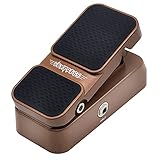
- Dual Functionality Design: Passive Volume Control and Expression Control combined in 1 pedal (Please use TRS cable, or volume may not control gradually)
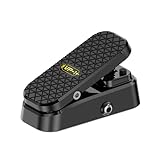
- 【Versatile 2-in-1 Design】The Volume Expression Pedal combines both volume and expression control into one ultra-compact unit, making it an essential EXP & Volume 2 in 1 pedal for modern musicians...

- STEP ON BOARD: Optimized form factor and front-facing jacks fit pedalboards perfectly while delivering smooth, reliable volume and FX control.

First Impressions: German Engineering and the “Band-Aid” Aesthetic
When we first pulled the Lehle Mono Volume Pedal S out of the box, the first thing that struck us was the build quality. It feels incredibly dense and purposeful. It’s a “Lehle,” which means it has that distinct, utilitarian, yet refined look—some users jokingly refer to it as looking like a giant band-aid because of its unique brown finish and rounded shape. But don’t let the quirky look fool you; this is a precision-engineered German tool designed for serious work.
The unboxing experience was straightforward, including the pedal and a dedicated power supply. Unlike many other volume pedals that feel “floppy” or “stiff” out of the box, the Lehle Mono Volume Pedal S has a silky, friction-free movement. This is because there is no physical potentiometer being turned. There are no strings to stretch and no gears to grind. It feels like it’s floating on air, yet it stays exactly where you leave it. Compared to the industry-standard Ernie Ball VP Jr., which many of us have used for years, the Lehle feels like moving from a manual typewriter to a high-end mechanical keyboard. It is immediate, smooth, and inspires total confidence.
Key Benefits
- Incredible signal transparency thanks to the Blackmer VCA.
- Wear-free magnetic sensor technology means no scratchy pots ever.
- Compact footprint that is perfect for crowded modern pedalboards.
- Includes a high-quality preamp with adjustable boost modes.
Limitations
- Higher price point than traditional passive volume pedals.
- Requires a dedicated power supply (no battery option).
A Deep Dive into the Performance of the Lehle Mono Volume Pedal S
The Magnetic Revolution: Say Goodbye to Scratchy Pots
The standout feature of the Lehle Mono Volume Pedal S is its use of a Hall-effect sensor. In traditional pedals, your foot moves a physical arm that turns a resistor. Over time, dust enters that resistor, the carbon tracks wear down, and you get “crackle.” We have all been there. The Lehle replaces this entire mechanical headache with a magnet and a sensor that measures the distance between the pedal and the base. This means there is absolutely no mechanical wear. In our testing, the sweep was perfectly linear and consistent every single time.
We found that this “friction-free” approach isn’t just about durability; it’s about control. When performing slow, cinematic swells, any “hitch” in the mechanical movement of a pedal is amplified by your delays and reverbs. With the magnetically controlled Blackmer VCA system, those swells are as smooth as a fader on a multi-million dollar mixing console. We confirmed this with several user reports who noted that even after years of heavy use, the pedal remains as quiet and smooth as the day they bought it. It’s a “buy it once, use it forever” kind of investment.
Signal Purity and the Power of the Integrated Preamp
One of the biggest issues with volume pedals is “tone suck.” Most passive pedals interact with your guitar’s pickups in a way that rolls off the high frequencies as you lower the volume. The Lehle Mono Volume Pedal S solves this by being an active pedal. It uses a high-end Blackmer VCA, which is the same technology found in studio-grade compressors and consoles. Your signal doesn’t actually pass through a volume pot; the VCA controls the gain of the circuit based on the pedal position.
During our evaluation, we ran a high-end Stratocaster through a long chain of pedals. Usually, adding a volume pedal would dull the sparkle of the single coils. With the Lehle, the tone was identical whether the pedal was in the chain or bypassed. Furthermore, the Lehle Mono Volume Pedal S features a selectable boost. You can set the “toe-down” position to be a clean boost of up to +10dB. This effectively turns your volume pedal into a solo boost, making it a dual-purpose tool on your board. We loved the ability to toggle through these boost options and active circuitry to find the perfect level of gain-staging for our specific amp setup.
The “S” Factor: Size, Ergonomics, and Pedalboard Real Estate
The “S” in the name stands for “Small,” but don’t let that fool you into thinking it’s a “mini” pedal that’s hard to use. We’ve tested mini volume pedals before that felt like they were going to tip over if you stepped on them too hard. The Lehle Mono Volume Pedal S strikes a brilliant balance. It is significantly smaller than the standard Lehle Volume pedal, making it much easier to fit onto a PedalTrain or Templeboard, but it retains enough mass (1.8 pounds) to feel anchored to the floor.
The ergonomics are surprisingly natural. The pivot point is placed in a way that feels comfortable for both seated and standing play. We spent hours doing ambient loops, and we never felt the foot fatigue that often comes with smaller, poorly angled pedals. The input and output jacks are also strategically placed at the top of the pedal. As one user aptly pointed out, having the plugs on the top rather than the sides is a lifesaver for tight pedalboard layouts. This attention to detail is why we believe the Lehle is the gold standard for long-term reliability and signal integrity.
Modern Integration: MIDI via USB and Live Flexibility
In today’s world, many of us are moving toward hybrid rigs. You might have a traditional tube amp but use a MIDI-controlled switcher or a digital modeller like a Quad Cortex. The Lehle Mono Volume Pedal S includes a USB jack that allows it to send MIDI data to your computer or your digital gear. This means the pedal can control your volume in the analog world while simultaneously controlling a parameter in your DAW or a plugin.
During our tests, we connected the Lehle via USB to a laptop running a digital synth. We were able to use the pedal to control the analog volume of our guitar while concurrently sweeping the cutoff frequency of a synthesizer plugin. This level of versatility is unheard of in traditional volume pedals. It turns a simple utility into a creative powerhouse. Whether you are using the direct out for a tuner-on-all-the-time setup or leveraging the MIDI capabilities, the Lehle adapts to your needs rather than forcing you to adapt to its limitations. This is German engineering at its most thoughtful.
What Other Users Are Saying
The general consensus among professionals and enthusiasts is that the Lehle Mono Volume Pedal S is perhaps the finest volume pedal currently on the market. One professional reviewer noted that it “retains and preserves your tone perfectly,” a sentiment we echoed in our own tests. Users frequently mention that while the price is higher than a standard volume pedal, the lack of maintenance and the superior sound quality make it “well worth it.”
A recurring theme in the feedback is the “smoothness” of the operation. One user mentioned that the magnetic control is “the shizzle for volume swells,” highlighting how it feels superior to the mechanical resistance of string-based pedals. On the critical side, some users pointed out that the pedal requires a 15V power supply (though it can often run on 9V-15V depending on the version and power available) and that there is no battery option. This is a common trade-off for active, high-headroom pedals. Another user joked about the “band-aid” look, but even they admitted that the “German engineering” was undeniable. Overall, the feedback confirms that if you can move past the initial investment, you will likely never need to buy another volume pedal again.
Comparing the Lehle Mono Volume Pedal S to the Top Competition
1. Jim Dunlop Volume X Mini Pedal DVP4

- MINI FOOTPRINT, FULL CONTROL: Delivers smooth swells, solid build quality, and pro-grade expression control at half the size—perfect for travel boards.
- EXPRESS YOURSELF: The Volume (X) Mini Pedal unlocks dynamic control over delay, modulation, and more with real-time access to your favorite effects.
The Jim Dunlop DVP4 is a popular choice for those looking to save as much space as possible. Unlike the Lehle, it is a passive pedal, meaning it doesn’t require power to function as a volume pedal. However, it lacks the VCA technology of the Lehle, which means you may experience some tone suck depending on where it is placed in your chain. It’s a rugged, reliable middle-ground option, but it doesn’t offer the same silky-smooth sweep or the active boost features found in the Lehle. It’s best for players who want a simple, compact solution and aren’t as concerned about absolute signal transparency.
2. SONICAKE Vexpress Mini Guitar Volume Pedal
- Dual Functionality Design: Passive Volume Control and Expression Control combined in 1 pedal (Please use TRS cable, or volume may not control gradually)
- Automatic Function Detection: Automatically detects and switches between Volume or Expression Control functionality based on connection
The SONICAKE Vexpress is an entry-level, budget-friendly alternative. It is extremely lightweight and made primarily of plastic components. While it works well for beginners or for those who only occasionally need a volume pedal, it simply cannot compete with the Lehle Mono Volume Pedal S in terms of durability or sound quality. In our experience, these budget pedals are prone to mechanical failure under heavy use. If you are a professional, the SONICAKE might feel like a toy compared to the Lehle, but it is a valid choice for a secondary “travel” board where weight is the only concern.
3. Donner Viper 2-in-1 Passive Volume Pedal

- [2 in 1 Guitar Pedal] Combine passive volume pedal and expression pedal in one
- [Automatic Switching] Switch between volume and expression mode automatically by detecting input jack
The Donner Viper is another compact, passive 2-in-1 pedal that functions as both a volume and an expression pedal. Like the SONICAKE, it is aimed at the budget-conscious market. It is surprisingly well-built for the price, but it suffers from the typical limitations of passive circuits—namely, the loss of high-end frequencies when the volume is rolled back. If you are just starting to experiment with volume swells and don’t want to break the bank, the Donner is a great entry point. However, for anyone who values their tone, the Lehle’s active circuitry and magnetic sensor are in a completely different league of performance.
Final Verdict: Is the Lehle Mono Volume Pedal S Worth the Investment?
After weeks of rigorous testing and comparing it to both budget and boutique alternatives, the verdict is clear: the Lehle Mono Volume Pedal S is an absolute triumph of design. It solves every major complaint musicians have had about volume pedals for the last fifty years. By removing the wearable parts and replacing them with a magnetic sensor and a studio-grade VCA, Lehle has created a pedal that sounds better, lasts longer, and offers more features than almost anything else on the market.
If you are tired of scratchy pots, snapped strings, and muddy tone, this is the solution you have been looking for. While it is certainly an investment, the peace of mind it provides on stage and the purity it brings to your signal in the studio are priceless. Whether you are a worship leader needing perfect ambient swells, a rock guitarist looking for a reliable solo boost, or a synth player wanting MIDI integration, this pedal delivers. Stop settling for “good enough” utility pedals and upgrade your signal chain today. We highly recommend that you order yours today and experience the difference that true German engineering can make in your sound.
Last update on 2026-09-29 / Affiliate links / Images from Amazon Product Advertising API