
Vandoren SRMIXT2 Tenor Sax Reed Mix Card Review: The Ultimate Jazz Cut Sampler for Tenor Saxophonists
Every tenor saxophonist eventually hits a frustrating acoustic wall. You pick up your horn, assemble your mouthpiece, slip on a reed, and push air through the tube, only to find that your tone sounds muffled, resistant, or entirely lacking in personality. Early in our playing journeys, many of us default to whatever basic reed came bundled with our student instrument or standard classical setup. However, as your musical ears develop and you begin diving into jazz, funk, or pop solos, you quickly realize that a standard traditional reed often feels like trying to run a race in heavy boots. Finding the ideal match between your mouthpiece, embouchure, and musical genre can transform your playability overnight. Yet, dropping a substantial amount of money on full boxes of four different reed models just to discover which geometry suits your embouchure is an expensive gamble. That is precisely why we decided to put the Vandoren SRMIXT2 Tenor Sax Reed Mix Card through a rigorous hands-on evaluation to see if this variety sampler truly solves the tonal puzzle for gigging players and aspiring jazz musicians alike.
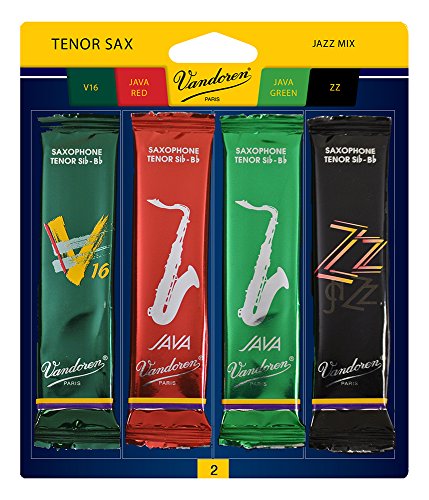
- Economical way to try out all four jazz style reeds
- Also available in other strengths

What to Consider Before Buying Tenor Saxophone Reeds and Acoustic Accessories
Selecting the ideal reed cut is one of the most cost-effective ways to fundamentally alter your sound, response, and dynamic range. Woodwind acoustic accessories are far more than mere consumable items; they represent the primary heart of sound generation on your instrument. The vibration of the cane against the lay of your mouthpiece dictates everything from low-register subtones to screaming high-note altissimo. When considering a specialized sampler pack like the Vandoren SRMIXT2 Tenor Sax Reed Mix Card, it is essential to understand how reed cut geometry interacts with your mouthpiece tip opening and personal blowing style.
The ideal candidate for this jazz reed sampler is a tenor saxophonist looking to expand their tonal palette, transition from classical classical cuts into modern jazz styles, or find the perfect pairing for a newly acquired mouthpiece. It is particularly beneficial for intermediate students in school jazz bands, seasoned players returning to the horn after years away, or active gigging musicians seeking specific tonal characteristics for different acoustic environments. Conversely, players who already have a dedicated, meticulously crafted reed customization routine—or those who require ultra-heavy strengths (such as strength 3.5 or higher)—might find a strength 2 variety card too soft for wide-open custom mouthpieces.
Before investing in new saxophone reeds, consider these crucial points in detail:
- Tip Thickness & Heart Thickness (Dimensions & Profile): The relationship between a reed’s tip thickness and its central heart determines both response speed and resistance. Jazz cuts generally feature a more flexible tip for fast articulation paired with a thicker or distinct heart profile to sustain harmonic richness and dynamic projection.
- Cane Cut Geometry (Unfiled vs. Filed): Unfiled (American cut) reeds feature a smooth, unbroken heel-to-vamp transition that provides a punchy, darker, or more direct sound center. Filed (French cut) reeds have a straight line scraped across the vamp, yielding greater flexibility, quicker response, and a brighter overtone series.
- Materials & Manufacturing Consistency: High-grade wild cane (Arundo donax) harvested with proper aging cycles ensures stable fiber density. Look for precise computer-controlled laser cutting and individual environmental sealing to guarantee that every reed out of the box responds reliably without warping.
- Ease of Use, Break-In & Moisture Maintenance: Fresh cane requires gradual break-in and proper wetting. Reeds sealed individually at factory humidity remain stable longer in storage, reducing the frustrating dynamic where half a box feels unplayable upon arrival.
While selecting the right reed profile is foundational for air response, your ligature also plays an essential supporting role in how freely that cane vibrates against the mouthpiece table. Before we dive into our detailed testing of each individual cut in this pack, if you are also exploring how different mounting hardware affects your instrument’s ring and pitch center, we encourage you to explore our comprehensive guide on horn setups.
While the Vandoren SRMIXT2 Tenor Sax Reed Mix Card is an excellent choice for dialing in your reed preference, it’s always wise to see how your entire setup stacks up against top-tier gear. For a broader look at complementary acoustic accessories, we highly recommend checking out our complete, in-depth guide:
Discover Our Top Tested Saxophone Ligatures and Acoustic Accessories Guide

- The metal buckle of sax mouthpiece ligature can quick and precise to fasten mouthpiece, Great protection for your mouthpiece


- DARK LIGATURE. Great for players seeking an easy-to-use, multi-genre ligature. This is considered the "go-to" ligature for music educators.
First Impressions and Key Features of the Vandoren SRMIXT2 Tenor Sax Reed Mix Card
When our sample of the Vandoren SRMIXT2 Tenor Sax Reed Mix Card arrived at our testing studio, our initial reaction was one of complete appreciation for the thoughtful packaging. Instead of tossing four bare reeds loose into a cardboard sleeve, Vandoren presents this set mounted on an informative blister card. Each individual reed is encased in its own proprietary “Flow Pack” atmosphere-controlled wrapper, which protects the natural cane fibers from atmospheric shifts, dryness, or humidity spikes during transit and storage. You can check the latest price and availability for this convenience pack across online retailers.
Flipping the mix card over reveals a clearly printed reed comparison matrix. This chart provides an immediate, intuitive breakdown of where each of the four included strength 2 cuts—the JAVA (Green), JAVA Red (Filed), ZZ, and V16—fall on the spectrum of brightness, flexibility, and resistance. Sliding the reeds out of their protective Flow Packs, we observed immaculate heel cuts, smooth rails, pristine tips, and gorgeous polished cane surfaces. Holding them up to light revealed remarkably uniform fiber grain across all four distinct cuts.
What We Like (Pros)
- Offers 4 distinct iconic jazz reed cuts in a single budget-friendly package.
- Individually sealed in Flow Packs to ensure factory-fresh moisture control.
- Includes an easy-to-read comparison chart to analyze cut characteristics.
- Eliminates the financial risk of purchasing four full boxes to sample tones.
What We Didn’t Like (Cons)
- Contains only one reed per cut, leaving no allowance for natural cane variation.
- Strength 2 may feel slightly soft for players using extra-wide metal mouthpiece openings.
In-Depth Performance Evaluation: Testing the Four Jazz Cuts
To conduct a rigorous, real-world evaluation of the Vandoren SRMIXT2 Tenor Sax Reed Mix Card, we tested all four reeds using two distinct mouthpiece setups: a standard hard rubber Meyer 6M for a versatile vintage vibe, and a modern metal Otto Link Super Tone Master 7* for maximum projection. Each reed was soaked properly, gently rubbed down, and played across extended practice sessions covering jazz standards, fast bebop lines, altissimo runs, and soft ballad subtones.
1. Individually Sealed Flow Packs: Preserving Cane Integrity
The immediate physical benefit of the Vandoren SRMIXT2 Tenor Sax Reed Mix Card lies in its individual packaging execution. Raw cane is notoriously sensitive to climate fluctuations. Reeds shipped in unsealed boxes often arrive brittle, warped, or unevenly dried depending on seasonal transit conditions. Vandoren’s Flow Pack system preserves optimal factory humidity inside each foil pouch. When we popped open the seal on each of the four reeds, the cane smelled fresh and felt pliable immediately upon moistening.
During our play testing, we noticed that this environmental consistency allowed all four reeds to reach optimal playing condition in less than two minutes of prep time. For players who want to jump straight into a practice session without spending twenty minutes reworking or flattening cane tables, you can see its full feature set and user reviews to understand why this factory sealing makes such a massive difference out of the box.
2. JAVA Original (Green) vs. JAVA Red: Bright Edge Meets Flexible Warmth
The core of this sampler card pits two legendary iterations of the JAVA line against each other: the original unfiled JAVA Green and the filed JAVA Red. In our play tests on the tenor horn, the original unfiled JAVA Green demonstrated a thick tip coupled with a flexible heart, resulting in immediate acoustic punch. The attack was crisp and snappy, producing a bright, cutting sound profile with abundant high-frequency overtones. It cut through heavy bass and drum grooves effortlessly, making it an ideal choice for funk, R&B, and loud big band lead tenor parts.
Switching over to the JAVA Red (the first filed reed in Vandoren’s jazz family), the acoustic personality shifted noticeably. Because it features a filed cut (a scrape removing outer bark across the vamp shoulder), the JAVA Red offers a more pliable heart and slightly less resistance at the tip. We found the sound center to be rounder, warmer, and significantly fuller in the low register from low C down to low Bb. Subtoning on ballads felt smooth and effortless, yet when pushed with higher air velocity, the reed yielded a gorgeous, velvety sizzle without going thin or nasal. The subtle differences between these two models alone highlight why the Vandoren SRMIXT2 Tenor Sax Reed Mix Card is an invaluable learning tool for tone shaping.
3. The ZZ and V16 Cuts: Vintage Character Meets Punchy Modern Projection
The remaining two cuts on the card—the ZZ and the V16—target distinctly different jazz tonal aesthetics. The ZZ cut was engineered by Vandoren to combine the fast tip response of the JAVA with the heart profile of the traditional cut. When we strapped the strength 2 ZZ onto our hard rubber mouthpiece, we instantly noticed its unique balance: it spoke with incredible speed during staccato passages, yet maintained a deep, rich resonance in the middle register. Pitch stability across octave leaps was rock solid, giving us immediate confidence when jumping from middle D up to high F#.
The V16 cut, by contrast, brings a thicker heart and a medium-thick tip geometry modeled after the classic jazz horn sounds of the 1950s and 60s. On our metal tenor mouthpiece, the V16 provided slightly more resistance than the JAVA Red or ZZ, giving our air stream something substantial to push against. The sonic result was a dark, broad, muscle-bound tone with rich sub-harmonics and incredible center projection. If you prefer a full-bodied, smoky jazz club tone that doesn’t sound overly bright or modern, the V16 cut included in this pack is an absolute standout performer.
4. Articulation, Intonation, and Playability Across the Saxophone Registers
Beyond individual tonal colors, a reed must perform reliably across technical demands. We evaluated all four reeds for consistency in articulation, dynamic range, and pitch accuracy. In terms of strength, all four reeds in this strength 2 card felt true to grade, though the V16 felt slightly firmer due to its heart design, while the JAVA Red felt the softest and most forgiving under the lip.
Low register entry (low C, B, and Bb) was exceptionally clean across the board, with minimal fluttering or key resistance. High-register palm keys remained stable and rich, avoiding the pinched, thin pitch tendencies that often plague inferior reed cuts. For intermediate players looking to bridge the gap between flat, muffled factory performance and professional dynamic expression, grabbing the Vandoren SRMIXT2 Tenor Sax Reed Mix Card offers a direct upgrade path that instantly opens up the horn’s natural acoustics.
What Real Saxophonists Are Saying
Feedback from the sax community strongly mirrors our own expert findings. Players across various skill levels praise the sampler concept as one of the smartest product offerings available for woodwind musicians. A returning player who picked up the saxophone after twenty years of military service shared that their tenor sax sounded muffled with standard stock reeds; after switching to this mix card, they noted, “With little to no effort I started…” producing vibrant tones, singling out the JAVA Red and ZZ cuts as absolute game-changers for their setup.
Another experienced player with over twelve years of performance history called their testing experience “a very pleasurable 4 hour practice session out of which came my two new favorite reeds,” highlighting how useful the card is for branching out beyond traditional classical cuts. Furthermore, music parents frequently noted that their student players in middle and high school jazz bands specifically requested re-orders of this pack after discovering which cut helped them project in ensemble settings.
On the critical side, feedback remains minimal and mostly centers around personal preference. A small minority of players who favor ultra-traditional, highly resistant classical reeds felt these jazz cuts were too free-blowing for their specific classical mouthpieces, with one user noting they preferred going back to traditional La Voz reeds. However, as another reviewer wisely summarized, “This is a terrific marketing idea from Vandoren. For a very reasonable price, you get to try out four of their quality reeds.” The consensus is clear: while individual cut taste is subjective, the value and discovery process provided by the sampler card is universally praised.
Comparing the Vandoren SRMIXT2 Mix Card to Top Gear Alternatives
To give you a comprehensive overview of how upgrading your acoustic rig fits into your overall horn setup, we compared this reed sampler against top-tier hardware accessories. Modern saxophonists know that sound production involves an interconnected chain: reed vibration, ligature pressure, and mouthpiece geometry. Below, we examine three popular acoustic accessories and how they interact with your tenor setup.
1. Vandoren LC07P Alto Sax Ligature

- Quick and precise tightening
- Expression with freedom
While the mix card under review focuses specifically on tenor sax reeds, players who also double on alto saxophone often seek the same level of precise acoustic response. The Vandoren LC07P Optimum Ligature features gilded finish construction and comes with three interchangeable pressure plates. Unlike standard metal hoops that press unevenly on the cane, the LC07P holds the reed with perfectly symmetrical vertical pressure. If you are pairing high-performance jazz reeds on alto, this ligature offers remarkable control over articulation and reed freedom. You can easily check current pricing for top saxophone accessories to complete your horn setup.
2. Rovner LGX Ligature for Tenor Sax

- LGX LIGATURE. Perfect for players who push the envelope of dynamics and expression. Superb for jazz, rock, marching, and military band players.
- INCREDIBLE CUT AND PROJECTION. Superior articulation and increased facility. Competes with amplified instruments even when played acoustically.
For tenor players utilizing slim metal mouthpieces (such as Otto Link or Berg Larsen metal models), the Rovner LGX-2M Next Generation Ligature offers a modern alternative to traditional metal caps. Engineered specifically for metal tenor mouthpieces, the LGX utilizes fabric mass to damp harsh upper partials while allowing the reed tip to flex freely. When paired with brighter reed cuts from the Vandoren SRMIXT2 Tenor Sax Reed Mix Card (like the JAVA Green), the Rovner LGX helps warm up the tone and eliminate unwanted buzz, making it a favorite for contemporary jazz and rock tenor players seeking a fat, rounded core sound.
3. Rovner Alto Sax Ligature
- MKIII LIGATURE. Often selected by concert band/orchestra players but is great for a variety of genres and play settings.
- DARK, WARM AND HEFTY TONE. Similar to the Dark, but responds with a heftier tone. A premium ligature that gives greater weight and tonal substance than either the Light or Dark
The Rovner MKIII C-1RL standard ligature is a classic dark-sounding choice for hard rubber mouthpieces across both alto and tenor setups. Made from durable neoprene-impregnated material, this ligature delivers a full, centered sound with smooth resistance. For players who find certain jazz reeds a bit too bright or lively, combining a free-blowing reed like the JAVA Red with a Rovner MKIII ligature provides ideal acoustic dampening, creating a gorgeous vintage jazz tone that is mellow, dark, and exceptionally warm in ballad settings.
Final Verdict: Is the Vandoren SRMIXT2 Tenor Sax Reed Mix Card Worth It?
After thorough hands-on testing, technical evaluation, and analysis of community feedback, we give the Vandoren SRMIXT2 Tenor Sax Reed Mix Card an enthusiastic endorsement. Vandoren has created a practical, affordable, and incredibly effective solution to one of the most common dilemmas faced by saxophonists: finding the right reed cut without spending a fortune on full boxes. The inclusion of four distinctly crafted jazz profiles—JAVA Green, JAVA Red, ZZ, and V16—in factory-fresh Flow Packs allows players to directly compare brightness, resistance, and response side-by-side on their own horn.
Whether you are a student joining your first jazz ensemble, a returning adult player breathing new life into an old tenor horn, or an experienced gigging musician fine-tuning a new mouthpiece pairing, this sampler card delivers incredible practical value. It takes the guesswork out of gear selection and gives you immediate clarity on which cane profile matches your embouchure. Don’t let a muffled, unresponsive reed hold back your musical expression any longer. We highly encourage you to order your Vandoren SRMIXT2 Tenor Sax Reed Mix Card today and unlock your saxophone’s true acoustic potential!
Last update on 2026-09-26 / Affiliate links / Images from Amazon Product Advertising API