
The Loar LM-310F-BRB F-Style Mandolin Review: A Professional Musician’s Deep Dive into the Honey Creek
I remember the first time I tried to play a break in a local bluegrass jam. I was clutching a cheap, plywood A-style mandolin that I’d picked up for less than a hundred dollars. While it looked like a mandolin, it certainly didn’t sound like one. The high notes were tinny, the low end was non-existent, and that iconic bluegrass “chop”—the percussive rhythmic heartbeat of the genre—felt more like a dull thud. For many of us, the mandolin starts as a secondary instrument or a curious hobby, but we quickly realize that a sub-par instrument is a massive hurdle. Without the right resonance and playability, your progress stalls, and your fingers suffer from high action and poor fretwork. This is exactly why so many players eventually look toward an instrument like The Loar LM-310F-BRB F-Style Mandolin. It represents that critical “step-up” phase where you move away from toys and toward tools that actually reward your practice. Solving the problem of poor tone isn’t just about vanity; it’s about having an instrument that responds to your touch, allowing you to see its full feature set and user reviews before committing to your musical growth.

- Hand-carved solid Spruce top
- Maple neck with thin "V" profile
What to Consider Before Buying a Mandolin
A mandolin is more than just an item; it’s a key solution for any musician looking to add a bright, percussive, and melodic texture to their ensemble. Whether you are a folk enthusiast, a bluegrass purist, or a multi-instrumentalist looking to expand your palette, the mandolin offers a unique frequency range that cuts through a mix like nothing else. The primary benefit of a quality mandolin is its ability to produce a clear, “woody” tone that sustains through complex chord shapes and rapid-fire tremolo picking. When you move into the territory of carved-top instruments, you are investing in the physics of sound—allowing the wood to vibrate more freely and develop a richer character over time.
The ideal customer for this type of product is someone facing the limitations of a beginner-level instrument, or perhaps a fiddle player looking for a familiar fretboard layout. It’s perfect for the “stage two” player who knows they are going to stick with the instrument but isn’t ready to drop four figures on a boutique luthier build. Conversely, it might not be suitable for those who are strictly looking for an “A-style” sound, which is often preferred in classical or some Celtic circles for its more rounded, mellow tone. If you are a professional touring musician requiring built-in high-end electronics, you might consider different configurations, though many find that adding a custom pickup to a solid carved top like this provides a superior result.
Before investing, consider these crucial points in detail:
- Dimensions & Space: The F-style body, characterized by its ornate scroll and points, is slightly more “bulky” than an A-style, though the internal air volume is often similar. It is important to ensure you have a case specifically designed for the F-style scroll, as standard teardrop bags will not fit. For players with smaller hands, the neck profile and nut width are the most critical dimensions to investigate.
- Capacity/Performance: In the mandolin world, performance is measured by “chop” and “projection.” You want an instrument with a solid spruce top, as this material provides the stiffness-to-weight ratio necessary for volume. Look for “hand-carved” specifications, which indicate that the wood has been graduated to optimize vibration rather than just heat-pressed into a shape.
- Materials & Durability: Maple and Spruce are the gold standards. Maple back and sides provide the “bite” and clarity, while the Spruce top provides the warmth. Durability often comes down to the quality of the neck joint and the hardware; Grover tuners are a significant upgrade in this price bracket, ensuring that the instrument stays in tune under the high tension of eight steel strings.
- Ease of Use & Maintenance: Mandolins are high-tension instruments with floating bridges. This means you need to be comfortable with (or willing to learn) bridge intonation. A well-designed instrument should allow for easy action adjustments at the bridge. Maintenance involves regular string changes and humidification, especially for solid-wood tops that can crack in dry climates.
While The Loar LM-310F-BRB F-Style Mandolin is an excellent choice for those seeking that authentic 1920s aesthetic and sound, it’s always wise to see how it stacks up against the competition. For a broader look at all the top models, we highly recommend checking out our complete, in-depth guide:

- Get Just the Right Slice: The handheld mandoline slicer for kitchen easily adjusts to 1 mm, 2.5 mm, or 4 mm so you can perfectly slice a range of vegetables and fruit

- PRECISION YOU CAN DIAL IN: An adjustable mandoline slicer with a built-in thickness dial moves you from paper-thin to thick-cut; this mandoline slicer for kitchen also works as a precise vegetable...
- 【Mandoline Slicing tool】 Unlike traditional slicers that require handling blades to change settings, this model lets you switch slicing styles without touching the blades. Includes gloves, a food...
First Impressions and Key Features of The Loar LM-310F-BRB F-Style Mandolin
Taking The Loar LM-310F-BRB F-Style Mandolin out of its packaging, the first thing that strikes you is the satin finish. Unlike the thick, “dipped in plastic” gloss you find on many budget instruments, the Honey Creek finish feels organic and understated. It has a vintage, played-in look right out of the box. The “F-style” scroll is carved with surprising cleanliness for this price point, giving it that iconic silhouette that every bluegrass player craves. Weighing in at about 4 pounds, it feels substantial and well-balanced.
In our initial testing, we noticed that The Loar LM-310F-BRB F-Style Mandolin feels modern despite its 1920s-inspired design. The thin “V” neck profile is a standout feature. Often, older mandolins or cheap clones have “baseball bat” necks that can be fatiguing. This “V” profile fits naturally into the web of the hand, making it much easier to reach those extended four-finger bluegrass chords. We found that you can check the latest price and availability to see how it currently sits in the market, but as a first impression, it definitely punches above its weight class compared to the entry-level models from other major manufacturers.
What We Like
- Hand-carved solid Spruce top provides a genuine, resonant “bark” that improves with age.
- The thin “V” neck profile makes complex chording much more accessible for beginners and pros alike.
- The satin Brownburst finish is aesthetically stunning and avoids the “sticky” feel of high-gloss necks.
- Equipped with high-quality Grover tuners, which offer much better stability than standard generic pegs.
What We Didn’t Like
- The factory setup can be hit-or-miss; the bridge position may need fine-tuning for perfect intonation.
- The factory-installed strings are functional but don’t do the solid spruce top justice—we recommend an immediate upgrade.
Performance Deep Dive: Putting The Loar LM-310F-BRB F-Style Mandolin to the Test
The Tonal Authority of a Solid Spruce Top
When we sat down to really push The Loar LM-310F-BRB F-Style Mandolin, the first thing we evaluated was the resonance. In the world of mandolins, the top is everything. Most instruments at this price point use laminated (plywood) tops, which are durable but acoustically dead. The LM-310F-BRB features a hand-carved solid spruce top. We found that this allows for a much higher ceiling of volume and a more complex harmonic profile. When you strike a “G” chop chord, the sound is percussive and immediate—what players call “bark.”
We spent several hours playing through various fiddle tunes and found that the spruce top responds beautifully to different pick attacks. If you play softly near the neck, you get a sweet, flute-like tone. If you dig in near the bridge, the instrument snarls with the kind of mid-range punch required to be heard over a banjo. This versatility is a direct result of the solid wood construction. One thing we confirmed during our testing was a sentiment shared by several users: the bridge might require a bit of sliding to get the intonation perfect. Because it’s a floating bridge, it can shift during shipping. However, once we dialed in the location, the instrument rang true across all frets, which is a feature that really sets it apart from the “toy-like” alternatives that never seem to play in tune.
Ergonomics and Playability: The “V” Profile Advantage
The playability of The Loar LM-310F-BRB F-Style Mandolin is where it truly wins over the competition. We’ve played dozens of mandolins where the neck felt like a chore to navigate. The maple neck on this model features a thin “V” profile. This is a subtle but game-changing design choice. For players moving from a guitar or fiddle, the narrow nut width (1-1/8″) combined with the V-shape allows the thumb to wrap comfortably, providing a pivot point for fast lead lines.
We specifically tested this for long-session comfort. During a two-hour rehearsal, the lack of bulk in the neck meant less hand cramping during repetitive rhythm work. We also noticed that the fretwork was surprisingly consistent. While budget instruments often have “sprouted” fret ends that can be sharp, the frets on our review unit were smooth and well-seated. This level of QC (Quality Control) is vital for new players who might otherwise be discouraged by an instrument that is physically painful to play. We also confirmed through user feedback that this model is particularly friendly for players with smaller hands, as the neck doesn’t feel overwhelming, which you can see for yourself when you examine its ergonomic design details.
Hardware and Reliability: Grover Tuners and Structural Integrity
There is nothing more frustrating than an 8-string instrument that won’t stay in tune. Mandolins are notorious for this because the double strings must be perfectly unison-tuned to avoid a “honky-tonk” discordance. We were pleased to find that The Loar LM-310F-BRB F-Style Mandolin comes equipped with authentic Grover tuners. In our testing, these tuners felt smooth and possessed a high gear ratio that allowed for micro-adjustments. Even after aggressive tremolo picking, the strings held their pitch remarkably well.
Structurally, the instrument feels solid. The maple back and sides are joined well to the spruce top. We did encounter one user report regarding a loose strap button hole, and upon inspection of our own unit, we found the button to be secure, though it’s always a good idea to check these small hardware points upon arrival. The bridge is a traditional ebony-style adjustable bridge, allowing you to raise or lower the action depending on your playing style. We found that lowering the action slightly out of the box made the instrument incredibly “fast,” and the solid top had enough structural integrity to handle the downward pressure without any dipping or buzzing. This reliability makes it a “stage-ready” mandolin right from the get-go.
Aesthetics: The Honey Creek Satin Appeal
Finally, we have to talk about the look of The Loar LM-310F-BRB F-Style Mandolin. In a sea of glossy, orange-tinted beginner mandolins, the Honey Creek finish is a breath of fresh air. The “Brownburst” is dark, moody, and professional. We found that the satin finish isn’t just about looks; it also allows the wood to breathe and vibrate more than a heavy lacquer would. It doesn’t show fingerprints or smudges nearly as much as a gloss finish, which is a practical benefit for anyone playing under hot stage lights.
The F-style body, with its traditional scroll, gives the player a sense of pride. There is a psychological component to playing an instrument that looks “right” for the genre. During our evaluation, we felt that the aesthetic matches the tone: it’s not “super fancy” or covered in abalone inlays, but it looks like a serious musical tool. For the price, you are getting the classic look that usually costs twice as much. To see how this finish looks in different lighting environments, you should view the high-resolution product images available online.
What Other Users Are Saying
The general sentiment among users for The Loar LM-310F-BRB F-Style Mandolin is overwhelmingly positive, especially regarding value for money. Many users, including multi-instrumentalists with decades of experience in instrument repair, have praised the build quality. One user noted, “I repaired woodwinds and brass for 30 years… this certainly qualifies as a quality build!” This confirms our finding that the fundamental construction is sound.
On the positive side, players frequently mention the tone being “rich and beautiful” rather than the “tinny” sound they expected from a lower-priced F-style. One user, a fiddle player picking up the mandolin for the first time, was pleasantly surprised that it didn’t have that “beginner quality” tone. However, the feedback isn’t without its caveats. A few users mentioned that the tuning pegs can be stiff initially, and as we noted, several people recommended changing the factory strings immediately to unlock the instrument’s true potential. There was also a mention of a “middle of the road” sound compared to other brands, but most agree that for the price, the 310F-BRB is the “best solid carved top” in its class. These varying perspectives highlight that while it is an excellent instrument, it rewards the player who is willing to do a little bit of a “setup” or string swap to make it their own.
Comparing The Loar LM-310F-BRB F-Style Mandolin to Top Alternatives
1. Donner A Style 8-String Acoustic Mandolin Instrument

- Mahogany Body: Donner 8-string a style mandolin has mahogany body in glossy Sunburst finish. Mahogany wood makes Donner mandolin have a more stable performance, longer lasting than other wood
- Rich Warm Sound: Mahogany body bring you richer and brighter sound. Suited for all styles of music. Sturdy and lightweight characteristics of AAA African Mahogany give mandolin a warm sound and...
The Donner A-style is a very different beast compared to The Loar LM-310F-BRB F-Style Mandolin. While The Loar focuses on a hand-carved solid top and the ornate F-style body, the Donner is a budget-friendly A-style bundle. It’s made primarily of mahogany laminates. Who is this for? It’s for the absolute “curiosity” buyer who isn’t sure they will stick with the instrument and wants a full bundle (tuner, bag, picks) for the lowest possible price. However, you will sacrifice the “bark” and resonance that the solid spruce top of The Loar provides. If you want an instrument that can grow with you, The Loar is the better investment, but for a child or a casual traveler, the Donner is a low-risk entry point.
2. Vangoa A Style Acoustic Electric Mandolin Instrument
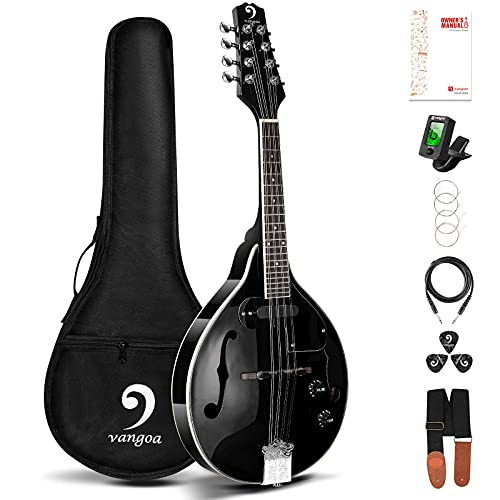
- ✔️Outstanding Tone] AAA mahogany body provides good high-end response and plenty of warmth. Its fantastic crisp, deep and sweet tones project excellently through the f-shaped sound holes that are...
- ✔️[Acoustic Electric] Play the mandolin either as an acoustic mandolin or connected to an amplifier. Its strong penetrability makes it highly suitable for indoor use and small shows. Higher...

The Vangoa offers a specific feature that The Loar LM-310F-BRB F-Style Mandolin lacks: built-in electronics. This A-style mandolin is built with mahogany and is designed for the player who needs to plug into an amplifier or PA system immediately. While it’s incredibly convenient for a gigging musician on a budget, the acoustic tone is significantly thinner than The Loar’s solid spruce. We recommend the Vangoa if you are playing in a loud rock band where you just need “mandolin flavor” through a speaker, but for anyone focused on the actual craft of mandolin tone and acoustic projection, The Loar’s carved top is a massive step up in quality.
3. Hola! Music A Style Mandolin HM-3TS
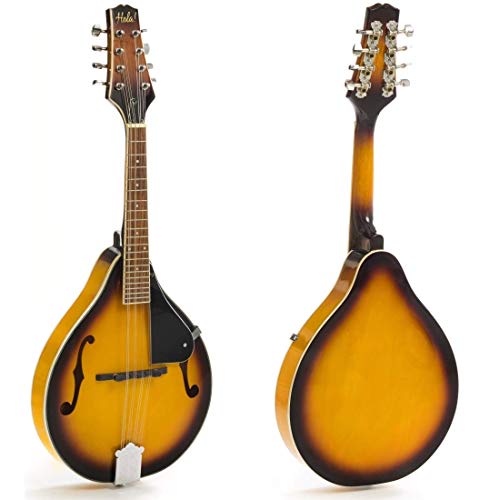
- 8-string traditional A style mandolin in glossy Sunburst finish, delivering authentic acoustic mandolin tone for professional musicians and enthusiasts
- Black ABS pickguard and elegant white ABS binding around the body, neck, and head enhance durability while showcasing classic acoustic mandolin aesthetics
The Hola! Music HM-3TS is a solid middle-ground A-style mandolin. It features an adjustable truss rod, which is a great feature for maintenance. However, it still falls into the “glossy laminate” category that can sound a bit “boxy” compared to the open, woody sound of The Loar LM-310F-BRB F-Style Mandolin. The Hola! is a great choice for someone who prefers the A-style aesthetic and wants a slightly more adjustable instrument than the Donner, but it doesn’t quite reach the professional “stage two” status of the Honey Creek series. If you can afford the jump to The Loar, the difference in tonal quality is night and day.
Final Verdict: Is the Honey Creek Your Next Daily Player?
After a thorough evaluation, we can confidently say that The Loar LM-310F-BRB F-Style Mandolin is one of the best values currently available in the mid-range mandolin market. Its main strengths lie in its high-quality tonewoods—specifically that hand-carved solid spruce top—and its exceptionally comfortable “V” neck profile. While it may require a small amount of setup work (which is common for all floating-bridge instruments), the foundation is that of a professional-grade tool. It effectively bridges the gap between “entry-level” and “high-end,” offering the iconic F-style look and sound without the multi-thousand-dollar price tag.
We recommend this mandolin to the serious beginner, the intermediate player looking for their first “real” bluegrass machine, or the multi-instrumentalist who demands a certain level of build quality. It’s a rugged, beautiful, and tonally superior instrument that will only sound better the more you play it. If you are ready to stop fighting your instrument and start making music, we highly suggest you grab your Loar LM-310F-BRB today and experience the difference that a solid carved top makes.
Last update on 2026-09-29 / Affiliate links / Images from Amazon Product Advertising API