
TC Electronic Nether Octaver Pedal Review: The Vintage Solution for Bottom-End Brutality
I have spent countless hours in the studio and on stage trying to solve a persistent problem: the “thin-sounding” solo. We have all been there. You kick on your favorite overdrive, step up for your moment in the spotlight, and suddenly the sound feels narrow and lacking in authority. This is the moment where many guitarists realize that traditional EQ and gain aren’t enough. You need physical weight; you need a second voice that anchors your sound to the floor. This is exactly why I started searching for a vintage-style octave pedal. Without a tool like the TC Electronic Nether Octaver Pedal, your leads can sound isolated and brittle, especially in a three-piece band where the sonic gap between the guitar and the bass can feel like a canyon. Solving this isn’t just about volume; it’s about filling the frequency spectrum. If you don’t address this, your high-gain riffs will lack the “gut-punch” factor, and your clean lines will miss that haunting, synth-like depth that defines so many classic records. To see if this pedal fits your specific rig needs, you can see its full feature set and user reviews before making a final decision.
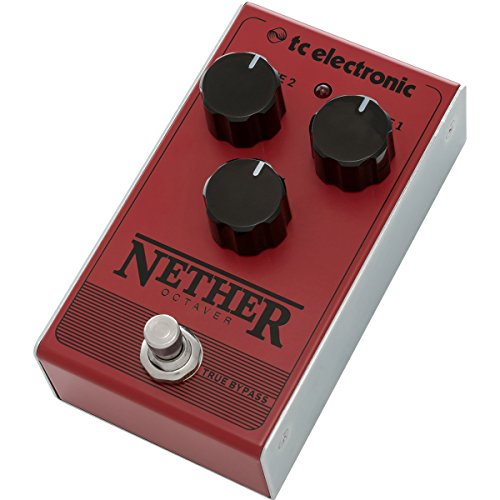
- Octave Effects Pedal with 2 Independent Octaves Dry Control
What to Consider Before Buying an Electric Guitar Pitch & Octave Effect
An Electric Guitar Pitch & Octave effect is more than just a creative toy; it’s a key solution for sonic expansion. These pedals work by analyzing your input signal and generating a new note that is exactly one or two octaves lower (or higher) than what you are playing. This allows a single guitarist to mimic the sound of a bass guitar, a Hammond organ, or a thick 70s-style synth. For those playing in bands with only one guitar player, an octave pedal is an essential tool for “faking” a rhythm section during a solo or adding massive weight to a main riff. It’s about transforming your instrument into something larger than life.
The ideal customer for this type of product is someone facing a lack of harmonic richness in their tone, particularly those who love vintage blues-rock, stoner rock, or experimental textures. It is perfect for players who want a “glitchy,” character-heavy sound that feels organic and analog. However, it might not be suitable for those who require crystal-clear polyphonic tracking (playing chords) or those who need a pristine, modern digital sound. If you are a session player needing perfect pitch-shifting for complex jazz chords, you might consider digital alternatives that specialize in polyphony. Before investing, consider these crucial points in detail:
- Dimensions & Space: Consider your pedalboard real estate carefully. While many modern pedals are shrinking to “mini” sizes, vintage-style units like the TC Electronic Nether Octaver Pedal often prioritize ease of use and physical stability. Ensure your board has a standard slot available with easy access to the top-mounted jacks, which can actually save side-to-side space in a tight setup.
- Capacity & Performance: Evaluate whether you need monophonic or polyphonic tracking. Monophonic pedals (like the Nether) track one note at a time and can “glitch” when chords are played, creating a unique lo-fi texture. Performance also depends on where the pedal sits in your chain; usually, it performs best at the very beginning of your signal path where the signal is cleanest.
- Materials & Durability: Look for an all-metal chassis. Since these pedals are meant to be stepped on in high-pressure situations, a plastic housing simply won’t last. The TC Electronic Nether Octaver Pedal features a heavy-duty “built like a tank” construction that is designed to withstand years of touring and stage abuse.
- Ease of Use & Maintenance: Maintenance for analog pedals is usually minimal, but you should consider the power requirements. Most run on a standard 9V DC power supply, but the ability to use a battery can be a lifesaver for quick jam sessions. Simple control layouts are also vital; you don’t want to be menu-diving during a soundcheck.
While the TC Electronic Nether Octaver Pedal is an excellent choice for those seeking that raw, analog grit, it’s always wise to see how it stacks up against the competition. For a broader look at all the top models, we highly recommend checking out our complete, in-depth guide:

- [Octave/Pitch shifter Pedal] With 7 shift types and 3 tone mode toggles, Harmonic Square guitar pedal gives you 21 options of semitonal, octave and detune sounds

- Industry-Standard Octave Pedal: The updated version features enhanced capabilities for modern guitarists


- Three shift modes: up, down or dual
First Impressions: Unboxing the TC Electronic Nether Octaver Pedal
When I first pulled the TC Electronic Nether Octaver Pedal out of its packaging, the first thing that struck me was the sheer weight of it. This isn’t one of those lightweight, flimsy pedals that slides around your floor. It feels like a solid block of vintage-inspired engineering. The deep red finish looks fantastic under stage lights, and the “Nether” graphic gives it a mysterious, underground aesthetic that fits its low-end purpose perfectly. The knobs have a satisfying resistance to them, allowing for precise adjustments without fear of accidentally bumping them into a new setting during a performance. You can check the latest price and availability here to see how it fits into your current budget.
Compared to market leaders like the classic Boss OC-2, the Nether feels more rugged. While the OC-2 is a legendary collector’s item, the TC Electronic Nether Octaver Pedal brings that same analog circuit philosophy into a modern, road-worthy housing with top-mounted jacks, which I personally find much more convenient for cable management. My initial impression was that TC Electronic wasn’t trying to reinvent the wheel; they were trying to perfect a classic, glitchy, monophonic octave sound for the modern player who doesn’t want to pay vintage collector prices.
Key Benefits
- Authentic all-analog circuit provides a warm, rich, and “earthy” sub-octave tone.
- Independent controls for Octave 1 and Octave 2 allow for massive, layered bass sounds.
- Top-mounted jacks make it incredibly easy to fit onto a crowded pedalboard.
- The “Dry” control allows you to blend your original signal perfectly for varied textures.
Limitations
- Monophonic tracking means it will struggle and glitch if you try to play chords.
- Larger footprint than “mini” pedals might require some rearrangement of your board.
A Deep Dive into the TC Electronic Nether Octaver Pedal’s Performance
The All-Analog Signal Path and Tonal Warmth
In a world increasingly dominated by digital modeling and DSP-heavy effects, the TC Electronic Nether Octaver Pedal stands out by sticking to its analog roots. We found that this all-analog design is the secret sauce behind its “warm and rich sound.” Digital octave pedals often have a clinical, almost “plastic” feel to the sub-octave. The Nether, however, produces a sub-octave that feels like it’s actually part of your guitar’s voice. When I engaged the Octave 1 knob, the low end felt velvety and thick, reminiscent of the classic tones used by Jimi Hendrix or Jimmy Page. It doesn’t just add a low note; it adds a character-rich growl that responds to the nuances of your playing. This analog nature is a feature that really sets it apart from the cheaper digital units on the market today.
The warmth is particularly noticeable when running the pedal into a slightly overdriven tube amp. While digital pedals can sometimes create harsh artifacts when they hit an overdriven preamp, the Nether’s signal remains musical. I spent several hours testing it with a variety of pickups—single coils and humbuckers—and the analog circuit managed to preserve the fundamental “DNA” of the guitar. It’s this organic quality that makes it so inspiring to play. It feels “alive” under your fingers, occasionally jumping or glitching in a way that feels like a vintage synthesizer rather than a computer error. This adds an element of unpredictability that can lead to some truly creative riff-writing.
Mastering the Dual Octave Layers
One of the most powerful features of the TC Electronic Nether Octaver Pedal is the inclusion of two independent octave controls. You have Octave 1 (one octave down) and Octave 2 (two octaves down). Most budget pedals only give you one sub-octave option, but having both allows you to create a “wall of sound.” When we dialed in a mix of both, the result was a “full-on bottom-end brutality” that could easily shake the walls of a rehearsal room. The Octave 2 control is incredibly deep—it’s a frequency range that you don’t just hear, you feel in your chest. When used sparingly, it adds a subtle “sub-woofer” effect to your guitar; when cranked, it transforms your instrument into a monophonic synth monster.
The independence of these controls is vital. I found that for fast, melodic leads, keeping Octave 1 at 12 o’clock and Octave 2 at zero kept the sound punchy and defined. However, for slow, doom-metal riffs or experimental soundscapes, bringing Octave 2 into the mix created a massive, cavernous sound that was incredibly satisfying. We found that the TC Electronic Nether Octaver Pedal handles these dual layers with surprising grace for an analog unit, provided you understand its monophonic limitations. It encourages you to play more deliberately, focusing on single notes to ensure the circuit can track the pitch accurately. It’s this specific control over the sub-frequencies that makes the TC Electronic Nether Octaver Pedal such a versatile tool for the studio.
The Art of the “Dry” Blend and Tracking Character
Any experienced pedal user knows that the “Dry” control is arguably the most important knob on an octave pedal. It determines how much of your original, unaffected guitar signal passes through to the output. Without a good dry control, your guitar can easily get lost in the sub-octave mud. We found the dry control on the TC Electronic Nether Octaver Pedal to be exceptionally well-tapered. You can dial in just a hint of sub-octave to add “girth” to a blues solo, or you can cut the dry signal entirely to achieve a pure, lo-fi bass sound. This latter setting is fantastic for recording bass lines on a guitar if you don’t have a bass player handy. The tracking has that classic “old-school” feel; it’s not perfectly instantaneous like a digital pedal, but that slight, microscopic hesitation is what gives analog octaves their unique “bounce.”
During our testing, we noticed that the tracking is most stable when playing above the 7th fret on the guitar. As you move lower on the neck, the pedal’s “brain” has to work harder to identify the low frequencies, leading to that characteristic “glitch” where the octave might jump between frequencies. While some might see this as a flaw, we see it as an essential part of the vintage experience. It sounds like an instrument from the 70s trying to find its way, and it’s beautiful for psych-rock and garage-rock styles. As one user noted, it is “Excelente para guitarra,” and we couldn’t agree more—it emphasizes the natural strengths of the electric guitar rather than trying to mask them with digital processing.
Rig Integration: Pedals, Amps, and Power
Setting up the TC Electronic Nether Octaver Pedal was a breeze. Because it utilizes a standard 9V center-negative power draw (and only uses 10mA), it won’t tax your power supply. In fact, its low amperage means it can run for ages on a 9V battery if you prefer a “grab and go” setup. We also appreciated the inclusion of True Bypass. This ensures that when the pedal is off, your signal remains completely pure and unaffected, which is crucial for maintaining the high-end sparkle of your guitar. The TC Electronic Nether Octaver Pedal integrates seamlessly into any chain, but we highly recommend placing it before your drive pedals. This allows the sub-octave to be distorted alongside your main signal, leading to a much more cohesive and aggressive tone.
The top-mounted jacks are another “quality of life” feature that we can’t praise enough. Many classic pedals have side jacks that force you to leave gaps between your effects. With the Nether, you can place your pedals side-by-side, maximizing your pedalboard space. This is a clear indication that TC Electronic designed this with the gigging musician in mind. Whether you’re playing through a small practice amp or a massive stack, the Nether provides a consistent, bass-heavy profile that can be tailored to any environment. It’s a workhorse pedal—plain and simple. It doesn’t need fancy screens or MIDI control to be effective; it just needs a guitarist who wants to play loud and low.
What Other Users Are Saying
The general sentiment surrounding the TC Electronic Nether Octaver Pedal is one of surprise at its value-to-performance ratio. Many guitarists who were initially looking for vintage Boss units have found that this pedal delivers the same “glitchy goodness” at a fraction of the price. The consensus is that it is a “must-have” for anyone playing stoner rock or classic heavy blues. One user specifically highlighted that it is “Excelente para guitarra,” emphasizing how well it tracks for lead lines and single-note riffs.
On the more critical side, some users who were expecting a modern, polyphonic “Drop Tune” style pedal were disappointed by its inability to handle chords. However, as we’ve discussed, this is a characteristic of the analog circuit, not a defect. It’s why many choose to order this pedal online specifically for its vintage character. Most negative feedback comes from a misunderstanding of what a monophonic analog octaver is designed to do. For those who understand its purpose, the feedback is overwhelmingly positive, citing its “build like a tank” durability and its “rich, synth-like textures” as high points.
Comparing the TC Electronic Nether Octaver Pedal to Its Top Alternatives
While the Nether is a standout for vintage tones, the market for pitch effects is diverse. Depending on your needs, one of these three alternatives might be a better fit for your specific rig.
1. DigiTech Whammy 5th Gen Pitch-shift Effect

- Classic Whammy Sound
- Chordal Whammyv-01 Pitch Shifting
The DigiTech Whammy 5th Gen is a legendary beast and a very different animal compared to the Nether. While the Nether is a compact, set-and-forget sub-octave pedal, the Whammy is a large expression-based pedal that allows for real-time pitch shifting, dive bombs, and harmony bends. It features polyphonic tracking, meaning you can shift entire chords without the glitches found in the TC Electronic Nether Octaver Pedal. If you are looking for Tom Morello-style squeals or need a wide range of pitch options (up and down), the Whammy is the clear winner. However, it takes up significantly more space and costs much more than the Nether. It’s for the experimentalist who needs total control over their pitch.
2. DigiTech DROP Compact Polyphonic Pitch-Shifter

- Polyphonic drop tune allows you to drop tune from 1 semi-tone to a full octave
- Momentary or latching mode footswitch
The DigiTech DROP is a specialized tool for guitarists who want to change their tuning on the fly without touching their tuning pegs. Unlike the Nether, which adds an octave to your existing signal, the DROP replaces your signal with a lower-tuned version. It is polyphonic and incredibly precise, with virtually no latency. This is the ideal alternative for a guitarist in a cover band who needs to play songs in E-standard, Eb, and Drop-C all in one set. It doesn’t have the “vintage glitch” or the “dry blend” character of the TC Electronic Nether Octaver Pedal, but it is a much better choice for pure utility and pitch-shifting accuracy.
3. Donner Octave Guitar Pedal Harmonic Square Mini Pitch Shifter
- [Octave/Pitch shifter Pedal] With 7 shift types and 3 tone mode toggles, Harmonic Square guitar pedal gives you 21 options of semitonal, octave and detune sounds
- [3 Tone Modes]: 3 tone modes including Sharp, Flat, and Detune; Sharp: Pitch up; Detune: Adjustable pitch signal shifted by 10 cents; Flat: Pitch down
The Donner Harmonic Square is the budget-conscious, ultra-compact alternative. This is a digital pedal, so it offers a wider variety of modes, including “Sharp,” “Flat,” and “Detune,” as well as 7 different shift types. It is significantly smaller than the Nether, making it perfect for “mini” boards. However, in our experience, the digital tone of the Donner lacks the warmth and “soul” of the analog TC Electronic Nether Octaver Pedal. While the Donner is incredibly versatile for its price, it can sound a bit sterile in comparison. This is for the player who wants to experiment with different pitch intervals on a very tight budget and board space.
Final Verdict: Is the TC Electronic Nether Octaver Pedal Right for You?
After an exhaustive evaluation, the TC Electronic Nether Octaver Pedal stands as one of the best “bang-for-your-buck” pedals on the market for fans of vintage tone. Its all-analog signal path provides a warmth and depth that digital pedals simply struggle to replicate. While its monophonic tracking might be a hurdle for some modern players, for those who crave the glitchy, synth-like sub-octaves of the 70s and 80s, it is a dream come true. It’s built like a tank, fits perfectly on modern boards thanks to top-mounted jacks, and offers two distinct sub-octave layers that can turn a thin guitar into a sonic powerhouse.
If you are looking for a clean, polyphonic pitch shifter to change your tuning or play complex chords, you may want to look at the DigiTech options. But if you want to add “bottom-end brutality” to your riffs and a “rich, earthy” character to your leads, I suggest you pick up the TC Electronic Nether Octaver Pedal today. It is a reliable, inspiring, and incredibly affordable tool that will fundamentally change the way you think about your low-end presence. Don’t let your tone sound thin for one more gig—bring the Nether into your rig and feel the weight of truly analog sub-octaves.
Last update on 2026-09-26 / Affiliate links / Images from Amazon Product Advertising API