
SAMTRONIC Power Vibration Speaker Review: A Game-Changer for Resonance and Creative Audio Setup
For DIY audio builders, sound designers, and creative musicians, achieving deep, rich audio in small spaces or unique custom enclosures is an ongoing battle. Standard compact speakers almost always sound thin and lacks the rich bass needed to bring audio to life. When you attempt to push a small driver past its mechanical limits, you are typically met with distortion, rattling, and a total loss of musical clarity. The core complication is simple: moving enough air to produce convincing low-end traditionally requires physical size—specifically, large speaker cones and bulky cabinets.
Without a massive footprint, most traditional transducers fall short, forcing creators to compromise on either sound quality or design aesthetics. This is exactly where resonance-based audio technology steps in. Instead of pushing air directly, a surface transducer transforms the actual furniture and structures around you into a massive speaker. By using a heavy-duty moving coil to vibrate flat panels, you can bypass the traditional size-to-bass ratio entirely. We decided to put this technology to the test to see if a compact unit could truly deliver on the promise of high-fidelity, bone-shaking low-end.
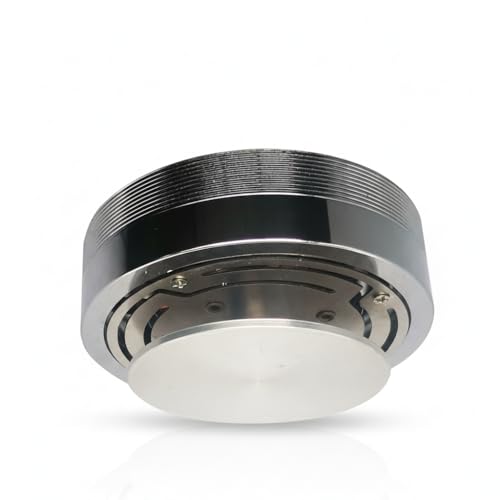
- Full Frequency Bass Performance: The horn delivers all frequency effect with very strong bass, equivalent to traditional loudspeaker 10 inch bass effect for powerful sound reproduction
- Innovative 360 Sound Transmission: Latest innovation breaks through traditional limitations with 360 degree frequency transmission for immersive audio experience
What to Look for in DIY Audio and Amplifier Transducers: A Comprehensive Buyer’s Guide
A transducer or specialty speaker driver is more than just an item; it’s a key solution for breaking free from the physical constraints of traditional speaker cabinets. For creative instrument amplifiers, experimental sound art, and specialized audio installations, a surface-vibrating driver acts as a direct mechanical bridge between digital signals and physical materials. Instead of restricting your sound to a manufactured box, these drivers utilize natural materials—such as wooden tabletops, acoustic panels, or custom soundboards—to amplify and color the output naturally.
The ideal customer for this type of product is an audio tinkerer, a custom cabinet builder, or a sound designer who wants to explore tactile bass and non-traditional acoustic setups. It is perfect for those who require a compact footprint but demand powerful low-end resonance. Conversely, it might not be suitable for those who want a simple, plug-and-play speaker that does not require external amplification, custom mounting, or careful placement. If you simply want to stream music from your phone without any DIY setup, a standard portable Bluetooth speaker is likely a better choice.
Before investing, consider these crucial points in detail:
- Dimensions & Space: Physical footprints are incredibly important when designing custom speaker cabinets or hiding audio gear inside furniture. You need to ensure the transducer has a profile that allows for secure, low-profile mounting. A compact depth makes it easier to mount internally inside tight spots, but it must still have enough physical weight to transfer mechanical energy efficiently.
- Capacity/Performance: Always verify the rated power and impedance of your driver. A higher-wattage rating ensures the speaker can handle dynamic peaks without burning out the voice coil. Ensure your choice matches your amplifier’s capabilities; matching a 4 Ohm driver with a compatible amplifier channel is crucial for maximizing thermal efficiency and overall volume.
- Materials & Durability: Look for high-grade metal construction, such as solid aluminum or iron casings. Because resonance drivers operate by violently shaking against hard materials, cheap plastic frames will quickly crack or rattle. A non-paper diaphragm is also essential for longevity, as it prevents humidity and atmospheric changes from warping the speaker’s internal geometry.
- Ease of Use & Maintenance: Consider how the transducer mounts to various surfaces. Some options require direct screw mounting, while others rely on adhesive pads or suspension brackets. Long-term care involves checking these connections periodically, as continuous low-frequency vibrations can loosen mounting screws or wear down adhesives over time.
Transitioning from standard guitar speakers to creative, tactile transducers opens up a massive world of acoustic possibilities. While the SAMTRONIC Power Vibration Speaker is an excellent choice, it’s always wise to see how it stacks up against the competition. For a broader look at all the top models, we highly recommend checking out our complete, in-depth guide:
Our Comprehensive Guide to the Best 12-Inch Guitar Speakers for Tone Seekers

- The World’s best-selling premium guitar speaker
- Low In Output But With The Weighty Low End Balance Of A 12", The G10 Greenback Features A Complex, Creamy Mid Range And Smooth, Vintage Top End.

- The G12M Greenback is the original Celestion ceramic magnet guitar speaker
Unboxing the SAMTRONIC Power Vibration Speaker: First Impressions and Technical Overview
Unboxing the SAMTRONIC Power Vibration Speaker immediately reveals its heavy-duty build quality. Weighing in with a solid, metallic heft, this is not a cheap plastic novelty. The frame is constructed from a combination of aluminum and iron, giving it the rugged feel of professional audio gear. Measuring roughly 75mm by 40mm, it fits easily in the palm of your hand, yet it feels dense and highly durable. You can see its full feature set and user reviews online to appreciate the high-quality industrial design that SAMTRONIC has utilized here.
The non-paper diaphragm is a standout feature, designed to handle extreme excursions without creating internal standing waves. This technical choice keeps vocals and mid-range frequencies clean, even when the heavy internal moving coil is working hard to pump out low-end notes. Overall, our first impression was highly positive—it feels like a serious tool designed for serious audio applications rather than a simple consumer toy.
Key Benefits & Advantages
- Incredible solid metal construction with premium aluminum and iron housing
- Compact 75mm footprint that easily mounts in tight, custom locations
- Produces deep, tactile bass response equivalent to much larger traditional drivers
- Highly accurate frequency tracking with zero paper-cone distortion
Drawbacks & Limitations
- Requires a dedicated external power amplifier to operate effectively
- Performance depends heavily on the material and thickness of the mounting surface
An In-Depth Performance Evaluation of the SAMTRONIC Power Vibration Speaker
We spent several weeks testing the performance of the SAMTRONIC Power Vibration Speaker in our audio lab, pairing it with various amplifiers, signal generators, and different mounting surfaces. Because this speaker relies on structural coupling rather than a traditional acoustic paper cone, the setup and the acoustic properties of your mounting materials play a massive role in the final sound quality. We pushed this speaker to its absolute limits to understand where it shines and where it encounters physical boundaries.
Acoustic Resonance Mechanics and Surface Coupling
The magic of the SAMTRONIC Power Vibration Speaker lies in its electrodynamic moving coil. When we wired the speaker to our test amplifier, the driver did not produce much audible sound in free air. However, the moment we pressed the heavy metallic base against a solid wooden workbench, the entire room filled with deep, warm sound. The mechanical vibration transfer is incredibly efficient. Because of this resonance technology, the flat surface itself acts as a massive acoustic radiator, dispersing sound waves in a full 360-degree pattern.
We noticed that hard, resonant woods like birch or pine offer a highly balanced tone, with crisp mids and surprisingly punchy bass. In contrast, mounting the transducer to a glass pane produced a brighter, slightly more brittle high-end response, though still incredibly clear. To optimize this effect, you can explore the exact specifications and pricing to see how this 50-watt transducer can be integrated into your custom wood or acrylic projects.
Frequency Response, Accuracy, and Signal Testing
To verify the brand’s claims regarding crystal-clear audio quality and low-frequency depth, we ran a series of technical sweep tests. Using a specialized DDS signal generator and frequency counter, we tested the driver’s accuracy across various hertz levels. We were highly impressed with how precisely the moving coil tracked the input signal. From deep sub-bass frequencies up through the high-mids, there was no sign of rattling or frequency drift.
The vocal range remained remarkably clean, confirming that the non-paper diaphragm successfully eliminates the internal standing waves that plague traditional small speakers. Even when pushing the speaker with pure sine waves, we found that the output was accurate and predictable. This precise tracking makes the driver an excellent tool not just for casual music playback, but also for frequency healing projects, therapeutic sound tables, and custom tactile feedback setups where exact hertz reproduction is required.
Power Handling, Thermal Efficiency, and Amplification
With a rated power of 50W and a 4 Ohm impedance, this driver requires decent power to reach its full acoustic potential. We paired the driver with a high-quality Class-D mini amplifier capable of delivering clean power. Throughout hours of continuous high-volume testing, the aluminum housing acted as a natural heatsink, dissipating thermal energy efficiently. The speaker remained cool to the touch, and we noticed zero thermal compression or loss of output power over time.
If you plan to build a custom setup, make sure you use a clean amplifier with adequate headroom. Pushing a low-quality amplifier into clipping will send harmful distortion straight to this precise moving coil. When properly amplified, you can safely harness the full power of its 50-watt transducer design without worrying about damaging the internal components during heavy listening sessions.
Tactile Feedback and Creative Mounting Strategies
One of our favorite aspects of testing the SAMTRONIC Power Vibration Speaker was experimenting with non-traditional mounting orientations. In our tests, we found that mounting the transducer upside down, allowing its heavy base to suspend and pull down on the resonant surface, provided an incredibly deep and rich bass response. This mounting style maximizes the mechanical throw, turning the attached panel into a highly efficient bass shaker.
The tactile feedback this setup provides is remarkable. If you mount it under a seat, a couch, or a gaming chair, it functions beautifully as a compact tactile transducer, letting you literally feel the kick drums, explosions, and low-frequency rumbles. This dual-nature—acting as both an audible 360-degree speaker and a physical bass shaker—is a feature that really sets it apart from typical drivers in this price class.
What Other Audio Enthusiasts Are Saying
The community feedback for this surface transducer is overwhelmingly positive, particularly among DIY builders, experimental musicians, and custom audio makers. Many users who are deeply involved in exploring sound, vibration, and resonance frequencies have praised the speaker for its incredible physical accuracy. One enthusiast confirmed that after pairing the unit with a DDS signal generator and high-quality tuning forks, they verified the exact hertz and tone output was highly precise across all tests.
Other users highlights its performance as an ultra-compact bass shaker. Multiple reviews point out that the bass response is amazingly strong, especially when mounting the unit hanging upside down to maximize physical throw. French-speaking builders have also complimented the industrial design, noting that it is “bien conçu et de bonne qualité” (well-designed and of good quality).
On the critical side, some buyers who were not fully familiar with transducer technology expressed disappointment when they realized it is not a standalone Bluetooth speaker. Because it lacks built-in wireless receivers and internal amplification, some users stated it was “not what they thought it was.” However, for those who understand that this is a specialized component requiring an external amplifier signal, the general consensus is that it is a powerful, highly durable, and extremely accurate product. If you want to read more about these projects, you can check the latest price and availability to see how other custom builders are utilizing this driver.
Comparing the SAMTRONIC Power Vibration Speaker to Alternative Guitar Speakers
While the SAMTRONIC Power Vibration Speaker operates as a unique surface-vibration transducer, many audio designers often compare various compact and specialized speakers when choosing drivers for unique instrument cabs, bedroom practice amps, or portable custom gear. Let’s look at how it compares to three traditional guitar speakers on the market.
1. CELESTION Eight 15 Guitar Speaker

- 100% Celestion tone crammed into an 8" guitar speaker
- Well-balanced midst and highs complement a surprisingly meaty bottom end
The CELESTION Eight 15 Guitar Speaker is a traditional 8-inch moving-cone speaker designed specifically for small guitar amplifiers. It offers classic, mid-forward guitar tones with clear highs and British-style grit. While the SAMTRONIC driver relies on external surfaces to create low-end rumble, the CELESTION Eight 15 utilizes its own paper cone and integrated steel basket to push air directly. If you are building a traditional, plug-and-play practice amplifier for electric guitar, the CELESTION is the logical choice. However, if you are looking to build a highly compact, hidden audio installation or need tactile vibrational bass feedback, the SAMTRONIC transducer is far more versatile and space-efficient.
2. CELESTION Ten 30 Guitar Speaker

- A full-blooded, authentic 10" Celestion guitar speaker
- Rich and expressive, characterized by warm lows with a vocal mid-range and articulate top end
Moving up in size, the CELESTION Ten 30 Guitar Speaker is a 10-inch driver that delivers a much warmer, punchier low-end than its 8-inch sibling. It is a fantastic option for small tube amplifiers where tonal warmth and classic break-up are desired. In comparison, the SAMTRONIC driver can deliver a low-end feel equivalent to a much larger traditional cabinet, but it does so without the massive footprint of a 10-inch frame. The CELESTION Ten 30 is highly directional and designed to project sound forward, whereas the SAMTRONIC driver excels at scattering sound in a 360-degree pattern by vibrating your furniture, making it better suited for immersive soundscapes and ambient listening environments.
3. Eminence Patriot Cannabis Rex 12′ Guitar Speaker
- A 12" American guitar speaker with a hemp cone and monster tone
- Clean and full sound with lots of body and high-end definition
For ultimate warmth, clean headroom, and a smooth top-end, the Eminence Patriot Cannabis Rex 12′ Guitar Speaker is a legendary choice. Utilizing a hemp cone, it tames harsh high frequencies and delivers a massive, full-bodied guitar tone. However, a 12-inch speaker like this requires a large, heavy wooden cabinet and a significant amount of physical space. The SAMTRONIC transducer, with its tiny 3-inch profile, obviously cannot compete with the raw volume of a 12-inch cabinet, but it offers a unique form of tactile physical rumble that even the Eminence cannot replicate. If you want a traditional, professional-grade guitar rig, go with the Eminence. If you want to experiment with custom audio surfaces, compact haptic setups, or invisible sound systems, the SAMTRONIC is the clear winner.
Final Verdict: Is the SAMTRONIC Power Vibration Speaker Worth It?
Ultimately, our time spent evaluating the SAMTRONIC Power Vibration Speaker has proven that it is an exceptionally well-engineered piece of audio hardware. Its heavy aluminum and iron body, combined with the innovative non-paper diaphragm, ensures that physical vibrations are translated into pure, undistorted acoustic energy. Whether you are using it to build an invisible sound system inside your custom wooden furniture, exploring exact frequencies for scientific or therapeutic purposes, or installing a tactile bass shaker for your desk chair, this speaker performs with incredible accuracy and power.
While it is not a plug-and-play speaker for casual consumers, it is an absolute dream for DIYers, audio experimenters, and sound engineers. Its ability to turn everyday flat surfaces into highly resonant, immersive 360-degree sound sources is incredibly fun and practical. If you are ready to elevate your creative audio projects and experience tactile, room-filling sound in a tiny package, we highly recommend that you grab your own SAMTRONIC Power Vibration Speaker today and start exploring the incredible world of surface resonance.
Last update on 2026-09-19 / Affiliate links / Images from Amazon Product Advertising API