
Roland DJ-202 Compact DJ Controller Review: The Ultimate Hybrid for Performers and Producers?
There is a specific kind of anxiety that comes with looking at modern DJ equipment. I remember a few years ago, after a long hiatus from the scene—back when Technics 1200s and heavy crates of vinyl were the only way to play—standing in a booth and realizing the world had moved on. The decks didn’t spin, the music lived on a thumb drive, and the interface looked more like a spaceship than a mixer. For many of us, whether we are returning to the craft after a decade away or just starting our journey, the barrier to entry feels massive. You want something that feels professional, but you aren’t ready to drop $3,000 on a standalone CDJ setup. You need a bridge between the tactile world of performance and the limitless world of digital production. We found that the Roland DJ-202 Compact DJ Controller aims to be exactly that bridge. Failing to choose the right entry-point hardware often leads to frustration with high latency, flimsy buttons, and software that crashes mid-set, ultimately killing your creative momentum before it even starts. You can see its full feature set and user reviews to understand why it has become a staple for so many home studios.
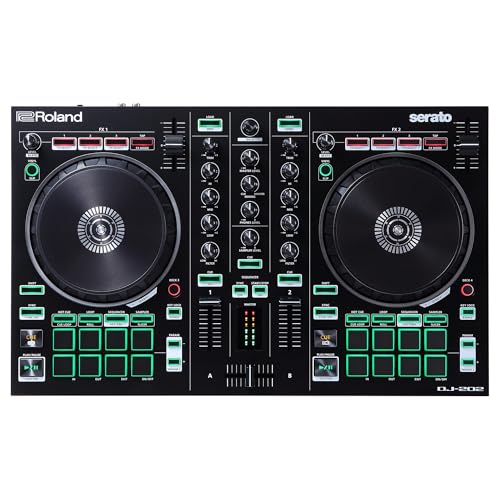
- Lay down the beat with genre-defining built-in drum kits from Roland's legendary TR-808, TR-909 and TR-606, realized with advanced ACB (Analog Circuit Behavior) technology
- Feel every move with large, low-latency platters, made to scratch

Crucial Considerations Before Investing in a DJ Controller
A DJ Controller is more than just an item; it’s a key solution for the modern performer who needs to manage vast digital libraries with the precision of a physical instrument. It solves the “mouse-and-keyboard” problem, allowing you to manipulate sound through touch, which is essential for timing and creative expression. Without a dedicated controller, you are simply a playlist manager; with one, you become a performer who can manipulate energy in a room.
The ideal customer for this type of product is someone facing the challenge of limited space or a limited budget but unwilling to compromise on sound quality. It’s perfect for the mobile DJ, the bedroom producer, or even dance instructors who need a portable, reliable way to manage music. However, it might not be suitable for those who demand a completely standalone experience without a laptop, or professional touring DJs who require balanced XLR outputs for massive club sound systems. If you fall into that category, you might want to check the latest price and availability to see if this fits your current tiered needs.
Before investing, consider these crucial points in detail:
- Dimensions & Space: Consider where you will be using the unit. A compact controller should be small enough to fit in a backpack or on a crowded desk, yet large enough that the buttons aren’t cramped for your fingers. The balance between portability and “room to breathe” on the interface is vital for accurate performance.
- Capacity/Performance: Look at the audio resolution and the latency of the jog wheels. For scratching and tight mixing, high-resolution 24-bit audio and low-latency platters are non-negotiable. You want a unit that responds instantly to your touch without a perceptible delay.
- Materials & Durability: While many entry-level controllers use plastic, the quality of that plastic matters. Look for “hard-shell” constructions and reinforced USB ports. A controller that feels “hollow” will likely not survive the rigors of travel or intense late-night practice sessions.
- Ease of Use & Maintenance: The software ecosystem is just as important as the hardware. Ensure the controller is “plug-and-play” with industry standards like Serato. Also, consider the upgrade path—does the hardware support advanced features if you decide to go from “Lite” to “Pro” software versions?
Choosing the right gear is about matching the tool to your specific creative workflow. While the Roland DJ-202 Compact DJ Controller is an excellent choice, it’s always wise to see how it stacks up against the competition. For a broader look at all the top models, we highly recommend checking out our complete, in-depth guide:
- The All-Rounder to Learn On: A simple, user-friendly layout inherited from pro Pioneer DJ gear makes it easy to start and grow

- Flagship Performance Controller: Built for serious hobbyists, mobile DJs, and pros who want a future-proofed open-format tool

- Closest Stepping Stone to the Club: A CDJ-3000 and DJM-A9 inspired layout builds muscle memory that transfers to the booth
First Impressions: Unboxing the Roland DJ-202 Compact DJ Controller
When we first pulled the Roland DJ-202 Compact DJ Controller out of its packaging, the first thing that struck us was the weight. At just 4.6 pounds, it is incredibly lightweight, but it doesn’t feel like a toy. The “stainless steel” material type listed in the specs provides a structural rigidity that many of its all-plastic competitors lack. The layout is immediately familiar to anyone who has seen a standard club setup, which is a testament to Roland’s design philosophy of keeping things “industry standard.”
The platters are the star of the show upon first touch. They are surprisingly large for a “compact” unit and have a brushed finish that feels great under the fingertips. Unlike some entry-level controllers that have “clicky” or loose platters, these have a smooth, weighted resistance. We found that setting it up was a breeze—just a single USB cable for both power and data. Compared to previous iterations of Roland gear, which could sometimes be complex, this felt streamlined and ready for action immediately. It’s a feature that really sets it apart in a crowded market of entry-level decks.
What We Loved
- Legendary TR-808 and TR-909 drum sounds built directly into the hardware.
- Exceptionally low-latency platters that make scratching feel natural and responsive.
- High-fidelity 24-bit/48 kHz audio quality that punches way above its price point.
- Highly portable, lightweight design that doesn’t sacrifice structural integrity.
What We Didn’t Like
- The performance pads can feel a bit stiff compared to high-end MPC-style pads.
- Lack of balanced XLR outputs means you’ll need adapters for some professional PA systems.
Deep Dive: Putting the Roland DJ-202 Compact DJ Controller Through Its Paces
The Roland Heritage: Built-in Drum Kits and Sequencing
We spent several hours testing the most unique feature of the Roland DJ-202 Compact DJ Controller: the integrated TR-drum kits. Most controllers in this price range are purely “mixers,” but Roland has injected their legendary production DNA into this unit. Using their proprietary Analog Circuit Behavior (ACB) technology, they’ve recreated the iconic sounds of the TR-808, TR-909, and TR-606. We found that having these sounds available on-board—without needing to load external samples—completely changes how you DJ. You aren’t just playing tracks; you’re “remixing” them on the fly by adding a 909 kick to a thin-sounding house track or layering 808 hi-hats over a hip-hop beat.
The 16-step sequencer is surprisingly intuitive once you get the hang of the shift functions. We were able to program custom drum patterns that synced perfectly with the Serato master tempo. This allows for transitions that are impossible on other controllers. Instead of just fading from Track A to Track B, you can fade into a drum beat you’ve just programmed, creating a bridge between songs. One user noted that for choreography and music production, this feature is “incredible,” and we have to agree. It transforms the controller from a playback device into a creative instrument.
Platter Precision and Professional Scratching
As an expert reviewer, I am often disappointed by the “jog wheels” on compact controllers. They are usually too small or have a lag that makes scratching impossible. However, we found that the Roland DJ-202 Compact DJ Controller features one of the most responsive platters in its class. The latency is virtually non-existent, meaning when you move the wheel, the digital waveform in Serato moves in perfect sync. This is critical for “baby scratches” and precise cueing.
The size of the platters is another win. They are larger than what you’d find on most “mini” controllers, providing a larger surface area for your palms. We tested this with both slow, melodic blends and fast, aggressive scratching. The resistance is fixed (you can’t adjust the tension), but the factory setting is a perfect middle ground—not too loose that it spins forever, and not so tight that it feels sluggish. Whether you’re an old-school vinyl purist getting back into the game or a newcomer, the tactile feedback here is top-tier for this price bracket.
Software Integration and the Serato Pro Advantage
The Roland DJ-202 Compact DJ Controller comes native with Serato DJ Lite, which is a fantastic starting point. However, the real value comes from the frequent promotions or upgrade paths to Serato DJ Pro. During our testing, we followed the process of registering the unit on the Roland website to unlock the Pro version. While some users have found the manual a bit vague on this process, we confirmed that registering your product through the official portal is the key to unlocking the full power of the software. Once we had Pro running, the controller really opened up, allowing for 4-deck control and more advanced effects mapping.
We were also impressed by how the controller handles the Serato Sampler. There is a dedicated volume control for the sampler right on the face of the mixer, which is a rarity at this price point. This allows you to trigger drops or vocal snippets without accidentally overpowering your main mix. For those who use iTunes (or Music on macOS), we found that the integration is seamless. As one user pointed out, if you encounter issues with M4A files, simply ensuring Quicktime is installed on your Windows machine resolves the playback issues immediately, allowing you to access your entire library without a hitch.
Audio Fidelity and Connectivity Solutions
Don’t let the RCA outputs fool you—the sound quality coming out of this unit is pristine. We ran the Roland DJ-202 Compact DJ Controller through a pair of high-end studio monitors and were genuinely surprised by the 24-bit/48 kHz resolution. The highs were crisp, and the low-end from the built-in drum machine was punchy and defined. It lacks the “muddiness” often found in budget-friendly controllers that use cheap digital-to-analog converters. If you want to hear it for yourself, you should see how it compares on the market in terms of audio specs.
The inclusion of a 1/4-inch microphone input with dedicated onboard effects (Reverb, Echo, Hi-pass, and Gate) is a massive bonus for mobile DJs or streamers. We tested the reverb and found it to be surprisingly “lush,” perfect for making announcements without sounding dry and abrasive. While we do wish there were XLR outputs for easier connection to professional house systems, the RCA outputs are more than sufficient for home studios, house parties, and small bar gigs. The rugged, compact design means you can toss it in a bag, head to the venue, and be plugged into the house mixer in under sixty seconds.
Real World Verdict: What Other Users Are Saying
The general sentiment surrounding the Roland DJ-202 Compact DJ Controller is one of high value and surprise. Many users who initially looked at more expensive brands found that this unit offered more “bang for the buck,” particularly due to the drum machine features. One veteran DJ, returning after a 15-year break, mentioned that this was the perfect way to “get back in the game” without a $2,000 commitment. We found that this sentiment is widely shared; this controller is widely considered a steal for those who want professional features on a budget.
On the positive side, users frequently praise the “pro feel” of the controls and the “plug and play” nature of the Windows 10 setup. One reviewer noted, “A lot of power and control for $300… the jog wheels have a great feel.” Another emphasized that the free Serato Pro upgrade (when available) essentially makes the hardware “free” considering the software’s standalone cost.
However, no product is perfect. Some users have reported frustration with the registration process for the software, noting that the manual doesn’t clearly explain how to claim the Pro voucher. Others have mentioned that the pads are a bit “stiff” for their liking, making precise timing on finger drumming a bit of a learning curve. There was also a notable mention from a user who struggled with Mac compatibility, though we found that most modern macOS updates have smoothed out these driver issues. Overall, the consensus is that if you are willing to spend ten minutes on registration and driver updates, the rewards are immense.
Comparing the Roland DJ-202 Compact DJ Controller to the Competition
1. Pioneer DJ DDJ-FLX4 2-Channel Multi-App DJ Controller
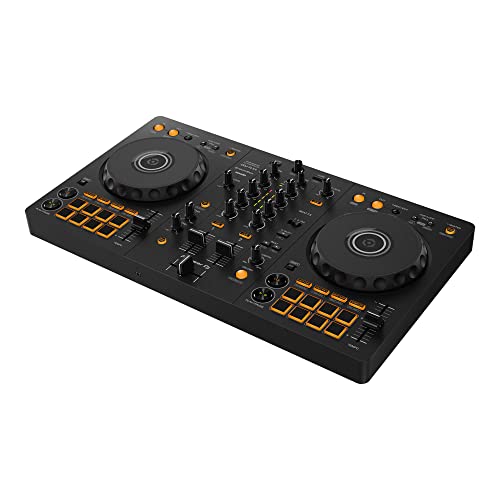
- Compatible with DJ software rekordbox and Serato
- Compatible with multiple devices that allow you to enjoy DJ from a variety of devices (beginning 2023)
The Pioneer DDJ-FLX4 is perhaps the closest rival to the Roland DJ-202. While the Roland wins on built-in production features (like the TR drums), the Pioneer excels in multi-app compatibility, working seamlessly with both rekordbox and Serato. It also features “Smart CFX” and “Smart Fader” features which are great for beginners who want to sound professional instantly. We recommend the FLX4 for users who might want to eventually transition to club-standard Pioneer hardware, whereas the Roland is better for those who want to blend DJing with live music production.
2. Pioneer DJ DDJ-REV1 2-Deck DJ Controller

- Learn to Scratch the Right Way: An open, battle-style layout mirrors a classic turntable and battle mixer setup
- Start for Free: Unlocks Serato DJ Lite so you can plug in and begin performing straight away
The DDJ-REV1 is designed with a “battle-style” layout, mimicking two turntables turned 90 degrees and a DJM-S series mixer. This makes it a fantastic choice for aspiring scratch DJs and open-format performers. Its horizontal pitch faders and specialized pad placement are unique. However, it lacks the sophisticated drum sequencing and high-resolution audio interface of the Roland DJ-202 Compact DJ Controller. If you are strictly focused on scratching, the REV1 is great; if you want a versatile studio tool, stick with Roland.
3. Numark Mixtrack Platinum FX 4-Deck Serato DJ Controller

- Complete Serato DJ System - DJ Controller for Serato DJ Lite (Included) with 4 decks of control, built-in 24bit audio interface and plug and play USB connectivity for Mac and Windows
- Visualize Your DJ Mix - Large 6-inch capacitive-touch jog wheels with high-resolution color displays that show beats per minute (BPM), platter position, beats remaining and pitch adjustment or key
The Numark Mixtrack Platinum FX stands out because of its built-in displays in the center of the jog wheels, showing BPM and track position. It also features paddle triggers for effects, which are incredibly fun to use. It offers 4-deck control just like the Roland, but in a much larger footprint. It feels more “plastic” than the Roland, and it lacks the internal drum kits. We suggest the Numark for those who want the visual feedback of the jog wheel displays, while the Roland remains the superior choice for audio fidelity and internal sequencing.
The Final Verdict: Is the Roland DJ-202 Compact DJ Controller Right for You?
After extensive testing and comparing the Roland DJ-202 Compact DJ Controller against both user expectations and industry competitors, we can confidently say it is one of the most capable controllers in the sub-$400 category. Its greatest strength lies in its hybrid nature—it isn’t just a way to play songs; it’s a way to create them. The inclusion of the TR-808 and 909 sounds, the high-resolution audio interface, and the exceptionally low-latency platters make it a professional tool in a portable frame.
While the stiff pads and the RCA-only outputs are minor drawbacks, they are easily overshadowed by the sheer creative potential of the onboard sequencer. Whether you are a latin dance teacher needing a reliable portable rig, a producer wanting to add a tactile element to your workflow, or a beginner looking for a “forever” entry-level deck, this unit delivers. We highly recommend this controller for anyone who values sound quality and creative flexibility over flashy lights or “auto-mix” gimmicks. It’s time to stop thinking about DJing and start doing it. You can get started with the Roland DJ-202 today and see just how far your creativity can take you.
Last update on 2026-09-20 / Affiliate links / Images from Amazon Product Advertising API