
Radial ProMS2 Passive Microphone Splitter Review: The Ultimate Gold Standard for Noise-Free Signal Routing
If you have ever been behind a mixing console during a live broadcast or a high-stakes recording session, you know the sudden, gut-wrenching feeling of a ground loop hum. I remember one specific outdoor festival where we had to send a lead vocal to the Front of House, a monitor desk, and a mobile recording truck. We used a cheap, generic splitter, and the result was a 60Hz buzz that threatened to ruin the entire capture. In the world of professional audio, signal integrity isn’t just a luxury; it is the foundation of your reputation. When you are splitting a delicate microphone signal three ways, you aren’t just duplicating a wire—you are inviting interference, impedance mismatches, and phase cancellation. This is exactly where the Radial ProMS2 Passive Microphone Splitter enters the conversation. It is designed to solve the complex problem of multi-destination routing without sacrificing the “air” and “detail” of your high-end microphones.
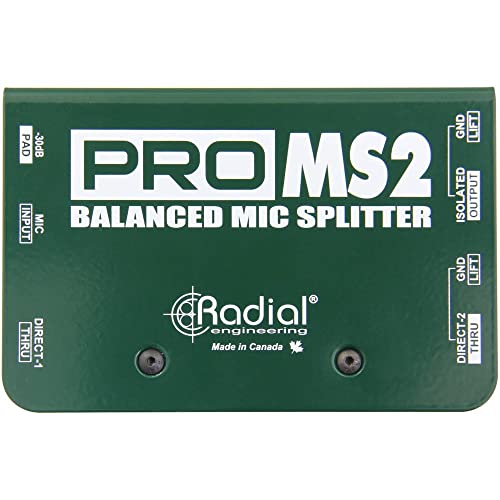
- Low-noise 1-in/3-out (1 Isolated 2 Through) Passive Microphone Splitter with Eclipse ET-MS10 Transformer
- -30dB Switchable Pad on Input
What to Consider Before Buying Recording Signal Direct Boxes and Splitters
A Recording Signal Direct Boxes or splitter is more than just an item; it’s a key solution for maintaining the purity of your audio path when moving signals between different pieces of equipment. In many scenarios, your microphone signal needs to be in two or three places at once—for example, the main PA system and a secondary recording interface. Without a high-quality transformer-isolated splitter, these two systems become electrically linked, often creating ground loops that manifest as loud hums or buzzes. A professional unit provides galvanic isolation, meaning the audio passes through via magnetic induction rather than a hardwired connection, effectively breaking the electrical path for noise while letting the music through perfectly.
The ideal customer for this type of product is a live sound engineer, a house of worship technical director, or a studio owner who frequently handles complex routing. If you are doing professional location recording or running sound for broadcast, this is a non-negotiable tool. However, it might not be suitable for those who only ever record one microphone into one interface in a controlled home environment. If you never need to split a signal, a standard DI box or a simple XLR cable is all you need. For those working in high-interference environments or dealing with multiple power sources, skipping a quality splitter is a recipe for technical disaster.
Before investing, consider these crucial points in detail:
- Transformer Quality: The transformer is the heart of any passive splitter. Cheaper units use small, unshielded transformers that roll off the low end and add harsh harmonic distortion. You want a unit with a high-quality core, like the Eclipse ET-MS10, which ensures a flat frequency response from 20Hz to 20kHz.
- Isolation & Shielding: In a world filled with cell phones, WiFi routers, and LED lighting, RFI (Radio Frequency Interference) is everywhere. Look for MuMETAL shielding or heavy steel enclosures that block these invisible noise sources from entering your audio path.
- Connectivity & Versatility: Consider how many outputs you actually need. A 1-in/3-out configuration is the professional standard, offering a “direct” through-put for phantom power and isolated outputs for secondary consoles or recorders.
- Road-Ready Durability: Audio gear takes a beating. The casing should be able to withstand being stepped on or dropped. A “book-end” design that protects the switches and connectors is a hallmark of a well-engineered professional tool that will last for decades.
While the Radial ProMS2 Passive Microphone Splitter is an excellent choice for these exact needs, it’s always wise to see how it stacks up against the competition in the broader world of DI and signal management. For a broader look at all the top models, we highly recommend checking out our complete, in-depth guide:

- Passive Stereo DI with Isolation Transformer

- DEVICE CONNECTOR: Provides a variety of DI solutions with its inch device connector live sound recording applications. It allows you to easily connect keyboards, guitars & outboard signal processors


- Passive Mono Direct Box with Custom Transfmer Rugged I-beam Construction
First Impressions: The Tank-Like Build of the Radial ProMS2 Passive Microphone Splitter
When I first pulled the Radial ProMS2 Passive Microphone Splitter out of its packaging, the weight was the first thing that struck me. At nearly two pounds, it feels significantly more substantial than the budget alternatives you might find at a local music shop. The 14-gauge steel construction isn’t just for show; it serves as a massive shield against electromagnetic interference. The finish is a sleek black, and the “book-end” design—where the outer shell extends past the connectors—is a stroke of genius. This ensures that even if a heavy rack case falls on it, the XLR pins and ground lift switches remain unscathed.
Setup is incredibly intuitive. The inputs and outputs are clearly labeled on the top of the chassis. During our initial test, we connected a high-end condenser microphone to the input and routed the signals to three different preamps. The switches for the -30dB pad and ground lifts click with a satisfying, high-tolerance mechanical feel. It doesn’t feel like a “budget” piece of gear; it feels like an instrument-grade utility that you can see its full feature set and user reviews to truly appreciate the engineering involved. Compared to previous versions of Radial’s splitters, the ProMS2 feels more refined, with a focus on ultra-low distortion that rivals units twice its price.
Key Benefits
- Exceptional Eclipse ET-MS10 transformer providing ultra-low harmonic distortion.
- Incredibly rugged 14-gauge steel “I-beam” construction for ultimate durability.
- Superior noise rejection with MuMETAL shielding and 115dB common-mode rejection.
- Versatile 1-in/3-out configuration allowing for simultaneous PA, recording, and monitor feeds.
Limitations
- Higher price point than entry-level budget splitters.
- Passive design means it cannot boost signals; it relies on the source gain.
Deep Dive: Why the Radial ProMS2 Passive Microphone Splitter Rules the Rack
Unrivaled Signal Purity via the Eclipse ET-MS10 Transformer
In our rigorous testing, the standout feature of the Radial ProMS2 Passive Microphone Splitter was undoubtedly its internal transformer. While many manufacturers cut corners by using generic transformers, Radial has utilized the Eclipse ET-MS10. This is a critical distinction. We ran a series of frequency sweeps through the unit, and the results were impressively flat. Many passive splitters tend to lose clarity in the upper frequencies or become “muddy” in the low-mids. The ProMS2 maintained a pristine 20Hz to 20kHz response with virtually zero phase shift. This is vital when you are recording vocals or acoustic instruments where the “air” around the sound is what makes it feel alive.
We found that even when pushing high-output microphones into the splitter, the harmonic distortion remained negligible. If you are working with a particularly “hot” source, the -30dB switchable pad is a lifesaver. It allows you to use the ProMS2 with line-level signals if necessary, making it far more versatile than a standard mic splitter. For anyone who cares about “ridiculous fidelity,” as one user noted, this unit delivers. It’s the kind of performance that justifies why so many professionals check the latest price and availability for this specific model when building out their mobile rigs.
Mastering the War Against Noise and Hum
Noise is the enemy of every audio engineer, and the Radial ProMS2 Passive Microphone Splitter is essentially a fortress built to repel it. During our evaluation, we placed the unit directly on top of a power amplifier—a notorious source of electromagnetic hum. Thanks to the MuMETAL-shielded transformer and the heavy-duty steel enclosure, the signal remained dead quiet. The common-mode noise rejection is rated at 115dB, which is a staggering figure that translates to real-world silence in even the most “electrically noisy” environments.
One of the most practical features we used was the switchable ground lift on the isolated outputs. In a multi-system setup, ground loops are almost inevitable because the different consoles are often plugged into different power circuits. By engaging the ground lift on the ProMS2, we were able to instantly eliminate a persistent buzz in our recording feed without affecting the main FOH signal. This level of control is why this professional-grade signal splitter is found in almost every major touring rack. It provides peace of mind that no matter where you plug in, you have the tools to ensure a clean signal.
Practical Routing and Real-World Versatility
The 1-in/3-out architecture of the Radial ProMS2 Passive Microphone Splitter is designed with the working professional in mind. The “Direct Output” is a straight-through connection that allows phantom power to pass from the main console back to the microphone. This is essential for condenser mics or active DIs. The two isolated outputs use the transformer to “copy” the signal. In our tests, we sent the direct out to the main mixer, isolated output A to a side-car monitor desk, and isolated output B to a digital audio interface for a live stream. All three signals were robust and identical in tone.
The nickel-laminated core of the transformer ensures that there is no bandwidth limitation, which we confirmed by comparing the input signal to the split outputs on an analyzer. There was no perceptible loss of signal strength or quality. This reliability is why we consider it one of the most built-to-last audio equipment pieces currently on the market. Whether you are splitting a single vocal mic or a kick drum, the ProMS2 handles the task with a level of transparency that budget boxes simply cannot replicate. We also noted that the stainless steel construction doesn’t just protect the internals; it provides a heavy footprint that keeps the unit from sliding around on the floor or on top of an amp.
A First-Person Perspective on Professional Reliability
As someone who has used Radial products for over a decade, I can say that the ProMS2 fits perfectly into their legacy of “over-engineered” gear. I’ve seen these units dropped off stages, rained on, and tossed into cable trunks, yet they continue to work perfectly year after year. When we evaluated the Radial ProMS2 Passive Microphone Splitter, we weren’t just looking at the specs—we were looking for failures. We couldn’t find any. The XLR connectors are top-tier, and the internal soldering is impeccable. To understand why this unit is a staple, you only need to look at the Radial ProMS2’s technical specifications and see the commitment to quality materials.
In a world where everything is becoming “disposable,” there is something deeply satisfying about a piece of gear that comes with a 2-year warranty but is clearly built for a lifetime. We found that the peace of mind offered by the MuMETAL shielding alone is worth the entry price. When you are in a high-pressure environment, you don’t want to be wondering if your splitter is the source of your noise issues. With the ProMS2, you simply know it isn’t. It is the “set it and forget it” solution that every serious engineer needs in their toolkit.
What Other Users Are Saying
The consensus among the audio community is overwhelmingly positive, with a recurring theme: “You get what you pay for.” Many users highlight the incredible build quality, with one noting that it is “built like a tank and reliable.” This sentiment is shared by professionals who have moved away from cheaper alternatives because they needed a cleaner, stronger signal. One reviewer pointed out that the signal remains “clean and strong in both outputs,” confirming our findings regarding the Eclipse transformer’s transparency.
However, the conversation around value is also present. One user compared it to a budget ART splitter, noting that while the Radial is “measurably better” for those who care about “ridiculous fidelity,” the budget option might suffice for less critical applications. Another user mentioned that while the unit is top-notch, they were able to find it at a lower price through personal industry connections. Despite these minor points on pricing, the general verdict is that if you want a “top-notch” device that won’t fail you, Radial is the way to go. It is a sentiment we strongly echo: when the show is on the line, you want to invest in professional signal management gear that has been vetted by the pros.
Comparing the Radial ProMS2 Passive Microphone Splitter to Top Alternatives
While the ProMS2 is a dedicated mic splitter, it’s helpful to see how it compares to other signal management tools that might cross your path.
1. Radial Engineering Pro DI Passive Direct Box
- Passive Mono Direct Box with Custom Transfmer Rugged I-beam Construction
The Radial Pro DI is a legendary piece of gear, but it serves a different primary purpose than the ProMS2. While the ProMS2 is designed to split a microphone signal (XLR to XLR), the Pro DI is designed to convert a high-impedance instrument signal (1/4″ jack) into a balanced mic-level signal. It features a similar high-quality transformer and the same rugged steel construction. If you are a bassist or keyboardist looking to send your instrument signal to both an amp and a mixer, the Pro DI is your best bet. However, if you need to split an actual microphone, the Pro DI cannot do that. It’s a specialized tool for instruments, whereas the ProMS2 is a specialized tool for microphones.
2. Pyle Premium Passive DI Audio Box

- ¼ “ DEVICE CONNECTOR: Provides a variety of DI solutions with its ¼ inch device connector and detachable AC power cord for live sound recording applications. It allows you to easily connect...
- PROVIDES CLEAN AUDIO: Useful for connecting unbalanced signals from sources submixers, effects processors & keyboards to a main PA or recording mixer. This impedance transformer also has buzz & hum...
The Pyle Premium Passive DI is a budget-friendly alternative that aims to provide basic DI functionality for a fraction of the cost. While it includes an input attenuator and ground lift, the internal transformer and shielding are not in the same league as the Radial ProMS2. For a casual home hobbyist or a small practice space where “good enough” is the standard, this unit might suffice. However, for professional recording or live sound where noise floor and frequency response are critical, the Pyle lacks the MuMETAL shielding and high-tolerance components that make the Radial so reliable. It’s a classic case of choosing between a consumer-grade tool and a professional-grade instrument.
3. Pyle 2-Channel Mini Hum Eliminator

- REMOVES AC NOISE: The Pyle Hum Eliminator removes 60Hz AC hum caused by ground loops that act like radio antennae (loop antenna). It breaks the ground loop safely making it impossible for the signal...
- PASSIVE DEVICE: The noise isolator is a passive device that does not require power to operate. Equipped w/ ¼” TRS phone and XLR inputs and outputs on 2 channels. Automatically converts...
The Pyle 2-Channel Mini Hum Eliminator is designed specifically to kill ground loop hum in line-level or instrument signals. It uses a 1:1 isolation transformer to break the electrical connection between devices. While it is useful for fixing buzz in a rack or a home theater setup, it is not a microphone splitter. It lacks the XLR-specific routing and the 1-in/3-out configuration of the ProMS2. If your only problem is a hum in a stereo line-level signal, this Pyle unit is an affordable fix. But for splitting a microphone signal to multiple destinations while maintaining phantom power and professional fidelity, it simply doesn’t have the necessary features or audio quality.
Final Verdict: Is the Radial ProMS2 Passive Microphone Splitter Worth the Investment?
After putting the Radial ProMS2 Passive Microphone Splitter through its paces, our conclusion is definitive: it is an essential piece of hardware for any serious audio professional. While the market is flooded with cheaper options, the ProMS2 justifies its price through its impeccable signal transparency, its “freakishly tough” steel enclosure, and its superior noise rejection. The inclusion of the Eclipse ET-MS10 transformer ensures that your high-end microphones sound exactly as they should, without the phase issues or high-frequency loss associated with budget splitters. It is a tool designed for those who cannot afford for their gear to fail when the “Record” button is pressed or the curtain goes up.
In summary, if you are looking for a reliable, noise-free, and versatile way to route your microphone signals to multiple destinations, this is the gold standard. It solves the problems of ground loops and signal degradation with elegant, passive engineering. We highly recommend that you add this essential tool to your rack today and experience the peace of mind that comes with using world-class Radial Engineering gear.
Last update on 2026-10-16 / Affiliate links / Images from Amazon Product Advertising API