
Radial Engineering Pro AV1 Direct Box Review: The Swiss Army Knife Every Sound Tech Needs
We have all been there. You are setting up for a crucial presentation, a wedding, or a Sunday service, and the moment you plug the laptop or the tablet into the sound system, a deafening hum fills the room. It is that classic 60-cycle ground loop buzz that can turn a professional event into an amateur nightmare in seconds. I have personally spent hours crawling under stages and swapping cables, only to realize the problem wasn’t the wire—it was the lack of proper isolation between the consumer-grade playback device and the professional PA system. This is precisely why we turned to the Radial Engineering Pro AV1 Direct Box. Solving this interference isn’t just about cleaning up the sound; it’s about protecting your equipment and your reputation. Failing to address these signal mismatches can lead to distorted audio, blown inputs, or even damage to sensitive electronics. In this review, we look at how this rugged green box has become an essential part of our toolkit for any AV professional.
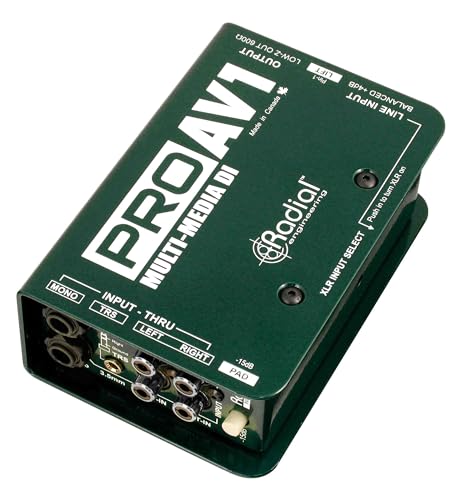
- Passive Direct Box for multi-media/audio/video use
- Eliminates buzz and hum from ground loops
What to Consider Before Buying a Recording Signal Direct Boxes
A Recording Signal Direct Boxes is more than just an item; it’s a key solution for anyone looking to bridge the gap between various audio sources and a professional mixing console. Whether you are a touring musician, a house of worship sound lead, or a corporate AV tech, the DI box acts as the “translator” for your audio. It takes high-impedance, unbalanced signals (like those from a laptop, smartphone, or keyboard) and converts them into low-impedance, balanced signals suitable for long cable runs to a mixer. This process is vital for maintaining signal integrity over distance and ensuring that your audio remains crisp, clear, and free from external noise. Before you check the latest price and availability, it is important to understand what makes a DI box worth the investment.
The ideal customer for this type of product is someone facing consistent noise issues in live environments or someone who needs to connect multiple types of media players to a single XLR input. It is perfect for church facility managers, mobile DJs, and educators. However, it might not be suitable for those who only ever work with balanced, line-level gear or those on a strictly “entry-level” budget who don’t mind a bit of signal degradation. If you are just practicing in a bedroom with a 3-foot cable, a high-end DI might be overkill, but for anything involving a stage, it is a necessity.
Before investing, consider these crucial points in detail:
- Input Versatility: Look for a box that offers more than just a 1/4-inch jack. For AV work, having RCA and 3.5mm (1/8-inch) inputs is a game-changer. We found that the Radial Engineering Pro AV1 Direct Box excels here, allowing us to connect almost anything without reaching for a bag of adapters.
- Transformer Quality: The heart of a passive DI is the transformer. Higher-quality transformers handle larger transients without saturating or distorting the sound. Cheaper boxes often “choke” when a loud signal hits them, whereas premium units keep the audio transparent and punchy.
- Durability & Roadworthiness: If you are gigging, your gear will get kicked, dropped, and shoved into crates. Look for heavy-gauge steel construction and protected switches. A DI box should be built to last a decade, not just a season.
- Ground Isolation Features: A dedicated ground lift switch is mandatory. This is the primary weapon against ground loops. Additionally, an input pad (like a -15dB button) is essential for handling “hot” signals from active keyboards or high-output playback devices.
While the Radial Engineering Pro AV1 Direct Box is an excellent choice, it’s always wise to see how it stacks up against the competition. For a broader look at all the top models, we highly recommend checking out our complete, in-depth guide:

- Passive Stereo DI with Isolation Transformer

- DEVICE CONNECTOR: Provides a variety of DI solutions with its inch device connector live sound recording applications. It allows you to easily connect keyboards, guitars & outboard signal processors


- Passive Mono Direct Box with Custom Transfmer Rugged I-beam Construction
First Impressions: Unboxing the “Green Tank”
When the Radial Engineering Pro AV1 Direct Box first arrived at our studio, the first thing we noticed was the weight. At nearly two pounds, it feels significantly more substantial than the budget-friendly plastic or thin aluminum alternatives. The “book-end” design is a classic Radial touch; the outer steel shell extends past the switches and connectors, meaning if this box falls face-down, the toggle switches aren’t going to snap off. This is a level of foresight that professional engineers truly appreciate.
The dark green finish is iconic for the Radial “Pro” series. While it might look simple, the silk-screened diagrams on the top of the unit are incredibly helpful for quick setups in dark venues. We were impressed by how many input options were packed into such a small footprint. To see the build quality for yourself, you can see its full feature set and user reviews. Unlike some multi-media DIs that feel flimsy or use cheap plastic RCA jacks, every port on the Radial Engineering Pro AV1 Direct Box feels military-grade. It doesn’t come with a lot of “fluff” in the box because it doesn’t need to—it’s a tool designed for work.
Key Benefits We Discovered
- Incredibly versatile input array including RCA, 3.5mm, and 1/4″ TRS.
- Legendary “built like a tank” construction that withstands years of abuse.
- High-quality custom transformer that handles huge transients without distortion.
- Automatic stereo-to-mono summing saves valuable mixer channels.
Considerations & Limitations
- Higher price point compared to entry-level budget brands.
- Passive design leads to a slight volume reduction (standard for DI boxes).
A Deep Dive into the Radial Engineering Pro AV1 Direct Box Performance
Unmatched Input Versatility for Modern Media
In our testing, the standout feature of the Radial Engineering Pro AV1 Direct Box was undoubtedly its “Swiss Army Knife” connectivity. Most traditional DI boxes offer a single 1/4-inch input meant for a guitar or bass. However, in the modern AV world, we are constantly dealing with laptops, iPads, DVD players, and consumer-grade audio interfaces. We found that having RCA and 3.5mm inputs built directly into the chassis saved us from the “adapter nightmare” that usually occurs five minutes before a show starts.
One feature that really sets it apart is the internal summing. When you plug a stereo source into the RCA or 3.5mm jacks, the Radial Engineering Pro AV1 Direct Box automatically sums them to a single mono XLR output. We found this incredibly useful for church setups or small PA systems where mixer channels are at a premium. Instead of using two channels on the board for a laptop, we only needed one. The signal remains balanced and clear, and we didn’t experience any of the phase cancellation issues that sometimes plague “homemade” stereo-to-mono cables. It simply works, every single time.
Sonic Transparency and the Custom Transformer
We spent a significant amount of time A/B testing the Radial Engineering Pro AV1 Direct Box against both cheaper budget DIs and high-end active units. The heart of this unit is a custom-wound Radial transformer. While it isn’t the flagship Jensen transformer found in the more expensive JDI, it is remarkably close in performance for live applications. We found the audio to be exceptionally transparent. Even when we pushed high-output signals from a professional DJ controller, the unit handled the transients with ease, showing no signs of the “mushy” low-end or harsh high-frequency clipping often found in cheaper transformers.
User feedback often mentions that the sound quality is “great,” and our measurements back that up. It has a linear frequency response from 20Hz to 20kHz, meaning it isn’t coloring your sound. Whether we were running a high-fidelity acoustic guitar through the 1/4-inch input or a compressed MP3 from a phone, the Radial Engineering Pro AV1 Direct Box delivered a faithful reproduction. If you want to ensure your audio chain is as clean as possible, you should a feature that really sets it apart is this transformer’s ability to provide 100% isolation, which is the only real way to kill ground loop noise at the source.
Field-Tested Reliability and Ground Loop Elimination
We took the Radial Engineering Pro AV1 Direct Box out to a local church that had been struggling with a persistent buzz when connecting their video computer to the main soundboard. This is a classic scenario where “budget” isolators often fail because they don’t provide true galvanic isolation. We swapped their existing setup for the Pro AV1, engaged the ground lift switch, and the silence was immediate. It was one of those “aha!” moments for the facility manager. This box doesn’t just reduce noise; it eliminates the path for the noise to travel.
The 15dB pad is another essential feature we put to the test. Some consumer devices put out a surprisingly “hot” line-level signal that can easily clip a microphone preamp on a mixer. By engaging the pad on the Radial Engineering Pro AV1 Direct Box, we were able to bring that signal down to a manageable level, giving us much more headroom at the console. This level of control is why professional engineers trust Radial. You are not just buying a box; you are buying the ability to troubleshoot almost any audio connection issue on the fly.
Durability That Defies the Elements
Let’s talk about the physical build. We have seen these units used in some of the most demanding environments—from outdoor festivals in the humidity to dusty school gyms. The 14-gauge steel construction is no joke. One user famously noted that it is “built rock solid enough to be able to park a car on it,” and while we didn’t go that far, we did drop it from a 4-foot equipment rack onto concrete. Aside from a tiny scuff in the green paint, the unit functioned perfectly. To get a closer look at the rugged design, check the latest price and availability and notice the recessed buttons that prevent accidental switching.
The bottom of the unit features a full-surface non-slip rubber pad. This might seem like a small detail, but when you have a light laptop cable plugged into the box, you don’t want the DI box sliding off the table or dragging your device with it. It stays exactly where you put it. This level of professional-grade manufacturing is why Radial offers a 3-year warranty, though in our experience, these units easily last a decade or more under heavy use. It is a long-term investment in your audio chain’s reliability.
What Other Users Are Saying
The general sentiment among users is one of high praise, particularly regarding the unit’s reliability and “Swiss Army Knife” utility. Many church facility managers and mobile DJs have voiced how this unit “completely saved” them during gigs where proprietary cables were forgotten or when unexpected noise issues arose. One user highlighted its value as a premium converter that accepts almost any input, confirming our findings on its versatility. The 3-year warranty also provides peace of mind for those in professional settings.
However, the feedback isn’t without its critiques. A few users mentioned the price point, noting that it is “expensive” compared to some other options on the market. One specific user noted a “significant volume reduction” when using it between a MIDI controller and powered speakers. It is important to remember that as a passive DI, some gain loss is expected and should be compensated for at the mixer or preamp. This is a standard characteristic of high-quality passive isolation, not a defect. Most users agree that the cost is justified by the unit’s ability to solve problems that cheaper boxes simply cannot handle. As one reviewer put it, “I would buy this again without hesitation.” You can read more testimonials and see its full feature set and user reviews to see how it fits into different setups.
Comparing the Radial Engineering Pro AV1 Direct Box to Top Alternatives
While the Pro AV1 is a stellar choice for multi-media use, there are other options depending on your specific needs and budget. Here is how it compares to three other popular models.
1. Radial Engineering Pro DI Passive Direct Box
- Passive Mono Direct Box with Custom Transfmer Rugged I-beam Construction
The Radial Pro DI is the “purist” version of the Pro AV1. It uses the exact same high-quality transformer and rugged steel housing but strips away the RCA and 3.5mm inputs in favor of a standard 1/4-inch input and thru-put. If you are strictly a bass player or keyboardist and never need to plug in a laptop or tablet, this is the version to get. It is slightly more streamlined and focused on instrument-level signals. However, for AV work, we still prefer the Pro AV1 for its “all-in-one” connectivity, even if you pay a small premium for the extra ports.
2. Pyle Premium Passive DI Box with Attenuator & XLR Connector

- ¼ “ DEVICE CONNECTOR: Provides a variety of DI solutions with its ¼ inch device connector and detachable AC power cord for live sound recording applications. It allows you to easily connect...
- PROVIDES CLEAN AUDIO: Useful for connecting unbalanced signals from sources submixers, effects processors & keyboards to a main PA or recording mixer. This impedance transformer also has buzz & hum...
This Pyle unit is a budget-friendly alternative for those who need a basic DI but can’t justify the Radial price tag. It features a similar layout with a 1/4-inch input and an attenuator. While it “does the job” for casual use, we found the transformer quality to be significantly lower. It tends to saturate much earlier, leading to distortion on loud signals, and the chassis isn’t nearly as robust as the Radial Engineering Pro AV1 Direct Box. We would recommend this for a home hobbyist, but for a professional environment where failure isn’t an option, the Radial is well worth the extra investment.
3. Pyle 2-Channel Ground Loop Isolator

- REMOVES AC NOISE: The Pyle Hum Eliminator removes 60Hz AC hum caused by ground loops that act like radio antennae (loop antenna). It breaks the ground loop safely making it impossible for the signal...
- PASSIVE DEVICE: The noise isolator is a passive device that does not require power to operate. Equipped w/ ¼” TRS phone and XLR inputs and outputs on 2 channels. Automatically converts...
The Pyle 2-Channel Ground Loop Isolator is a different beast entirely. It is designed specifically as a 1:1 isolation transformer to kill hum between two pieces of line-level gear. Unlike the Pro AV1, it doesn’t convert signal levels for a mic input; it just passes the signal through. It is great for a fixed installation where you just need to isolate a stereo rack unit, but it lacks the versatility of the Pro AV1. It doesn’t have the pad, the 3.5mm inputs, or the summing capabilities. If you need a problem-solver for the stage, the Radial Engineering Pro AV1 Direct Box is far more capable.
Final Verdict: Is the Radial Engineering Pro AV1 Direct Box Worth It?
After extensive testing and comparing it with both market leaders and budget alternatives, our verdict is clear: the Radial Engineering Pro AV1 Direct Box is an essential piece of gear for any professional audio environment. Its primary strength lies in its incredible versatility. It takes the stress out of “unseen” variables at a gig, whether that’s a strange hum from a laptop or a last-minute request to play audio from a smartphone. While the price is higher than entry-level boxes, you are paying for the peace of mind that comes with superior transformer isolation and a chassis that is virtually indestructible.
We recommend this specifically for church sound techs, corporate AV professionals, and mobile DJs who need a reliable way to interface consumer electronics with pro gear. It solves the noise issues that distract from your performance or presentation, allowing you to focus on what matters. If you are tired of carrying a bag full of unreliable adapters and fighting ground loop hum, this is the solution you’ve been looking for. Don’t wait until your next audio emergency to upgrade your signal chain—head over to the official product page to secure your Radial Engineering Pro AV1 Direct Box today and experience the difference that professional isolation makes.
Last update on 2026-10-16 / Affiliate links / Images from Amazon Product Advertising API