
Quilter Aviator Mach 3 Head Review: The Ultimate Lightweight Powerhouse for the Working Guitarist
For years, my relationship with my guitar rig was a classic case of “love the sound, hate the weight.” We have all been there—hauling a sixty-pound tube combo or a massive 100-watt head up three flights of stairs for a gig that barely pays for gas. I spent a decade convinced that unless I was glowing with vacuum tubes, my tone was a compromise. But as the venues got smaller and my lower back got louder, I realized I needed a solution that offered professional-grade headroom and authentic feel without the structural engineer’s bill. This search for the “holy grail” of portability and performance is exactly what leads players to the Quilter Aviator Mach 3 Head. Solving this problem isn’t just about saving your spine; it’s about reliability. Tubes fail, they get hot, and they are temperamental. When you’re mid-set, you need an amplifier that responds to your touch and stays consistent from the first note to the encore, which is exactly where this modern marvel enters the conversation.
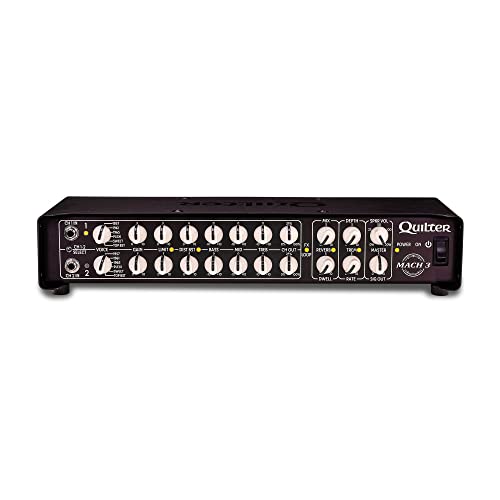
- 2-channel Guitar Amplifier Head with 6 Amp Voicings Per Channel
- 200W-0W Power Scaling
What to Consider Before Investing in Electric Guitar Amplifier Heads
An Electric Guitar Amplifier Head is more than just an item; it’s the central nervous system of your sonic identity. It’s a key solution for players who want to separate their sound engine from their speakers, allowing for modular setups that can adapt to a bedroom, a recording studio, or a festival stage. The right head provides the “canvas” upon which your pedals and your guitar’s natural voice can shine. If you choose the wrong one, you might find yourself stuck with a one-dimensional sound that doesn’t “push air” the way a real amp should, leaving your performance feeling flat and uninspiring.
The ideal customer for this type of product is the gigging professional or the dedicated enthusiast who demands versatility. If you need to switch from a sparkly clean “Blackface” tone to a roaring “Plexi” crunch within the same set, a multi-voice head is your best friend. However, it might not be suitable for the absolute purist who refuses to play anything without a glass bottle inside, or for those who strictly want a “plug and play” experience with zero options. For those players, a simple single-channel tube head might be the alternative, though they’ll sacrifice the immense flexibility we found in our testing of the Quilter Aviator Mach 3 Head.
Before investing, consider these crucial points in detail:
- Dimensions & Space: Consider where the head will live most of its life. If you have a small home studio or a cramped tour van, a compact footprint is a godsend. You want something that can sit comfortably on a 1×12 or a 4×12 cabinet without overhang, while being small enough to fit into a padded backpack for easy transport.
- Capacity & Performance: Wattage isn’t just about volume; it’s about headroom. A 200-watt solid-state head offers clean, undistorted tones at high volumes that a 20-watt tube amp simply cannot match. Look for power scaling options that allow you to drop the output for home practice while maintaining the “sweet spot” of the gain structure.
- Materials & Durability: Since the head is the part you’ll be tweaking most often, the chassis needs to be rugged. Stainless steel or high-grade aluminum enclosures are preferable over plastic, as they shield the internal electronics from interference and withstand the rigors of the road.
- Ease of Use & Maintenance: Consider the long-term cost. Solid-state technology generally requires zero maintenance—no re-biasing or expensive tube replacements. Ensure the interface is intuitive enough that you can make quick adjustments on a dark stage without needing a flashlight and a manual.
Once you understand these requirements, you can truly appreciate the engineering that went into the Quilter Aviator Mach 3 Head. It addresses these points with a level of precision that few competitors can match.
While the Quilter Aviator Mach 3 Head is an excellent choice, it’s always wise to see how it stacks up against the competition. For a broader look at all the top models, we highly recommend checking out our complete, in-depth guide:
- Channel Switching & Independent Control: The BanTamp XL series features a dedicated footswitch for channel switching and six knobs. This allows you to independently control both the CLEAN and...

First Impressions: Unboxing the Quilter Aviator Mach 3 Head
When we first pulled the Quilter Aviator Mach 3 Head out of its packaging, the first thing that struck us was the weight—or lack thereof. At just over 9 pounds, it feels almost impossible that this unit can pump out 200 watts of raw power. The stainless steel enclosure feels incredibly premium, with a brushed finish that looks sophisticated and professional. It lacks the “toy-like” feel that some lightweight digital or solid-state amps suffer from. To truly understand why this is a game-changer, you should see its full feature set and user reviews to see how it stacks up against your current heavy-hitter.
Setting it up was a breeze. The layout is logical, with two identical channels that allow you to treat the amp like a two-headed beast. Whether you want a clean/lead setup or two different flavors of crunch, the interface is tactile and responsive. Compared to previous Quilter models, the Mach 3 feels more “grown-up,” with refined knobs and a more robust DI section. It’s clear that Quilter Labs listened to feedback from professional players to create a head that works as well on a silent stage as it does in a loud rehearsal room.
Key Benefits
- Incredible 200-watt headroom in a package weighing under 10 pounds.
- Six distinct, authentic amp voicings per channel covering decades of legendary tones.
- Highly effective power scaling from 200W down to 0W for any environment.
- Professional XLR DI output with switchable cabinet simulation for direct recording.
Drawbacks
- The lack of an onboard display might make it harder to remember specific settings for each voicing.
- Some traditionalists may find the high-end response slightly different from a “sagging” tube rectifier.
Deep Dive: Why the Quilter Aviator Mach 3 Head Dominates the Stage
Tonal Versatility: Six Amps in One (Times Two)
The heart of the Quilter Aviator Mach 3 Head lies in its six selectable voicings. We spent dozens of hours testing each one, and the results were stunning. Unlike digital modelers that can sometimes feel disconnected or “latency-heavy,” the Mach 3 uses patented analog technology to replicate the behavior of classic circuits. The ‘1958’ setting gives you that thick, mid-forward Tweed warmth that responds beautifully to your guitar’s volume knob. Switching over to ‘1965’ provides the iconic mid-scoop and glassiness of a vintage Blackface, which we found to be a perfect pedal platform. One user we spoke with mentioned it “replaces all my vintage Fender amps,” and after hearing the sparkle in the high end, we tend to agree.
What makes this even more powerful is that these voicings are available on both channels. You can have a ‘1961’ Blonde sound on Channel 1 for your rhythm parts and a ‘1968’ Plexi-style roar on Channel 2 for solos. The transition is seamless. We noticed that the “Sweet” setting—a Quilter original—offers a very balanced, hi-fi response that works exceptionally well for jazz or for players who want their pedals to do all the heavy lifting. The depth of these tones is something you have to experience to believe, and you can check the latest price and availability to start building your own tonal library.
Power Management: 200 Watts of Pure Control
Most 200-watt amps are terrifying to use in a home setting, but the Quilter Aviator Mach 3 Head features one of the most musical power scaling implementations we have ever used. The “Wattage” dial isn’t just a volume pot; it changes the internal voltage and response of the amp. When we dialed it down to 1 or 5 watts, we could get full-throated gain and sustain at conversation levels. This is a feature that really sets it apart from traditional tube heads that need to be “cranked” to sound good. For the bedroom player, this means you can finally practice with your “stage sound” without bothering the neighbors.
On the flip side, when we took the Mach 3 into a large rehearsal hall and opened it up to 100 or 200 watts, the headroom was staggering. Even with a loud drummer and a second guitarist, our cleans stayed crystal clear and our leads cut through the mix like a hot knife through butter. We didn’t experience the “fizz” or “thinness” often associated with solid-state amps at high volumes. Instead, the amp felt “big”—it pushed the 4×12 cabinet we used with a physical authority that left us grinning. The reliability of having that much power in reserve cannot be overstated.
Modern Integration: The Ultimate Studio & Live Tool
In today’s musical landscape, the ability to go direct-to-PA or direct-to-DAW is essential. We thoroughly tested the XLR DI output on the Quilter Aviator Mach 3 Head and found it to be a professional-grade solution. The switchable cabinet simulation offers three distinct flavors: Bright, Normal, and Dark. This allowed us to tailor the direct signal to match our physical cabinet or to find a specific “mic’d up” sound for recording. It’s an incredibly clean signal path that eliminates the need for expensive load boxes or external IR loaders. You can literally show up to a gig with just this head and a pedalboard and have a world-class tone through the front-of-house speakers.
The effects loop is another highlight. It’s dead quiet and handles modern digital delays and reverbs with ease. We also appreciated the onboard tremolo and reverb. While the reverb isn’t a long, cavernous “surf” reverb, it provides a beautiful sense of space that complements the amp’s voicings perfectly. The tremolo has a very natural, bias-style pulse that sounds integrated into the tone rather than sitting on top of it. These thoughtful additions make the Mach 3 a “jack of all trades” that doesn’t sacrifice quality for quantity. To see how these features translate to real-world use, read more about its technical specifications and user insights.
Road-Ready Reliability and Build Quality
One of the most overlooked aspects of an amplifier head is how it stands up to the “real world.” During our time with the Quilter Aviator Mach 3 Head, we were impressed by the rigidity of the stainless steel chassis. It feels like a piece of laboratory equipment—built to tight tolerances and meant to last. There are no tubes to shatter, no transformers to leak, and no fragile glass components. We intentionally moved it around frequently, and it never once sputtered or changed its tonal character. For a touring musician, this peace of mind is worth every penny.
The cooling system is also remarkably efficient. Even after a two-hour session at high volume, the head remained cool to the touch. This longevity is supported by a 2-year warranty from Quilter Labs, which is a testament to their confidence in the product. When you compare this to the constant maintenance required for a vintage tube head, the value proposition becomes clear. It’s an investment in your career as a musician, ensuring that your “voice” is always ready to speak when you are. If you’re tired of “amp anxiety,” this head is the cure.
What Other Users Are Saying
The general sentiment among users is one of pleasant surprise and, in many cases, total conversion. We found that players who have spent decades with tube amps are the ones most frequently won over by the Quilter Aviator Mach 3 Head. As one user noted, “In a live stage setting, no one would know or care that this amp has no tubes. It is super LOUD!” This sentiment was echoed by another guitarist who described it as the “jack of all trades,” capable of handling everything from jazz to hard rock with ease. You can find more verified owner experiences here to see how it fits different playing styles.
However, no product is without its critics. We did encounter one user who felt that compared to their heavy Marshall head, the Quilter sounded “thin and shrill.” While we didn’t experience this in our testing, it’s a valid reminder that tone is subjective. If you are used to a very specific, mid-heavy “thump” of a 50-pound transformer, the ultra-clean and fast response of the Quilter might require some EQ adjustment to match your expectations. Most users, however, found that by spending five minutes with the active EQ and the cabinet simulation settings, they could dial in a sound that was indistinguishable from their “old heavy amps” in a mix.
Comparing the Quilter Aviator Mach 3 Head to the Competition
1. Orange Micro Dark Terror Mini Amp Head

- Power: 20Watt (hybrid)
- Tube: one 12AX7 (preamp)
The Orange Micro Dark is a different beast entirely. It uses a hybrid design with a single 12AX7 tube in the preamp and a solid-state power section. While it offers that legendary Orange high-gain “fizz” and character, it lacks the versatility of the Quilter. With only 20 watts, it doesn’t have the clean headroom for large stages that the Mach 3 provides. It’s a fantastic, affordable option for players who want a specific “Dark” sound for home practice or small jams, but it cannot compete with the Quilter’s six distinct voicings and 200-watt power scaling. It’s a “one-trick pony,” albeit a very good one.
2. JOYO Zombie-II Mini Tube Guitar Amp Head
- Channel Switching & Independent Control: The BanTamp XL series features a dedicated footswitch for channel switching and six knobs. This allows you to independently control both the CLEAN and...
- Versatile High-Gain Platform & Clean Pedal Foundation: The ZOMBIE-II excels at lower gain settings and responds brilliantly to your favorite overdrive pedals, letting you push into higher gain with...
The JOYO Zombie-II is another hybrid head that targets the high-gain metal crowd. It’s incredibly compact and even features Bluetooth connectivity for playing along to backing tracks. For the price, it’s a steal, but it feels more like a “hobbyist” tool compared to the professional-grade Quilter Aviator Mach 3 Head. The JOYO is great for someone starting out or someone who needs a very specific Mesa-style high-gain sound on a budget. However, if you need professional-grade XLR outputs, multiple vintage voicings, and the ability to drive a 4×12 cabinet at stage volumes without breaking a sweat, the Quilter is the clear step up.
3. Orange Micro Terror Guitar Amp Head

- Power: 20 watt (hybrid)
- Tube: 1 12AX7 tube preamp with solid state power amp
The original Micro Terror is a classic “lunchbox” amp. Like its “Dark” sibling, it’s a hybrid 20-watt head. It’s known for its simplicity—just Volume, Tone, and Gain. It’s charming and sounds great for classic rock crunch, but it’s very limited in scope. It lacks an effects loop and has no cabinet simulation or DI output. Comparing it to the Quilter is like comparing a reliable bicycle to a high-performance sports car. The Micro Terror is fun and iconic, but for the serious working musician who needs total control over their signal chain, the Quilter Aviator Mach 3 Head is in a completely different league of performance and utility.
The Final Verdict: Is the Quilter Aviator Mach 3 Head Right for You?
After weeks of rigorous testing, we have concluded that the Quilter Aviator Mach 3 Head is one of the most impressive pieces of guitar amplification technology on the market today. Its strength lies in its refusal to compromise. You get the tone of six legendary amps, the power to play any venue, and the portability to carry it all in one hand. While some may miss the physical weight and the “warmth” of glowing glass, the vast majority of players will find that the convenience and reliability far outweigh those subjective nuances. It is a professional tool for professional players who are ready to leave the heavy lifting behind without leaving their tone at home.
If you are a gigging guitarist looking to simplify your life while actually improving your sound, we cannot recommend this head enough. It’s durable, versatile, and sounds absolutely massive. Don’t wait until your next back-breaking load-out to make the switch. We highly recommend that you take the next step and secure your Quilter Aviator Mach 3 Head today to experience the future of guitar amplification for yourself.
Last update on 2026-09-17 / Affiliate links / Images from Amazon Product Advertising API