
PRORECK 4-Channel XLR Extender Review: Is This Compact Ethercon Solution the Ultimate Cable Killer?
If you have ever had to wrap 100 feet of a heavy, thick-gauge 12-channel copper snake at two o’clock in the morning after a grueling four-hour live gig, you know exactly what physical exhaustion feels like. Traditional analog stage snakes are a physical nightmare. They are heavy, incredibly bulky, prone to internal wire degradation, and a massive pain to pack away. Even in a recording studio or a theater control room, routing thick bundles of XLR cables through walls or across rafters is a logistical headache. We knew there had to be a better way to streamline our audio and DMX setups without sacrificing signal integrity or breaking our backs.
That is where modular, category-cable-based extenders come into play. By leveraging the shielding and high-speed design of standard Cat6 network cables, you can run multiple balanced audio channels or complex DMX stage lighting controls down a single, lightweight Ethernet line. In this comprehensive evaluation, we are putting the PRORECK 4-Channel XLR Extender to the test. We wanted to see if this ultra-portable, budget-friendly passive device could truly replace our heavy copper runs while maintaining pristine sound quality and flawless lighting synchronization.
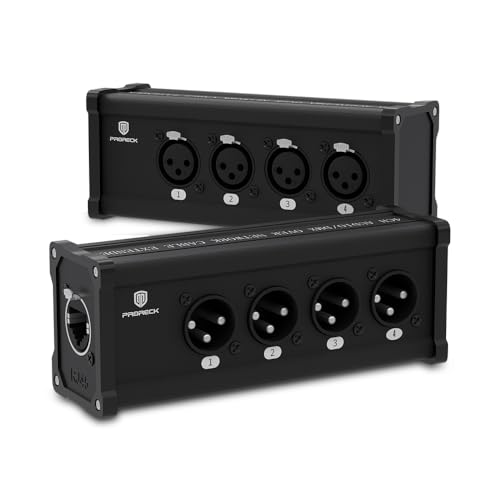
- PRORECK 4-Channel XLR to RJ45 Extender – The PRORECK Extender combines four 3-pin XLR connectors with an Ethercon RJ45 Cat6 interface, ensuring reliable DMX and audio transmission for stage and...
- Professional DMX & Audio Solution by PRORECK – Designed to deliver stable lighting control and crystal-clear sound, this PRORECK extender minimizes interference and signal loss during live...
What to Consider Before Buying a Multi-Channel Recording Snake
A recording snake is more than just an item; it’s a key solution for clean signal path management, reducing stage clutter, and protecting your expensive audio equipment from accidental trips and cable wear. Whether you are running a professional recording studio, managing a house of worship live sound system, or setting up a mobile DJ rig, consolidating multiple signals into a single, unified pipeline is the secret to a professional and reliable workflow.
The ideal customer for this type of product is someone facing frequent mobile setups, working in tight studio spaces, or managing long-distance signal routing where traditional copper cables would be too heavy and expensive. It is perfect for gigging bands, theater technicians, live sound engineers, and AV rental companies. On the other hand, it might not be suitable for those who require massive, permanent installations with dozens of inputs (where digital stage boxes with built-in preamps and network protocols like Dante are more appropriate), or for situations where independent, high-amperage phantom power must be routed to multiple condenser mics without a shared grounding path.
Before investing, consider these crucial points in detail:
- Dimensions & Space: Consider the physical footprint of the stage box. Traditional snakes require dedicated flight cases due to their weight and rigidity, whereas compact RJ45 extenders can fit directly inside a standard backpack or a small drawer in your rack case, dramatically reducing your transport volume.
- Capacity/Performance: Evaluate how many channels you need to run simultaneously. A 4-channel box is the perfect sweet spot for quick stage returns, drum kit overheads, localized keyboard rigs, or a clean run of DMX lighting signals to your main truss.
- Materials & Durability: Look for heavy-duty enclosures made of extruded metal or aluminum. Check whether the XLR connectors are physically screwed into the chassis frame or if they are simply soldered directly to an internal circuit board without external mechanical support, as the latter will break down over time under heavy use.
- Ease of Use & Maintenance: High-contrast, clear numeric labeling on each channel is vital on a dark stage. Additionally, check if the system uses standard RJ45 connections or ruggedized Ethercon jacks, which lock securely in place and prevent accidental disconnects during a live performance.
By understanding these parameters, you can make a highly informed decision that aligns perfectly with your production needs and physical setup limitations.
While the PRORECK 4-Channel XLR Extender is an excellent choice, it’s always wise to see how it stacks up against the competition. For a broader look at all the top models, we highly recommend checking out our complete, in-depth guide:

- 8 Channels Snake Splitter Cable: 8-Channel XLR Snake cable with professional sound performance. It has 8 different channels to the stage box. The XLR connectors on box are female and the fantail...

- 32-Channels Snake Splitter Cable: 32 Different Channels XLR TRS 1/4" combo Jacks snake cable with professional sound performance. It has 2 trunks with male connectors, one is 5 Feet long, another is...

- Newly Upgraded 8-channel Design: The Snake cable is specially designed for 8 channels (also suitable for 1/2/3/4/5/6/7 channels) and can be used to transmit balanced mono audio signals from 8 devices...
First Impressions and Key Features of the PRORECK 4-Channel XLR Extender
Unboxing the PRORECK 4-Channel XLR Extender, we were immediately struck by just how compact and feather-light this unit is. It feels almost impossible that a device this small can successfully replace four long runs of heavy-duty microphone cables. The body is constructed from sleek, extruded anodized aluminum, giving it a modern and rugged appearance that can easily withstand being stepped on or tossed into an accessory bin. Before you deploy it, you will want to see its full feature set and user reviews online to appreciate the smart engineering that went into this design.
One of the first things we checked was the quality of the connectors. The XLR female inputs and male outputs lock securely and have a highly satisfying, robust click when mated with professional cables. Unlike cheaper competitors on the market, the connectors on this unit are directly supported to the face of the chassis by physical screws. This is a massive win for longevity, as it ensures that the mechanical stress of plugging and unplugging cables is absorbed by the aluminum frame rather than the delicate internal solder joints.
Key Advantages
- Extremely lightweight extruded aluminum chassis that reduces gig-bag weight.
- Connectors are physically secured to the faceplate with screws for maximum durability.
- Highly clean, professional direct-solder joint design internally to prevent signal loss.
- Clear, high-contrast numerical markings (1 through 4) for flawless stage patching.
Limitations
- The end caps are made of plastic, which may be vulnerable to extreme crush forces.
- Not recommended for independent +48V phantom power passthrough across multiple channels due to shared grounding.
Deep Dive: Real-World Performance Analysis of the PRORECK 4-Channel XLR Extender
To truly understand how this compact extender holds up, we integrated it into several active production environments, including a multi-instrumentalist recording session and a dynamic DMX-controlled stage lighting setup.
1. Mechanical Engineering and Durability Under Stress
When you are working in live production, gear gets abused. It gets stepped on, dropped from stages, and shoved into crowded road cases. During our hand-on testing of the PRORECK 4-Channel XLR Extender, we paid close attention to its physical limits. The extruded aluminum shell is incredibly rigid, showing absolutely no flexing or bending even when we applied significant direct pressure. We opened up the casing to inspect the internal circuitry and were highly impressed by the clean, professional solder joints.
The fact that the Neutrik-style XLR sockets are secured to the face of the unit with dual screws is a feature usually reserved for much more expensive stage boxes. It means that even after hundreds of patch cycles, the internal connections remain completely isolated from physical strain. While we would have preferred aluminum end caps instead of plastic ones to make the unit completely indestructible, the plastic used is dense and shows no signs of cracking under normal handling. It is wise to check the latest price and availability of this rugged little device to see how much value is packed into this structural design.
2. Signal Integrity, Noise Rejection, and Audio Fidelity
Our primary concern with any passive audio extender that runs multiple channels over a single network cable is signal crosstalk and electromagnetic interference (EMI). We ran a 150-foot shielded Cat6 Ethercon cable from our main tracking room to our console room, patching the PRORECK 4-Channel XLR Extender on both ends. We routed a combination of line-level synthesizer tracks and low-output dynamic microphone signals through the channels.
The results were phenomenal. We detected absolutely zero audible hiss, RF hum, or high-frequency degradation. The passive design introduces no latency whatsoever, ensuring that your audio remains completely pure and phase-coherent. Because Cat6 cables feature tightly twisted pairs, they are naturally highly resistant to external noise, provided you use a high-quality shielded cable. In our experience, this device proved to be just as quiet and transparent as our high-end, traditional copper snake cables, making it a feature that really sets it apart from older, unshielded analog systems.
3. Versatility: Transitioning from Live Sound to DMX Stage Lighting
One of the most powerful aspects of the PRORECK 4-Channel XLR Extender is its cross-functional capability. It is not just an audio tool; it is also a highly efficient DMX 512 distribution block. We tested this by running four independent DMX universes over a single Cat6 cable to our stage trussing. Setting up the lighting rig was incredibly fast. Instead of running four thick, heavy DMX cables up the side of our crank stands, we simply ran one thin, black Cat6 line.
The lighting fixtures responded instantly, with zero flickering, signal dropouts, or command delays. The numbered ports (1, 2, 3, and 4) made it incredibly simple to patch our fixtures to the correct decoder channels without having to trace cables visually. This multi-protocol versatility makes the extender an indispensable Swiss Army knife for mobile DJs, event production companies, and regional theaters alike. We highly recommend you explore this professional-grade hardware extender if you want to clean up your stage layout and drastically speed up your load-in and load-out times.
4. Understanding Grounding Limits and the Phantom Power Caveat
While this extender is an absolute game-changer, it is vital to understand its technical limitations to avoid issues during your performances. Standard RJ45 Ethernet connectors only have eight pins. Since a single balanced 3-pin XLR cable requires three conductors (positive, negative, and ground), a 4-channel snake would technically require twelve individual wires. To overcome this limitation and squeeze four channels into an eight-conductor Cat6 cable, passive extenders must share a common ground pathway through the overall shield of the Ethernet cable.
Because of this shared grounding architecture, we do not recommend using the PRORECK 4-Channel XLR Extender to route +48V phantom power to multiple condenser microphones simultaneously. While it can technically work in a pinch if you use a high-quality, fully shielded Cat6/Cat7 cable, any grounding imbalance can lead to audible crosstalk between channels, hums, or potential power delivery issues to your delicate microphones. For dynamic microphones, line-level instruments, and DMX lighting, this is a non-issue and performs flawlessly, allowing you to upgrade your stage layout and audio routing with absolute ease.
What Other Real Users Are Saying
To ensure our findings align with the broader audio community, we analyzed user experiences from field technicians who rely on this system daily. The consensus is overwhelmingly positive, with multiple professionals highlighting the exceptional build quality relative to its very accessible price point.
One live sound engineer gave the unit an enthusiastic “6-star” endorsement, noting that out of several similar kits they have purchased from various manufacturers, this particular version from PRORECK is by far the best built and represents the greatest overall value. They confirmed our observations regarding the internal build quality, praising the cleanly soldered connections and the critical screw-support on the faceplate. They also noted that Neutrik XLR connectors click smoothly and lock with rock-solid security.
Users consistently mention utilizing these devices with shielded Ethernet cables over long distances to quickly add four auxiliary channels to their main stage boxes or run extra monitor returns to the stage. The only consistent warning echoed by users is the technical limitation regarding phantom power passthrough, reminding prospective buyers that this is a passive system designed around shared-grounding limitations. Despite this constraint, the general user feedback confirms that you can invest in this highly reliable multi-channel interface with complete confidence for your standard audio and lighting needs.
Comparing the PRORECK 4-Channel XLR Extender to Top Alternatives
To help you determine if this is the absolute best fit for your specific gear bag, let’s look at how it compares to three popular traditional alternatives on the market.
1. Hosa 25-Feet Audio Cable


The Hosa Little BRO is a classic, traditional analog copper stage snake featuring a fixed 25-foot length with eight send channels. Unlike our primary modular review product, this Hosa snake is a single, non-customizable unit. While it is highly reliable for permanent, small-room installations—such as routing a drum kit’s close mics to a nearby wall panel—it is incredibly bulky to transport and limited to its fixed 25-foot distance. Those who need modular flexibility where they can run a 10-foot Cat6 cable one day and a 200-foot run the next will find the PRORECK system far superior in adaptability and transport convenience.
2. Seismic Audio 24-Channel XLR Snake Cable

- Model #: SACB-24x8x100
- Sends: 24 XLR Male Connectors
If you are running a massive live concert setup with full band inputs, the Seismic Audio 24-Channel Snake is an absolute workhorse. This is a traditional heavy-duty analog copper snake that spans 100 feet and offers a low-profile circuit board stage box. However, comparing this to our compact PRORECK extender is a matter of scale. The Seismic Audio snake is incredibly heavy, requires multiple people to coil properly, and is highly expensive. It is perfect for permanent concert venues or large festival stages, but for small bands, acoustic duos, or mobile DJs, it is massive overkill that will unnecessarily clutter your transport vehicle.
3. Seismic Audio 12-Channel XLR Snake Cable

- Model Number: SAEM-12x4x50 (12 Channel Snake Cable) 50 feet
- Sends: 12 XLR Male Connectors - Returns: 4 XLR Female Connectors
This 12-channel snake from Seismic Audio provides 12 sends and 4 returns over a 50-foot heavy-duty copper cable run. It features color-coded, clearly labeled connections and is built for medium-sized stage setups. While it offers more channels out of the box than a single 4-channel Ethercon unit, it still suffers from the weight and stiffness of traditional thick-jacketed analog copper lines. For technicians who prefer a lightweight, modular setup, using two or three of our primary PRORECK extenders alongside thin, inexpensive Cat6 lines offers a far more modern, customizable, and back-saving stage configuration.
Our Final Verdict: Is the PRORECK 4-Channel XLR Extender Worth It?
After putting the PRORECK 4-Channel XLR Extender through its paces in real-world live sound and DMX lighting environments, we can confidently say that it is an exceptional, high-value tool that deserves a permanent spot in every audio engineer’s workbox. It elegantly solves the problem of stage cable clutter, replacing heavy, tangled analog copper runs with a single, sleek, and inexpensive Cat6 cable.
While users must keep in mind its passive grounding limitations regarding simultaneous +48V phantom power delivery, its stellar performance with dynamic microphones, instrument lines, stage monitors, and DMX lighting fixtures makes it an absolute winner. The rugged extruded aluminum housing, combined with faceplate-screwed connectors and flawless signal integrity, ensures this unit will survive the rigors of the road for years to come. We strongly suggest you grab your own PRORECK XLR Extender kit today to simplify your setup, save your back, and elevate your production quality to a truly professional level.
Last update on 2026-10-05 / Affiliate links / Images from Amazon Product Advertising API