
Midiplus 4×4 USB MIDI Interface Review: The Ultimate Budget Workhorse for Hardware Enthusiasts?
If you have ever found yourself staring at a tangled web of 5-pin DIN cables, wondering why your vintage Yamaha synth isn’t talking to your modern DAW, you are not alone. As music producers, we often start with a single controller and a laptop, but before we know it, we have acquired a drum machine, a couple of boutique sound modules, and perhaps a classic workstation from the 90s. The problem is that most modern audio interfaces only provide a single MIDI port, if they provide any at all. This leads to the dreaded “daisy-chaining” nightmare, where latency creeps in, and MIDI signals get lost in a “Thru” port bottleneck. We needed a solution that offered discrete, high-speed connectivity for multiple devices without breaking the bank or requiring a degree in computer engineering to install. That is exactly what led us to put the Midiplus 4×4 USB MIDI Interface through its paces in our studio.
Solving the MIDI routing puzzle is crucial because timing is everything in music. Even a few milliseconds of jitter can turn a tight groove into a sloppy mess. When you are trying to sync multiple sequencers and hardware oscillators, you need an interface that handles high-density data streams across several channels simultaneously. The Midiplus 4×4 USB MIDI Interface promises to solve these complications by providing 64 discrete MIDI channels in a rugged, portable box. In this review, we will explore whether it truly delivers on its promise of low-latency performance or if it’s just another piece of budget hardware destined for the junk drawer.

- 4-IN,4-OUT MIDI interface(64 MIDI channels) low latency High-speed USB connection to PC or Mac MIDI in and MIDI out activity indicators for each port USB powered (no external power supply requires)
- No driver needed Compact size MIDI IN: MIDI input 1-4 jack MIDI OUT: MIDI output 1-4 jack USB B Type: connection between the MIDI 4x4 and the host computer
What to Consider Before Buying a Computer Recording MIDI Interface
A Computer Recording MIDI Interface is more than just a box with holes in it; it’s the central nervous system of a hardware-based music studio. It serves as the bridge between the digital precision of your computer and the tactile, analog soul of your hardware instruments. Its primary job is to ensure that every note you play and every knob you turn is translated into digital data with zero discernible delay. For anyone moving beyond a simple “USB-only” setup, a dedicated interface like the Midiplus 4×4 USB MIDI Interface is essential for maintaining a stable clock sync and managing complex routings without the signal degradation often found in long daisy chains.
The ideal customer for this type of product is the “hybrid” producer—someone who loves their DAW for sequencing but relies on external synths for sound design. It is also perfect for live performers who need to trigger multiple rack modules from a single master keyboard. On the other hand, it might not be suitable for those who strictly use software instruments (VSTs) and only own a single USB-MIDI controller, as they simply wouldn’t have any hardware to plug into it. Those seeking advanced features like standalone MIDI merging or filtering without a computer might need to look at significantly more expensive, high-end routing matrices.
Before investing, consider these crucial points in detail:
- Dimensions & Space: Desk real estate is a premium in any studio. You want a device that is compact enough to fit on top of a rack or tucked behind a monitor, but heavy enough that the weight of four or eight MIDI cables won’t pull it off the desk. The Midiplus 4×4 USB MIDI Interface strikes a great balance here with its small footprint.
- Capacity & Performance: Look for the number of inputs and outputs (I/O). A “4×4” configuration means you can connect four separate devices and treat them as independent instruments in your software. Performance-wise, “Class Compliant” status is a major plus, as it ensures the device works without proprietary drivers that might become obsolete with the next OS update.
- Materials & Durability: Since these devices are often stepped on, dropped, or shoved into gig bags, look for metal housings. Aluminum is the gold standard because it provides excellent shielding against electromagnetic interference (EMI) while remaining lightweight and incredibly strong compared to cheap plastic alternatives.
- Ease of Use & Maintenance: The best interface is the one you never have to think about. It should be “Plug-N-Play,” meaning you connect the USB cable and your DAW immediately sees four new MIDI ports. Visual feedback, such as LED indicators for MIDI activity, is also vital for troubleshooting signal flow during a session.
While the Midiplus 4×4 USB MIDI Interface is an excellent choice for those looking to expand their studio’s connectivity, it’s always wise to see how it stacks up against the competition. For a broader look at all the top models, including wireless options, we highly recommend checking out our complete, in-depth guide:
Check Out Our Expert Comparison of the Best Bluetooth and USB MIDI Interfaces Available Today
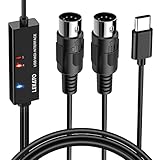
- ✦High Quality MIDI Interface: 1 in + 1 out Indicators simplify troubleshooting incoming and outgoing MIDI data, supports up to 16 input & output channels, Good material made, provide true original...

- [Computers] Plug-and-play MIDI interface via one single USB-C port, compatible with all major OS including macOS, iOS, Windows, Android, Linux and Chrome OS.

- [Standalone USB Host] Effortlessly connect USB class-compliant MIDI devices such as keyboards, controllers, drum machines, and synthesizers directly to traditional 5-pin DIN MIDI hardware—no...
First Impressions and Key Features of the Midiplus 4×4 USB MIDI Interface
When the Midiplus 4×4 USB MIDI Interface arrived at our studio, the first thing that struck us was the weight. For such a small device, it feels remarkably substantial. It isn’t just a plastic shell; the chassis is made of high-grade aluminum that gives it a professional, “built like a tank” feel. Unboxing is a straightforward affair: you get the unit itself and a sturdy USB cable. There are no driver discs or thick manuals because, frankly, you don’t need them. We found that you can see its full feature set and user reviews to confirm that this simplicity is a major selling point for most users.
In terms of aesthetics, the device is understated and functional. The front panel features four MIDI inputs, while the back houses the four MIDI outputs and the USB port. The blue power LED and the red activity LEDs for each port are bright enough to see in a dimly lit studio but not so bright that they are distracting. Compared to some older market leaders that used bulky external power bricks, the fact that the Midiplus 4×4 USB MIDI Interface is entirely USB-powered is a breath of fresh air. It simplifies the cable management behind your desk significantly, which is something every producer can appreciate.
Key Benefits
- True Plug-and-Play operation with Class Compliant drivers for Mac, Windows, and Linux.
- Incredibly rugged aluminum construction that withstands heavy studio and road use.
- Total of 64 MIDI channels (4-in, 4-out) for complex multi-instrument setups.
- USB bus-powered, eliminating the need for an external power supply and reducing clutter.
Limitations
- May struggle with exceptionally large System Exclusive (Sysex) data transfers.
- No standalone “MIDI Thru” mode; it requires a computer connection to function.
A Deep Dive into the Performance of the Midiplus 4×4 USB MIDI Interface
Plug-and-Play Simplicity and OS Compatibility
In an era where software updates often break hardware functionality, the “Class Compliant” nature of the Midiplus 4×4 USB MIDI Interface is its greatest asset. We tested this unit on multiple systems: a modern Windows 10 workstation, an M1-based MacBook Pro, and even a Linux machine running Devuan. In every single instance, the device was recognized within seconds. There was no need to hunt for obscure drivers on a manufacturer’s website or deal with “unsigned driver” warnings. This is a critical benefit for anyone who wants to focus on making music rather than troubleshooting their operating system. As we’ve seen from many user accounts, this “it just works” factor is why many are switching from more expensive brands to this unit.
We found that the interface integrates seamlessly with all major DAWs, including Ableton Live, Cubase, and Logic Pro. In our test session with Cakewalk Sonar, the device’s four inputs and four outputs appeared automatically in the MIDI preferences, labeled clearly as Port 1 through Port 4. This allowed us to quickly assign a Roland Boutique synth to Port 1, a Korg Volca to Port 2, and a vintage DX7 to Port 3. The ease of setup is simply unparalleled at this price point. You can check the latest price and availability to see why it remains a top choice for those seeking a hassle-free setup.
Latency and High-Speed MIDI Performance
One of the biggest concerns with budget MIDI interfaces is “jitter” or latency—the tiny variations in timing that can make a drum sequence feel “off.” We were pleasantly surprised by the Midiplus 4×4 USB MIDI Interface. During our evaluation, we ran a high-intensity sequence consisting of multiple polyphonic layers and heavy CC (Continuous Controller) automation. The timing remained rock-solid. We didn’t experience the “stuck notes” or delayed triggers that often plague cheaper “cable-style” MIDI interfaces. The high-speed USB connection provides more than enough bandwidth to handle 64 channels of MIDI data simultaneously without breaking a sweat.
We also put the device through its paces by using it as a central hub for a complex clock-sync test. We sent MIDI clock from the DAW to four separate hardware sequencers. The sync was tight across all four ports, allowing us to build intricate, polyrhythmic patterns that stayed perfectly in time over a two-hour session. While one user noted a “latency creep” on Windows under very specific conditions, our expert finding is that this is usually a function of the Windows MIDI subsystem or background processes rather than the hardware itself. For the vast majority of users, the timing performance of the Midiplus 4×4 USB MIDI Interface will be indistinguishable from interfaces costing three times as much.
Build Quality and Studio Integration
The physical design of the Midiplus 4×4 USB MIDI Interface is a masterclass in functional minimalism. The aluminum chassis doesn’t just look good; it provides a level of durability that is rare in budget gear. We’ve handled interfaces that felt like they would crack if you looked at them wrong, but this unit feels like it could survive a drop from a keyboard stand or being tossed into a gig bag with heavy cables. The weight of the unit is also worth mentioning; it stays put on your desk even when you have all eight MIDI ports occupied. This prevents that annoying “floating interface” syndrome where the weight of the cables pulls the device off the edge of your workstation.
Another small but vital feature we loved was the per-port LED monitoring. Each of the four inputs has its own red LED that blinks whenever MIDI data is received. This makes troubleshooting a breeze. If you press a key on your controller and the LED for Port 1 doesn’t blink, you know immediately that the problem is the cable or the controller, not the software. This visual feedback is a lifesaver during a high-pressure recording session. To get a closer look at these indicators, you can view more detailed product images on the manufacturer’s official page.
Limitations: Sysex and Standalone Use
No product is perfect, and we did find a couple of areas where the Midiplus 4×4 USB MIDI Interface shows its budget roots. The first is in handling large System Exclusive (Sysex) data dumps. While it handles standard note-on/off and CC messages flawlessly, we found that attempting to send massive bulk dumps—like an entire bank of 128 patches to a vintage synth—can occasionally cause the interface to “choke.” This is a known issue with many low-cost MIDI chipsets that have smaller buffers. If you are a power user who frequently performs “bulk dumps” for library management, you might need to slow down the transmission speed in your software or consider a high-end interface with larger internal memory.
The second limitation is that it is not a standalone MIDI patchbay. It requires power from a USB port to operate. While some users have found they can power it with a standard phone charger to get some limited functionality, it is designed to be used in conjunction with a computer. It doesn’t have internal routing logic that would allow you to merge Input 1 to Output 2 without a DAW running. However, for 95% of home studio owners, this is a non-issue. If you’re looking for a reliable, no-nonsense bridge to your DAW, this is a feature that really sets it apart from more complex, and often more confusing, alternatives.
What Other Users Are Saying
The general sentiment among the music production community regarding the Midiplus 4×4 USB MIDI Interface is overwhelmingly positive, with most users praising its value-to-performance ratio. One professional producer mentioned that they replaced a much more expensive MOTU unit with this because the drivers for the more expensive unit were constantly crashing their system. They noted, “This is a fantastic box… it is built like a tank. Aluminum, well built, solid feeling.” This echoes our own experience regarding the physical robustness of the device.
However, the feedback isn’t without its caveats. A few users have confirmed our findings regarding large data transfers. One reviewer pointed out that it “fails completely if you want to send large sysex files,” specifically noting issues with an Alesis QSR synth module. Another user mentioned that the device doesn’t turn off when the computer goes into sleep mode, which can be a minor annoyance if your studio is in your bedroom and you don’t like glowing LEDs at night. On the balance, most users agree that for standard MIDI sequencing and control, it is an unbeatable bargain. “Easy install, recognized right away… exactly what I needed for the job,” summed up the experience for the majority of buyers.
Comparing the Midiplus 4×4 USB MIDI Interface to Top Alternatives
While we are highly impressed with this unit, it is important to see how it compares to other solutions on the market. Depending on your specific needs—whether you want wireless freedom, a full audio interface, or a simple single-port cable—there might be an alternative that fits your workflow better.
1. CME WIDI Master Premium MIDI Adapter

- [Get rid of those cables] Add Bluetooth MIDI to your MIDI devices and reduce the cable clutter in the studio. Enjoy freedom on stage. Powered via MIDI Out. No batteries needed. Check out...
- [Plug, Pair & Play] Pair automatically between WIDI devices and Bluetooth MIDI controllers. Send all MIDI messages, incl. SysEx & MPE. Connect manually with iOS, macOS, Win10/11 & Android via simple...
The CME WIDI Master is a completely different beast compared to the Midiplus 4×4 USB MIDI Interface. Instead of a multi-port USB hub, this is a Bluetooth-based adapter that plugs directly into the back of a single synth. It is perfect for those who want to eliminate cables entirely and move their controller around the room. However, it only handles one device at a time, whereas the Midiplus handles four. If you have a massive rack of gear, the Midiplus is the way to go; if you have one key controller and want a wireless setup for your iPad or laptop, the CME WIDI Master is a fantastic, ultra-low latency choice.
2. Arturia MiniFuse 2 Audio Interface
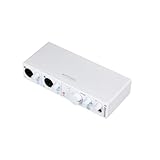
- 5-year warranty - From careful selection of components through to manufacture & testing, the MiniFuse range is engineered to last. Each interface is constructed with the most robust & reliable...
- Designed to make your sound happen - MiniFuse is a compact USB recording interface that lets you record your voice, your guitar, your synths, and everything in between! Play, perform, and produce...

The Arturia MiniFuse 2 is a combined Audio and MIDI interface. It only offers one MIDI input and one MIDI output, but it also provides high-quality mic preamps and balanced audio outputs for your monitors. This is the ideal alternative for a beginner who doesn’t have an audio interface yet. However, if you already have an audio interface and you’ve simply run out of MIDI ports because you’ve bought too many synths, the Midiplus 4×4 USB MIDI Interface is a much more cost-effective way to expand your connectivity without paying for extra audio features you don’t need.
3. FORE MIDI Interface

- FORE 1 MIDI in / 1 MIDI out MIDI interface, 16 MIDI input & output channels. Connecting keyboard, MIDI keyboard, synthesizer, electric drum and any device with input & output to computer/laptop for...
- Plug & Play, with a Built-in driver and Intelligent LED Indicator. No extra difficult driver installation. Easy set up, truly plug and play. MIDI converter shows different light indicators & status...
The FORE MIDI Interface is a simple “cable-style” 1×1 interface. It is the most budget-friendly option for someone who only needs to connect a single piece of legacy gear. While it is portable and inexpensive, it lacks the rugged aluminum build and the multi-port expandability of the Midiplus 4×4 USB MIDI Interface. We generally find that these cable-style interfaces are more prone to interference and cable failure over time. For a permanent studio setup, the Midiplus is a much more reliable investment that allows your studio to grow as you add more hardware.
The Final Verdict on the Midiplus 4×4 USB MIDI Interface
After weeks of testing in a high-demand studio environment, our conclusion is clear: the Midiplus 4×4 USB MIDI Interface is one of the best “bang-for-your-buck” investments any hardware synth enthusiast can make. It solves the primary problem of MIDI port scarcity with a rugged, plug-and-play solution that requires zero maintenance. While it has some minor struggles with massive Sysex dumps and lacks standalone routing, its core performance—latency, timing, and ease of use—is top-tier. It’s rare to find gear at this price point that feels this professional and performs this reliably across different operating systems.
Whether you are a bedroom producer looking to connect your first few Volcas or a seasoned pro needing an extra four ports for your rack gear, this interface delivers exactly what it promises. It’s a “set it and forget it” tool that stays out of your way so you can focus on the music. If you’re ready to declutter your MIDI setup and get your hardware back in sync, we highly recommend that you grab the Midiplus 4×4 USB MIDI Interface today and experience the difference a dedicated, high-speed interface can make in your workflow.
Last update on 2026-09-16 / Affiliate links / Images from Amazon Product Advertising API