
Fiddlerman Carbon Fiber Violin Shoulder Rest Review: Lightweight Comfort Meets Modern Ergonomics
If you have ever spent hours practicing shifting exercises, complex bowings, or long orchestra rehearsals, you know the grueling physical toll a poorly fitted violin setup can take on your neck, shoulder, and back. For months during my own practice routine, I struggled with persistent tension along my left collarbone and upper trapezius. Every time I tried to hold the violin securely without clamping down with my jaw, the instrument would slip, forcing me to hitch my left shoulder upward. This unnatural posture not only restricted my left-hand finger agility, making vibrato feel rigid and stiff, but it also left me with deep aches at the end of every practice session.
Finding a shoulder rest that provides a secure grip, custom height adjustment, and proper ergonomic contour without dampening the acoustic resonance of your instrument is often an arduous trial-and-error process. A poorly designed shoulder rest can weigh down your instrument, deaden its natural tone, or worse, slip off mid-performance and scratch your delicate varnish. That critical search for an ultra-lightweight, comfortable, and stable support system led us directly to test the Fiddlerman Carbon Fiber Violin Shoulder Rest. In this detailed review, we explore whether this hybrid carbon-composite accessory truly solves the age-old dilemma of ergonomic comfort versus uninhibited acoustic projection.

- CUSTOM FIT: The Fiddlerman Violin Shoulder Rest includes height adjustable feet for a custom fit. The feet are slightly height adjustable.
- WORKS FOR VIOLINS AND VIOLAS: Designed to fit 4/4 and 3/4 Violins but can also fits 13" and 14" Violas.
What to Consider Before Buying a Violin Shoulder Rest
A violin shoulder rest is far more than just a piece of plastic or wood clamped to the back of your instrument; it is a vital structural interface between the player’s body and the instrument. The right shoulder rest fills the physiological gap between your jaw and collarbone, enabling a natural, upright playing posture without requiring excessive clamping pressure. By stabilizing the violin at a comfortable angle, a well-engineered support system liberates your left hand to glide effortlessly across the fingerboard, facilitating smoother position shifts, faster fingerwork, and relaxed, fluid vibrato.
The ideal customer for the Fiddlerman Carbon Fiber Violin Shoulder Rest is an intermediate to advanced violinist, student, or gigging musician seeking a lightweight, highly durable support option that minimizes body tension without sacrificing aesthetic elegance. It is particularly beneficial for players using lightweight acoustic violins or modern electric models who wish to avoid adding unnecessary bulk. Conversely, players with exceptionally long necks who require ultra-tall vertical extension bars, or those who prefer heavy, thick memory-foam cushions, might find a fully custom orthotic rest or a heavy-duty contoured metal unit more suitable.
Before investing, consider these crucial points in detail:
- Dimensions & Space: Consider the arch and width profile of the shoulder rest relative to your instrument’s lower bouts and your own shoulder width. A rest that is too rigid or broad can slip off lower bouts, while one that is too narrow may pinch the ribs of your violin. Additionally, compact dimensions ensure the shoulder rest fits inside standard violin case accessory compartments or instrument hood pockets without requiring complete disassembly every time you pack up. You can check current pricing and real-time availability to evaluate sizing specifications for your instrument.
- Capacity & Performance: Evaluate how effectively the accessory balances hold-stability with acoustic freedom. A heavy shoulder rest absorbs sound energy directly from the back plate, muffling tone and dampening projection. A high-performing rest maintains minimal surface contact with the instrument’s purfling and edge, allowing the wood to vibrate freely while offering enough leverage to hold the violin effortlessly horizontally.
- Materials & Durability: Look closely at the structural materials of both the main bridge body and the end feet. High-tech carbon fiber and polymer composites offer superior strength-to-weight ratios compared to traditional dense hardwoods or cheap solid plastics. Durability also extends to the rubber or silicone grips on the feet; soft, non-marring compounds prevent varnish damage, while sturdy internal screw threads prevent stripping over years of height adjustments.
- Ease of Use & Maintenance: Consider how simple the unit is to adjust, assemble, and customize to your neck height. Swiveling feet, intuitive height screws, and easily replaceable foam pads mean you spend less time fussing with hardware adjustments before a concert and more time playing comfortably. Long-term maintenance should require nothing more than an occasional wipe down with a microfiber cloth.
While evaluating these critical factors, it is always wise to compare how different body designs impact your posture and freedom of movement before making a final commitment.
While the Fiddlerman Carbon Fiber Violin Shoulder Rest is an excellent choice, it’s always wise to see how it stacks up against the competition. For a broader look at all the top models, we highly recommend checking out our complete, in-depth guide:

- THE PERFECT FIT: The Fiddlerman Violin Shoulder Rest includes height adjustable feet for a custom fit. The feet are also collapsible for easy storage in violin cases.

- Compatible With 4/4 & 3/4 Violin: Height, width, angle can all be adjusted by the screws available on both sides, fit 4/4 and 3/4 violin sizes, as well as 13" or 14" violas. Traditional areas of high...

- 🎻 REAL MAPLE WOOD SHOULDER AND CHIN REST - The MIVI Classic Maple Wood Violin Shoulder Rests is made from genuine maple hardwood construction to offer a more natural and comfortable experience...
Unboxing and First Impressions of the Fiddlerman Carbon Fiber Violin Shoulder Rest
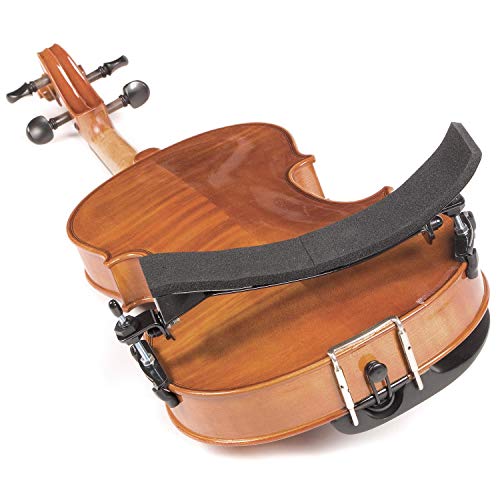
Unboxing the Fiddlerman Carbon Fiber Violin Shoulder Rest immediately reveals Fiddlerman’s focus on practical, performance-driven design. Upon removing the unit from its packaging, the first thing that strikes you is its extraordinary lack of weight. Weighing in at an astonishingly light 0.64 ounces, it feels practically weightless in the hand. The main arch is constructed from a specialized sleek carbon/polymer composite material. While it sports a faux wood-look finish overlaid across the top body, the underlying carbon structure provides a rigid, low-mass core engineered to survive daily transport in student gig bags and professional instrument cases alike.
Inspecting the hardware, the height-adjustable feet feature soft, durable rubber feet designed to firmly grip the violin’s rim without digging into or dulling the instrument’s delicate varnish. The pre-attached dense foam padding running along the underside is neatly cut, contoured, and secured tightly against the arch. Before attaching it to our test instruments, we felt eager to test whether this modern composite bridge could deliver both rock-solid stability and acoustic warmth. To examine its detailed design specifications further, taking a look at its foot mounting assembly is a great starting point.
What We Like
- Extremely lightweight carbon/polymer composite construction weighing under 0.7 ounces
- Anatomically contoured S-curve shape offers natural shoulder leverage and holding stability
- Durable, varnish-safe rubber feet hold the instrument securely without slipping or scratching
- Faux-wood finish provides a classic aesthetic while retaining high-tech material strength
What We Didn’t Like
- Initial foot screw insertion into body holes can require firm alignment effort
- Padding layer is sleek and minimal, which may require adjustment for players wanting extra cushioning
A Deep Dive into Hands-On Performance and Daily Usability
1. Ergonomic Contour and Natural Shoulder Support
When evaluating any shoulder rest, ergonomic geometry is the absolute baseline of functionality. During our intensive hands-on testing sessions with the Fiddlerman Carbon Fiber Violin Shoulder Rest, the immediate highlight was the pronounced wave contour of the bridge. Unlike flat or barely curved budget rests that sit awkwardly on top of the collarbone, the main body of this unit features a flowing, asymmetrical S-curve. This specific arch naturally wraps over the crest of the left shoulder and hooks gently beneath the collarbone. As a result, the physical strain required to keep the instrument parallel to the floor is dramatically reduced.
In practice, this tailored contour allows you to completely release tension in your left arm and shoulder blade. We tested this by setting up a series of shifting exercises from first position all the way up to seventh position. Because the rest hooks gently over the shoulder without pinching, the violin stayed rock-steady even during fast downward shifts, which is typically when an ill-fitting shoulder rest slides out of position. You can instantly let go of the fingerboard with your left hand, and the violin remains securely balanced between your chin and collarbone. For players who struggle with fatigue during extended practice sessions, this ergonomic shape offers an immediate boost in leverage and relaxation. To see how this shape compares to standard setups, you can see full product specs and user ratings online.
Furthermore, the ergonomic shape proves impressively versatile across various body types. While shoulder anatomy varies widely from player to player—some having narrow shoulders with sharp collarbones and others possessing wider, flatter upper torsos—the curvature of the arch balances body weight distribution effectively. Rather than concentrating pressure on a single point on the collarbone, the frame spreads the weight across a broader surface area, preventing localized bruising and posture compensation during long rehearsals.
2. Structural Integrity: Carbon Composite Strength vs. Acoustic Resonance
One of the primary concerns classical musicians have when choosing accessories is acoustic dampening. Massive wooden or dense plastic shoulder rests add bulk to the back of the violin, acting as a dampening pad that mutes high-frequency harmonics and diminishes overall projection. The Fiddlerman Carbon Fiber Violin Shoulder Rest addresses this challenge through its ultra-light carbon/polymer composite frame. At a featherlight 0.64 ounces, adding this rest to a 4/4 violin introduces virtually no felt mass to the instrument body.
During acoustic testing with a high-end bench-crafted acoustic instrument, we evaluated tone production both with and without the rest attached. The results were remarkably transparent. Because the composite material is rigid yet exceptionally light, it absorbs minimal vibrational energy from the instrument’s back plate. The violin maintained its bright, complex overtones, ringing projection, and quick bow response across all four strings. The lower register retained its deep warmth, while the upper E-string brilliance remained uninhibited. You can investigate this lightweight shoulder rest to see why modern composite materials are rapidly becoming a preferred choice for studio and stage players alike.
Additionally, the strength of the carbon polymer composite body ensures long-term structural integrity. Traditional wood rests can crack along the grain lines if dropped on a stage floor or squeezed too tightly inside an overloaded accessory pocket. Plastic models often bow and bend flexingly under pressure, causing the feet to splay outward and slip off the instrument mid-song. The carbon frame of the Fiddlerman Carbon Fiber Violin Shoulder Rest maintains rigid structural tension under normal playing force, ensuring that the distance between the gripping feet remains fixed and stable at all times.
3. Foot Grip Stability, Threading Precision, and Height Adjustability
A shoulder rest is only as reliable as its clamping system. The Fiddlerman Carbon Fiber Violin Shoulder Rest utilizes metal screw-threaded mounting feet clad in flexible, non-marring rubber boots. The soft rubber compounds on the feet are specifically formulated to grip the varnish along the hard edges of the upper or lower bouts securely, preventing unexpected slippage without leaving unsightly dull spots or sticky residues on soft oil or spirit varnishes. Throughout our multi-week test period, the feet remained firmly anchored, even when performing energetic spiccato passages or forceful accents.
Height adjustment is achieved by rotating the threaded foot stems into the multi-hole mounting brackets on either end of the composite arch. This allows players to raise or lower the pitch angle of the violin relative to their chin, as well as customize the resting height on both the neck side and shoulder side independently. Fine-tuning these angles is critical for achieving a natural chin-rest fit without straining the sternocleidomastoid neck muscles. To review exact height ranges and fitting options, you can explore the height adjustable options directly.
It is worth noting, however, that the initial assembly phase requires a careful hand. Because the threaded holes in the composite arch are manufactured with tight tolerances to prevent wobble during play, turning the foot screws into the body holes during first-time assembly can feel stiff. We found that aligning the threads carefully at a straight 90-degree angle before screwing them down ensures a clean fit without cross-threading. Once threaded into position, the connection is solid, virtually eliminating foot wobble or rattling during performance.
4. Aesthetic Finishes, Foam Padding, and Instrument Safety
Visual appeal matters on stage, and Fiddlerman has designed this rest with a faux-wood aesthetic that offers the timeless look of traditional polished maple while retaining all the structural advantages of high-tech composites. From a distance of just a few feet, the realistic varnish print blends seamlessly with the ribs and back plate of a fine instrument, giving it an understated, professional look under stage lighting.
On the underside, the rest features closed-cell dense foam padding engineered for comfort and durability. Rather than using soft, squishy open-cell foam that compresses flat under minor pressure, this high-density foam offers support that maintains its shape. It cushions the collarbone effectively without bottoming out against the rigid composite arch underneath. You can read more about its foam padding features to understand how it maintains structural cushioning over extended use.
Instrument safety is further reinforced by the deep curve of the end feet. The legs hook cleanly over the purfling area of the violin’s lower bout, ensuring that no metal hardware ever comes into direct contact with the instrument’s wooden body. Even if you press down heavily on the instrument, the bottom of the composite arch stays elevated well above the back plate, maintaining a safe clearance gap that preserves your violin’s structural finish.
What Other Users Are Saying
To supplement our hands-on evaluation, we analyzed extensive feedback from musicians who have integrated the Fiddlerman Carbon Fiber Violin Shoulder Rest into their daily practice and performing routines across acoustic and electric violins alike. The overwhelming consensus highlights its outstanding value-to-performance ratio and comfortable ergonomic shape.
Many users who play modern electric instruments—such as the Yamaha SV250 or Yamaha YEV 104—praise this shoulder rest for making their setups feel significantly lighter and more ergonomic. Electric violins are notoriously heavier than traditional acoustic instruments, and players frequently note that adding this light composite rest balances the instrument’s weight without adding unnecessary bulk. Acoustic players similarly celebrate the ergonomic contouring, with several noting that its curve allows them to let go of the fingerboard entirely without the instrument slipping, solving long-standing posture and dropping issues.
On the flip side, some users noted minor installation hurdles during initial setup. A few players reported that screwing the threaded grips into the body holes required noticeable hand force and patience during unboxing. A small minority of players with unique collarbone anatomy felt the padding was somewhat thin compared to plush, oversized sponge rests, occasionally experiencing mild pressure points after multiple hours of uninterrupted playing. However, most players agree that once the feet are adjusted to the correct position and height, the rest delivers exceptional stability, durability, and functional performance that punches far above its price tag. You can view updated customer feedback to see how other musicians evaluate its daily comfort.
Comparing the Fiddlerman Carbon Fiber Violin Shoulder Rest to Leading Competitors
1. Bon Musica 4/4 Violin Shoulder Rest
- Fits 4/4 Violin
- Height and Width Adjustable
The Bon Musica 4/4 Violin Shoulder Rest is a heavily customizable, metal-framed rest designed for players who need extreme, tailor-made physical support. Featuring a flexible aluminum hook that can be physically bent over the player’s shoulder, it locks the instrument firmly in place, making it a favorite among musicians recovering from neck injuries or those requiring maximum stability. However, compared to the sleek, featherlight Fiddlerman Carbon Fiber Violin Shoulder Rest, the Bon Musica is considerably heavier and bulkier. While the Bon Musica excels in rigid posture control, the Fiddlerman rest offers far superior freedom of movement, lighter weight, quicker mounting, and minimal acoustic dampening for players who prefer a less restrictive hold.
2. EVEREST EZ-4A Violin Shoulder Rest

The EVEREST EZ-4A Violin Shoulder Rest is one of the most popular entry-level models on the market, known for its fixed plastic design, vibrant color options, and budget-friendly price point. Built from a single piece of molded ABS plastic, the Everest is incredibly durable and easy for young students to manage. However, its fixed curve lacks the refined ergonomic tapering found on the Fiddlerman Carbon Fiber Violin Shoulder Rest. Furthermore, the Everest’s heavier plastic body can dampen instrument vibration slightly more than Fiddlerman’s ultra-light carbon/polymer composite material. Players stepping up from a beginner setup will find the Fiddlerman rest offers a lighter feel, superior tone projection, and a far more professional aesthetic finish.
3. Kun Original Shoulder Rest 1/2 & 3/4 Violin
The Kun Original Shoulder Rest remains an industry standard across music schools and conservatories worldwide. Featuring a classic curved bar design with simple fold-down or standard height-adjustable feet, the Kun is reliable and widely accessible. However, when comparing build materials, the carbon composite design of the Fiddlerman Carbon Fiber Violin Shoulder Rest offers a noticeably lower overall mass and enhanced structural rigidity compared to the standard plastic bar of the Kun Original. Players who enjoy the traditional shape of a Kun-style rest but want a lighter accessory that preserves full acoustic resonance will find the Fiddlerman rest to be an exceptional modern upgrade.
Final Verdict: Is the Fiddlerman Carbon Fiber Violin Shoulder Rest Worth It?
After testing and thorough evaluation, the Fiddlerman Carbon Fiber Violin Shoulder Rest stands out as an impressive fusion of modern material engineering, ergonomic comfort, and exceptional value. By leveraging a high-strength carbon/polymer composite frame, Fiddlerman has succeeded in creating a shoulder rest that weighs less than 0.7 ounces while remaining rigid, durable, and highly supportive. Its anatomical S-curve arch cradles the shoulder naturally, liberating your left hand for fluent technique, relaxed vibrato, and swift shifting across all positions.
While installing the threaded feet during initial unboxing can require a bit of patience and firm alignment, the payoff is a rock-solid, wobble-free fit that protects your instrument’s finish while maximizing its natural tone and projection. Whether you are an advancing student looking to eliminate neck strain, a gigging violinist playing long outdoor events, or an electric violin enthusiast seeking to lighten your overall rig, this accessory delivers top-tier performance at a very accessible price point. If you are ready to upgrade your playing posture and enjoy weightless support, we highly recommend that you secure your Fiddlerman Carbon Fiber Violin Shoulder Rest today and experience the ergonomic difference for yourself.
Last update on 2026-10-24 / Affiliate links / Images from Amazon Product Advertising API