
Marshall Dsl20hr Tube Guitar Amp Head Review: The Ultimate Balance of Iconic British Growl and Modern Versatility
For decades, the “Marshall Stack” has been the visual and sonic backdrop of rock and roll. But for most of us, owning a 100-watt Plexi or a JCM800 isn’t just a financial hurdle; it’s a logistical nightmare. We’ve all been there: you want that thick, harmonically rich tube saturation, but you’re playing in a spare bedroom or a small club where anything past “2” on the volume knob results in a knock from the neighbors or a frustrated sound engineer. The struggle to find a real tube amp that offers genuine British grit at manageable volumes is what led us to spend weeks evaluating the Marshall Dsl20hr Tube Guitar Amp Head. When we set out to find a solution that wouldn’t compromise on tone just to save on space, we realized that the “all-tube” experience is often lost in smaller, digital “practice” amps. Solving this problem isn’t just about convenience; it’s about preserving the inspiration that only comes when you feel the air moving from a high-quality valve circuit. Failing to find the right balance usually leads to a “fizzy” tone that lacks the punch and soul required for serious playing.
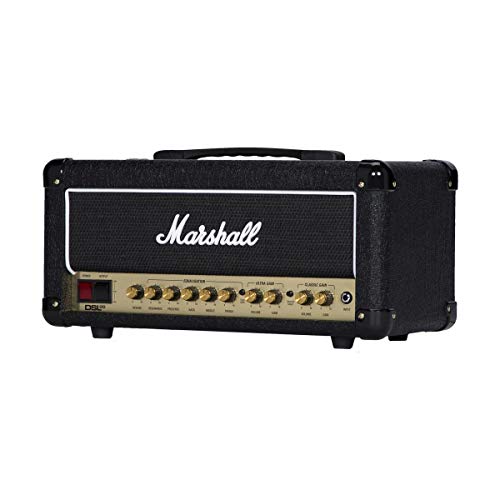
- Marshall Dsl20hr 20W Tube Guitar Amp Head
What to Consider Before Buying an Electric Guitar Amplifier Head
An Electric Guitar Amplifier Head is more than just an item; it’s a key solution for guitarists who want to separate their sound engine from their speakers. Unlike a combo amp, a head offers the flexibility to pair your “brain” with different cabinets—a 1×12 for home practice or a 4×12 for the stage. This category of gear is designed to provide the core tonal character, gain structure, and power management that defines your musical identity. Choosing a tube head specifically ensures you get the dynamic response and “bloom” that solid-state or digital modeling often struggles to replicate perfectly.
The ideal customer for this type of product is someone facing the transition from a beginner setup to a professional-grade rig, or a seasoned pro who needs a portable, reliable “fly-rig” that still delivers authentic analog heat. It’s perfect for the recording musician who needs a quiet signal path and the gigging guitarist who is tired of hauling 80-pound combos. However, it might not be suitable for those who strictly play through headphones and prefer the infinite “preset” variety of a digital modeler, as a tube head requires a speaker load or a dedicated load box to function safely. If you are looking for something strictly for ultra-low volume “silent” practice without any external gear, you might consider a high-end plugin or a dedicated headphone amp instead.
Before investing, consider these crucial points in detail:
- Dimensions & Space: Consider where the amp will live. A head like the Marshall Dsl20hr Tube Guitar Amp Head is compact, but it still requires a footprint for the cabinet underneath. Measure your desk or rehearsal space to ensure you have enough clearance for ventilation, as tube amps generate significant heat during operation.
- Capacity & Performance: Wattage is key. While 20 watts might sound low compared to a 100-watt monster, in the tube world, 20 watts is incredibly loud. Look for “power reduction” features that allow you to drop the output for home use without losing the “pushed” tube feel.
- Materials & Durability: Look for a solid chassis and quality transformers. The weight of a head often tells a story about its components. While some modern heads are getting lighter, the best ones still use robust housing to protect the fragile glass valves inside from the rigors of the road.
- Ease of Use & Maintenance: Consider the layout. Are the controls intuitive? Also, remember that tubes are a consumable part. A good amp should have easily accessible tubes for when they inevitably need replacing after a few years of heavy use.
Understanding these factors will help you determine if a dedicated head-and-cab setup is right for your workflow. While the Marshall Dsl20hr Tube Guitar Amp Head is an excellent choice, it’s always wise to see how it stacks up against the competition. For a broader look at all the top models, we highly recommend checking out our complete, in-depth guide:
- Channel Switching & Independent Control: The BanTamp XL series features a dedicated footswitch for channel switching and six knobs. This allows you to independently control both the CLEAN and...


- Channel Switching & Independent Control: The BanTamp XL series features a dedicated footswitch for channel switching and six knobs. This allows you to independently control both the CLEAN and...
First Impressions: Unboxing the Marshall Dsl20hr Tube Guitar Amp Head
The moment we pulled the Marshall Dsl20hr Tube Guitar Amp Head out of its packaging, it was clear that Marshall hasn’t lost their touch for aesthetics. It carries that iconic black Tolex, gold faceplate, and the script logo that instantly commands respect. At 26 pounds, it feels substantial—heavy enough to feel “expensive” and well-built, but light enough to carry from the car to the stage with one hand. We were impressed by the solid feel of the potentiometers; they have a smooth, weighted resistance that suggests high-quality components. Before you even plug it in, you should see its full feature set and user reviews to understand the modern refinements Marshall has baked into this legendary series. Compared to the older DSL15, this version feels more “pro,” with the addition of a proper EQ section and better connectivity options. The initial look and feel suggest a piece of gear that is ready for both the bedroom and the dive bar tour.
Key Benefits
- Authentic Marshall EL34 tube tone that ranges from shimmering cleans to high-gain roar.
- Power reduction switch (20W to 10W) makes it exceptionally versatile for home and stage.
- Comprehensive EQ including Presence and Resonance controls for deep tonal sculpting.
- High-quality series effects loop that remains transparent and quiet even with multiple pedals.
Limitations
- The built-in digital reverb is quite subtle; players wanting “surf” levels of wash will need a pedal.
- Ultra Gain channel can become “fizzy” if the gain is maxed out past 2 o’clock without EQ adjustment.
A Deep Dive into the Performance of the Marshall Dsl20hr Tube Guitar Amp Head
Tonal Versatility: From Classic Plexi to Modern Metal
The heart of the Marshall Dsl20hr Tube Guitar Amp Head is its two-channel design: Classic Gain and Ultra Gain. During our testing, we spent the first few hours on the Classic Gain channel. With the gain set low, it provides a surprisingly headroom-heavy clean that is “chimey” rather than “sterile.” As we pushed the gain past noon, we found that “edge-of-breakup” sweet spot that is perfect for blues and classic rock. One user noted that with an LP or SG, setting the gain to 3 o’clock produces a “fantastic blues tone,” and we have to agree. It captures the bark and growl of a vintage Marshall without requiring ear-splitting volumes.
Switching over to the Ultra Gain channel is where the “DSL” (Dual Super Lead) DNA really shows. This channel is a beast. It offers a massive amount of saturation. We found that for modern hard rock and GNR-style tones, you don’t actually need to max the gain. In fact, keeping it between 10 o’clock and 1 o’clock provides the best clarity. Some users have reported a “fuzzy” mess on this channel, but we found that by backing off the gain and utilizing the EQ, those issues disappear. It’s a professional tool that requires a bit of “dialing in” to find the sweet spot, but once you do, it delivers a fat, massive sound that punches through a mix with ease. To see how others are dialing in these heavy tones, you can explore the detailed specifications and user feedback here.
Power Management: The 20W/10W Split
One of the most critical features of the Marshall Dsl20hr Tube Guitar Amp Head is the power reduction switch. In the 20W mode, this amp is surprisingly loud. We ran it through a 2×12 cabinet and it easily kept up with a heavy-hitting drummer during a rehearsal. It has enough “thump” and headroom to work for small to medium-sized gigs without needing to be mic’d up. However, for those of us living in apartments, the 10W mode is a godsend. Unlike some power soaks that dull the high end, Marshall’s implementation feels very natural.
We found that at 10W, the power tubes compress a bit earlier, giving you that “cranked” feel at much lower decibel levels. This makes it “VERY usable for home use,” as one reviewer correctly pointed out. You can get those rich, saturated lead tones at volumes that won’t result in an eviction notice. This feature alone makes the Marshall Dsl20hr Tube Guitar Amp Head a much more practical investment than a fixed-wattage vintage head. It’s the kind of feature that really sets it apart in a crowded market of lunchbox amps.
Advanced Tonal Sculpting: Presence and Resonance
Many smaller amp heads skimp on the master section, but the Marshall Dsl20hr Tube Guitar Amp Head includes both Presence and Resonance controls. In our experience, these are the secret weapons of this amp. The Resonance control allows you to add a low-end “thump” that makes a small 1×12 cabinet sound like a much larger 4×12. It interacts with the power amp stage to give you a physical feeling of bass that standard EQ knobs can’t touch. We found this especially useful when playing at lower volumes to keep the sound feeling “big.”
The Presence control, on the other hand, lets you bite through the mix by adjusting the upper-mid and high frequencies in the power section. If your guitar feels a bit dark or “muddy,” a quick turn of the Presence knob brings everything into sharp focus. Combined with the 3-band EQ and the Mid-Shift button (which scoops the mids for that classic “metal” sound), you have a ridiculous amount of control. While some users find the Mid-Shift button less useful, we found it perfect for modern thrash tones. You should check the latest price and availability to see if this level of control fits your budget.
Connectivity and the Professional Workflow
Finally, we have to talk about the “extras” that make this a modern workhorse. The FX loop on the Marshall Dsl20hr Tube Guitar Amp Head is fantastic. We ran a series of delays and reverbs through it, and the signal remained incredibly quiet and transparent. This is often a weak point on budget tube amps, but Marshall has done a stellar job here. Furthermore, the emulated output (developed in conjunction with Softube) is a great addition for silent recording or sending a signal directly to a PA. While we still prefer a mic’d cabinet for critical recording, the emulated out is more than adequate for high-quality demos.
We also appreciated the included footswitch, which allows for seamless switching between the Classic and Ultra channels and toggling the FX loop on and off. It’s a simple, rugged design that worked flawlessly throughout our testing. For a head in this price range, getting a dedicated, switchable FX loop is a massive win. If you’re a pedal-heavy player, you really should view the current pricing to see how this fits into your gear-buying plan, as it replaces the need for several outboard buffers or loop switchers.
What Other Users Are Saying
The general consensus among the guitar community is overwhelmingly positive, especially regarding value for money. Most users praise the Marshall Dsl20hr Tube Guitar Amp Head for its “fantastic tone” and its ability to deliver the “Marshall sound” without the typical Marshall price tag. One user mentioned that it sounds better than their old JCM2000 TSL, which is high praise considering that was a flagship model in its day. We also saw many comments regarding its portability and how “intuitive” the controls are for anyone who has used a Marshall before.
On the critical side, some users have mentioned that the built-in reverb “leaves a bit to be desired,” suggesting it’s too subtle for those who want a lush, ambient sound. Another user noted that the output transformer on the 20W version is physically smaller than the older 15W version, which they suspect might lead to a “smaller” sound, though our testing found the 20W to be incredibly punchy. There was also a mention of the Ultra Gain channel being “fuzzy,” but as we noted, this is often a matter of dialing in the gain correctly rather than a flaw in the amp’s design. Overall, the sentiment is that for under $600, you are getting a professional-grade tube head that “takes pedals great and delivers massive, fat tones.”
Comparing the Marshall Dsl20hr Tube Guitar Amp Head to Top Alternatives
1. Orange Micro Dark Terror Mini Guitar Amp

- Power: 20Watt (hybrid)
- Tube: one 12AX7 (preamp)
The Orange Micro Dark is a hybrid beast—it uses a single 12AX7 tube in the preamp but has a solid-state power section. Compared to the Marshall Dsl20hr Tube Guitar Amp Head, the Orange is significantly smaller and more affordable. However, it lacks the complex “bloom” and dynamic response of the Marshall’s all-tube power section. The Orange is fantastic for high-gain “doom” and “stoner rock” tones and is incredibly portable, fitting in a gig bag. If you are on a tight budget and don’t mind the hybrid design, it’s a great choice, but for those seeking authentic British EL34 roar and more tonal controls (the Orange only has a ‘Shape’ knob), the Marshall is the clear winner.
2. JOYO Zombie-II Mini Tube Guitar Amp
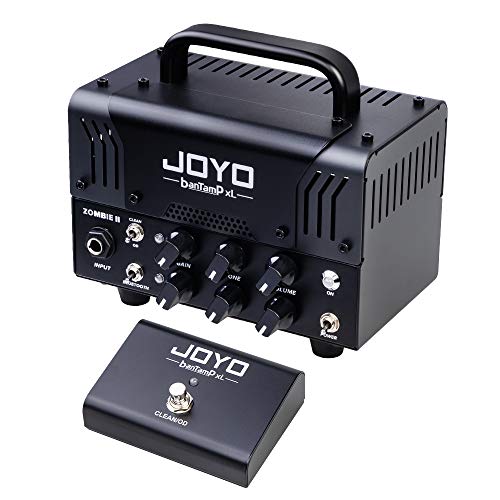
- Channel Switching & Independent Control: The BanTamp XL series features a dedicated footswitch for channel switching and six knobs. This allows you to independently control both the CLEAN and...
- Versatile High-Gain Platform & Clean Pedal Foundation: The ZOMBIE-II excels at lower gain settings and responds brilliantly to your favorite overdrive pedals, letting you push into higher gain with...
The JOYO Zombie-II is another hybrid head that specifically aims for the “Mesa Boogie” high-gain sound. It’s an incredible value and even includes Bluetooth for jamming along to backing tracks. In terms of sheer gain, it rivals the Marshall Dsl20hr Tube Guitar Amp Head. However, where the Marshall excels in “edge of breakup” and classic rock tones, the JOYO is more of a “one-trick pony” for modern metal. The JOYO’s build quality is decent for the price, but it feels a bit more like a “gadget” compared to the road-ready, all-tube construction of the Marshall. Choose the JOYO if you need a cheap metal machine; choose the Marshall for a professional, versatile rig.
3. Orange Micro Terror Guitar Amp Head
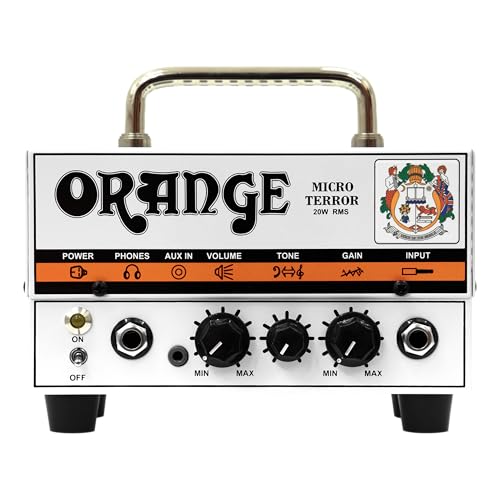
- Power: 20 watt (hybrid)
- Tube: 1 12AX7 tube preamp with solid state power amp
The original Micro Terror is the lighter, “classic” brother to the Dark Terror. It offers a brighter, more vintage-voiced crunch. Like its Dark sibling, it’s a hybrid design. When compared to the Marshall Dsl20hr Tube Guitar Amp Head, the Micro Terror feels much more limited. It lacks an FX loop and a dedicated EQ section, making it harder to integrate into a professional pedalboard setup. While it’s a fun, “cool-looking” amp that sounds surprisingly good for its size, it cannot compete with the Marshall in terms of features, volume, or authentic tube “feel.” It’s a great backup amp, but the Marshall is a primary gigging tool.
Final Verdict: Is the Marshall Dsl20hr Tube Guitar Amp Head Worth It?
After extensive testing, we can confidently say that the Marshall Dsl20hr Tube Guitar Amp Head is one of the best values in the tube amp market today. It successfully bridges the gap between a “bedroom” amp and a “stage” amp, offering legitimate professional tones in a package that won’t break your back or your bank account. While the reverb is a bit weak and the Ultra Gain channel requires some finesse to dial in, the core sound is 100% authentic Marshall. The addition of Resonance and Presence controls, along with a quiet, switchable FX loop, makes it a modern workhorse that can handle everything from sparkling cleans to the heaviest metal.
We recommend this amp to any guitarist who wants that “big amp” sound at a variety of volumes. Whether you are a bedroom hobbyist, a home studio owner, or a gigging musician playing small clubs, this head will deliver. It’s built to last, sounds fantastic, and carries a legendary pedigree that actually lives up to the hype. If you are ready to stop compromising on your tone, we strongly suggest you get the best price available today and experience the Marshall roar for yourself. It’s an investment in your sound that you won’t regret.
Last update on 2026-09-18 / Affiliate links / Images from Amazon Product Advertising API