
BONADE Alto Saxophone Ligature Review: Classic Acoustic Projection Meets Modern Fitting Realities
As saxophonists, we spend countless hours chasing the ultimate sound. We try dozens of mouthpieces, experiment with synthetic and cane reeds of varying cuts, and obsess over neck angle and voicing techniques. Yet, it is astonishingly common to overlook the humble metal band holding the entire sound generator together: the ligature. For decades, players across jazz and classical disciplines have learned the hard way that a poorly designed or improperly fitting ligature can choke vibration, deaden harmonic overtones, and turn an otherwise brilliant horn into a sluggish chore to play.
When you encounter stuffy articulation, inconsistent response between registers, or reeds that slipped out of alignment halfway through an intense solo, the culprit is often how your ligature clamps down on the reed table. Finding an accessory that offers maximum resonance without sacrificing mechanical stability is a non-negotiable step in building a professional horn setup. To see if a traditional metal classic still holds up against contemporary alternatives, we put the BONADE Alto Saxophone Ligature through its paces in our studio testing lab, evaluating its tonal balance, clamping force, build quality, and real-world ergonomics.

What to Consider Before Buying an Alto Saxophone Ligature
An alto saxophone ligature is more than just a mechanical clamp; it is a vital sound-conduction component that directly dictates how freely your reed can vibrate against the mouthpiece table. When you pluck a reed’s tip, the entire body of the cane must oscillate. A ligature that dampens these micro-vibrations diminishes your dynamic range, stifles upper harmonics, and forces you to blow harder to achieve projection. Selecting the right ligature restores freedom to your sound board while ensuring steady, reliable reed position throughout long practice sessions and live performances.
The ideal customer for this type of traditional metal band is a saxophonist seeking crisp articulation, center-focused acoustic projection, and an immediate feel across all registers. It suits classical saxophonists requiring precise attack and clear tonal boundaries, as well as lead alto players who need to cut through a big band section. Conversely, it might not be suitable for those who prefer the darker, warmer, and more cushioned response characteristic of modern fabric or leather ligatures, nor for players who frequently swap unusual mouthpiece shapes without tweaking their hardware. Before making a decision, you can check the latest price and availability to see how this time-tested option fits your budget.
Before investing, consider these crucial points in detail:
- Dimensions & Compatibility: Mouthpiece outer diameters vary wildly across brands. While standard hard rubber pieces like Meyer, Selmer C*, or Vandoren AP3 share similar dimensions, subtle variations in exterior taper or pressure plate thickness can drastically change how a rigid metal ligature fits around the body.
- Capacity/Performance & Acoustic Output: Metal ligatures offer brighter, more resonant sound transfer compared to flexible leather or woven synthetic options. Pay attention to how the contact points affect reed dampening, as minimal contact surface area usually yields enhanced resonance and faster transient response.
- Materials & Durability: Solid brass or stainless steel with protective lacquer or plating ensures your hardware withstands years of screw tension without stripping threads or warping out of round. Lacquered metal effectively prevents oxidation while adding a subtle aesthetic sheen.
- Ease of Use & Adjustment Screws: Dual-screw versus single-screw mechanisms drastically change how pressure is distributed. Dual top-screws allow independent adjustment of the reed heel and vamp, but require precise threading depth and screw length to operate smoothly without pinching.
Understanding these variables helps narrow down whether a rigid, dual-screw lacquered metal band aligns with your tonal preferences and gear rig.
While the BONADE Alto Saxophone Ligature is a classic choice, it’s always wise to see how it stacks up against the competition. For a broader look at all the top models, we highly recommend checking out our complete, in-depth guide:

- The metal buckle of sax mouthpiece ligature can quick and precise to fasten mouthpiece, Great protection for your mouthpiece


- DARK LIGATURE. Great for players seeking an easy-to-use, multi-genre ligature. This is considered the "go-to" ligature for music educators.
First Impressions and Key Features of the BONADE Alto Saxophone Ligature
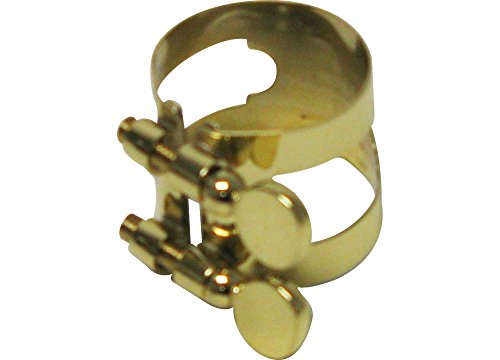
Unboxing the BONADE Alto Saxophone Ligature reveals an instantly recognizable, clean aesthetic. Fabricated from stainless steel with a warm, brass-lacquered finish, it weighs a nimble 0.8 ounces and measures approximately 2.29 x 1.7 x 1 inches. Its design centers around two parallel metal sound rails running along the contact area, engineered to elevate the ligature body slightly off the reed table so that only two thin metal strips press against the cane spine. To examine the complete specs and craft details for yourself, feel free to see its full feature set and user reviews.
Upon taking it out of its protective casing, the lacquered metal shines brilliantly, displaying a classic band configuration with two traditional knurled tightening screws. The structural integrity feels solid—there is no flimsiness in the band rings, and the folded metal metal plates housing the screw threads are firmly integrated into the main body. However, as soon as we lined it up with various standard hard rubber alto mouthpieces, we noticed that its circular geometry is tightly tailored, leaving little tolerance for thicker mouthpiece bodies without proper screw adjustment.
Advantages
- Delivers brilliant, focused tonal projection and crisp front-end articulation.
- Parallel pressure rails minimize direct contact with the reed body, maximizing vibration.
- Durable stainless steel frame with a protective, beautiful brass lacquer coating.
- Incredible cost-to-performance ratio for students and advanced players alike.
Drawbacks
- Included stock tightening screws can feel too short on slightly thicker standard hard rubber mouthpieces.
- Rigid metal band offers very little flex, demanding exact mouthpiece sizing.
Deep Dive into the BONADE Alto Saxophone Ligature’s Performance
Acoustic Resonance and Tonal Character
Our hands-on acoustic testing with the BONADE Alto Saxophone Ligature revealed immediately noticeable benefits in dynamic control and overtone presence. When paired with a mid-facing hard rubber mouthpiece and a medium-grade cane reed, the ligature allowed the lower register—from low Bb up through D1—to speak with effortless depth and zero resistance lag. The reduced-contact design, facilitated by two raised metal longitudinal ribs beneath the body, leaves the sides of the reed free from excess dampening pressure.
As we pushed into the altissimo range, the acoustic response stayed bright, crystalline, and tight. Compared to soft fabric or leather ligatures that tend to soak up higher frequencies for a darker, rounder tone, this metal design focuses sound waves into a tight beam of sonic energy. Slur-to-tongue transitions felt lively and instantaneous. Saxophonists playing classical solo literature or lead alto in big bands will appreciate how effortlessly sound projects through dense ensemble textures without requiring excessive breath pressure. Those wanting to elevate their horn’s acoustic output can check the latest price and availability to experience this level of response firsthand.
Mechanical Construction and Pressure Plate Design
The structural heart of the BONADE Alto Saxophone Ligature is its specialized pressure system. Rather than wrapping flat metal entirely around the circumference of the reed, two longitudinal ribs hold the reed flat against the table. This geometry distributes clamping pressure along two parallel lines on the heel of the reed rather than crushing the entire curve. During our testing, this translated to a noticeably lower rate of reed warping over multi-hour play-testing sessions.
The stainless steel chassis under the lacquered brass surface provides structural stiffness. Even when cranked down firmly, the band maintains its shape without stretching or deforming over time. This rigidity is a massive advantage over cheaper pot-metal alternatives that bend out of alignment after a few months of use. The metal finish resists thumb oils and tarnish well, requiring only a simple wipe with a microfiber cloth after playing to maintain its visual luster.
Sizing, Standard Screws, and Mouthpiece Fit Reality
While the tonal output of the BONADE Alto Saxophone Ligature is stellar, physical fitting on certain standard hard rubber mouthpieces presents a known nuance that prospective buyers must navigate. During our evaluation on industry-standard hard rubber mouthpieces (including Meyer 5M, Selmer C*, and Ishimori Wood Stone Studio Deluxe models), we found that the internal circumference of the non-inverted band is exceptionally snug.
Because the folded piece of metal sitting under the screws acts as a raised contact base, it expands the physical depth between the outer band and the screws. When mounting a fresh, thicker reed onto a standard rubber mouthpiece, the stock screws provided by the manufacturer can feel brief. Catching the initial thread on the lower screw often requires pressing the two side flanges together manually with considerable thumb force before the screw threads bite. For players who prefer not to wrestle with their setup before a gig, taking a moment to inspect its detailed build specifications and considering slightly longer replacement screws or careful band positioning will ensure a hassle-free experience.
On-Stage Ergonomics and Everyday Reliability
In practical daily use, once secured properly on the mouthpiece, the BONADE Alto Saxophone Ligature performs impeccably. The dual knurled screws provide fine-grained control over clamping pressure. You can tighten the lower screw to lock down the heel of the reed while keeping the top screw slightly relaxed to give the reed’s heart maximum freedom to vibrate. This level of independent tension control is something single-screw designs simply cannot replicate.
During aggressive horn switching or mid-rehearsal tuning adjustments, the ligature holds its position firmly without slipping up or down the taper of the mouthpiece neck. It stays put, maintaining seal integrity between the reed heel and the mouthpiece table so you don’t lose suction during crucial performance moments. Its compact 0.8-ounce weight adds zero noticeable mass to the front of the instrument, keeping the horn balanced in hand.
What Other Users Are Saying
Real-world user feedback for the BONADE Alto Saxophone Ligature echoes our hands-on testing findings across the board. The general consensus among active saxophonists is that this product delivers exceptional tonal value, though physical sizing on modern or boutique mouthpieces is a frequent point of discussion.
On the positive side, countless saxophonists sum up their experience briefly, labeling it simply as a “good ligature” that dramatically improves instrument projection without breaking the bank. Experienced players praise its ability to open up sound on stuffy mouthpieces, noting that its acoustic clarity easily rivals hand-crafted boutique metal ligatures costing five times as much.
On the critique side, detailed user reports highlight the exact thread length issue we observed during studio testing. Multiple players using standard-sized hard rubber mouthpieces—such as the Ishimori Wood Stone Studio Deluxe, Meyer Bros, or Selmer C*—noted that the non-inverted model feels extremely tight out of the box. Users report that because the folded metal plate under the screws adds thickness to the band’s outer circumference, the standard ligature screws included by the factory are somewhat short. Some players resolve this by gently flexing the metal band, buying slightly longer replacement screws, or opting for an inverted installation style to get full thread engagement.
Comparing the BONADE Alto Saxophone Ligature to Top Alternatives
1. Rovner LGX Ligature for Tenor Sax

- LGX LIGATURE. Perfect for players who push the envelope of dynamics and expression. Superb for jazz, rock, marching, and military band players.
- INCREDIBLE CUT AND PROJECTION. Superior articulation and increased facility. Competes with amplified instruments even when played acoustically.
While designed for slender tenor metal mouthpieces rather than standard hard rubber alto setups, comparing the BONADE Alto Saxophone Ligature to a fabric-and-metal hybrid like the Rovner LGX illustrates the vast difference between rigid metal and flexible dark-sounding options. The Rovner LGX utilizes a synthetic fabric strap with metal mass loaded points to dampen unwanted high frequencies while securing the reed softly. Saxophonists who find metal ligatures too bright or cut-throat will prefer the Rovner’s forgiving fit and warm acoustic profile. However, for alto players who demand maximum cutting power, fast front-end articulation, and bright projection, the Bonade metal construction remains superior. To contrast design approaches before deciding, you can check the latest price and availability of the Bonade model online.
2. Rovner Bb Clarinet Ligature

- LIGHT LIGATURE. Often selected by jazz band players and rock/blues players, this ligature is a variation on the dark model for those seeking a more contemporary sound.
- RESPONSIVE AND FREE-PLAYING. This ligature provides a responsive and free-playing sound and affords a full range of musical expression for jazz improvisation.
Though tailored for Bb Clarinet hard rubber mouthpieces, many doubling saxophonists keep Rovner Light ligatures in their case as emergency backups due to their universal elasticity. Unlike the uncompromising, solid stainless steel band of the Bonade ligature, the flexible Rovner fabric easily stretches across varying mouthpiece dimensions without screw length issues. However, this flexibility comes at the cost of transient response; the Rovner yields a rounder, softer attack that suits woodwind doubling, whereas the Bonade offers aggressive core projection, superior acoustic ring, and precise harmonic control specifically tailored for alto saxophone soloists.
3. Vandoren LC07P Alto Sax Ligature

- Quick and precise tightening
- Expression with freedom
The Vandoren LC07P Optimum represents the premium end of metal ligature design, featuring a gilded gold finish, a single top-quick-tightening screw, and three interchangeable pressure plates to customize acoustic resonance. While the Vandoren LC07P offers unmatched versatility and an effortless single-screw mounting experience, it comes at a significantly higher price point. The Bonade provides a remarkably similar level of brilliant projection and pressure-rail vibration control at a small fraction of the cost, making it a far better option for students, advancing players, and budget-conscious professionals.
Final Verdict on the BONADE Alto Saxophone Ligature
The BONADE Alto Saxophone Ligature remains an enduring classic for good reason. Its lacquered stainless steel construction, dual-screw design, and iconic raised pressure rails offer an outstanding balance of core tonal projection, instantaneous articulation response, and rugged long-term durability. While buyers should be mindful that its snug band tolerance on standard hard rubber mouthpieces like Selmer or Meyer models might require firm fitting or slightly longer screws during initial setup, the resulting acoustic pay-off is undeniable.
If you are looking to unlock your mouthpiece’s full dynamic potential, eliminate stuffiness, and gain laser-focused sound projection without spending hundreds on boutique hardware, this model is an absolute steal. Take your horn’s performance to the next level today—we strongly recommend that you claim your BONADE Alto Saxophone Ligature here and feel the difference in your very next practice session.
Last update on 2026-09-26 / Affiliate links / Images from Amazon Product Advertising API