
LR Baggs Voiceprint DI Guitar Effects Pedal Review: Is This the End of Piezo Quack?
If you have ever stood on a stage, plugged your beautiful, resonant $3,000 acoustic guitar into a PA system, and heard a thin, “clacky,” and metallic sound come out of the speakers, you know my pain. For decades, we have settled for the “piezo quack”—that artificial high-end bite that strips away the soul of an instrument. We search for the perfect DI box, the most transparent preamp, or the most expensive microphone setup, but the complications of live sound (feedback, stage bleed, and setup time) usually force us back into the world of compromised tone. This is exactly why the LR Baggs Voiceprint DI Guitar Effects Pedal caught our attention. It promises to bridge the gap between the natural resonance of your guitar and the convenience of a direct signal, using technology that previously required a studio engineer and hours of tweaking.

- Voice blends your instrument’s custom Voiceprint with your pickup signal for enhanced accuracy
- Antifb applies your anti-feedback profile for effective feedback control. Short press for phase inversion
What to Consider Before Buying an Acoustic Guitar Effects Pedal
An Acoustic Guitar Effects pedal is more than just an item; it’s a key solution for any musician who wants their live performance to sound as professional as their studio recordings. The primary problem this category solves is the loss of “air” and woodiness that happens when you convert physical vibrations into an electrical signal. By using Impulse Response (IR) technology and advanced EQ, these pedals can restore the complex harmonic overtones of a guitar’s body. Before you dive into the world of IR, check the latest price and availability of this high-end solution to see how it fits your current budget.
The ideal customer for this type of product is someone facing inconsistent stage sound or someone who performs with multiple instruments and needs a way to make each one sound “real” through a single PA. It’s perfect for the gigging professional who needs a “set it and forget it” solution. However, it might not be suitable for those who prefer a purely analog signal path or those who find smartphone integration cumbersome, as this pedal relies heavily on an external app for its most powerful features.
Before investing, consider these crucial points in detail:
- Signal Integrity & Conversion: You want a pedal that handles your guitar’s high-impedance signal without adding unwanted hiss or coloring. Look for high-quality A/D converters that maintain the nuances of your playing dynamics.
- Feedback Management: In a live setting, an “authentic” acoustic sound often leads to feedback because you are introducing low-frequency resonance back into the signal. A dedicated anti-feedback circuit is non-negotiable for high-volume stages.
- Portability & Build Quality: If you are gigging, your pedal will be stepped on, dropped, and subjected to beer spills. All-metal construction and high-quality footswitches are essential for longevity.
- Ease of Use & Maintenance: Consider the learning curve. Some pedals are plug-and-play, while others, like the LR Baggs Voiceprint DI Guitar Effects Pedal, require an initial calibration phase. Ensure the long-term maintenance, such as firmware updates, is supported by the manufacturer.
While the LR Baggs Voiceprint DI Guitar Effects Pedal is an excellent choice, it’s always wise to see how it stacks up against the competition. For a broader look at all the top models, we highly recommend checking out our complete, in-depth guide:

- Analog Preamp and Digital Reverb
- One-Stop Gig Solution for Acoustic Instruments Players with Main Effects needed

- 🎸🎸【9 AMP Models & 8 IR CAB】LEKATO Multi-functional Guitar Effects Pedal with Chorus,Tremolo,Delay,Reverb effects, including 9 Amp preamps and 8 classic IR cabinets body model, Support IR...

First Impressions: Unboxing the LR Baggs Voiceprint DI Guitar Effects Pedal
Upon opening the box, the first thing I noticed was the sheer weight of the unit. At 150 grams, it feels much denser than its dimensions suggest. It is housed in a rugged, grey metal chassis that screams “road-ready.” Unlike many plastic-heavy multi-effects units, this feels like a piece of high-end studio gear. The controls are minimalist: a few knobs and two sturdy metal footswitches. It’s clear that L.R. Baggs prioritized durability. However, the micro-USB connection felt a little dated for a product released in this era—USB-C would have been preferred. That said, the primary focus here isn’t the hardware interface, but the “Voiceprint” technology hidden inside. For those looking for a premium build, you can see its full feature set and user reviews to understand why this unit is priced as a professional tool.
Key Benefits
- Incredibly accurate Impulse Response (IR) capture of your actual guitar.
- Professional-grade anti-feedback profile that is instrument-specific.
- Built like a tank with 99 preset slots for multiple instruments.
- Intuitive iPhone app integration for deep EQ and leveling.
Drawbacks
- Lack of an Android app at launch (though iOS performance is stellar).
- The pairing process can be tricky if you don’t read the manual carefully.
A Deep Dive into the Performance of the LR Baggs Voiceprint DI Guitar Effects Pedal
The Voiceprint Capture: A Studio in Your Pocket
The “magic” of this pedal lies in the Voiceprint capture process. We found that instead of using generic IRs (which are basically photos of *someone else’s* guitar), this unit creates a custom “Voiceprint” of *your* guitar. I took my Taylor 814ce and followed the AcousticLive app prompts. You essentially tap on the bridge and strum the guitar while your iPhone sits a few inches away. The app’s algorithm analyzes the delta between what your pickup hears and what the phone’s microphone hears. In less than a minute, it generates a profile that effectively subtracts the “quack” and adds the “air” back in. We were genuinely impressed by how much of the guitar’s woodiness was restored. It doesn’t just sound like “an acoustic guitar”; it sounds like *my* acoustic guitar. This is a feature that really sets it apart from standard DI boxes that only offer fixed EQ curves.
Sonic Accuracy and the “Voice” Blend
Once you have your Voiceprint loaded, the “Voice” knob on the pedal becomes your best friend. In our testing, we found that setting this to 100% can sometimes feel a bit “processed” or “synthetic” if the initial recording wasn’t done in a quiet room. However, the sweet spot is usually between 50% and 70%. At this level, you get the punch and reliability of your undersaddle pickup (UST) combined with the resonance of the Voiceprint. We tested this with several instruments—not just guitars. One of our testers used it for a Yamaha Silent Guitar, and the transformation was night and day. It went from a “plinky” electric-acoustic to a full-bodied nylon string. Even exotic instruments like a Cuban Tres or a Mandolin benefited from this technology. The algorithm is incredibly sophisticated at measuring timbre and playing response, ensuring that your dynamics are preserved rather than compressed into oblivion.
Mastering the Stage: Feedback Control and Presets
One of the biggest fears when using IR technology live is feedback. Since the LR Baggs Voiceprint DI Guitar Effects Pedal is adding resonance back into the signal, it can be prone to “howling.” However, the Anti-Feedback (Anti-FB) knob is a total game-changer. During our evaluation, we pushed the volume on a 1000-watt PA system until the guitar started to rumble. Turning the Anti-FB knob doesn’t just cut a wide swath of frequencies; it applies a specific “anti-feedback profile” created during the capture process. It surgically removes the problematic frequencies while leaving the tone intact. Furthermore, the ability to store 99 presets means you can have a specific profile for your dreadnought, your parlor guitar, and your banjo, all accessible with the “Select” knob. For the multi-instrumentalist, this professional-grade flexibility is worth every penny.
The User Interface and Setup Hurdles
We need to address the elephant in the room: the setup. While the app is intuitive, the pairing process between the phone and the pedal had us scratching our heads for a moment. As many users have noted, the instruction manual is a bit sparse. We found that you must press down on the “Voice” rotary knob to initiate pairing—a step that isn’t immediately obvious. Once paired, however, the Bluetooth connection remained stable throughout our sessions. Some users have reported noise when the Bluetooth is active, but in our controlled tests using high-quality shielded cables, the noise floor was impressively low. If you are a player who hates menus, you might find the initial “iPhone homework” annoying, but the results are so superior to standard DI boxes that the 10-minute setup is a small price to pay for world-class tone.
What Other Users Are Saying
The general sentiment among professional guitarists is one of awe, though it is tempered by the technical requirements of the unit. One user mentioned that this was the “best live sound they’ve ever had,” specifically praising the elimination of the “quacky” tone. We saw this sentiment echoed by many who play professionally and were tired of fighting with Front of House (FOH) engineers. Another user, who plays a Cuban Tres, noted that the pedal “does exactly what it promises” by capturing the true character of an instrument that wasn’t even the primary focus of the designers.
On the negative side, some users expressed frustration with the lack of iPad compatibility and the delayed Android app release. There were also mentions of the “always-on” Bluetooth causing a slight interference pattern in some environments. One user who bought a used unit experienced consistency issues, which highlights the importance of buying new to ensure you have the full 2-year warranty and the latest firmware. Overall, the consensus is that if you are willing to follow the setup instructions carefully and use an iPhone, the LR Baggs Voiceprint DI Guitar Effects Pedal is an absolute “must-have” for serious performers. You can read more detailed user testimonials here to see if your specific instrument has been tested.
Comparing the LR Baggs Voiceprint DI Guitar Effects Pedal to Its Top Alternatives
1. SONICAKE Acoustic Guitar Effects Pedal
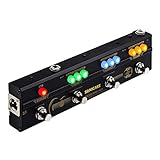
- Analog Preamp and Digital Reverb
- Built-in Notch Filter and MUTE with gain and frequency range adjustment can quickly eliminate whistling or on the sound is further shaped in detail
The SONICAKE is a much more traditional, budget-friendly alternative. While it features an analog preamp and a digital reverb, it lacks the Impulse Response technology that makes the LR Baggs unit so special. It’s a great “all-in-one” strip for someone who just needs a basic EQ and reverb for small coffee house gigs. However, it won’t fix a bad-sounding pickup. We would recommend this for beginners or those on a strict budget who aren’t ready to dive into the world of IR profiling.
2. MOOER Acoustikar Acoustic Guitar Simulator

- [Warm Sound] Restore the sound of the acoustic guitar. Play the sound texture of an acoustic guitar with an electric guitar.
The MOOER Acoustikar is actually designed to make an *electric* guitar sound like an acoustic, though it can be used to reshape an acoustic signal. It offers three modes: Piezo, Standard, and Jumbo. While it’s incredibly compact and affordable, the sound is significantly more “synthetic” than the custom Voiceprints of the LR Baggs. It’s a fun utility pedal for a pedalboard with limited space, but it lacks the professional DI features like XLR output and surgical anti-feedback.
3. ToneWoodAmp SOLO Multi-Effect Processor
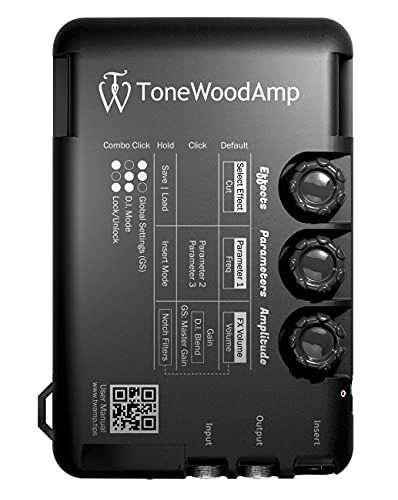
- 【One Of A Kind Experience】The ToneWoodAmp works on virtually any acoustic guitar! Adds beautiful sounding organic guitar effects to your acoustic* and acoustic-electric guitar, NO AMP REQUIRED...
- 【No Amp Required】 XXXX Get Reverbs like Hall, Room, Plate, Delay, Leslie, Auto-Wah, and Chorus, no amp required! All sounds come from the soundhole of your guitar organically. Buy one ToneWoodAmp...
The ToneWoodAmp is a completely different beast. Instead of focusing on the signal going to the PA, it uses the back of your guitar as a speaker to create effects like reverb and delay *unplugged*. It’s a revolutionary tool for practice and intimate performances. However, for a professional stage setup where you need to send a high-quality signal to a sound system, the LR Baggs Voiceprint DI Guitar Effects Pedal is much more effective. If you want “magic” in your bedroom, get the ToneWood; if you want “magic” in the stadium, stick with LR Baggs.
The Final Verdict: Is the LR Baggs Voiceprint DI Guitar Effects Pedal Worth It?
After extensive testing and comparing it against both entry-level simulators and high-end DIs, our verdict is clear: the LR Baggs Voiceprint DI Guitar Effects Pedal is the current gold standard for acoustic impulse response technology. It solves the two biggest hurdles for live acoustic players—unnatural tone and feedback—in a single, rugged package. While the reliance on an iPhone for setup might be a hurdle for some, the payoff is a sound that was previously only achievable in a studio with a $2,000 microphone and a treated room.
We highly recommend this pedal for any gigging musician who is serious about their tone. Whether you play a high-end Martin or a silent guitar, the ability to “print” your instrument’s soul into a DI box is a game-changer. If you are ready to retire the “quack” and experience the true voice of your instrument on stage, we suggest you head over and grab the LR Baggs Voiceprint DI today; your audience (and your sound guy) will thank you.
Last update on 2026-07-25 / Affiliate links / Images from Amazon Product Advertising API