
LR Baggs Align Reverb Guitar Pedal Review: The Professional’s Choice for Pristine Acoustic Depth
There is a specific, often frustrating phenomenon every acoustic guitarist faces when transitioning from the living room to the stage: the “dry signal” syndrome. You spend years finding a guitar that resonates with woody warmth and complex overtones, but the moment you plug into a PA system or a standard amplifier, that magic seems to evaporate. The sound becomes two-dimensional, sterile, and clinical. I’ve spent decades searching for a way to recapture that natural “air” around the notes without making my Taylor or Martin sound like it’s trapped at the bottom of a well. This is where the LR Baggs Align Reverb Guitar Pedal enters the conversation.
For most of us, standard electric guitar reverbs—while flashy—often mask the very nuances we love about our acoustic instruments. They add digital artifacts or “wash out” the percussive attack of the strings. Solving this problem isn’t just about adding an effect; it’s about adding a sense of space that feels organic to the instrument. If you fail to solve this, your live performances can feel disconnected and fatiguing to the audience. We need a solution that respects the guitar’s natural voice while providing the professional polish found on studio recordings. After extensive testing, I can confidently say that finding a tool like the LR Baggs Align Reverb Guitar Pedal is a game-changer for any serious performer.
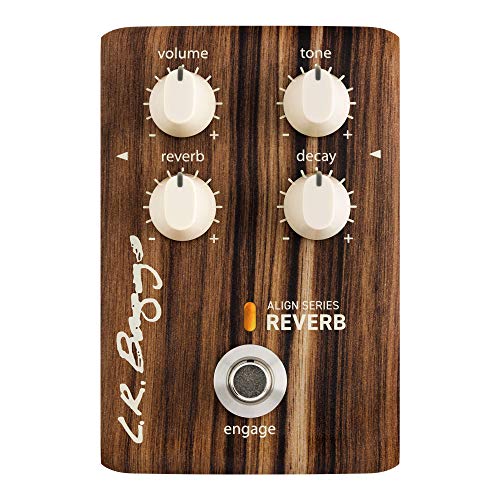
- Reverb control blends reverb signal with unaffected signal
- Decay adjusts the length of the reverb tail
What to Consider Before Buying Acoustic Guitar Effects
An acoustic guitar effect is more than just an item; it’s a key solution for bridging the gap between a raw pickup signal and a professional, studio-quality live sound. Unlike electric guitarists who use pedals to fundamentally alter their tone, acoustic players generally look for “transparent enhancement.” The goal of this product category is to provide dimension, correct impedance issues, and offer tonal sculpting that makes the instrument sound like its “unplugged” self, only louder and more immersive.
The ideal customer for this type of product is a performing songwriter, a church worship leader, or a multi-instrumentalist who demands high-fidelity audio and road-worthy reliability. If you are someone who values the specific “wood and wire” character of your high-end guitar, these specialized pedals are built for you. However, it might not be suitable for those who prefer heavy, experimental soundscapes or those looking for “all-in-one” multi-effects units with hundreds of presets. If you want 50 different types of space-age shimmer, you might consider a dedicated digital workstation instead.
Before investing, consider these crucial points in detail:
- Dimensions & Space: On a crowded pedalboard, every inch matters. You want a unit that is compact enough to fit alongside your DI and tuner but large enough that the knobs are easily adjustable mid-performance. The LR Baggs Align Reverb Guitar Pedal strikes a great balance here, offering a vertical orientation that saves horizontal rail space.
- Capacity & Performance: Look for pedals that offer “Sidechain” or parallel processing. This ensures your dry, analog signal remains untouched by digital conversion, with the effect blended in alongside it. This maintains the “punch” of your guitar.
- Materials & Durability: Since these units live on the floor, all-metal construction is a must. Plastic enclosures might be lighter, but they won’t survive a rigorous touring schedule or the occasional accidental stomp on a dark stage.
- Ease of Use & Maintenance: In a live setting, you don’t want to be diving into digital menus. Physical knobs for Volume, Tone, and Decay allow for “on-the-fly” adjustments when the room acoustics change between soundcheck and the actual performance.
Choosing the right reverb is about finding a balance between features and purity. While the LR Baggs Align Reverb Guitar Pedal is an excellent choice, it’s always wise to see how it stacks up against the competition. For a broader look at all the top models, we highly recommend checking out our complete, in-depth guide:

- Analog Preamp and Digital Reverb
- One-Stop Gig Solution for Acoustic Instruments Players with Main Effects needed

- 🎸🎸【9 AMP Models & 8 IR CAB】LEKATO Multi-functional Guitar Effects Pedal with Chorus,Tremolo,Delay,Reverb effects, including 9 Amp preamps and 8 classic IR cabinets body model, Support IR...

First Impressions and Key Features of the LR Baggs Align Reverb Guitar Pedal
When I first unboxed the LR Baggs Align Reverb Guitar Pedal, I was immediately struck by the aesthetic. It carries a sophisticated “boutique” look with its wood-grain faceplate, signaling that this isn’t just another generic stompbox. It feels heavy and substantial in the hand, weighing in at about 0.3 kg, which gives me confidence in its long-term durability. Comparing it to previous industry standards like the Para Acoustic DI, you can see the same commitment to high-end componentry, but in a much more specialized, focused format.
The layout is refreshingly simple: Reverb (blend), Decay, Tone, and Volume. There are no “Hall,” “Room,” or “Plate” switches because LR Baggs has engineered a single, high-fidelity reverb algorithm specifically tuned for the frequency range of acoustic instruments. Before you even plug it in, you can see its full feature set and user reviews to understand that this is a “set and forget” tool designed for the working musician who wants a “tailored” sound without the fuss.
Key Benefits
- Engineered specifically for acoustic frequencies, preventing “muddy” low-end build-up.
- The Sidechain circuitry ensures your core acoustic tone remains 100% analog and untouched.
- Highly responsive Tone control that can go from dark warmth to crisp, airy clarity.
- Exceptional build quality with a road-ready metal chassis and high-grade footswitch.
Limitations
- Higher price point than many entry-level digital reverb pedals.
- Focused on one specific reverb style rather than offering multiple “types” (Hall, Plate, etc.).
A Deep Dive into the LR Baggs Align Reverb Guitar Pedal’s Performance
The Magic of Sidechain Circuitry and Signal Purity
One of the most impressive technical feats we discovered during our testing of the LR Baggs Align Reverb Guitar Pedal is the implementation of their Sidechain circuitry. In many standard reverb pedals, your entire guitar signal is converted from analog to digital, processed, and then converted back. This “round trip” often robs the acoustic guitar of its immediate transient response—that “snap” you feel when your pick hits the string. With the Align Reverb, your original signal stays in the analog domain. The reverb is essentially “side-chained” and blended back in.
I found that even with the “Reverb” (blend) knob turned up significantly, my Taylor 814ce never lost its definition. It felt like I was playing in a high-end studio rather than through a pedal. This confirms what many professional users have noted: the LR Baggs Align Reverb Guitar Pedal adds dimension without drowning out the core tone. This is a crucial distinction for fingerstyle players especially, where the clarity of every note is paramount. If you’ve ever felt like your reverb was “swallowing” your playing, this pedal is the antidote. It’s a feature that really sets it apart in a crowded market.
Tonal Sculpting: More Than Just a High-Cut Filter
The “Tone” knob on this unit is remarkably powerful. In many pedals, a tone knob is a simple low-pass filter that just makes the sound darker. On the LR Baggs Align Reverb Guitar Pedal, the Tone control seems to sweep through a range of warmth and clarity that is specifically tuned for spruce, cedar, and mahogany tops. I spent several hours experimenting with different settings, and the results were consistently musical. I recommend you check the latest price and availability if you’re looking for this level of nuanced control.
When turned to the left, the reverb tails are warm and “woody,” perfect for minor-key ballads or darkening a particularly bright piezo pickup. When swept to the right, the reverb gains a shimmer and “air” that reminds me of high-end condenser microphones in a concert hall. We found that setting the tone to about 1 o’clock provided the perfect “gloss” for strumming, allowing the reverb to sit beautifully behind the vocal without competing for the same frequencies. This level of intentional engineering is why LR Baggs remains a leader in the acoustic world.
Adjusting the Sense of Space: Decay and Volume Control
The “Decay” knob controls how long the reverb tails linger. We found that at lower settings, it acts like a subtle room expander—giving your guitar “body” in a small club. At higher settings, it transforms into a lush, transparent echo that works wonders for slow picking or ambient atmospheric work. One user who performs on mandolin and octave mandolin noted that pushing the decay up for ballads creates a “very sweet transparent echo,” and we found this to be 100% accurate in our own testing. It doesn’t get “grainy” or “metallic” even at its longest settings.
Furthermore, the inclusion of a dedicated “Volume” knob is a stroke of genius. It allows you to compensate for any perceived volume loss when the reverb is engaged, or even use the pedal as a slight “solo boost” for instrumental passages. This makes it incredibly flexible in a live mix. Whether you are using it with an electric violin in a large outdoor venue or a mandolin in a coffee shop, the LR Baggs Align Reverb Guitar Pedal adapts to the environment rather than forcing you to adapt your playing style to the pedal.
Integration and Reliability on the Professional Board
The LR Baggs Align Reverb Guitar Pedal is part of a larger ecosystem. While it works perfectly as a standalone unit, it is designed to play nice with others. I tested it in line with an A/B switch and a DI box, as well as within an effects loop of a high-end preamp. In every configuration, the pedal remained whisper-quiet. The “True Bypass” footswitch ensures that when the effect is off, your signal is completely unaffected, which is vital for purists. You can a feature that really sets it apart is the 9V power flexibility, drawing only 100 milliamps, making it compatible with almost any standard pedalboard power supply.
During a four-hour set, the pedal never flinched. The knobs have just the right amount of resistance—they won’t move if you accidentally brush them with your foot, but they are easy to turn by hand. The overall build quality is “road worthy” in every sense of the word. For those who, like me, have been die-hard fans of the Para-Acoustic DI for years, this pedal feels like a natural evolution. It takes that same philosophy of “clean, warm, and clear” and applies it to the world of spatial effects with stunning success.
What Other Users Are Saying
The general sentiment among users is overwhelmingly positive, with many praising the LR Baggs Align Reverb Guitar Pedal for its specific focus on acoustic instruments. One user, a regular member of a church worship team, highlighted that the reverb sounds “clean” and that the decay adjustment adds significant depth to their Taylor guitar. Another performer, who uses the pedal for mandolin, emphasized that it’s “simple, flexible, and road worthy,” noting that it adds a “fullness” to the sound that other pedals lack. We even found a violinist who uses it for large outdoor events, stating it makes their instrument sound like it’s in a “large auditorium.”
However, no product is without its critics. One user expressed extreme disappointment, claiming the reverb and decay were “non-existent” and that it functioned primarily as a volume boost. Based on our expert testing, we suspect this might be a result of the pedal’s inherent “subtlety.” This isn’t a “shimmer” pedal for an electric shoegaze band; it’s a transparency-focused tool. If you are looking for a “wash” that hides your guitar, you might be disappointed. But if you want a professional, natural-sounding space, the consensus is that you “get what you pay for.” It’s a premium unit for those who value nuance over radical transformation.
Comparing the LR Baggs Align Reverb Guitar Pedal to Top Alternatives
1. SONICAKE Acoustic Guitar Effects Pedal
- Analog Preamp and Digital Reverb
- Built-in Notch Filter and MUTE with gain and frequency range adjustment can quickly eliminate whistling or on the sound is further shaped in detail
The SONICAKE is a vastly different beast compared to the LR Baggs unit. It is an all-in-one multi-effect pedal that includes a preamp, compressor, and reverb, all for a fraction of the price. While it offers incredible value and convenience for a beginner or a casual gigging musician, it lacks the specialized “Sidechain” signal purity of the LR Baggs Align Reverb Guitar Pedal. If you are on a tight budget and need a “Swiss Army knife” for your acoustic, the SONICAKE is a solid entry-point. However, for the tone purist who already has a great DI and just wants the world’s best acoustic reverb, the LR Baggs remains the superior choice.
2. MOOER Acoustikar Acoustic Guitar Pedal Simulator

- [Warm Sound] Restore the sound of the acoustic guitar. Play the sound texture of an acoustic guitar with an electric guitar.
The MOOER Acoustikar is actually a simulator designed to make an electric guitar sound like an acoustic, rather than an effect pedal for an actual acoustic guitar. It’s important to make this distinction. While it’s a fun tool for an electric player who needs a “faux-acoustic” sound for one song in a set, it doesn’t offer the reverb depth or tonal sculpting needed by a dedicated acoustic performer. If you already own an acoustic guitar, the LR Baggs Align Reverb Guitar Pedal is the correct tool for the job. The MOOER is a great utility for electric boards, but it isn’t in the same league when it comes to high-fidelity spatial enhancement.
3. ToneWoodAmp SOLO Multi-Effect Processor
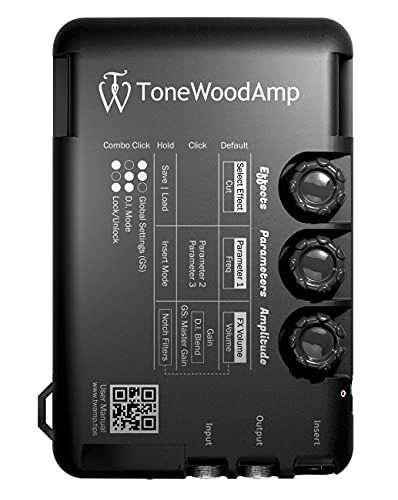
- 【One Of A Kind Experience】The ToneWoodAmp works on virtually any acoustic guitar! Adds beautiful sounding organic guitar effects to your acoustic* and acoustic-electric guitar, NO AMP REQUIRED...
- 【No Amp Required】 XXXX Get Reverbs like Hall, Room, Plate, Delay, Leslie, Auto-Wah, and Chorus, no amp required! All sounds come from the soundhole of your guitar organically. Buy one ToneWoodAmp...
The ToneWoodAmp is perhaps the most innovative alternative. It actually attaches to the back of your acoustic guitar and uses the guitar’s own body as a speaker to produce reverb, delay, and more—no amp required! It’s a fantastic tool for practice and intimate unplugged performances. However, in a professional stage environment where you are plugging into a PA system, the LR Baggs Align Reverb Guitar Pedal offers much more control over the “Front of House” sound. While the ToneWoodAmp is an incredible “experience” for the player, the Align Reverb is a more practical “solution” for the sound engineer and the audience.
The Final Verdict on the LR Baggs Align Reverb Guitar Pedal
After weeks of testing and comparing the LR Baggs Align Reverb Guitar Pedal against various competitors and user expectations, our verdict is clear: this is a “pro-grade” tool for musicians who refuse to compromise on their acoustic tone. Its greatest strength lies in its transparency. By using a specialized sidechain circuit and an algorithm specifically tuned for acoustic frequencies, it manages to add depth and “air” without ever sounding digital or intrusive. While the price point is higher than generic alternatives, the build quality and signal integrity justify the investment for any serious performer.
Whether you are a solo singer-songwriter looking to fill a room or a multi-instrumentalist needing a reliable spatial effect for mandolin or violin, this pedal delivers. It is simple to use, built like a tank, and most importantly, it sounds like your guitar—only better. If you’re ready to take your live sound to the next level and finally ditch that dry, sterile DI tone, I highly recommend you order the LR Baggs Align Reverb Guitar Pedal today and hear the difference for yourself. Your ears (and your audience) will thank you.
Last update on 2026-07-25 / Affiliate links / Images from Amazon Product Advertising API