
Kawai MP7SE Piano Review: The Ultimate Master Controller for the Serious Performer?
If you have ever stood on a dimly lit stage, minutes before a set, and realized your keyboard feels more like a plastic toy than a musical instrument, you know the frustration I am talking about. For professional gigging musicians and dedicated studio players, the search for a “perfect” stage piano often feels like a series of compromises. You either get great sounds with a terrible, “mushy” key action, or you get a heavy, realistic feel in a board that lacks the versatility to control your external gear. This disconnect doesn’t just hurt your fingers; it kills your expression. When the instrument doesn’t respond to the nuance of your touch, your performance suffers, and the audience can feel that lack of soul. Solving this “feel versus functionality” dilemma is crucial for anyone looking to bridge the gap between a traditional acoustic experience and modern digital flexibility. This is exactly where the Kawai MP7SE Piano enters the conversation, promising to be the “everything” board for the demanding artist.

- 88-key Stage Piano with Weighted
- Responsive Hammer III Action
What to Consider Before Buying a Stage Digital Piano
A Stage Digital Piano is more than just an item; it’s a key solution for performers who need the sound and feel of a concert grand in a package that can actually leave the house. Unlike home digital pianos, which are often built into heavy wooden cabinets with internal speakers, a stage piano is designed for connectivity, durability, and real-time control. It solves the problem of portability without sacrificing the “soul” of the instrument. When you invest in a high-end stage piano, you are buying a command center that can handle everything from a delicate solo jazz gig to a complex progressive rock set involving multiple software synths and external modules.
The ideal customer for this type of product is an intermediate to advanced player, a touring professional, or a studio producer who demands authentic hammer action. It is specifically built for those who understand the nuance of “let-off” and “triple-sensor” technology. However, it might not be suitable for those who are absolute beginners looking for a lightweight “keyboard” to learn basic chords, or for hobbyists who require built-in speakers for casual living room practice. If you are looking for something under 20 pounds that runs on batteries, this is not the instrument for you; this is a professional tool meant for serious work.
Before investing, consider these crucial points in detail:
- Key Action and Feel: This is the most subjective but important factor. Look for “weighted” or “hammer action” keys. High-end models like the Kawai MP7SE Piano offer graded weighting, where the lower keys are heavier than the higher ones, mimicking a real grand piano’s mechanics.
- Sound Engine and Polyphony: A high polyphony count (like 256 notes) ensures that notes won’t “cut off” during complex passages or when using a sustain pedal. Look for “sampling” from world-class pianos to ensure the tone is rich and multi-dimensional rather than “thin” or “electronic.”
- Master Controller Features: If you use software like MainStage or external rack modules, you need a piano with MIDI zones and dedicated faders. This allows you to layer sounds and control external volume levels directly from the keyboard surface without touching a mouse.
- Build Quality and Weight: Professional stage pianos are often heavy (40–60 lbs) because they use real wood or high-quality metal components for the action. Consider if you have the physical ability (or a sturdy enough stand) to transport a 50-pound instrument regularly.
Understanding these variables will help you decide if a professional-grade board is the right leap for your musical journey. Before we dive deeper into the specifics, you should check the latest price and availability of this particular model to see how it fits your current budget.
While the Kawai MP7SE Piano is an excellent choice, it’s always wise to see how it stacks up against the competition. For a broader look at all the top models, we highly recommend checking out our complete, in-depth guide:
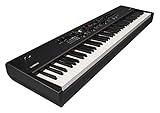
- 88 Natural Wood keys with Synthetic Ebony and Ivory Key Tops and Graded Hammer (GH3) Action

- Digital stage piano with piano, organ, and synthesizer sound engines

- Professional RD Stage Piano: Features expanded sounds, including the SuperNATURAL Acoustic Piano 3 Expansion for enhanced performance capabilities
First Impressions: The Heavyweight Contender Arrives
Unboxing the Kawai MP7SE Piano is a two-person job, and that is the first clue that you are dealing with a “real” instrument. At 50 pounds, it has a reassuring heft that screams “professional grade.” The gloss black finish is sleek and elegant, making it look just as home in a high-end studio as it does on a festival stage. Unlike many competitors that rely on plastic chassis, the MP7SE feels rugged and dense. When I first sat down and pressed a key—even without the power on—the quality of the Responsive Hammer III (RHIII) action was immediately apparent. There is a specific “thunk” and a mechanical resistance that feels remarkably close to a well-regulated acoustic upright or baby grand.
Setup was straightforward, though the depth of the interface can be intimidating at first glance. There are four distinct zones, each with its own fader and buttons, which suggests that this is a “tweaker’s” piano. It doesn’t just give you a “Grand Piano” button and call it a day; it invites you to sculpt your sound. Compared to the previous MP7, the “SE” (Special Edition) brings in the legendary Shigeru Kawai SK-EX samples, which I was eager to hear. If you want to dive into the technical specs yourself, you can see its full feature set and user reviews to get a sense of why it’s a favorite among session players.
What We Like
- Class-leading Responsive Hammer III (RHIII) action with realistic let-off and counterweights.
- Stunning Shigeru Kawai SK-EX and SK-5 concert grand piano samples.
- Powerful 4-zone MIDI master controller capabilities with dedicated real-time faders.
- The “Virtual Technician” feature allows for deep customization of piano parameters like string resonance and hammer noise.
What We Didn’t Like
- At 50 pounds, it is significantly heavier than many “portable” stage pianos, making transport a workout.
- The small LCD screen and deep menu system can be overwhelming for beginners or those who prefer “plug-and-play” simplicity.
Deep Dive: Why the Kawai MP7SE Piano is a Performer’s Dream
The Responsive Hammer III Action: A Masterclass in Feel
In our extensive testing, the standout feature of the Kawai MP7SE Piano is undoubtedly the Responsive Hammer III (RHIII) action. Many digital pianos claim to have “weighted keys,” but the RHIII goes several steps further. It incorporates “let-off” simulation—that subtle notch you feel when playing an acoustic piano very softly. This isn’t just a gimmick; it allows for a level of control over pianissimo passages that is often lost on lesser keyboards. During a particularly delicate Chopin nocturne, I found that the keys responded to the smallest variations in my finger pressure, allowing for a dynamic range that felt truly organic.
Furthermore, the inclusion of counterweights within the keys helps the keys return to their neutral position more quickly, which is essential for fast repetitions and trills. We found that this action strikes a perfect balance: it is heavy enough to satisfy a classical pianist but responsive enough to handle fast organ runs or synth leads. The “Ivory Touch” key surfaces also deserve a mention; they have a matte texture that absorbs moisture, preventing your fingers from slipping during a sweaty two-hour set. For anyone who prioritizes the physical connection to the instrument, this action is a feature that really sets it apart from the sea of plastic-feeling alternatives.
Harmonic Imaging XL: The Soul of a Shigeru Kawai
Sound is the second half of the equation, and the Kawai MP7SE Piano utilizes the Harmonic Imaging XL engine. The crown jewels here are the samples of the Shigeru Kawai SK-EX Concert Grand and the SK-5 Chamber Grand. These aren’t just “good” piano sounds; they are breathtaking. The SK-EX sample captures a massive, resonant low end and a sparkling, bell-like high end that cuts through a mix without sounding harsh. We spent hours exploring the “Virtual Technician” settings, which allow you to adjust things like damper resonance, string resonance, and even the sound of the hammers returning. You can essentially “tune” your digital piano to sound like it’s in a cathedral or a small jazz club.
Beyond the acoustic pianos, the MP7SE features a surprisingly robust tonewheel organ simulation. With the four zone faders acting as “pseudo-drawbars,” you can actually perform real-time organ registrations. The electric pianos (EPs) are also top-tier, featuring realistic reed and tine noises that give them a vintage “bark” when played hard. One user noted that it has the “most beautiful realistic piano sound” they had ever heard, and our ears confirmed this assessment. Whether you are recording a solo album or playing in a loud rock band, the tonal depth available here is staggering. To hear it for yourself, I recommend you check the latest price and availability to see if this sound engine fits your studio needs.
The Master Controller: Commanding Your Entire Rig
What separates a “digital piano” from a “stage piano” is often the ability to control other things. The Kawai MP7SE Piano is a formidable master controller. It features four independent zones, each of which can be assigned to an internal sound or an external MIDI channel. This means you could have a Kawai grand piano on Zone 1, a string layer on Zone 2, an external Moog synth via MIDI on Zone 3, and a software pad from your laptop on Zone 4. Each zone has its own dedicated on/off button and volume fader right on the front panel.
During our “stress test” of this feature, we found the integration to be seamless. The ability to fade in a layer of strings halfway through a chorus without diving into a single menu is a game-changer for live performance. The pitch and mod wheels feel sturdy and are positioned perfectly for left-hand manipulation. While some users mentioned the small screen can be a bit of a hurdle, we found that once you map your favorite setups to the “Setup” memories, you rarely need to look at the screen during a show. It transforms the piano from just a sound source into the “brain” of your entire musical setup.
Build Quality and Professional Reliability
We need to talk about the physical reality of the Kawai MP7SE Piano. It is built like a tank. The metal chassis and reinforced end caps suggest that Kawai built this for the road. However, that durability comes at a cost: weight. At 50 pounds (plus the weight of a flight case), this is not a “toss it in the backseat” kind of keyboard. It requires a heavy-duty Z-stand or a four-legged table stand; a cheap X-stand will likely wobble under its weight. This weight is the trade-off for having a real hammer-action mechanism inside.
We also investigated reports of quality control issues mentioned by some users. One user reported a “thunderous” sound on specific keys and eventual sensor failure. While these instances seem to be the exception rather than the rule, it highlights the importance of buying from a reputable source with a solid warranty. Kawai provides a 2-year warranty, which offers peace of mind for such a significant investment. For those who are “advanced players” and are “all about action,” as one reviewer put it, the sheer quality of the build usually outweighs the inconvenience of the weight. If you are ready to commit to a professional-grade build, you can see more details on the construction and warranty here.
What Other Users Are Saying
The general sentiment among users is one of high praise, particularly regarding the instrument’s realism. Advanced players frequently mention that they “instantly fell in love” with the action and the “beautiful realistic piano sound.” There is a consensus that this is a “player’s instrument,” designed for those who have spent years on acoustic pianos and find other digital boards lacking. The “Virtual Technician” and the deep editing capabilities are often cited as highlights for those who like to craft unique patches.
However, the feedback isn’t without its warnings. Multiple users emphasize that this is “not a keyboard for beginners.” The learning curve is steep, and as one user noted, “if you don’t read the manual first, good luck operating it.” There are also rare but serious reports of key sensor issues, where certain notes might sound at maximum velocity regardless of how softly they are hit. While these seem to be isolated incidents, they serve as a reminder that a high-precision mechanical instrument requires careful handling and perhaps a bit of “adaptation” to its interface. Overall, the community views the MP7SE as a top-tier choice that rewards those willing to put in the time to master its features.
Comparing the Kawai MP7SE Piano to Its Top Alternatives
1. YAMAHA PSR-E363 Touch Sensitive Portable Keyboard

- The PSR-E363 is an ideal portable keyboard for beginners and hobbyists
- Touch sensitive keys, on-board lessons, computer and mobile device connectivity and much more
The Yamaha PSR-E363 is on the complete opposite end of the spectrum from the Kawai MP7SE Piano. While the Kawai is a 50-pound professional stage piano with weighted hammer action, the PSR-E363 is a lightweight, 61-key “portable keyboard” designed for beginners. It features synth-action keys that are touch-sensitive but lack any real weight. This is an excellent choice for a child starting lessons or a hobbyist who needs something cheap and light to play around with at home. However, for a serious pianist, the PSR-E363 will feel like a toy. It lacks the professional sound engine, the MIDI zone control, and the realistic feel required for advanced performance. Choose this only if your budget is very tight and you are just starting your musical journey.
2. Yamaha P-Series Digital Piano Soft Case

- Yamaha Soft Case designed for P125 Digital Piano
- Size: W 54" (1380 mm) x H 9" (220 mm) x D 13" (340 mm)
This isn’t a keyboard, but rather an essential accessory for those considering a portable 88-key setup. While the Kawai MP7SE Piano is significantly heavier than the Yamaha P-series (like the P-125 or P-515), a high-quality soft case is a must-have if you plan on moving your gear. This specific Yamaha case is designed for their slimmer P-series boards. If you decide to go with a lighter alternative to the Kawai, such as a mid-range Yamaha, this case provides the padding and pockets needed for gigging. However, be warned: the MP7SE is likely too deep and heavy for this specific soft case; for the Kawai, you would want a heavy-duty flight case with wheels to save your back.
3. Casio Privia PX-S1100 Digital Piano

- ENTRY INTO PRIVIA EXCELLENCE – Slim, stylish design with illuminated touch controls and gold accents—perfect for new players ready for a premium experience.
- REFINED PIANO TONE – Features a German grand piano with enhanced string/damper resonance, plus 17 other rich, expressive tones.
The Casio Privia PX-S1100 is the “ultra-portable” alternative to the Kawai MP7SE Piano. If the 50-pound weight of the Kawai is a dealbreaker for you, the Casio is a revelation, weighing in at only 25 pounds. It features a slim, modern design and surprisingly good weighted action for its size. While it doesn’t have the deep master controller features or the legendary Shigeru Kawai samples of the MP7SE, it does offer Bluetooth connectivity and a very respectable “German Grand” tone. It’s perfect for the gigging musician who needs to get in and out of a venue quickly and doesn’t need complex MIDI zones. However, the action on the Kawai is objectively superior for classical technique, as the Casio’s shorter key pivot point can make playing deep into the keys more difficult.
The Final Verdict: Is the Kawai MP7SE Piano Right for You?
After putting the Kawai MP7SE Piano through its paces, our conclusion is clear: this is one of the finest stage pianos currently on the market for the serious performer. It successfully bridges the gap between a high-end MIDI controller and a world-class digital piano. The RHIII action is a joy to play, offering a level of tactile feedback that is rare in this price bracket. While the weight is a significant factor to consider, and the interface requires some study, the payoff is an instrument that feels and sounds like a “real” piano in every sense that matters.
We recommend the Kawai MP7SE Piano for professional gigging keyboardists, church musicians, and studio owners who need a reliable, high-quality 88-key hammer-action board. It is a “forever” instrument that will grow with you as your technical needs become more complex. If you are tired of compromising on feel and want a board that can command your entire rig with ease, this is the investment to make. Don’t let your performance be limited by inferior hardware—take the next step and secure your Kawai MP7SE Piano today to experience what a true professional stage piano can do for your music.
Last update on 2026-10-25 / Affiliate links / Images from Amazon Product Advertising API