
Hughes & Kettner Spirit of Rock 25-watt Nano Amp Review: Legendary Tone in the Palm of Your Hand
For years, my ritual before any gig or rehearsal was the same: a grueling session of heavy lifting. Dragging a massive 50-watt tube head and a 4×12 cabinet up a flight of narrow stairs is a rite of passage every guitarist knows too well. However, as the years went by, my back started to protest. I found myself searching for a “holy grail” solution—an amplifier that could deliver that visceral, high-gain rock energy without requiring a team of roadies to move. I needed something that could fit in my gig bag but still command a stage. This search eventually led me to the Hughes & Kettner Spirit of Rock 25-watt Nano Amp. The promise was bold: genuine analog tone, massive headroom, and the soul of a classic rock stack in a box no bigger than a couple of guitar pedals. We decided to put this tiny titan to the test to see if it could actually replace our beloved (and heavy) tube rigs.
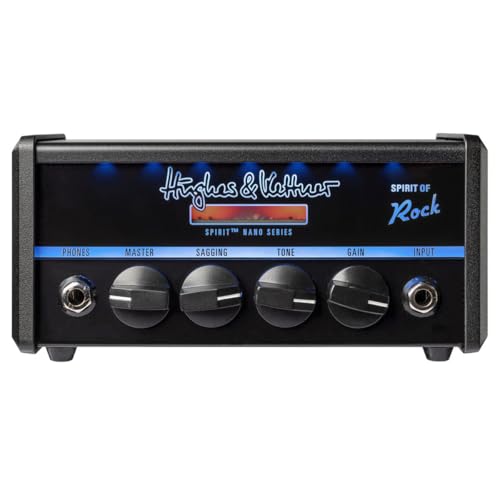
- 25-watt Micro Guitar Amp Head with Spirit Tone Generator
- Unfiltered Line Out
What to Consider Before Buying Electric Guitar Amplifier Heads
An Electric Guitar Amplifier Head is more than just an item; it’s a key solution for guitarists who want to separate their sound engine from their speakers. Unlike combo amps, a head allows you to mix and match different cabinets, giving you immense control over your final “air move.” Whether you are recording in a bedroom or playing a club, the head is the brain of your operation. Choosing the right one determines your dynamic range, your interaction with pedals, and, ultimately, your signature sound. If you choose poorly, you might find yourself with an amp that sounds “fizzy” or lacks the “thump” required to cut through a live drummer.
The ideal customer for this type of product is someone facing the challenges of modern musicianship: the need for portability, silent recording capabilities, and consistent tone at various volume levels. It is perfect for the gigging professional who wants a reliable backup or a primary ultra-light rig, as well as the home studio enthusiast who needs high-quality DI (Direct Injection) tones. However, it might not be suitable for those who demand the specific, glass-shattering headroom of a 100-watt vintage tube head or players who require multi-channel switching and built-in digital effects like reverb and delay. For those players, a full-sized modeling head or a traditional tube beast might be the only answer.
Before investing, consider these crucial points in detail:
- Dimensions & Space: Consider where the amp will live. If you’re a touring musician, every inch of space in your luggage matters. You want something that fits into a backpack or a gig bag pocket without adding significant weight. A compact footprint also makes it easier to place on top of any borrowed cabinet at a venue.
- Capacity & Performance: Look at the wattage and how that power is delivered. In the world of solid-state and analog-modeled amps, 25 watts can be surprisingly loud, but you need to ensure the amp can handle the impedance of your favorite cabinets. Check if the “feel” of the power—the sag and saturation—is adjustable to mimic the behavior of pushed tubes.
- Materials & Durability: Since these units are often transported frequently, the build quality is paramount. A metal enclosure (like stainless steel) is generally preferred over plastic for its shielding properties and its ability to withstand the rigors of the road. High-quality jacks and pots are also essential for long-term reliability.
- Ease of Use & Maintenance: A great nano head should be “plug and play.” Complicated menus can be a hindrance on stage. Look for intuitive controls and useful outputs like headphones and DI outs. Analog-based units often require less maintenance than tube amps, as there are no glass valves to break or bias over time.
While the Hughes & Kettner Spirit of Rock 25-watt Nano Amp is an excellent choice, it’s always wise to see how it stacks up against the competition. For a broader look at all the top models, we highly recommend checking out our complete, in-depth guide:
FULL ANALYSIS
Check Out Our Top 10 Picks for the Best Mini Guitar Amp Heads for Home Practice and Gigs
- Channel Switching & Independent Control: The BanTamp XL series features a dedicated footswitch for channel switching and six knobs. This allows you to independently control both the CLEAN and...

Unboxing the Hughes & Kettner Spirit of Rock 25-watt Nano Amp: First Impressions
Taking the Hughes & Kettner Spirit of Rock 25-watt Nano Amp out of its box is a bit of a surreal experience. It weighs a mere 2.5 pounds, and its dimensions are so diminutive that you almost question its legitimacy as a “real” amplifier. However, once you feel the cold touch of the stainless steel enclosure, you realize this is a serious piece of engineering. The aesthetic is classic Hughes & Kettner—clean, professional, and featuring that iconic blue glow when powered on. It doesn’t feel like a toy; it feels like a precision instrument. Before you even plug it in, you can see its full feature set and user reviews to understand why this has become a cult favorite among rock purists.
The layout is refreshingly simple. You have your Master, Sagging, Tone, and Gain controls. On the back, the connectivity options are surprisingly generous for such a small unit. We were particularly impressed by the dedicated headphone output featuring the famous Red Box cabinet emulation, which suggests that H&K didn’t cut corners on the output stage. Compared to some of the hybrid or digital micro-amps we’ve tested, the Spirit of Rock feels more “organic” right out of the gate. It promises an analog signal path that mimics the behavior of a tube power amp, and we were eager to see if that “Spirit Tone Generator” could live up to the hype.
Key Benefits
- Incredibly portable at just 2.5 lbs—fits in almost any gig bag.
- Spirit Tone Generator provides authentic, touch-sensitive analog rock tones.
- Sagging control allows for “cranked tube” feel at any volume level.
- Built-in Red Box cabinet emulator for excellent silent practice and DI recording.
Limitations
- No built-in reverb, which may require an external pedal for some players.
- Single-channel design means you’ll rely on your guitar’s volume knob for cleans.
A Deep Dive into the Hughes & Kettner Spirit of Rock 25-watt Nano Amp’s Performance
The Spirit Tone Generator: Redefining Analog Distortion
The heart of the Hughes & Kettner Spirit of Rock 25-watt Nano Amp is the Spirit Tone Generator. Unlike many modern mini-amps that rely on digital signal processing (DSP) to “mimic” a tube sound, H&K has stuck to a fully analog signal path. When we first plugged in a Gibson Les Paul and struck a power chord, the response was immediate. There’s a certain “width” to the frequency range that you usually only get from much larger transformers. We found that the gain structure is voiced perfectly for classic to modern rock. It doesn’t get “fizzy” or “thin” as you crank the gain; instead, it thickens up, adding harmonically rich overtones that feel three-dimensional.
We spent several hours testing how it reacts to player dynamics. If you pick lightly, the amp cleans up beautifully, retaining a chimey top end. Dig in, and it barks with the authority of a much larger British-style head. This touch sensitivity is the hallmark of the Spirit technology. In our tests, it felt significantly more “real” under the fingers than many of the popular modeling softwares we use in the studio. For those who want that organic connection to their instrument, you should definitely check the latest price and availability for this analog powerhouse.
The Sagging Control: Mastering the Power Amp Feel
Perhaps the most innovative feature of the Hughes & Kettner Spirit of Rock 25-watt Nano Amp is the “Sagging” knob. In a traditional tube amplifier, “sag” occurs when the power supply can’t quite keep up with the demand of the tubes when they are pushed hard, resulting in a natural compression and a “squishy” feel that guitarists love. Usually, you can only get this effect by turning a 50-watt amp up to ear-splitting levels. With the Spirit of Rock, H&K has decoupled this effect from the volume.
As we turned the Sagging control up, the amp’s response became more compressed and saturated, even at bedroom volumes. It’s a feature that really sets it apart from other solid-state heads. At lower settings, the amp is punchy and tight—perfect for fast rhythmic playing. As you dial it past noon, it starts to bloom and sustain like a vintage plexi on the verge of meltdown. We found this to be incredibly useful when recording direct; it adds that “pushed air” quality to the DI signal that is usually missing from direct-recorded guitars. It transforms the 25 watts of power into something that feels much more substantial and “expensive” than the price tag suggests.
Versatility and Real-World Power: Driving the Big Cabs
A common question we had was: “Can 25 watts actually drive a 4×12 cabinet?” The answer is a resounding yes. We hooked the Hughes & Kettner Spirit of Rock 25-watt Nano Amp up to a standard Marshall 1960A cabinet (16 ohms) and were genuinely shocked by the volume. It’s loud enough to easily keep up with a drummer in a rehearsal space or a small club. While it might lose some “clean” headroom at maximum volumes, for rock music—where a bit of grit is usually desired—it performs admirably. The “Spirit” technology seems to maximize the efficiency of the 25-watt power section, providing a “big amp” feel that defies its physical size.
The unfiltered Line Out is another stroke of genius. While the Red Box output is great for quick setups, the Line Out allows you to use your own favorite Impulse Responses (IRs) in your DAW or an external IR loader. We found that pairing the Spirit of Rock’s analog preamp with high-end Celestion IRs resulted in professional-grade recorded tones that were indistinguishable from a miked-up cab. Whether you’re using it as a backup on your pedalboard or your main studio tool, you can explore the detailed technical specs to see how it fits into your specific signal chain.
Silent Practice and the Red Box Heritage
For many of us, practicing at 2:00 AM is a necessity, but we don’t want to sacrifice tone for the sake of the neighbors. The headphone output on the Hughes & Kettner Spirit of Rock 25-watt Nano Amp utilizes the legendary Red Box cabinet emulation. In our testing, the headphone sound was full, wide, and lacked that “beehive” buzz often associated with cheap headphone jacks. It actually makes you want to practice longer because the tone is inspiring. It captures the essence of a 4×12 cabinet, giving you a sense of space and weight even through a pair of studio monitors or headphones.
We also appreciated the simplicity of the controls during these late-night sessions. You don’t have to scroll through screens to find a good sound; you just turn the Tone and Gain knobs until it sounds right. The lack of built-in reverb is noticeable here, but we found that adding a simple reverb pedal in front of the amp (or through the DAW if recording) solved the issue perfectly. For the price, the quality of the Red Box output alone makes this a compelling purchase for any home recordist. You can find more user feedback on its recording capabilities to see how other professionals are utilizing this feature in their home setups.
What Other Users Are Saying
The general consensus among the guitar community regarding the Hughes & Kettner Spirit of Rock 25-watt Nano Amp is one of genuine surprise. We’ve observed that most users, like us, initially underestimated the unit based on its size. One experienced musician of thirty years noted that while it isn’t a direct replacement for a massive JCM 2000 tube head, it sounds “good for the money” and has “plenty of power to run a 4×12 loud and bright.” This echoes our findings: it’s a high-performance tool that punches well above its weight class.
Another user highlighted that the “gain is huge” and expressed disbelief at how loud it actually gets. The sentiment of “perfect sound with simplistic controls” is a common thread throughout the feedback. On the flip side, some users have pointed out the lack of built-in reverb as a slight drawback, and one mentioned that the lightweight nature (largely due to the compact components) makes it feel “mostly plastic” despite the steel housing. However, these are minor gripes when considering the price-to-performance ratio. Overall, the feedback confirms our experience: this is a reliable, high-gain rock machine that offers incredible value for those who need a portable, great-sounding rig. It’s consistently praised as a “good buy” for those looking for that specific Spirit of Rock bite.
How Does It Stack Up? Hughes & Kettner Spirit of Rock 25-watt Nano Amp vs. The Competition
While the Spirit of Rock is a fantastic choice, it’s essential to see how it compares to other leaders in the micro-amp market. Depending on your tonal needs—whether you want British crunch, modern high-gain, or a hybrid tube feel—one of these alternatives might catch your eye.
1. Orange Micro Dark Terror 20W Guitar Amp Head

- Power: 20Watt (hybrid)
- Tube: one 12AX7 (preamp)
The Orange Micro Dark Terror is perhaps the closest rival to the Spirit of Rock. Unlike the H&K, this is a hybrid amp featuring a single 12AX7 tube in the preamp. It offers a darker, more aggressive high-gain character that is a staple of the Orange sound. While the Hughes & Kettner Spirit of Rock 25-watt Nano Amp feels more “classic rock” and “versatile” with its Sagging control, the Micro Dark is built for metal and hard rock players who want that specific Orange “fuzz-adjacent” distortion. It also includes an FX loop, which the H&K lacks, making it a better choice if you use a lot of time-based effects like delays and modulations in your signal chain.
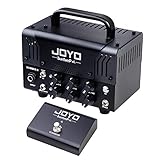
2. JOYO Zombie-II Mini Tube Guitar Amp Head
- Channel Switching & Independent Control: The BanTamp XL series features a dedicated footswitch for channel switching and six knobs. This allows you to independently control both the CLEAN and...
- Versatile High-Gain Platform & Clean Pedal Foundation: The ZOMBIE-II excels at lower gain settings and responds brilliantly to your favorite overdrive pedals, letting you push into higher gain with...
The JOYO Zombie-II is part of the BanTamp XL series and is specifically designed to emulate the “Mesa Boogie” high-gain sound. Like the Orange, it uses a 12AX7 tube in the preamp. The standout feature here is the two-channel design (Clean and Overdrive) which can be switched via a footswitch—something the single-channel Spirit of Rock doesn’t offer. It also includes Bluetooth connectivity for jamming along to backing tracks. However, in our experience, the Hughes & Kettner Spirit of Rock 25-watt Nano Amp offers a more “authentic” and less “compressed” analog feel thanks to the Spirit Tone Generator. Choose the JOYO if you need two channels and Bluetooth; choose the H&K if you want pure, touch-sensitive rock tone.
3. Orange Micro Terror Guitar Amp Head

- Power: 20 watt (hybrid)
- Tube: 1 12AX7 tube preamp with solid state power amp
The original Orange Micro Terror is a classic in this category. It’s simpler than the Dark version, focusing on bright, crunchy British tones. It’s incredibly loud for 20 watts and very user-friendly. When compared to the Hughes & Kettner Spirit of Rock 25-watt Nano Amp, the Micro Terror feels a bit more “one-dimensional.” The H&K’s Sagging control gives it a level of dynamic complexity and power-amp-style saturation that the Micro Terror can’t quite match. However, the Micro Terror is often available at a slightly lower price point, making it an excellent entry-level choice for those who just want the basic Orange crunch in a tiny package.
Final Verdict: Is the Hughes & Kettner Spirit of Rock 25-watt Nano Amp the King of Mini Heads?
After weeks of testing, we can confidently say that the Hughes & Kettner Spirit of Rock 25-watt Nano Amp is a masterpiece of compact engineering. It solves the primary problem of the modern guitarist: how to get big, inspiring rock tones in a package that fits in a coat pocket. Its strengths lie in its incredible touch sensitivity, the innovative Sagging control, and the professional-grade Red Box DI output. While it lacks reverb and an FX loop, these are small sacrifices for the quality of the raw tone it provides. It isn’t just a “backup” amp; it’s an amp that you’ll find yourself reaching for as your primary choice for practice, recording, and small gigs.
We recommend this amp to any rock or blues player who values portability and analog feel over digital menus and endless options. It’s a “purist’s” micro-amp. If you’re tired of lugging around heavy gear but refuse to compromise on the visceral “thump” of a real amplifier, this is the solution you’ve been waiting for. Don’t let the size fool you—this is a serious rock machine with a massive heart. If you’re ready to upgrade your portable rig, we highly suggest you check out the Hughes & Kettner Spirit of Rock today and experience the “Spirit” for yourself.
Last update on 2026-09-18 / Affiliate links / Images from Amazon Product Advertising API