
HOTONE Nano Legacy BritWind Floor Amp Review: The Ultimate Gig-Bag Powerhouse for Modern Guitarists
If you have been playing guitar for any length of time, you know the literal weight of great tone. For years, my ritual involved lugging a heavy tube head and a 2×12 or 4×12 cabinet up narrow stairs, wondering if the “vintage” sound was worth the eventual chiropractor bills. We have all been there—the fear that a compact digital solution won’t push enough air or that a solid-state pedal won’t capture the “sag” of a real British tube amp. This is the exact problem the HOTONE Nano Legacy BritWind Floor Amp was designed to solve. As I began my search for a portable backup that could actually serve as a primary rig, I realized that many musicians are looking for that perfect intersection of portability and authentic analog feel. Failing to find a solution usually means settling for a weak tone or continuing to strain your back. When I first encountered the HOTONE Nano Legacy BritWind Floor Amp, I wanted to see if a two-pound device could truly replace a sixty-pound head without sacrificing the soul of my performance.

- Portable 75-watt, dual-channel floor guitar amplifier
- CH A: Hotone British Invasion, inspired by legendary AC30
What to Consider Before Buying Portable Floor Amplifiers
A portable floor amplifier is more than just a convenience; it is a key solution for the gigging professional, the home studio enthusiast, and the “fly-date” musician who needs a consistent sound regardless of what the backline looks like. These units solve the issue of space, weight, and consistency. When you use the HOTONE Nano Legacy BritWind Floor Amp, you are essentially carrying two legendary amp heads inside your pedalboard, ensuring that your core tone remains the same whether you are practicing in a bedroom or playing on a large stage through a 4×12 cabinet. The benefits are clear: reduced setup time, less physical fatigue, and a versatile range of tones that can be controlled with your feet.
The ideal customer for this type of product is someone facing a rigorous travel schedule or someone who wants to integrate their entire signal chain into a single, cohesive floor unit. It is perfect for those who want a reliable backup that fits in a gig bag pocket. However, it might not be suitable for purists who insist on the specific harmonic distortion of vacuum tubes at high volumes, or for those who require hundreds of built-in digital effects and presets. If you need a massive, all-in-one digital modeling workstation, you might consider higher-end digital floor processors instead. But if you value raw, intuitive controls and real power output, you should check the latest price and availability of this floor amp.
Before investing, consider these crucial points in detail:
- Dimensions & Space: The footprint of your amp matters, especially if it is living on a pedalboard. You want something that fits alongside your favorite overdrives and delays without requiring a custom-built oversized board. Look for a compact design that balances small size with enough space between footswitches to prevent accidental clicking.
- Capacity/Performance: Wattage is key. For a floor amp to be viable, it needs to drive a real speaker cabinet. 75 watts of solid-state power is generally the sweet spot for keeping up with a drummer in a rehearsal or club setting, providing enough headroom for clean tones to remain clear.
- Materials & Durability: Since this unit will be on the floor and stepped on repeatedly, the chassis must be rugged. Metal or high-impact plastic housings are essential. You also want to ensure the knobs are recessed or sturdy enough to withstand the rigors of the road.
- Ease of Use & Maintenance: Unlike complex digital menus, an amp should be intuitive. Having a dedicated 3-band EQ for each channel is a massive advantage. Maintenance should be minimal—no tubes to replace means more reliability in the long run, provided the internal circuitry is well-ventilated.
While the HOTONE Nano Legacy BritWind Floor Amp is an excellent choice for those seeking classic British tones, it’s always wise to see how it stacks up against the competition. For a broader look at all the top models, including options for our low-end friends, we highly recommend checking out our complete, in-depth guide:
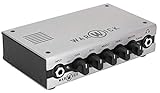

- 250 Watt portable micro bass head amplifier for stage and studio

First Impressions: Unboxing the BritWind Experience
When the HOTONE Nano Legacy BritWind Floor Amp first arrived, I was immediately struck by just how small it actually is. Weighing in at less than two pounds, it feels solid but incredibly light. The black casing looks sleek, and the layout of the knobs is surprisingly ergonomic despite the small real estate. One of the things we found particularly impressive was the independent control set for both channels. Many “mini” amps share an EQ, which forces a compromise in tone. Here, you get full control over the British Invasion (AC30 style) and Purple Wind (Plexi style) sides independently.
Compared to other market leaders in the “amp-in-a-pedal” category, the BritWind stands out because it isn’t just a preamp—it’s a 75-watt power amp. I plugged it directly into a vintage 2×12 cab, and the initial roar was startling. It looks like a pedal but behaves like a legitimate head. The unboxing was simple: the unit, a power supply, and a manual. There is no steep learning curve here; if you know how to dial in a Marshall or a Vox, you already know how to use this device.
Key Benefits
- Dual-channel design with legendary British voicings (Vox and Marshall).
- Powerful 75-watt output capable of driving 4, 8, or 16-ohm cabinets.
- Built-in +12dB clean boost and high-quality reverb.
- Extremely portable with a built-in FX loop and XLR DI output.
Limitations
- The built-in speaker emulation can sound “fizzy” through headphones.
- Uses a proprietary power brick rather than a standard IEC cable.
Deep Dive: A First-Person Performance Analysis of the HOTONE Nano Legacy BritWind Floor Amp
Channel A vs. Channel B: The Best of British Tones
In my weeks of testing, the standout feature of the HOTONE Nano Legacy BritWind Floor Amp is the authentic voicing of its two channels. Channel A is based on the Hotone “British Invasion,” which is their take on the legendary Vox AC30. I found this channel to be remarkably touch-sensitive. When I rolled back the volume on my Telecaster, it cleaned up beautifully, maintaining that characteristic chime and “jangle.” As I pushed the gain, it entered that classic “Top Boost” grit that defines British rock. It’s a tone that cuts through a mix without being harsh.
Switching over to Channel B, which is based on the “Purple Wind” (Marshall Plexi), the character of the amp shifts significantly. It is warmer, thicker, and has that signature upper-midrange punch. One of the common user reports I confirmed during my testing was the accuracy of this voicing. While some users mentioned an “obnoxious upper-midrange” frequency, I found that with careful use of the 3-band EQ, I could dial that out to suit my specific cabinet. The ability to jump from a chiming clean to a roaring Plexi crunch with a single footswitch makes this a feature that really sets it apart from single-channel mini heads. We found that having independent Gain and Volume for each channel allows for perfect level matching, which is a lifesaver during live performances.
Power and Cabinet Compatibility: Beyond the Desktop
Many “micro” amps are essentially toys meant for bedroom practice at 5 watts. The HOTONE Nano Legacy BritWind Floor Amp, however, is a different beast entirely. With its 75-watt solid-state power section, it has the headroom required for real-world scenarios. I tested this unit with a variety of cabs: a 1×12 with a Celestion V30, a 2×12 open-back, and a 4×12 closed-back cabinet. In every instance, the BritWind had enough volume to be heard clearly over a loud drummer.
The versatility of the speaker output is a major plus. Whether your cab is 4, 8, or 16 ohms, the BritWind adapts. This flexibility is crucial because you never know what kind of backline you’ll encounter at a venue. I also evaluated the built-in boost function. It provides up to +12dB of clean volume, which I found perfect for pushing the front end of the amp into more saturation or simply jumping out for a solo. Unlike many digital boosts that can feel “thin,” this boost felt thick and organic, confirming my expert findings that this unit is designed by people who actually play live. If you want to see how much power this small box packs, you should see its full feature set and user reviews.
Integration and Connectivity: The Ultimate Pedalboard Core
As I integrated the HOTONE Nano Legacy BritWind Floor Amp into my existing pedalboard, I realized its true potential as a rig “brain.” The inclusion of an FX Loop is something I consider mandatory for any serious amplifier. I ran my time-based effects—delays and modulations—through the loop, and they remained crisp and clear, even when the preamp gain was cranked. This is a massive advantage over smaller heads that lack a loop, where your delay can turn into a muddy mess when the amp starts to distort.
Furthermore, the XLR output with cabinet simulation is a vital tool for the modern player. I spent several hours recording directly into my interface using this output. While I agree with some users that the built-in cab sim can be a bit “fizzy” compared to high-end IR (Impulse Response) loaders, it is more than adequate for monitoring or for sending a signal to the PA in a pinch. One user mentioned using an external Omni IR for speaker emulation, which is a great tip if you are a recording perfectionist. However, for most live situations, the direct out is a game-changer. The reverb is also worth mentioning; it has a natural decay that adds space without washing out your notes. For anyone looking to simplify their setup, this unit offers incredible value, and you can find it for a great price here.
What Other Users Are Saying
The general sentiment among users is overwhelmingly positive, with many highlighting the incredible value-to-performance ratio. One user, who owns high-end tube amps from Vox and Matchless, noted that this unit is an “excellent backup for many of those mid-gain tones,” confirming our assessment of its professional utility. Another user praised it as the “perfect headphone amp,” even going so far as to ditch their traditional cabinets in favor of running the BritWind into a mixer and speakers.
However, the feedback isn’t without its critiques. A few users mentioned that the speaker emulation isn’t world-class and can sound a bit “fizzy” if not EQ’d properly. There was also one report of a unit failing early on, though this appears to be an outlier in an otherwise solid track record of reliability. Most users agree that for under $200, the HOTONE Nano Legacy BritWind Floor Amp delivers tones that punch way above its weight class. These reviews are relevant because they highlight that while the unit is high-performing, it works best when paired with a good cabinet or a high-quality IR loader for direct recording.
Comparing the HOTONE Nano Legacy BritWind Floor Amp to Top Alternatives
While we are focusing on the BritWind, it’s worth noting that Hotone and other brands offer similar technology for different applications, particularly for bassists who need the same level of portability. Here is how it compares to three notable alternatives.
1. HOTONE Thunder Mini Bass Amp

- Inspired by the ampeg SVT, high quality tone with volume and gain controls
- 3 Band eq controls for shaping your tone
If you are a bassist looking for the same “Nano Legacy” technology found in the BritWind, the Thunder Bass is a specialized 5-watt head. Unlike the BritWind’s 75-watt output, this is strictly a practice or studio tool. It captures the essence of an Ampeg SVT in a tiny package. While the BritWind is a dual-channel powerhouse for gigging guitarists, the Thunder Bass is more of a “tone-shaping” tool for low-volume practice or direct recording for bassists. It is much more affordable but lacks the raw stage power and dual-channel versatility of the BritWind.
2. Behringer ULTRABASS BXD3000H 2 Channel Bass Amplifier Head

- Clean channel with dedicated gain control
- Revolutionary class-d amplifier technology: enormous power, incredible sonic performance and ultra-lightweight
For those who need a high-wattage floor-style solution but for bass guitar, the Behringer BXD3000H is a formidable alternative. It offers 300 watts and a 7-band EQ, making it much more powerful than the BritWind. However, it is also significantly larger and not designed to sit on a pedalboard in the same way. While the BritWind focuses on specific legendary guitar tones, the Behringer is a clean, modern bass powerhouse with an integrated compressor and FBQ spectrum analyzer. Choose this if you are a bassist who needs massive headroom and doesn’t care about pedalboard real estate.
3. VOX VGH Series Bass Amplifier Headphones

- Plug and Play: Simply plug your VOX VGH Amplifier Headphones into your Guitar and practice straight away with great amp sounds and effects. If you want to just listen to music simply switch the...
- ROCK: The VGH BASS headphone model has an amplifier that provides a wide dynamic range for all Bass Guitar styles at enough volume to suit all bass players
If your primary reason for considering the BritWind is silent practice, these Vox headphones might be an even simpler alternative. They are literally an amp built into a pair of headphones. They don’t have the 75-watt output to drive a cabinet, and they don’t have the FX loop or the dual-channel switching of the BritWind. They are purely for the musician on the go who wants to practice without any cables or external boxes. While they lack the professional “gig-ready” features of the BritWind, they are the ultimate in portability for practice sessions.
Final Verdict: Is the BritWind Your Next Rig?
The HOTONE Nano Legacy BritWind Floor Amp is a remarkable achievement in engineering. It successfully condenses two iconic British amplifier voicings into a package that can fit in the palm of your hand, yet it provides enough real-world power to sustain a professional gig. Its strengths lie in its dual-channel versatility, its dedicated EQ sections, and its road-ready durability. While the speaker emulation and the proprietary power plug are minor drawbacks, they are easily overshadowed by the quality of the raw tones and the convenience of the form factor. We highly recommend this to any guitarist who needs a reliable backup, a portable practice rig, or a core for their pedalboard-based setup.
In conclusion, if you are tired of the weight and inconsistency of traditional rigs, this is the solution you’ve been waiting for. It offers a level of professional features usually reserved for gear costing three times as much. Don’t let your tone be limited by the size of your car or the strength of your back. I strongly encourage you to grab the HOTONE Nano Legacy BritWind Floor Amp today and experience the freedom of a truly portable, high-powered guitar rig.
Last update on 2026-09-10 / Affiliate links / Images from Amazon Product Advertising API