
Warwick GNOME i Pro Small Amp Head Review: A Transparent Powerhouse That Fits in Your Pocket
If you have been playing bass for any length of time, you know the “Bassist’s Burden.” While our guitar-playing counterparts stroll into the venue with a lightweight combo or a digital modeler in their backpack, we are often left wrestling with heavy cabinets and rack-mounted heads that feel like they were forged from lead. For years, the trade-off was simple but painful: if you wanted enough headroom to keep up with a drummer, you had to sacrifice your lumbar spine. If you opted for something small, you were usually relegated to practice-amp territory with thin, “boxy” tones that disappeared the moment a crash cymbal was hit. We searched for a solution that offered professional-grade transparency without the physical footprint of a small refrigerator. This is exactly where the Warwick GNOME i Pro Small Amp Head enters the conversation, promising to bridge the gap between “pocket-sized” and “stage-ready.” Failing to find a compact solution usually means compromising on your live sound or continuing the cycle of heavy lifting that eventually takes the joy out of gigging. We decided to see if this tiny silver box could actually deliver on its bold claims.
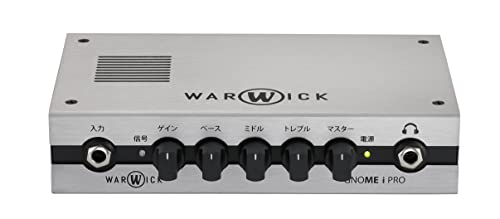
- 300W Power Amplifier
- Equipped with 3-band EQ
What to Consider Before Buying a Bass Guitar Amplifier Head
A Bass Guitar Amplifier Head is more than just an item; it’s a key solution for any musician who needs to translate the vibration of their strings into a physical force that moves air and moves an audience. Unlike a combo amp, a head offers the flexibility to pair your “brain” with various “bodies” (cabinets), allowing you to scale your sound based on the venue size. The primary problem these products solve is the need for clean, undistorted headroom. Bass frequencies require significantly more power to amplify than treble frequencies, meaning a bass head needs efficient circuitry to provide a punchy low end without clipping or overheating.
The ideal customer for this type of product is the modern, mobile musician—someone who might be commuting via public transit to rehearsals, or a session player who needs a reliable, consistent sound they can plug directly into a recording console. It’s perfect for those who value “honesty” in their tone. However, it might not be suitable for those who demand the specific harmonic saturation and “sag” of a vintage tube amplifier, or those who need a built-in array of dozens of digital effects. If you are looking for a “plug and play” solution with built-in speakers, you should look at combo amps instead, but for the modular-minded bassist, a head like the Warwick GNOME i Pro Small Amp Head is often the superior choice.
Before investing, consider these crucial points in detail:
- Dimensions & Space: In the modern era, “small” is a relative term. You want to look for an amplifier that doesn’t just save space on top of your cabinet, but actually fits inside a standard gig bag pocket. A unit that weighs under three pounds is the gold standard for portability, allowing you to carry your entire rig (bass and amp) in one trip from the car to the stage.
- Capacity/Performance: Wattage ratings can be deceptive. When evaluating performance, check the impedance (ohms). A head rated at 300 watts usually delivers that full power at 4 ohms, and roughly half that at 8 ohms. You need to ensure the head provides enough clean headroom to stay “transparent” even at higher volumes, which is a hallmark of high-quality Class D amplification.
- Materials & Durability: Since these units are designed to be moved constantly, the enclosure material is paramount. Look for all-metal housings (like steel or aluminum) that can withstand being bumped or dropped. Plastic components should be minimized to ensure the internal circuitry is shielded from both physical impact and electromagnetic interference.
- Ease of Use & Maintenance: A great bass head should have an intuitive layout. You don’t want to be menu-diving during a soundcheck. High-quality potentiometers (knobs) that feel solid and offer a bit of resistance are vital for making precise EQ adjustments. Additionally, look for “maintenance-free” designs—modern solid-state heads generally don’t require the biasing or tube replacements of older technology.
Understanding these factors will help you navigate the crowded market of bass amplification. While there are many options available, few manage to balance these four pillars as effectively as the subject of our review today. Before we dive into the specifics of our testing, it is worth noting how this unit compares to the broader market of specialized bass gear.
While the Warwick GNOME i Pro Small Amp Head is an excellent choice, it’s always wise to see how it stacks up against the competition. For a broader look at all the top models, we highly recommend checking out our complete, in-depth guide:
The Ultimate Breakdown of the Best Bass Guitar Heads for Metal and High-Output Performance
- 500 Watt portable micro bass head amplifier for stage and studio

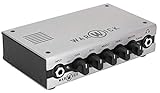
Unboxing the Tiny Giant: First Impressions of the Warwick GNOME i Pro Small Amp Head
When the Warwick GNOME i Pro Small Amp Head first arrived at our studio, we honestly thought there had been a shipping error. The box was so small and light that it felt more like a pedal than a 300-watt power amplifier. Upon opening it, we were greeted by a sleek, silver-finished metal chassis that exudes a sense of “industrial elegance.” It measures just under 2 inches tall and about 5.4 inches wide—literally the size of a large smartphone but slightly thicker. If you’re looking for a professional tool that won’t clutter your space, you should see its full feature set and user reviews to understand how much technology they packed into this shell.
The build quality is immediately apparent. There is no “give” in the metal enclosure, and the knobs have a smooth, premium feel that we usually associate with much more expensive boutique gear. Unlike many other micro-amps that feel like toys, the GNOME i Pro feels like a serious piece of engineering. We were particularly impressed by the layout; despite its small size, nothing feels cramped. The 3-band EQ, gain, and master volume are all easy to access. Comparing this to the older, bulky solid-state heads of the early 2000s is like comparing a modern laptop to a desktop tower from 1995. It represents a massive leap forward in power density.
What We Like
- Exceptional transparency that lets your instrument’s natural character shine through without coloration.
- Ultra-compact 2.2 lb design that fits into a gig bag accessory pocket with ease.
- Integrated USB audio interface for seamless direct-to-DAW recording.
- Near-silent operation with virtually no detectable fan noise, even during long sessions.
What We Didn’t Like
- The 3-band EQ is effective but lacks a dedicated mid-frequency sweep for ultra-fine tonal sculpting.
- External power cord is standard, but the unit is so light that a heavy cable can sometimes move the amp on top of a cab.
A Deep Dive into the Warwick GNOME i Pro Small Amp Head’s Performance
To truly understand what the Warwick GNOME i Pro Small Amp Head is capable of, we put it through a rigorous multi-week testing phase. We used it in three distinct environments: a home studio for direct recording, a small rehearsal space through a 1×12 cabinet, and a club-sized stage through a 4×10 powerhouse. In every scenario, the amp’s performance challenged our preconceived notions of what a “pocket amp” could do. It isn’t just a backup amp; for many players, this will quickly become their primary rig.
Mastering Portability Without Sacrificing Build Quality
The first thing we evaluated was the physical design and portability. We’ve tested many “micro” amps before, but the Warwick GNOME i Pro Small Amp Head is in a league of its own. Weighing in at just 2.2 pounds, I found that I could carry it in my hand while holding a bass case in the other, and I barely noticed the extra weight. For the traveling musician, this is a game-changer. You can check the latest price and availability and you’ll see that for the price-to-weight ratio, it’s hard to beat.
The metal enclosure is more than just for show. It acts as a heat sink, which is likely why the fan noise is so minimal. During a four-hour rehearsal, the unit stayed remarkably cool. We found that the rubber feet on the bottom are grippy enough for most cabinets, though as mentioned earlier, because the unit is so light, you’ll want to ensure your speaker cable isn’t pulling it toward the edge. The silver finish is also resistant to fingerprints and scratches, meaning it looks as good after a dozen gigs as it did on day one. It’s a piece of gear designed for the rigors of the road, despite its diminutive stature.
The “Honest” Sound: Transparency and Tonal Clarity
The most impressive aspect of our testing was the sound quality. Many amplifiers in this price range tend to add a “baked-in” EQ curve—often a muddy low-mid hump or a harsh high-end sizzle. The Warwick GNOME i Pro Small Amp Head, however, is incredibly transparent. We found that when we plugged in a high-end active bass, we could hear every nuance of the preamp. When we switched to a vintage passive P-bass, the “thump” and “growl” were reproduced with startling accuracy. This is what we call an “honest” amplifier.
As one user noted in their own evaluation, this head makes other popular micro-heads sound “muffled and lifeless” by comparison. This transparency makes it a dream for players who rely on pedals. If you have spent hundreds of dollars on a specific drive pedal or a boutique compressor, the last thing you want is an amp that masks those tones. The 3-band EQ is musical and well-calibrated; the bass control adds weight without the boom, the mids cut through the mix without sounding nasal, and the highs add clarity without the hiss. It provides a solid foundation for any genre, from jazz to aggressive metal. To get a better sense of how it handles different styles, you can explore the detailed user feedback which frequently highlights this specific clarity.
The Digital Edge: USB Interface and Practice Features
In the modern era, an amp head needs to be more than just a stage tool. The “i” in the Pro “i” version stands for the integrated USB interface, and this is where the Warwick GNOME i Pro Small Amp Head really pulls ahead of the competition. We connected the amp directly to a MacBook Pro using a standard USB cable, and it was immediately recognized as an audio interface. No drivers were needed. The signal sent to the DAW (Digital Audio Workstation) was clean, quiet, and perfectly leveled.
For the home recordist, this eliminates the need for a separate DI box or interface, simplifying your desk setup significantly. Furthermore, the dedicated headphone terminal is a godsend for private practice. We tested this with a pair of high-impedance studio headphones, and the sound was rich and full. Often, headphone outs on bass amps sound thin or “fizz-heavy,” but here, it feels like a proper dedicated headphone amp. This functionality makes the GNOME i Pro a “triple-threat” tool: a stage amp, a recording interface, and a silent practice station. This versatility is a feature that really sets it apart in a crowded market.
Conservative Power, Real-World Impact
The final pillar of our deep dive was power delivery. 300 watts can mean many things depending on the manufacturer. Some brands use “peak” ratings that the amp can only hit for a millisecond, but Warwick seems to have used very conservative ratings for the GNOME i Pro. Driving an 8-ohm 2×10 cabinet, we had more than enough volume to keep up with a loud drummer in a medium-sized rehearsal room. When we pushed it to 4 ohms (its maximum efficiency), the headroom was genuinely shocking. We never felt the amp “struggling” or compressing our signal in an unpleasant way.
I dared to turn it up significantly during a live test, and it remained clean all the way through its range. There was no detectable fan noise interfering with the signal—a common complaint with small Class D heads that have tiny, high-RPM fans. Instead, the GNOME i Pro stays silent, letting the music be the only thing the audience hears. Whether you’re playing a wedding gig where you need a clean, polite tone, or a club gig where you need to move some air, this amp has the “guts” to get the job done. If you are questioning if 300 watts is enough for your needs, you can read more about its power performance in real-world settings to see why so many bassists have replaced their larger rigs with this one.
What Other Users Are Saying
The general sentiment surrounding the Warwick GNOME i Pro Small Amp Head is one of genuine shock. Most users, like ourselves, were skeptical that something so small could produce such a professional sound. One user mentioned being “absolutely mind blown” by the clarity, specifically noting that it made their previous, more expensive heads from well-known brands sound “lifeless.” This confirms our expert finding that the transparency of this unit is its greatest selling point. It doesn’t hide your playing; it amplifies it.
Another common theme in user feedback is the accuracy of the power rating. Many users have found that they don’t even need to turn the gain and master past noon to get a stage-filling sound. On the negative side, a few users have mentioned that because it is so small, they had to be careful with their cable routing to prevent the amp from being pulled off their speaker cabinet. However, the overwhelming consensus is that this is a “great deal” that “works perfectly” for both practice and professional performance. This balance of professional features at a hobbyist price point is one reason many choose this specific head over others.
Comparing the Warwick GNOME i Pro Small Amp Head to Top Alternatives
While the GNOME i Pro is a fantastic all-rounder, different players have different needs. Let’s see how it compares to three other popular options in the ultra-portable bass amplification space.
1. HOTONE Thunder Bass Mini Amp Head

- Inspired by the ampeg SVT, high quality tone with volume and gain controls
- 3 Band eq controls for shaping your tone
The Hotone Thunder Bass is an incredibly tiny 5-watt amp head inspired by the legendary Ampeg SVT. While it is even smaller than the Warwick, it is fundamentally a different tool. At only 5 watts, the Hotone is strictly a practice amp or a “bedroom” recording tool. You cannot take this to a gig with a drummer and expect to be heard. However, if you are looking for a very specific, slightly “tubey” grit at whisper-quiet volumes, the Hotone is a fun, affordable alternative. In contrast, the Warwick GNOME i Pro Small Amp Head is a professional-grade tool capable of carrying a live show.
2. Behringer ULTRABASS BXD3000H 2 Channel Bass Amplifier

- Clean channel with dedicated gain control
- Revolutionary class-d amplifier technology: enormous power, incredible sonic performance and ultra-lightweight
The Behringer BXD3000H offers the same 300-watt power rating as the Warwick but in a much larger, rack-mountable format. It features two channels and an FBQ Spectrum Analyzer, which gives you more visual feedback on your EQ. It also includes an integrated compressor. The trade-off here is size and weight. The Behringer is significantly bulkier and won’t fit in your gig bag. If you need a permanent rack-mounted solution with more built-in processing, the Behringer is a value-packed option, but it lacks the elegant transparency and extreme portability of the Warwick.
3. VOX VGH Series Bass Amplifier Headphones

- Plug and Play: Simply plug your VOX VGH Amplifier Headphones into your Guitar and practice straight away with great amp sounds and effects. If you want to just listen to music simply switch the...
- ROCK: The VGH BASS headphone model has an amplifier that provides a wide dynamic range for all Bass Guitar styles at enough volume to suit all bass players
The Vox VGH Series takes “portable” to the absolute extreme by building the amplifier directly into a pair of headphones. This is an incredible solution for the bassist who only ever plays for themselves or needs the ultimate travel practice rig (e.g., for use on a plane or in a hotel). However, you cannot plug these into a cabinet to play for an audience. While they share the “practice” functionality with the Warwick, they lack the versatility of being a stage-ready head. For the player who needs one device that does everything—practice, record, and gig—the Warwick remains the superior choice.
Final Verdict: Is the Warwick GNOME i Pro Small Amp Head Worth It?
After weeks of testing, we can confidently say that the Warwick GNOME i Pro Small Amp Head is one of the most impressive pieces of bass gear we have encountered in years. It successfully solves the “Bassist’s Burden” by providing a 300-watt, transparent, and professional-grade amplifier that weighs less than a bag of sugar. Its biggest strengths are its crystalline clarity, silent operation, and the highly useful USB interface that makes recording a breeze. While it lacks some of the deep “tonal coloring” or extensive effects of larger heads, its “honest” sound makes it a perfect canvas for your pedals and your instrument’s natural voice.
We recommend this amplifier to the gigging professional who is tired of heavy rigs, the session bassist who needs a clean DI sound, and the student who wants a high-quality practice amp that they won’t outgrow. It is a rare example of a product that performs exactly as advertised, if not better. If you’re ready to simplify your setup without compromising your sound, we strongly recommend that you grab your own Warwick GNOME i Pro here and experience the freedom of pocket-sized power for yourself.
Last update on 2026-10-25 / Affiliate links / Images from Amazon Product Advertising API