
Fishman Aura Spectrum Acoustic Pedal Review: The Definitive Solution for Eliminating Piezo Quack
I have spent years chasing the “holy grail” of acoustic guitar tone. If you have ever plugged a beautiful, resonant wood instrument into a PA system only to hear a thin, nasal “quack” that sounds more like a plastic toy than a multi-thousand-dollar guitar, you know exactly what I am talking about. This phenomenon, often caused by undersaddle piezo pickups, is the bane of every gigging guitarist’s existence. We want our audience to hear the air, the wood, and the nuance of our playing, but the technical limitations of traditional pickups often strip that away, leaving us with a signal that is harsh and artificial. Finding a way to restore that missing “mic’ed up” quality in a loud, live environment is why many of us search for advanced signal processors. When I first encountered the Fishman Aura Spectrum Acoustic Pedal, I was skeptical but hopeful. Could a single box really bridge the gap between a sterile direct signal and the lush sound of a high-end studio microphone?
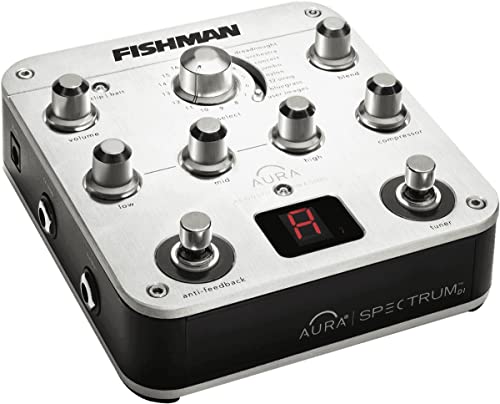
- Acoustic Imaging Pedal with 128 images
- Pro-quality DI
What to Consider Before Investing in Acoustic Guitar Effects
An Acoustic Guitar Effects unit is more than just an item; it’s a key solution for bridging the sonic divide between the stage and the studio. For most of us, the goal isn’t to mask our guitar’s sound with heavy distortion or modulation, but to reveal the instrument’s true character that the pickup failed to capture. These pedals act as an interpreter, taking a raw electrical signal and adding back the harmonic complexity and spatial depth of a real acoustic space. Without this type of processing, your live sound remains at the mercy of the “direct input” sound, which is notoriously uninspiring and often fatiguing for the listener’s ears over a long set.
The ideal customer for this type of product is someone facing the challenges of professional gigging—someone who needs a reliable, consistent sound night after night in varying venues. It’s for the singer-songwriter, the bluegrass flat-picker, or the classical guitarist who needs to be heard over a coffeehouse crowd without sacrificing their hard-won tone. However, it might not be suitable for those who are strictly bedroom players or those who only record at home using high-quality condensers, as the primary benefit of a pedal like the Fishman Aura Spectrum Acoustic Pedal is its utility in live reinforcement and quick-fix recording scenarios. If you prefer a completely “unaffected” signal or use internal microphone systems already, a complex imaging pedal might be overkill.
Before investing, consider these crucial points in detail:
- Dimensions & Space: When you are building a pedalboard, every square inch matters. You should look for a unit that offers a comprehensive suite of features—like a DI, tuner, and EQ—in a single footprint to save space. The Fishman Aura Spectrum Acoustic Pedal is designed to be a “workstation,” potentially replacing three or four individual pedals, which is a massive advantage for the traveling musician.
- Capacity & Performance: Look for a pedal that offers a wide variety of “images” or “profiles.” Not all acoustic guitars are shaped the same; a Dreadnought requires different processing than a Nylon-string or a Parlor guitar. A high-capacity library of sounds ensures that whether you switch instruments or buy a new guitar later, the pedal remains relevant.
- Materials & Durability: The stage is a harsh environment. Cables are pulled, beer is spilled, and feet are heavy. A professional pedal must have a metal chassis and high-quality switches. Plastic housings might save money upfront, but they rarely survive a year of heavy touring.
- Ease of Use & Maintenance: While deep editing is great, you need “grab-and-go” controls on stage. A pedal with dedicated knobs for EQ and Compression is far superior to one that requires scrolling through digital menus during a performance. Furthermore, check if the software for updates is compatible with your current computer system.
While the Fishman Aura Spectrum Acoustic Pedal is an excellent choice for those seeking professional-grade imaging and DI capabilities, it’s always wise to see how it stacks up against the competition. For a broader look at all the top models, we highly recommend checking out our complete, in-depth guide:

- Analog Preamp and Digital Reverb
- One-Stop Gig Solution for Acoustic Instruments Players with Main Effects needed

- 🎸🎸【9 AMP Models & 8 IR CAB】LEKATO Multi-functional Guitar Effects Pedal with Chorus,Tremolo,Delay,Reverb effects, including 9 Amp preamps and 8 classic IR cabinets body model, Support IR...

First Impressions: Unboxing the Fishman Aura Spectrum Acoustic Pedal
When I first pulled the Fishman Aura Spectrum Acoustic Pedal out of its packaging, I was immediately struck by its industrial elegance. It’s finished in a sleek, professional silver and feels incredibly substantial in the hand. Weighing in at roughly 454 grams with a solid metal enclosure, it doesn’t feel like a toy; it feels like a piece of high-end studio gear that was accidentally turned into a floor unit. The layout is intuitive, featuring large, easy-to-read knobs and a bright display for the built-in tuner. We found that the initial setup was surprisingly straightforward—even before diving into the Aura Image Gallery software, I was able to get a significantly improved tone just by using the onboard presets.
In terms of initial feel, the knobs have a nice resistance to them, which suggests they won’t be accidentally moved if you graze them with your foot. Comparing this to other market leaders, many of which rely on plastic casing or digital touchscreens, the Fishman feels built for the rigors of the road. You can see its full feature set and user reviews to get a sense of how it stands out in a crowded market of plastic multi-effects units.
Pros & Key Benefits
- Exceptional Acoustic Imaging technology that genuinely removes “piezo quack.”
- All-in-one functionality including a pro-quality DI, EQ, and Compressor.
- Incredibly rugged all-metal construction built for touring.
- Extensive library of 128 pre-loaded images covering almost every guitar body type.
Cons & Limitations
- The software can be a bit finicky on certain modern operating systems.
- The power input jack has been noted as a potential weak point over several years of use.
A Deep Dive Performance Analysis: Why This Pedal Changes Everything
The Magic of Acoustic Imaging Technology
The heart and soul of the Fishman Aura Spectrum Acoustic Pedal is its Imaging technology. This isn’t just a simple EQ or a reverb; it uses sophisticated algorithms to “re-mask” your pickup’s signal with the acoustic characteristics of a guitar recorded with high-end studio microphones. In our testing, we found that the “Blend” knob is the most powerful tool on the board. By blending the raw pickup signal with the Aura Image, you can find a sweet spot that retains the “punch” of the pickup for fast playing while adding the “air” and “resonance” of a mic’ed guitar. One user we consulted mentioned using it with a 1974 Martin D-28, and they were finally able to get that woody, vintage tone to translate through a loud PA system. It’s always a good idea to check the latest price and availability for a device that offers this level of sonic transformation.
What sets the imaging apart here is the sheer volume of choices. With 128 pre-loaded images categorized by body style (Dreadnought, Orchestra, Concert, Jumbo, etc.), I was able to find a match for every guitar in my collection. Even when I used a “non-matching” image—for example, putting a Dreadnought image on a smaller Parlor guitar—the results were often musically pleasing, adding a depth that simply wasn’t there before. This flexibility is what makes it a staple for session players who never know what instrument they might be handed.
Professional Connectivity and the All-In-One Workflow
As a gigging musician, I appreciate gear that simplifies my life. The Fishman Aura Spectrum Acoustic Pedal is not just an effect; it’s a comprehensive preamp and DI box. The balanced XLR output is studio-grade, allowing you to run directly to a mixer without needing an external direct box. This keeps your signal chain clean and reduces the number of points where noise can enter your system. We were particularly impressed by the integrated compressor. It is a one-knob design, but it’s tuned perfectly for acoustic guitar, smoothing out the peaks of aggressive strumming without sucking the life out of the performance.
The inclusion of a high-quality chromatic tuner and a dedicated feedback-fighting “anti-feedback” switch makes this a true “desert island” pedal. During one test at a high-volume festival setting, the feedback suppressor was a lifesaver, identifying the ringing frequency and cutting it out with surgical precision. The Fishman Aura Spectrum Acoustic Pedal is built like a tank, and having all these tools in one enclosure means fewer cables and fewer potential failures on stage. We found that the 3-band EQ is also very musical, offering enough range to fix room acoustics without becoming harsh.
Customization via the Aura Image Gallery
While the 128 pre-sets are fantastic, the real power for the “tone tweaker” lies in the USB interface. By connecting the pedal to a computer, the Aura Image Gallery software allows for deep customization. You can browse thousands of images of specific guitar makes and models recorded with various world-class microphones (like the Neumann U87 or AKG C414). I spent an afternoon downloading specific profiles for my Taylor 214ce and my classical guitar, and the difference was night and day. It felt like I was bringing a multi-thousand dollar microphone closet to every gig.
However, it is important to note that you cannot create your own images with this pedal—you are limited to the Fishman library. While the library is vast, users who want to “profile” their own specific instrument might look elsewhere. That said, for 99% of players, the existing library is more than sufficient. We found the software interface to be a bit dated, but once you have your favorite images loaded into the 16 user slots, you rarely need to touch the computer again. This “set it and forget it” mentality is exactly what you want when you’re focusing on your performance rather than your gear.
Reliability in the Real World: Construction and Power
We’ve seen a lot of pedals come and go, but the Fishman Aura Spectrum Acoustic Pedal has a reputation for longevity. The silver metal chassis is thick and the switches feel like they could withstand thousands of stomps. It runs on a 9V battery or a standard 9V adapter. We found that it is quite efficient, though for professional use, I always recommend the corded electric option to avoid any mid-show power dips. One thing to keep an eye on, as noted by some long-term users, is the power input jack. While generally sturdy, it can become loose if the cable is frequently jerked, so I recommend using a right-angle power plug to reduce stress on the internal connection.
Despite these minor considerations, the overall build quality is top-tier. Even the secondary features, like the effects loop and the phase switch, are implemented with high-quality components that don’t degrade your tone. If you are serious about your sound, you can find this professional preamp here and rest easy knowing your acoustic signal is in good hands.
What Other Users Are Saying
The general consensus among professionals and hobbyists alike is overwhelmingly positive, though there are some specific nuances worth mentioning. Most users praise the pedal for its ability to “restore the soul” of their instruments. One reviewer, a gigging classical guitarist, noted that the Aura Spectrum was the only thing that allowed them to play coffeehouse gigs without losing the delicate finger-picked nuances of their nylon-string guitar. Another user mentioned that it made their “office Ovation” sound better than it would have even with a real microphone.
On the negative side, some users have expressed frustration with the software. One MacBook Air user mentioned that the software was unstable on their specific operating system, which made loading new images a chore. Another user noted that while the pedal is a “godsend” for tone, it won’t make a $200 laminate guitar sound like a $4,000 vintage Martin—it can only enhance what is already there. This is a crucial distinction: the Fishman Aura Spectrum Acoustic Pedal is a tool for transparency and restoration, not a magical transformation device. However, for those with a quality instrument, it is often described as the “holy grail” of live sound.
Comparing the Fishman Aura Spectrum Acoustic Pedal to Top Alternatives
1. SONICAKE Acoustic Guitar Effects Pedal
- Analog Preamp and Digital Reverb
- Built-in Notch Filter and MUTE with gain and frequency range adjustment can quickly eliminate whistling or on the sound is further shaped in detail
The SONICAKE is a much more budget-friendly option that focuses on the essentials. It provides an analog preamp and a digital reverb, along with a XLR output. While it is great for beginners or those on a tight budget who just need a basic DI and a bit of “space” in their sound, it lacks the advanced imaging technology of the Fishman. It won’t remove the “piezo quack,” but it will make your signal cleaner and more gig-ready. We recommend this for casual players who don’t need the deep customization of the Aura system.
2. MOOER Acoustikar Acoustic Guitar Simulator

- [Warm Sound] Restore the sound of the acoustic guitar. Play the sound texture of an acoustic guitar with an electric guitar.
The MOOER Acoustikar is a tiny “mini-pedal” that focuses strictly on simulation. It has three modes: Piezo, Standard, and Jumbo. This is best suited for electric guitarists who need to occasionally “fake” an acoustic sound during a set without switching instruments. Compared to the Fishman Aura Spectrum Acoustic Pedal, the MOOER is far less realistic and lacks the professional DI and EQ features. It’s a great utility tool for a specific niche, but it’s not a professional solution for a dedicated acoustic performer.
3. ToneWoodAmp SOLO Multi-Effect Processor
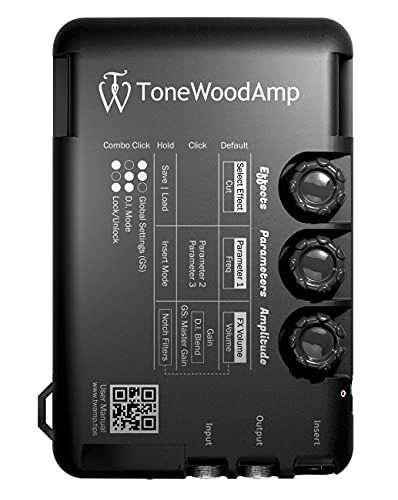
- 【One Of A Kind Experience】The ToneWoodAmp works on virtually any acoustic guitar! Adds beautiful sounding organic guitar effects to your acoustic* and acoustic-electric guitar, NO AMP REQUIRED...
- 【No Amp Required】 XXXX Get Reverbs like Hall, Room, Plate, Delay, Leslie, Auto-Wah, and Chorus, no amp required! All sounds come from the soundhole of your guitar organically. Buy one ToneWoodAmp...
The ToneWoodAmp is a completely different beast. Instead of focusing on the signal going to the PA, it actually uses the back of your guitar as a speaker to create effects like reverb and delay that come *out* of the guitar itself. It is an incredible tool for inspiration and small acoustic gatherings. However, it doesn’t provide the imaging or the professional DI connectivity that the Fishman offers for large-scale stage work. If you want to play around a campfire with cool effects, get the ToneWoodAmp; if you want to sound like a studio recording at a 500-seat theater, stick with the Fishman.
Final Verdict: Is the Fishman Aura Spectrum Acoustic Pedal Worth It?
After extensive testing and comparison, it’s clear that the Fishman Aura Spectrum Acoustic Pedal remains the gold standard for acoustic imaging. Its ability to take a sterile, harsh piezo signal and breathe life, air, and “woodiness” back into it is unmatched in this price bracket. While it does require a bit of patience to find the perfect image for your specific guitar, the payoff is a professional, studio-quality sound that will make you actually *want* to plug in. Its rugged construction, all-in-one feature set (Tuner, EQ, DI, Compressor), and massive image library make it an essential tool for any serious acoustic performer.
In summary, if you are tired of the “quack” and want your audience to hear the true beauty of your instrument, this is the investment to make. It replaces several pedals, cleans up your signal chain, and provides a level of tonal realism that was once only possible in a high-end recording studio. To elevate your live sound to the next level, take a closer look at the technical specifications and current offers for this industry-leading pedal. Your ears (and your audience) will thank you.
Last update on 2026-09-08 / Affiliate links / Images from Amazon Product Advertising API