
DigiTech Whammy 2 Pitch Shift Effect Pedal Review: The Ultimate Expression Tool for Modern Guitarists
We have all been there: you are sitting in your practice space, your favorite distortion pedal is engaged, your delay is set just right, but your solos still feel… ordinary. You are looking for that “X-factor,” that screaming, soaring, or gut-punching sound that defines legendary riffs. The problem isn’t your playing; it’s the physical limitation of the standard guitar fretboard. Without a tool to manipulate pitch in real-time, you are confined to the notes under your fingers. Many players attempt to solve this with standard fixed octave pedals, but they quickly realize that static shifts lack the soul and movement required for truly expressive performances. Failing to find a dynamic solution leads to a stagnant sound, making it impossible to replicate the iconic “squeals” of Tom Morello or the deep “dive bombs” that define modern rock and metal. This is exactly where the DigiTech Whammy 2 Pitch Shift Effect Pedal enters the fray, promising to turn your six-string into a multi-octave monster.
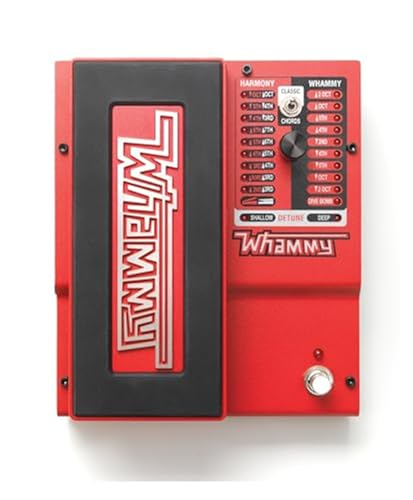
- 6 Whammy modes including famous 2 Octave Up as heard on 100’s of songs!
- 10 Harmony Bend modes including 2nd Up to 3rd Up simulating pedal steel bends!
The Essential Buyer’s Guide: What to Look for in Electric Guitar Pitch & Octave Effects
An Electric Guitar Pitch & Octave Effects pedal is more than just an item; it’s a key solution for guitarists who want to transcend the traditional limits of their instrument. These pedals allow you to shift your pitch up or down by specific intervals, create lush harmonies, or even simulate the sound of a 12-string guitar or a bass. The primary benefit is versatility. Instead of lugging three different guitars tuned to various registers, a high-quality pitch shifter allows you to transform your tone at the tap of a toe. It opens up a world of “color” that standard modulation simply cannot touch, providing the “飛び道具” (flying tool/secret weapon) effect that Japanese users often praise for its ability to cut through a mix.
The ideal customer for this type of product is someone facing creative stagnation or a professional musician who needs to replicate complex studio recordings on stage. It is perfect for experimental rockers, metalheads looking for massive “dive bombs,” and even session players who need a quick “detune” for chorus-like textures. However, it might not be suitable for those who strictly play traditional jazz or blues where a purely organic, un-manipulated signal is the gold standard. If you are a purist who finds digital artifacts distracting, you might prefer a standard analog chorus over a digital pitch shifter.
Before investing, consider these crucial points in detail:
- Dimensions & Space: When adding an expression-style pedal to your board, footprint is everything. The DigiTech Whammy 2 Pitch Shift Effect Pedal measures roughly 8 inches by 6.3 inches, which is substantial. You need to ensure your pedalboard has enough real estate not just for the pedal itself, but for your foot to comfortably sweep the expression treadle without hitting neighboring switches.
- Capacity/Performance: Look for the “tracking” capability. This refers to how quickly the pedal’s internal brain (the pitch detection engine) can identify your note and shift it. High-performance pedals like the Whammy series are known for near-instantaneous tracking, which is essential for fast solos. If the tracking is slow, you will experience a “latency” that makes playing feel disconnected and sluggish.
- Materials & Durability: Since your full body weight (or at least a significant portion of it) will be pressing on the expression pedal, metal construction is non-negotiable. Plastic housings in this category often fail under the rigors of touring. A “tank-like” build ensures that the internal sensors and the physical hinge remain calibrated after hundreds of shows.
- Ease of Use & Maintenance: Consider the interface. Do you prefer a simple knob to select modes, or do you need deep menu diving? Most players prefer the tactile feel of a rotary switch. Additionally, check the power requirements; many high-end pitch shifters require specific voltages or amperages, so having an included power supply is a massive bonus for long-term maintenance and reliability.
While the DigiTech Whammy 2 Pitch Shift Effect Pedal is an excellent choice, it’s always wise to see how it stacks up against the competition. For a broader look at all the top models, we highly recommend checking out our complete, in-depth guide:

- [Octave/Pitch shifter Pedal] With 7 shift types and 3 tone mode toggles, Harmonic Square guitar pedal gives you 21 options of semitonal, octave and detune sounds

- Industry-Standard Octave Pedal: The updated version features enhanced capabilities for modern guitarists


- Three shift modes: up, down or dual
First Impressions and the Iconic Design of the DigiTech Whammy 2 Pitch Shift Effect Pedal
The moment we pulled the DigiTech Whammy 2 Pitch Shift Effect Pedal out of the box, the first thing that struck us was the weight. At 3.8 pounds, it feels incredibly substantial. The classic red finish isn’t just for show; it’s a signal to any sound engineer or fellow musician that you’re ready to get experimental. Unlike the smaller “drop” style pedals, this unit demands attention on your board. We found the setup to be incredibly straightforward. It’s a corded electric unit, and we were pleased to find it includes its own power supply, which is a rarity these days. This is a huge plus because these digital engines are power-hungry, and using a generic adapter can often introduce unwanted noise. To get the most out of your sound, you should see its full feature set and user reviews to understand why the 9V power requirement is so specific.
Plugging it in, the interface is refreshingly intuitive. There are no complicated screens; just a solid rotary knob to cycle through the 6 Whammy modes and 10 Harmony Bend modes. The expression pedal has a smooth, resistant throw—not too loose that it flops around, and not too tight that it requires a gym membership to move. We immediately tested the “2 Octave Up” mode, and the response was lightning-fast. Compared to older versions or cheaper clones, the pitch detection engine here feels significantly more “wired” to your fingers. It doesn’t just feel like an effect; it feels like an extension of the guitar’s bridge.
Key Benefits
- Incredibly robust, all-metal construction that is “built like a tank.”
- Legendary “2 Octave Up” mode for iconic soloing sounds.
- Included power supply ensures consistent, noise-free performance.
- Fast and accurate pitch detection engine minimizes latency.
Drawbacks
- Large footprint requires significant pedalboard space.
- Can be an expensive investment for a single-effect unit.
Deep Dive: The Professional Performance of the DigiTech Whammy 2 Pitch Shift Effect Pedal
The Heart of the Beast: Pitch Detection and Latency
When we put the DigiTech Whammy 2 Pitch Shift Effect Pedal through its paces, the first thing we analyzed was the digital “brain.” In the world of pitch shifting, latency is the enemy. If you strike a note and the shifted sound arrives even a few milliseconds late, your brain feels the disconnect, and your timing suffers. We found that DigiTech’s cutting-edge pitch detection engine handles this flawlessly. Even during rapid-fire alternate picking or complex legato runs, the pedal tracked every note with surgical precision. We were able to reproduce the famous solo from “Killing in the Name” almost immediately, and the pedal kept up with every frantic movement of the foot.
User feedback consistently backs this up, with many noting that the “sound quality is excellent and professional” compared to other options on the market. We noticed that the pedal maintains the “girth” of your original tone better than most. While some digital shifters can make your guitar sound thin or “plastic,” this unit retains a certain weight in the lower frequencies. This is likely why it has become a staple for bass players as well as guitarists. If you want to ensure your rig has this level of professional response, you can check the latest price and availability for this industry standard.
Mastering the Expression Pedal: Dive Bombs and Harmony Bends
The standout feature of the DigiTech Whammy 2 Pitch Shift Effect Pedal is, of course, the expression pedal. This isn’t just a volume pedal; it’s a dynamic controller for the pitch engine. In “Whammy Mode,” you can sweep from your original note up to two octaves higher or down to a “monster dive bomb” that sounds like your strings are falling off the guitar. We spent hours testing the 10 Harmony Bend modes, which are designed to simulate pedal steel bends. This is where the pedal moves from “飛び道具” (wild effect) to a genuine musical tool. You can play a note, and as you depress the pedal, a second voice shifts in harmony while the original note remains constant.
This creates a lush, organ-like swell or a country-style “bend” that is physically impossible to do with your hands alone. We found the “Detune” setting to be a hidden gem. One user mentioned using it as a chorus more than their dedicated Boss pedal, and we have to agree. It provides a shallow pitch shift that adds a shimmering, watery texture to clean chords without the “cheesy” modulation of a standard chorus. To truly master these expressive bends, you need a pedal that responds to the nuances of your foot pressure, a feature that really sets this unit apart from its digital competitors.
Integration and Control: MIDI and the Professional Rig
For the professional musician or the studio tinkerer, the inclusion of MIDI In and Out/Thru is a game-changer. While many hobbyists may never touch these ports, they allow the DigiTech Whammy 2 Pitch Shift Effect Pedal to be controlled by an external sequencer or a MIDI foot controller. We tested this by syncing the pedal to a DAW, allowing us to automate pitch shifts during a recording session. This means you can have perfectly timed octave jumps without even touching the pedal during the take. This level of control is why the Whammy has appeared on albums by U2, Van Halen, and Led Zeppelin.
Beyond automation, the MIDI functionality allows you to change modes remotely. If your pedal is tucked away in a rack or at the back of a large board, you can use a simple MIDI command to switch from “1 Octave Down” to “2 Octaves Up” instantly. This technical edge is a significant part of why this pedal commands a higher price point. It isn’t just a toy; it’s a professional-grade processor. To see how this could integrate into your current setup, we recommend you experience this legendary pitch shifter firsthand through the detailed documentation available online.
Tone Character: Embracing the Digital “Glitch”
We need to talk about the “sound” of the Whammy. It is a digital pedal, and it makes no effort to hide that. However, for many users, that digital character is exactly the point. There is a certain “quirky squeal” that happens when the pedal tracks very high notes or multiple notes at once. While some might call this a flaw, we call it character. It’s that slightly “lo-fi” digital artifacting that gives Tom Morello’s solos their distinctive, alien quality. If you play a full chord through the harmony modes, the pedal sometimes “warbles” as it tries to track multiple frequencies.
In our testing, we found this to be incredibly inspiring for hip-hop sounding tracks and experimental rock. As one user noted, it’s the “only thing I know that does deep pitch shifts and harmonic shifts” with this specific flavor. If you are looking for a perfectly clean, 100% transparent polyphonic shifter, you might look elsewhere, but if you want the sound that defined a decade of rock music, this is it. It’s a “rare pedal that nearly always gets used in some form or another all throughout the night” because it adds that essential bit of “color” to your playing. You can mastering the art of dive bombs and discover these unique tonal textures yourself.
What Other Users Are Saying
The general sentiment surrounding the DigiTech Whammy 2 Pitch Shift Effect Pedal is overwhelmingly positive, with a strong emphasis on its professional build and iconic sound. Most users agree that while it is an investment, it’s one that pays off in creativity. One long-time user mentioned, “I would absolutely not go to a show on either guitar or bass without this great pedal… it’s built like a tank and can handle everything you throw at it.” This echoes our findings regarding the durability of the metal chassis. Another guitarist highlighted its ease of use, stating that “out of the box with just an hour of fooling around I was playing the solo from Killing in the Name perfectly.”
However, the feedback isn’t without its warnings. A few users mentioned the high price point as a barrier, with one noting it’s “kind of expensive for a pedal that I won’t be using very much.” It is certainly a “distinctive” sound that can be overused if you aren’t careful. More critically, one user reported a durability issue where the internal switch failed after a week, leaving the pitch “stuck.” While this appears to be a rare manufacturing defect rather than a design flaw, it underscores the importance of buying from a reputable source with a good return policy. Overall, the consensus is that if you are serious about your tone and want to “turn your guitar into a bass or get some crazy buckethead solos,” this pedal is an essential investment.
Comparing the DigiTech Whammy 2 Pitch Shift Effect Pedal to the Competition
1. DigiTech DROP Compact Polyphonic Pitch-Shifter

- Polyphonic drop tune allows you to drop tune from 1 semi-tone to a full octave
- Momentary or latching mode footswitch
The DigiTech DROP is a very different beast compared to the Whammy 2. While the DigiTech Whammy 2 Pitch Shift Effect Pedal is built for expression and mid-solo manipulation, the DROP is designed for utility. It lacks an expression pedal entirely, focusing instead on allowing you to “drop tune” your entire guitar by semi-tones or a full octave at the click of a button. We recommend the DROP for guitarists who need to switch between standard and Eb or Drop D tuning instantly without swapping instruments. It features a much smaller footprint, making it ideal for cramped pedalboards. However, if you want to perform those iconic “Whammy squeals” or dynamic bends, the DROP simply cannot do it.
2. DigiTech Whammy (5th Gen) 2-Mode Pitch-shift Effect Pedal

- Classic Whammy Sound
- Chordal Whammyv-01 Pitch Shifting
The 5th Gen Whammy is the modern evolution of the Whammy 2. It introduces a “Chords” mode, which uses advanced polyphonic tracking to shift entire chords without the digital “warble” we mentioned earlier. This makes it much “cleaner” and more transparent than the Whammy 2. It also features True Bypass, which ensures your tone remains untouched when the pedal is off. We recommend the 5th Gen for players who want the most modern, technically perfect version of the effect. However, some purists still prefer the Whammy 2 or earlier versions for their specific “glitchy” digital character and the nostalgia of the original pitch detection algorithms. It’s a battle between modern perfection and classic character.
3. Donner Octave Guitar Pedal Digital Octave Mini Pitch Shifter
- [Octave/Pitch shifter Pedal] With 7 shift types and 3 tone mode toggles, Harmonic Square guitar pedal gives you 21 options of semitonal, octave and detune sounds
- [3 Tone Modes]: 3 tone modes including Sharp, Flat, and Detune; Sharp: Pitch up; Detune: Adjustable pitch signal shifted by 10 cents; Flat: Pitch down
If the DigiTech Whammy 2 Pitch Shift Effect Pedal is the high-end professional choice, the Donner Harmonic Square is the budget-friendly entry point. This is a “mini” pedal, meaning it takes up almost no space on your board. It offers 7 shift types and 3 tone modes. We found that for simple octave-up or octave-down sounds, the Donner performs admirably for its price. However, it lacks an expression pedal, and the tracking is noticeably slower and more prone to artifacts than the DigiTech units. We recommend the Donner for hobbyists or those who just want to experiment with octave sounds without committing to a $200+ investment. For professional-grade expression control, however, there is no substitute for the Whammy.
Final Verdict: Is the DigiTech Whammy 2 Pitch Shift Effect Pedal the Ultimate Addition to Your Rig?
After extensive testing and comparing it with both its predecessors and its modern rivals, we can confidently say that the DigiTech Whammy 2 Pitch Shift Effect Pedal remains a titan in the world of guitar effects. Its combination of a lightning-fast pitch engine, a rugged “tank-like” build, and the incredibly expressive expression pedal makes it more than just a pitch shifter—it’s a whole new way to play your instrument. While the large footprint and the higher price tag might give some pause, the sheer creative potential it unlocks is worth every penny. Whether you are chasing the legendary sounds of the 90s or looking to forge your own path with MIDI-controlled experimentation, this pedal delivers. It’s not just for solos; the “Detune” and “Harmony” modes provide enough texture to justify its place on your board for every song in your set. If you are ready to stop playing by the rules and start manipulating the very fabric of your tone, we highly recommend you check out the DigiTech Whammy 2 today and see what it can do for your sound.
Last update on 2026-09-26 / Affiliate links / Images from Amazon Product Advertising API