
DigitalLife Quad-I/O MIDI Router Review: The Rugged Hub Your Hardware Synth Setup Deserves
If you are like us, your studio started with a single MIDI keyboard and a laptop. But then, the “hardware bug” bit. Suddenly, you found yourself surrounded by boutique drum machines, vintage synth modules, and modern sequencers. The problem? Most entry-level audio interfaces only offer a single MIDI port, if they offer any at all. We have spent countless hours fumbling behind desks, swapping 5-pin DIN cables just to get a sequence from Point A to Point B. It is a workflow killer that drains creativity. This is where a dedicated solution like the DigitalLife Quad-I/O MIDI Router becomes not just a luxury, but an absolute necessity for anyone serious about hardware integration.
The struggle of managing a hardware-heavy studio is real. When you have multiple controllers and multiple sound sources, you hit a bottleneck. Do you daisy-chain your gear using “MIDI Thru” ports? If you do, you’ll quickly notice timing jitter and latency creeping into your recordings as the signal passes through each device’s internal circuitry. The more devices in the chain, the sloppier the timing gets. For a producer, unstable timing is the kiss of death. We searched for a tool that could act as a central nervous system for our gear—something that could split one master clock to four different synths, or merge two controllers to play one rack-mount module. Without a reliable router, you are essentially playing a game of “cable Tetris” every time you want to start a new track. The DigitalLife Quad-I/O MIDI Router promises to solve this by providing a stable, high-performance bridge between all your 5-pin DIN devices.

- Flexible MIDI Connectivity: Designed for producers, the 5-Pin DIN interface offers flexible signal control. It manages MIDI routing for pros with multiple devices, ensuring stable & precise data...
- Six Modes of Operation: Features two functions with six modes: a 4-In/4-Out MIDI Thru Box and a 2-In/4-Out MIDI Merge Box. It operates in standalone mode without a computer, allowing you to route...
What to Consider Before Buying a Computer Recording MIDI Interface
A Computer Recording MIDI Interface is more than just an item; it’s a key solution for bridging the gap between the tactile world of hardware and the precision of digital recording. When you’re dealing with multiple synthesizers, controllers, and drum machines, the interface acts as the traffic controller, ensuring that every note, clock signal, and CC message reaches its destination without delay. Choosing the right one can mean the difference between a seamless session and an afternoon spent troubleshooting “stuck notes” and sync issues.
The ideal customer for this type of product is someone facing a growing collection of hardware who needs a centralized way to route signals, while it might not be suitable for those who strictly work “in the box” with VSTs and a single USB controller. If you only have one keyboard, a simple USB-to-MIDI cable might suffice. However, if you are looking to sync a drum machine to your DAW while playing a synth from a separate master keyboard, you need the routing logic found in the DigitalLife Quad-I/O MIDI Router.
Before investing, consider these crucial points in detail:
- Dimensions & Space: In a crowded studio, every square inch matters. You want an interface that is compact enough to sit on your desk or mount under a shelf, but heavy enough that the weight of four thick MIDI cables won’t pull it off the table. Look for units that offer a small footprint without sacrificing port accessibility.
- Capacity & Performance: Evaluate how many inputs and outputs you actually need today, and how many you might need in a year. A 4×4 interface like the DigitalLife Quad-I/O MIDI Router is often the “sweet spot” for small to mid-sized setups, offering enough ports for a master controller, a drum machine, and a couple of polysynths.
- Materials & Durability: Plastic housings are common in budget gear, but they don’t hold up well to the rigors of touring or constant cable swapping. A metal chassis is the gold standard; it provides shielding against electromagnetic interference and ensures the unit can survive a fall or a heavy hand in the heat of a performance.
- Ease of Use & Maintenance: Complex software drivers can be a nightmare. We prefer “plug-and-play” devices that work natively with Windows and Mac. Furthermore, having physical buttons or switches to change routing modes (Thru vs. Merge) is a massive time-saver compared to menu-diving in a computer app.
While the DigitalLife Quad-I/O MIDI Router is an excellent choice, it’s always wise to see how it stacks up against the competition. For a broader look at all the top models, we highly recommend checking out our complete, in-depth guide:

- ✦High Quality MIDI Interface: 1 in + 1 out Indicators simplify troubleshooting incoming and outgoing MIDI data, supports up to 16 input & output channels, Good material made, provide true original...
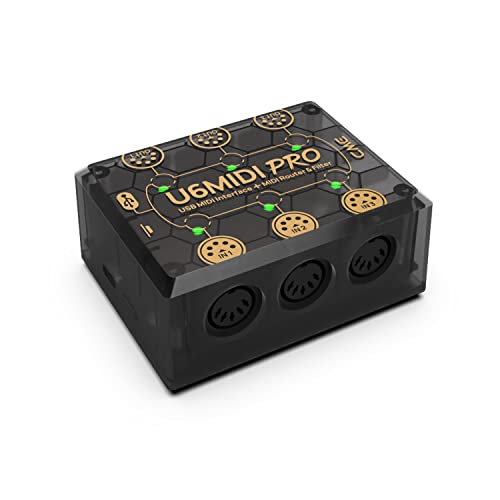
- [Computers] Plug-and-play MIDI interface via one single USB-C port, compatible with all major OS including macOS, iOS, Windows, Android, Linux and Chrome OS.

- [Standalone USB Host] Easily connect class compliant USB MIDI instruments like keyboards, controllers, effect pedals and synthesizers directly to your MIDI hardware without a computer. Accommodate up...
First Impressions: Rugged Red Metal and Real-Time Feedback
Opening the box of the DigitalLife Quad-I/O MIDI Router, the first thing we noticed was the striking red finish. It isn’t just a paint job; the entire chassis is made of a sturdy metal that feels premium in the hand. In an industry where so much gear is moving toward lightweight plastic, this felt like a throwback to professional rack gear. Weighing it in our hand, we knew it wouldn’t slide around our desk. We were also impressed by the eight high-visibility LEDs on the front panel. Many interfaces leave you guessing if a signal is actually moving, but these lights provide immediate visual confirmation for every input and output. Before you even hook it up to your DAW, you should see its full feature set and user reviews to understand the flexibility this rugged little box offers.
What We Like
- Extremely durable metal housing that feels “tour-ready.”
- Versatile 6-mode operation (Merge and Thru) for standalone use.
- Eight dedicated status LEDs for easy troubleshooting.
- Compact, stackable design that is perfect for small studio spaces.
What We Didn’t Like
- Routing modes may reset if the power is completely disconnected.
- Requires an external USB power source for standalone (non-computer) use.
Deep Dive: Performance Analysis of the DigitalLife Quad-I/O MIDI Router
Unrivaled Build Quality and Studio Portability
We have tested dozens of MIDI boxes over the years, and the DigitalLife Quad-I/O MIDI Router stands out immediately for its construction. Many competitors at this price point use plastic enclosures that feel hollow and brittle. When you are plugging and unplugging 5-pin DIN cables—which require a bit of force—you want a jack that is securely mounted to a metal frame. We found the ports on this unit to be exceptionally snug and well-aligned. The metal housing doesn’t just feel good; it acts as a heat sink and provides a layer of protection against the RF noise often found in studios filled with power cables and monitors. For those with limited desk real estate, its footprint is remarkably small, and the fact that it’s “stackable” means you can buy a second unit as your gear list grows. If you are looking for gear that feels professional, you should check the latest price and availability for this robust interface.
Flexible Routing: The Power of Merge and Thru Modes
The true genius of the DigitalLife Quad-I/O MIDI Router lies in its internal logic. Most budget interfaces are “dumb” pipes—they just send data from the computer to the synth. This unit, however, features six distinct modes of operation. We spent a significant amount of time testing the 2-In/4-Out Merge mode. This allowed us to take a sequencer (like an Arturia BeatStep) and a master keyboard, merge their signals, and send them simultaneously to four different sound modules. The timing remained rock-solid. In “Thru” mode, it acts as a high-performance splitter, taking one input and duplicating it across four outputs. This is a lifesaver for syncing multiple drum machines to a single master clock. As one user noted, it “gives you more options than some other boxes,” and our testing confirmed that these routing options are intuitively laid out. This flexibility makes it a feature that really sets it apart from basic 1×1 interfaces.
Intuitive Monitoring with 8-LED Feedback
There is nothing more frustrating than a MIDI setup that isn’t making sound. Is it the cable? Is it the channel setting? Is the interface even receiving data? With the DigitalLife Quad-I/O MIDI Router, those questions are answered instantly. The front panel features eight LEDs—four for Input and four for Output. During our testing, these LEDs were bright enough to see from across the room but not so bright that they were distracting in a dark studio. We found this especially useful when troubleshooting a complex MIDI chain; if the “In 1” LED is blinking but “Out 3” isn’t, you know exactly where the routing break is. This real-time signal feedback is a “handy” feature that we think every interface should have, but few actually execute this well. It provides a level of confidence during a live performance that software-only indicators simply cannot match.
Standalone Versatility and Power Management
While most people will use the DigitalLife Quad-I/O MIDI Router connected to a DAW via USB, its ability to function as a standalone router is a huge plus. By connecting it to a standard USB power adapter (like a phone charger), you can route your gear without even turning on your computer. This is perfect for “DAW-less” jams. We did notice a quirk mentioned in user feedback: if the power is cut, the unit might require a quick reset or button press to return to your preferred mode. While a minor inconvenience, the stability it offers once set up is impressive. The low power consumption means it won’t tax your laptop’s battery when you are producing on the go. If you value a setup that works independently of a computer, you should look closer at its standalone capabilities.
What Other Users Are Saying
The general consensus among the community is that the DigitalLife Quad-I/O MIDI Router is a “super-robust solution” for managing multiple connections. One user highlighted its effectiveness for “multi-synth modules and keyboards,” noting that it works well despite the minor inconvenience of needing a reset after power failures. Another reviewer called it “excellent” and specifically praised the “handy” LED feedback, which matches our findings regarding its troubleshooting utility.
However, it isn’t without its detractors. One user felt that for their specific needs, “it wasn’t worth it,” and another mentioned that the mode selection knob cycles through channels but didn’t always hold the preferred channel after a complete shutdown. We found that while these are valid points for users who frequently power-cycle their entire studio, the actual MIDI performance and timing remained flawless during our sessions. For those who leave their gear in a “ready” state, these issues are negligible compared to the routing power you get for the price. As another reviewer put it simply: “simpel en effectief” (simple and effective).
Comparing the DigitalLife Quad-I/O MIDI Router to the Competition
1. CME WIDI Master Premium MIDI Adapter

- [Get rid of those cables] Add Bluetooth MIDI to your MIDI devices and reduce the cable clutter in the studio. Enjoy freedom on stage. Powered via MIDI Out. No batteries needed. Check out...
- [Plug, Pair & Play] Pair automatically between WIDI devices and Bluetooth MIDI controllers. Send all MIDI messages, incl. SysEx & MPE. Connect manually with iOS, macOS, Win10/11 & Android via simple...
The CME WIDI Master is a completely different beast, focusing on wireless Bluetooth MIDI connectivity. While the DigitalLife Quad-I/O MIDI Router is a centralized wired hub, the CME adapter is meant for those who want to eliminate cables entirely between two specific devices. It offers ultra-low latency (3ms), which is impressive for Bluetooth. We would recommend the CME WIDI Master for someone who wants to play a synth from across the room using an iPad or a remote keyboard. However, for a permanent studio setup where you need to route four devices at once, the DigitalLife’s physical ports and merge/thru logic are far more reliable and versatile.
2. Arturia MiniFuse 2 Audio Interface
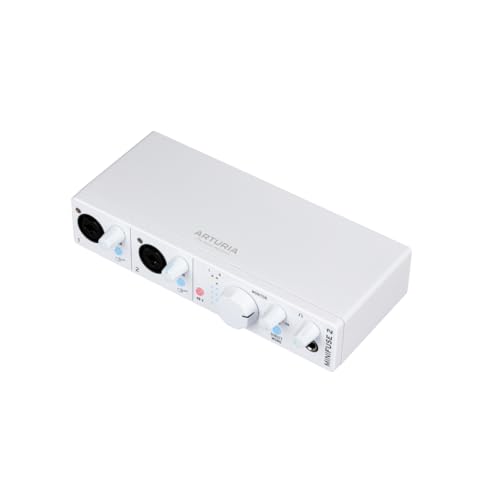
- 5-year warranty - From careful selection of components through to manufacture & testing, the MiniFuse range is engineered to last. Each interface is constructed with the most robust & reliable...
- Designed to make your sound happen - MiniFuse is a compact USB recording interface that lets you record your voice, your guitar, your synths, and everything in between! Play, perform, and produce...

The Arturia MiniFuse 2 is an audio interface that happens to have MIDI I/O. It is a fantastic choice for beginners who need to record both audio (vocals/guitar) and a single MIDI device. However, it only offers a 1-In/1-Out MIDI configuration. If you own more than one piece of hardware gear, you will outgrow the MiniFuse’s MIDI capabilities almost instantly. The DigitalLife Quad-I/O MIDI Router is the perfect companion *to* the MiniFuse; you would run the MIDI out of the Arturia into the DigitalLife to expand your single port into four. Buy the Arturia for its great preamps and software, but buy the DigitalLife for your synth collection.
3. FORE MIDI Interface

- FORE 1 MIDI in / 1 MIDI out MIDI interface, 16 MIDI input & output channels. Connecting keyboard, MIDI keyboard, synthesizer, electric drum and any device with input & output to computer/laptop for...
- Plug & Play, with a Built-in driver and Intelligent LED Indicator. No extra difficult driver installation. Easy set up, truly plug and play. MIDI converter shows different light indicators & status...
The FORE MIDI Interface is a basic, budget-friendly USB-to-MIDI cable. It is designed for one task: connecting one MIDI keyboard to a computer. It lacks the metal build, the 8-LED monitoring, the merge/thru modes, and the standalone capabilities of the DigitalLife Quad-I/O MIDI Router. While the FORE is “good enough” for someone just starting out with a single controller, it feels like a toy compared to the professional-grade DigitalLife unit. If you plan on having more than one synth, skipping the cable-style interfaces and going straight for the Quad-I/O will save you money and frustration in the long run.
Final Verdict: Is the DigitalLife Quad-I/O MIDI Router Right for You?
After putting the DigitalLife Quad-I/O MIDI Router through its paces, we can confidently say it is one of the best values in the MIDI interface market today. Its combination of a rugged metal chassis, intuitive visual feedback, and flexible routing modes makes it a “workhorse” for any hardware-based studio. While the memory of the mode selection after a power-off could be improved, the actual stability of the MIDI clock and the lack of perceptible latency are what matter most for music production. It simplifies the complex task of routing multiple controllers and sound modules, allowing you to focus on the music rather than the technical hurdles. Whether you are a hobbyist looking for high-quality gear without breaking the bank or a professional needing a reliable expansion for your MIDI network, this unit delivers. To take your studio connectivity to the next level, we highly recommend that you purchase the DigitalLife Quad-I/O MIDI Router today and experience a more seamless workflow.
Last update on 2026-09-16 / Affiliate links / Images from Amazon Product Advertising API