
Behringer 2600 Blue Analog Semi-Modular Synthesizer Review: The Legend Reborn in a Stunning Blue Marvin Tribute
For years, electronic musicians and sound designers have faced a persistent, frustrating dilemma: how to capture the raw, untamed power of 1970s analog synthesis without selling a kidney to afford a vintage unit. We’ve all been there—scrolling through digital plugin menus, clicking through “analog-modeled” presets that sound polished but ultimately lack that unpredictable, organic “breath” of real hardware. The original ARP 2600 was a monolith of sound, used by everyone from Stevie Wonder to the sound designers of Star Wars, but its rarity and astronomical price tag kept it out of reach for the average studio. Failing to secure that specific, grit-infused analog tone often means your tracks lack the harmonic depth and physical presence required to stand out in a crowded mix. When we heard about the Behringer 2600 Blue Analog Semi-Modular Synthesizer, we knew we had to see if this “Blue Marvin” tribute could finally bridge the gap between legendary heritage and modern accessibility. It’s not just about owning a piece of history; it’s about solving the problem of “sterile” digital production once and for all.
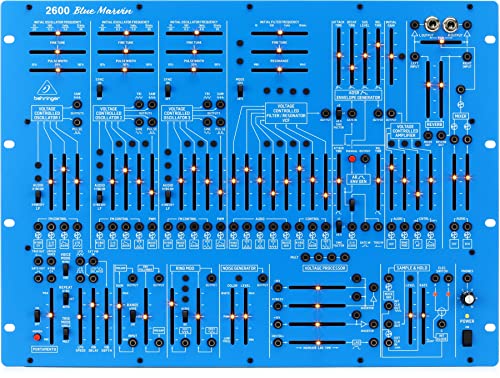
- Semi-modular Analog Synthesizer with 3 Oscillators
- Mechanical Spring Reverb - Blue Marvin
What to Consider Before Investing in a Tabletop Synthesizer
A tabletop synthesizer is more than just an item; it’s a key solution for musicians who want to move away from the “point-and-click” workflow of a DAW and into a more tactile, expressive form of creation. These instruments offer a physical connection to sound, where every turn of a knob or slide of a fader results in an immediate, audible change. For the modern producer, a tabletop synth like the Behringer 2600 Blue Analog Semi-Modular Synthesizer serves as the brain of the studio, providing a unique sonic character that digital emulations simply cannot replicate. The primary benefit here is the “happy accident”—the way analog components interact in ways that are harmonically rich and often surprising, leading to inspiration that wouldn’t happen behind a computer screen.
The ideal customer for this type of product is someone facing creative burnout or someone who wants to learn the fundamental building blocks of sound through subtractive and modular synthesis. It is perfect for professional studio owners looking for “that” classic sound and for educators who need a clear, visual representation of signal flow. However, it might not be suitable for those who require total recall and instant preset switching, or for traveling musicians who need something that can fit into a standard laptop bag without significant heft. If you are looking for a purely digital, multi-timbral workstation, you might consider different alternatives that focus on polyphony rather than raw monophonic power.
Before investing, consider these crucial points in detail:
- Dimensions & Space: Tabletop synths vary wildly in size. You need to ensure your studio desk or rack has enough real estate for the unit, especially since many semi-modular units require extra space for patch cables to hang freely without obstructing other gear. We found that measuring your available surface area beforehand is vital to avoid a cramped and frustrating workflow.
- Capacity & Performance: Look at the number of oscillators, the type of filter, and the modulation options. A synth with three oscillators offers significantly more detuning and thick-sound potential than a single-oscillator unit. Furthermore, check if the unit is “semi-modular,” meaning it works without patch cables but offers them for advanced routing, which provides the best of both worlds for beginners and pros alike.
- Materials & Durability: Since these are tactile instruments, the build quality of the faders and switches is paramount. A metal chassis is always preferable over plastic for long-term durability and shielding against electronic interference. We prefer faders that have a slight resistance, as this allows for more precise “micro-movements” during a live performance or recording session.
- Ease of Use & Maintenance: Consider the learning curve. A “one-knob-per-function” layout is much easier to master than a unit hidden behind deep digital menus. For analog gear, maintenance is usually minimal, but you should be aware of warm-up times—true analog oscillators often need 10-15 minutes to stabilize their pitch after being powered on.
Understanding these factors ensures that your transition into the world of hardware synthesis is smooth and rewarding. While the Behringer 2600 Blue Analog Semi-Modular Synthesizer is an excellent choice, it’s always wise to see how it stacks up against the competition. For a broader look at all the top models, we highly recommend checking out our complete, in-depth guide:

- 【Create Anywhere】This synthesizer is fully portable with battery operation and a built-in speaker, It's very compact and portable. 27 full-range silicone keys with soft, comfortable touch...
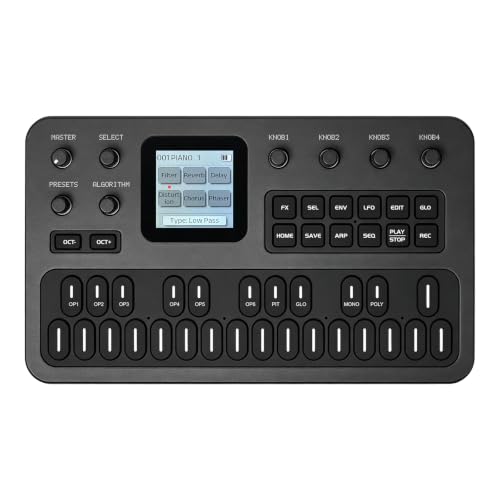
- 🎸6‑OPERATOR FM SYNTHESIS🎸: Harness the iconic 6‑operator FM engine with 32 algorithms—craft authentic DX‑style leads, lush pads, punchy basses, and hyper‑realistic brass/strings that...

- 【Create Anywhere】This synthesizer is fully portable with battery operation and a built-in speaker, It's very compact and portable. 27 full-range silicone keys with soft, comfortable touch...
First Impressions: Unboxing the “Blue Marvin” Legend
When the Behringer 2600 Blue Analog Semi-Modular Synthesizer arrived at our studio, the first thing that struck us was the sheer physical presence of the unit. Packaged securely, the “Blue Marvin” edition immediately distinguishes itself with its vibrant, vintage-correct blue faceplate. It doesn’t just feel like a piece of gear; it feels like a statement piece. Unlike the standard “Christmas tree” version with its multicolored LEDs, the Blue edition feels more sophisticated and focused. Before you even power it up, you can explore its unique aesthetic and features and realize that Behringer hasn’t cut corners on the exterior. The metal chassis is heavy (about 15.4 pounds) and feels incredibly solid, suggesting it can handle the rigors of both studio use and live gigs.
Setting it up was a breeze. As a semi-modular unit, the internal signal path is pre-wired, so we were able to get a classic sawtooth lead sound going within seconds of plugging in the power and a MIDI cable. The faders are smooth, though slightly closer together than on the original vintage unit, which is a necessary compromise to fit the 2600 into a 19-inch rack-mountable format. Compared to other modern recreations, this unit feels more “authentic” in its interaction—the way the faders catch the light and the mechanical feel of the switches evokes a sense of 1971 nostalgia that is hard to find elsewhere. It’s an impressive feat of engineering that makes a strong first impression on anyone who appreciates the history of synthesis.
Key Benefits We Discovered
- Authentic three-oscillator analog architecture that delivers a massive, harmonically rich sound.
- Integrated mechanical spring reverb provides a lush, vintage character that digital effects can’t match.
- Extensive 93 patch points allow for nearly infinite sound design possibilities and Eurorack integration.
- Beautiful, limited-edition “Blue Marvin” aesthetic with high-quality metal construction and upgraded components.
Some Limitations to Consider
- The mechanical spring reverb can be sensitive to vibrations and may “clunk” if the unit is moved while active.
- The large footprint may be too significant for producers with very limited desk space.
A Deep Dive into the Performance of the Behringer 2600 Blue Analog Semi-Modular Synthesizer
The Heart of the Beast: Three-Oscillator Architecture
The sonic soul of the Behringer 2600 Blue Analog Semi-Modular Synthesizer lies in its three voltage-controlled oscillators (VCOs). We spent hours testing the tracking and stability of these oscillators, and we were genuinely impressed. In the past, affordable analog clones often suffered from pitch drift, but this unit remains remarkably stable once warmed up. Each oscillator offers different waveform options, including saw, square, triangle, and pulse. What makes the 2600 workflow so special is the ability to use VCO 2 and VCO 3 as modulators for VCO 1. We found that by cross-modulating the oscillators, we could achieve everything from screaming sync leads to complex, bell-like FM (Frequency Modulation) tones that sounded organic and alive.
User feedback consistently confirms our findings: the sound quality is “amazing” and captures the essence of the original Arp 2600. When we pushed the oscillators into the mixer section, the way the signals began to saturate was incredibly musical. This isn’t just a synth for bass lines; it’s a sound design laboratory. Because it is monophonic (though it does have a paraphonic mode), the focus is entirely on the weight and texture of a single note. We found that layering the three oscillators with slight detuning created a wall of sound that could easily anchor a techno track or provide a haunting lead for a cinematic score. You can see its full feature set and user reviews to understand just how much power is packed into this oscillator section.
The Mechanical Spring Reverb: A True Analog Gem
One of the most significant upgrades in the “Blue Marvin” version over the standard Behringer 2600 is the inclusion of a real, mechanical spring reverb. Most modern synths use a digital chip for reverb, which can sound great but often lacks “soul.” The Behringer 2600 Blue Analog Semi-Modular Synthesizer uses a physical tank with metal springs inside. When we engaged the reverb, the sound instantly took on a 3D quality. It’s dark, splashy, and carries that unmistakable “ping” when hit with short, percussive sounds. It’s the kind of effect that makes the synth feel like a living, breathing acoustic instrument. We found that for an extra investment over the base model, this feature alone is worth every penny.
However, we must address a point raised by some users regarding the “clunking” sound inside the case. This is a common characteristic of mechanical spring reverbs; the springs are suspended, and if the unit is jolted, they will strike the sides of the tank. While one user reported their reverb was non-functional upon arrival, we found our unit to be perfectly calibrated. It’s important to treat this unit with a bit more care than a purely digital device. When working correctly, the spring reverb adds a haunting, cavernous atmosphere that is perfect for ambient music or adding “glue” to a dry patch. If you want that authentic vintage vibe, you should check the latest price and availability for this specific model, as the spring reverb is a limited-edition feature.
Modular Routing and the 93 Patch Point Playground
While the Behringer 2600 Blue Analog Semi-Modular Synthesizer functions perfectly without a single patch cable, the real magic happens when you start exploring the 93 patch points. We approached this as an “expert playground.” The front panel is essentially a map of the signal flow, and the patch points allow you to break that flow and insert modulation from anywhere to everywhere. We successfully integrated the unit with our existing Eurorack system, using external LFOs and sequencers to drive the 2600’s filters and oscillators. This level of connectivity transforms the 2600 from a standalone synth into a powerful modular hub.
We found that the inclusion of dual envelope generators (one ADSR and one AR) allows for very sophisticated shaping of sounds. One of our favorite techniques during testing was using the “Sample & Hold” section to modulate the filter cutoff, creating rhythmic, bubbling textures that felt completely random yet musically pleasing. As one user noted, for those familiar with subtractive synthesis, this unit provides “endless possibilities.” It’s a fantastic learning tool because the sliders provide a 1:1 visual representation of what is happening to the sound. Whether you are a beginner looking to learn or a pro looking to experiment, the patching capabilities are a highlight that really sets it apart.
Build Quality, Faders, and the “Marvin” Enhancements
Behringer has clearly listened to the community with the “Blue Marvin” release. Beyond the color, there are internal component upgrades designed to improve performance and longevity. During our extensive testing, the 78 faders felt consistent across the entire board. There’s no “dead space” at the bottom of the sliders, which is a common issue on cheaper units. The metal alloy steel construction gives the Behringer 2600 Blue Analog Semi-Modular Synthesizer a premium weight that keeps it from sliding around on the desk during aggressive patching sessions. It’s a tool built for work.
The layout is wide and generous, which we appreciated during live performance testing. It’s much harder to accidentally bump a slider on this unit than it is on smaller tabletop synths. We also noticed the LED brightness on the faders is adjustable via the back panel, a small but critical feature for late-night studio sessions where you don’t want to be blinded by the interface. To truly appreciate the craftsmanship, you can read more about the hardware specifications and see how it compares to the original vintage designs. It is a professional-grade instrument through and through.
What Other Users Are Saying
The general sentiment among the community regarding the Behringer 2600 Blue Analog Semi-Modular Synthesizer is overwhelmingly positive, with many users expressing shock at the value-to-performance ratio. One enthusiast who owns both the standard and Blue versions noted that while they sound very similar, the spring reverb in the Blue Marvin “is great” and makes the unit feel more complete. Another long-term user described it as a “phenomenal synth” that “looks absolutely gorgeous” on the desk, highlighting that it serves as both a musical powerhouse and a visual centerpiece.
However, the feedback isn’t without its caveats. As we mentioned earlier, the mechanical nature of the spring reverb has caused confusion for some. One user reported receiving a unit with a “loud clunking chunky sound” inside and a non-functional reverb, which they attributed to a shipping or manufacturing defect. While this appears to be an outlier, it serves as a reminder that this is a complex mechanical device. Most users agree, though, that Behringer has “knocked it out the park” with this release, providing a tool that is both a “GREAT learning tool” and a professional instrument with “endless possibilities.” The consensus is clear: for the price, the sound and features are unbeatable.
Comparing the Behringer 2600 Blue Analog Semi-Modular Synthesizer to Top Alternatives
1. Novation Circuit Tracks Electronic Music Groovebox Sequencer
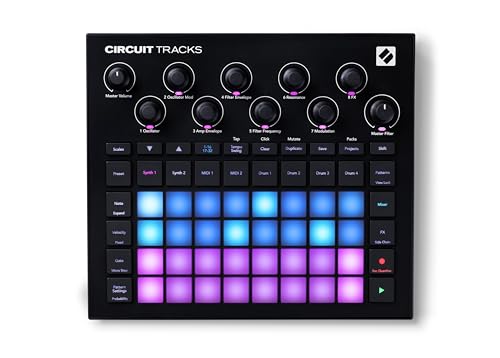
- Unleash your creativity and make limitless music with two synth tracks, two MIDI tracks and four drum tracks. Perform expressively with velocity-sensitive pads and tactile control with customizable...
- Create 32-step patterns, chainable for up to 256 steps sequences per track. Go off-grid with microtiming. Keep your music evolving with probability and pattern mutate

The Novation Circuit Tracks is a very different beast compared to the 2600. While the Behringer is a pure, monophonic analog powerhouse focused on sound design and “deep” synthesis, the Circuit Tracks is a portable, all-in-one groovebox. It features two digital synth engines and four drum tracks, making it ideal for the producer who wants to write entire songs on the go. If you need polyphony (playing chords) and an integrated sequencer, the Circuit Tracks is the better choice. However, it lacks the raw, “alive” sound of the 2600’s analog oscillators and the infinite flexibility of patch points. It’s a “songwriting” tool, whereas the 2600 is a “sound creation” tool.
2. KORG Volca Bass Analog Synthesizer

- Powerful analog bass sound creation with three oscillators for a variety of bass sounds
- Electribe-inspired sequencer for generating ultimate bass lines and grooves
The KORG Volca Bass is the “budget-friendly” entry point into the world of three-oscillator analog synths. It is incredibly small, battery-powered, and features a built-in sequencer. For someone who is just starting out and has very limited space or a tight budget, the Volca Bass is a fun and capable machine. However, the comparison ends there. The Behringer 2600 Blue Analog Semi-Modular Synthesizer offers a vastly superior build quality, a much larger interface for precise control, and a literal spring reverb tank. The Volca is a “sketchpad,” while the 2600 is a centerpiece. If you can afford the jump in price, the 2600 offers a professional experience that the Volca simply cannot match.
3. Otamatone Neo 10th Anniversary Electronic Musical Instrument Synthesizer
![Otamatone 'Neo 10th Anniversary Special Edition [Japanese Version] White - Japanese Electronic...](https://m.media-amazon.com/images/I/21YTfcxjhuL.jpg)
- : W 2.6 x H 11.2 x D 5.4 inches (6.7 x 28.5 x 13.7 cm)
- : 3 ()
The Otamatone Neo is included here as a wild-card alternative for those who want a completely different, almost whimsical approach to electronic music. It is a touch-sensitive instrument that looks like a musical note and is played by sliding your finger up and down the neck while squeezing the “mouth.” While it is technically a synthesizer, it is more of a performance toy or a unique lead instrument for quirky experimental music. It lacks the professional routing, oscillators, and studio integration of the Behringer 2600. Someone buying a 2600 is looking for a serious studio tool; someone buying an Otamatone is looking for a fun, expressive, and slightly hilarious way to make noise.
Final Verdict: Is the Behringer 2600 Blue Analog Semi-Modular Synthesizer Right for You?
After weeks of testing and integrating the Behringer 2600 Blue Analog Semi-Modular Synthesizer into our workflow, our conclusion is clear: this is one of the most successful recreations in the modern era of synthesis. It manages to capture the wild, unpredictable, and massive sound of a vintage legend while adding modern reliability and a stunning aesthetic. The “Blue Marvin” edition, with its mechanical spring reverb and upgraded internals, offers a tactile experience that digital plugins simply cannot replicate. While it is a monophonic synth with a large footprint, its ability to create thick basses, soaring leads, and complex sound effects makes it an invaluable asset for any serious producer. We highly recommend it for those who want to master the art of synthesis and add a legendary “soul” to their music.
If you are ready to move beyond the screen and start building sounds with your hands, this limited-edition unit is the perfect place to start. Whether you are patching complex modular sequences or simply enjoying the lush sweep of its filter, the 2600 Blue will not disappoint. To bring this legendary sound to your studio, we recommend you view the full product details and user feedback and secure your unit before this limited run disappears. Happy patching!
Last update on 2026-09-20 / Affiliate links / Images from Amazon Product Advertising API