
Best Tabletop Synthesizers: Our Top 10 Picks & Reviews
Introduction
In our latest studio evaluation, we spent weeks putting the market’s leading compact instruments through their paces to find the definitive gear for your setup. Whether you are building a DAWless jam rig or looking for that one perfect desktop companion, the options have never been more diverse. After rigorous testing, we have crowned the MOOG Labyrinth Semi-Modular Analog Synthesizer as our top pick. Its unique parallel generative architecture and dual sequencer design offer a level of sonic exploration that stands head and shoulders above the competition, making it the ultimate choice for synthesists seeking truly evolving textures.
Best Choice MOOG Labyrinth Semi-Modular Analog Synthesizer |
Best Price KORG Volca Bass Analog Synthesizer |
 Novation Circuit Tracks Groovebox Sequencer | |
|---|---|---|---|
| Synthesizer Type | Semi-Modular Parallel Analog | Analog Synthesizer | Standalone Groovebox / Digital Synth |
| Oscillators | Dual low-harmonic oscillators | 3 Analog Oscillators | 2 polyphonic synth tracks + 4 drum tracks |
| Sequencer | Dual generative 8-step | 16-step with Active Step | 32-step patterns (expandable to 256) |
| Connectivity | 32-point patch bay & 3.5mm MIDI | Sync jack & MIDI IN | Full-size MIDI In/Out/Thru & Sync Out |
| Power Source | Included Power Supply | Battery-powered (6x AA) or optional AC | Internal Rechargeable Battery |
| Buy Now | See latest price | See latest price | See latest price |
Our Top 10 Picks for Best Tabletop Synthesizers
#1 MOOG Labyrinth Semi-Modular Analog Synthesizer – Ideal for: Deep sonic exploration and generative composition.
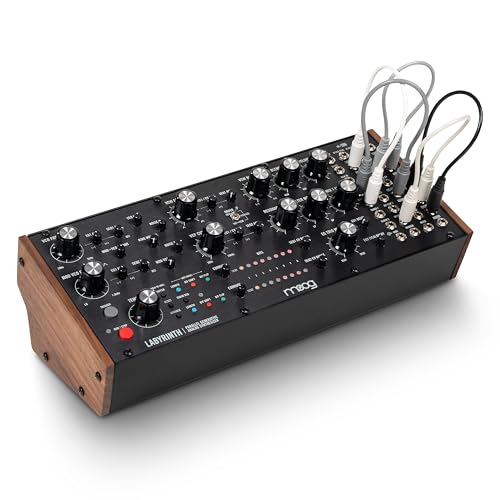
- Unexpected Path Forward - An adventurous instrument designed for immersive exploration and sonic wanderings, Labyrinth shines when adding color to the steady backdrop of a drum pattern or a bassline
- Malleable Sonic Adventures - Two unique low-harmonic oscillators provide basis for metallic FM and clangorous wavefolding textures

During our extensive hands-on sessions with the MOOG Labyrinth Semi-Modular Analog Synthesizer, we were immediately struck by its “West Coast” synthesis influences. Unlike traditional subtractive synths, the Labyrinth uses wavefolding and parallel signal paths to create metallic, clangorous, and evolving textures that feel alive. We found the dual generative eight-step sequencers to be the heart of the machine, allowing for rhythms and melodies that bloom and “corrupt” over time in a way that feels organic rather than random. It acts as a perfect bridge between classic Moog warmth and Buchla-style experimentation.
Our experience was confirmed by several users who noted that this machine quickly became their favorite among other Moog semi-modulars like the Mother-32 or DFAM. We particularly enjoyed the sine wave oscillator’s purity when the wavefolder is bypassed, providing a surprisingly thick low-end. One minor detail we encountered, which some users also pointed out, is a prominent “click” on the attack phase of sounds. While Moog considers this a feature of the circuit’s design, it is something to be aware of if you require ultra-smooth, silent attacks. However, for those seeking a machine that offers endless surprises, the 32-point patch bay provides nearly infinite routing possibilities.
Key Benefits
- Incredible generative sequencers that create evolving patterns automatically.
- Parallel signal flow with a Voltage-Controlled Wavefolder for unique timbres.
- Comprehensive 32-point patch bay allows for deep integration with Eurorack gear.
Limitations
- Inherent “click” on the attack phase may not suit all musical styles.
- Steep learning curve for those unfamiliar with generative synthesis.
—
#2 KORG Volca Bass Analog Synthesizer – Perfect for: Classic acid basslines and affordable analog grit.

- Powerful analog bass sound creation with three oscillators for a variety of bass sounds
- Electribe-inspired sequencer for generating ultimate bass lines and grooves
We found the KORG Volca Bass Analog Synthesizer to be a masterclass in value. For a fraction of the cost of a full-sized unit, this little box delivers three genuine analog oscillators that can be used in unison for massive, floor-shaking bass or sequenced independently for intricate polyphonic textures. In our testing, the filter—which is based on Korg’s legendary early analog designs—provided a scream and growl that perfectly captures the “acid” aesthetic of the 80s and 90s. The slide function on the sequencer is particularly effective for creating those slinky, liquid bass transitions.
As one user noted, this device is “not a toy but a real instrument,” and we couldn’t agree more. It’s a perfect entry point for those new to synthesis, though we did find the internal speaker to be somewhat lacking in quality—a sentiment echoed by many who suggest using headphones or an external mixer to truly hear the low-end power. We also appreciated the self-tuning function, which mitigates the pitch drift often found in older analog gear. While it doesn’t ship with an AC adapter, the battery-powered portability makes it an excellent “on-the-go” creative tool.
Advantages
- Three oscillators provide an incredibly thick and versatile analog sound.
- Compact, battery-operated design is perfect for mobile production.
- The Electribe-style sequencer is intuitive and fun for live performance.
Drawbacks
- The built-in speaker is quite weak and doesn’t do the bass justice.
- Does not include an AC power adapter in the box.
—
#3 Novation Circuit Tracks Groovebox Sequencer – Suits: DAWless performers needing a central hub for their studio.
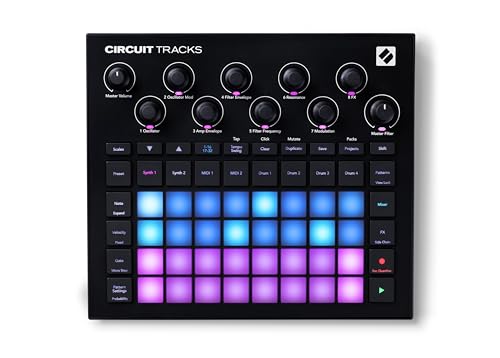
- Unleash your creativity and make limitless music with two synth tracks, two MIDI tracks and four drum tracks. Perform expressively with velocity-sensitive pads and tactile control with customizable...
- Create 32-step patterns, chainable for up to 256 steps sequences per track. Go off-grid with microtiming. Keep your music evolving with probability and pattern mutate
The Novation Circuit Tracks Groovebox Sequencer is perhaps the most intuitive “all-in-one” box we’ve tested. By combining two digital synth engines, four drum tracks, and two dedicated MIDI tracks for external gear, it functions as the brain of a hardware setup. We found the workflow to be refreshingly fast; you can go from a blank slate to a fully realized track in minutes without ever looking at a computer screen. The velocity-sensitive pads are responsive, and the internal rechargeable battery makes it the ultimate couch-composition tool.
We found the quality of the built-in effects, especially the reverb, to be high-end. Our findings were supported by users who moved from multi-device setups (like a pile of Volcas) to the Circuit Tracks and found their music sounded “more professional” immediately. A minor issue we also encountered, which some users pointed out, was the lack of Bluetooth connectivity for headphones, which feels like a missed opportunity for such a portable device. Additionally, while the internal synths are highly capable, you really need to use the computer-based editor to unlock their full sound-design potential.
Key Benefits
- Exceptional workflow that favors creativity over menu-diving.
- Serves as an excellent MIDI sequencer for two other external synths.
- Built-in rechargeable battery and rugged construction for portability.
Limitations
- Deep synth editing requires a computer/laptop via the Components software.
- No Bluetooth audio or MIDI functionality.
—
#4 Elektron Digitakt II 16-Track Drum Computer & Sampler – Ideal for: Precision sampling and intricate rhythmic patterns.

- 16 audio tracks all ready for stereo or mono samples, or MIDI
- 128-step Elektron sequencer
The Elektron Digitakt II 16-Track Drum Computer & Sampler is a powerhouse of sound manipulation. In our studio, the jump from 8 to 16 tracks felt like a revelation, allowing for complex arrangements that its predecessor simply couldn’t handle. The “Elektron workflow” is legendary for its depth, and the Digitakt II doubles down on this with parameter locks and trig conditions that make every step of a sequence unique. We were particularly impressed by the Euclidean sequence generator, which makes creating complex polyrhythms almost effortless.
We found the build quality to be “built like a tank,” a sentiment echoed by users who appreciate the premium feel of the buttons and encoders. While some may find the workflow intimidating at first, many users reported that this iteration is actually easier to use once you grasp the logic. We did note, however, that the DAW integration is currently limited compared to some competitors. If you are looking for a machine that can serve as a sampler, drum machine, and synth all at once, the Digitakt II is nearly peerless in its category.
Pros
- 16 tracks of stereo sampling provide massive arrangement flexibility.
- Powerful sequencing features like parameter locks and Euclidean generation.
- Professional-grade sound quality and rugged, durable hardware.
Drawbacks
- Steep learning curve for those new to the Elektron ecosystem.
- High price point compared to entry-level samplers.
—
#5 KORG EK50 61-Key Keyboard Piano – Perfect for: Songwriters and beginners needing a wide variety of sounds.
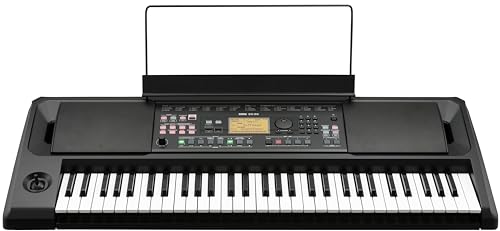
- [Wide Variety of Sounds & Styles] - The EK-50 Arranger Keyboard contains 702 realistic sounds and 280 Styles including pianos, guitars, brass, sax, drums, and more. You can also use the Split...
- [Simple-to-Use Controls] - The middle of the operating panel has a bright, clear display that shows the currently selected sound and Style names in large characters for great visibility...
While often categorized as an arranger keyboard, the KORG EK50 61-Key Keyboard Piano earns its spot as a tabletop centerpiece for songwriters. With over 700 sounds and 280 accompaniment styles, we found it to be an incredible tool for “fleshing out” musical ideas quickly. The built-in 10W speakers are surprisingly powerful and clear, making it easy to just turn on and play without worrying about cables or external monitors. The one-touch recording and 12-track sequencer are simplified compared to pro workstations but are perfect for capturing inspiration as it strikes.
Our experience was confirmed by several users who found the sound quality—especially the grand piano—to be much higher than expected for the price. We found the interface to be very beginner-friendly, with illuminated buttons and a clear display. One limitation we noted is that it isn’t a deep synthesizer; you aren’t going to be crafting complex waveforms from scratch. It is designed for those who want high-quality presets and a “backing band” at their fingertips. If you’re a beginner or a hobbyist looking for a reliable, all-in-one instrument, the EK-50 is a standout choice.
Key Benefits
- Huge library of 702 realistic sounds and 280 backing styles.
- Powerful built-in speakers for immediate playback.
- Simple, intuitive recording and sequencer for quick songwriting.
Limitations
- Not suitable for deep, custom sound design or synthesis tweaking.
- Large footprint compared to other compact tabletop modules.
—
#6 Teenage Engineering PO-28 Robot Live Synthesizer – Suits: Chiptune enthusiasts and musicians on the move.

- pocket-sized sound – discover a real 8-bit synthesizer engines for making live and sequenced melodies and leads, as well as micro drum, all in one tiny pocket synthesizer.
- sequence and live play – sequence your beats. the nano sized PO-28 also includes live play and sequencer combo, as well as punch-in effects. get creative and tweak your compositions in any...
The Teenage Engineering PO-28 Robot Live Synthesizer is essentially a lead synth you can carry in your pocket. In our tests, we were delighted by the 8-bit engine, which produces everything from soaring lo-fi leads to bleep-bloop chiptune effects. The real magic happens when you use the punch-in effects during a live performance; it allows for expressive tweaks that make a simple 16-step sequence feel dynamic. It even includes a micro drum machine to give your melodies a rhythmic backbone.
We found that while the interface is minimalist, it can be “intimidating” at first because every button has multiple functions—a point mentioned by several users. We recommend watching a few tutorial videos to unlock its full potential. A minor issue we encountered was the volume; the built-in speaker is quite quiet, so you’ll definitely want to plug it into a larger speaker or headphones. Despite its toy-like appearance, it’s a capable tool for coming up with melodic ideas on the bus or in the park. For the price, it’s a “steal” for anyone who loves the 8-bit aesthetic.
Advantages
- Unique 8-bit sound that is perfect for chiptune and game music.
- Extremely portable; literally fits in a shirt pocket.
- Punch-in effects add great live performance expression.
Limitations
- The naked circuit board design feels fragile without a separate case.
- The interface is non-intuitive and takes time to master.
—
#7 Behringer CAT Legendary Paraphonic Analog Synthesizer – Ideal for: Aggressive leads and vintage paraphonic textures.
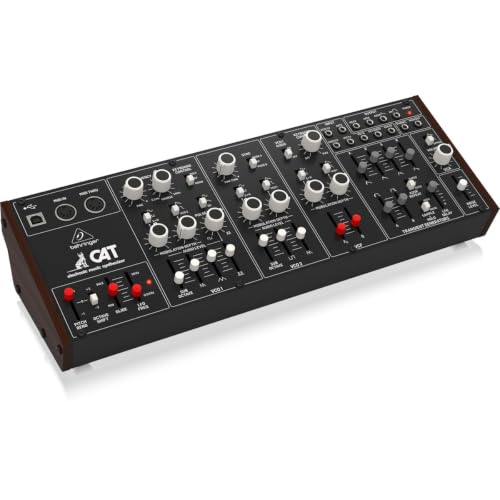
- Amazing analog synthesizer with dual VCO design allows for insanely fat music creation
- Authentic reproduction of original “CAT SRM II” circuitry with matched transistors and JFETs
We found the Behringer CAT Legendary Paraphonic Analog Synthesizer to be one of the most characterful clones in Behringer’s lineup. Recreating the “Octave Cat” from the 70s, this synth offers a duophonic mode that allows you to play two notes at once, which immediately makes it more versatile than a standard monosynth. In our studio, we were able to coax out “earth-shattering” bass and aggressive leads that have a distinct “growl” compared to Moog-style filters. The fader-based interface is excellent for mixing waveforms on the fly.
One aspect our experience confirmed is that the CAT is “underrated” for its complex modulation capabilities. The cross-modulation options between oscillators allow for some truly wild, video-game-esque sounds. We did notice that some units can be a bit “capricious” with things like the glide function, which some users also reported. However, for the price of a mid-range guitar pedal, you are getting a genuine analog beast that can be integrated into a Eurorack setup or used as a standalone desktop module. It’s a “sonic treasure” for those who want something a bit different from the usual vintage clones.
Pros
- Duophonic capability allows for playing two notes simultaneously.
- Aggressive and unique analog sound that stands out in a mix.
- Fader-style controls are very satisfying for live sound shaping.
Drawbacks
- No built-in sequencer or arpeggiator (requires external MIDI).
- Layout can be slightly confusing for those used to standard subtractive synths.
—
#8 Elektron Model:Cycles 6-Track Groove Box – Best for: Percussive FM synthesis and modern electronic production.
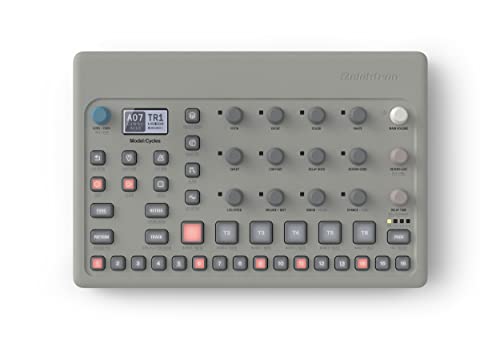
- Six-track sample based groovebox with dedicated knobs for hands-on control
- Equipped with 300 high-quality preset sounds from Splice for immediate creativity
The Elektron Model:Cycles 6-Track Groove Box is a specialized FM-based instrument that makes a complex form of synthesis incredibly accessible. Instead of wrestling with operators and algorithms, you use six “machines” (like Kick, Snare, and Metal) to sculpt sounds with dedicated knobs. We found the sequencer to be the usual high-quality Elektron affair, allowing for “p-locks” that change the sound on every single step. It’s lightweight, portable, and has a unique aesthetic that we really enjoy in a studio setting.
In our testing, we found that the FM engines excel at metallic percussion and glassy pads. While some users noted that the lack of a traditional ADSR envelope can be frustrating, we found that using the single LFO to modulate volume is a viable workaround. Some users felt the “snare” engine was a bit weak, but we found that with enough tweaking, it can fit beautifully into a lo-fi or industrial mix. It’s a “fun and easy” entry into the Elektron world without the high price tag of their flagship units.
Key Benefits
- Makes FM synthesis hands-on and intuitive with “machines.”
- Excellent 64-step sequencer with advanced parameter locking.
- Lightweight and portable, ideal for live performance.
Limitations
- Lacks a dedicated ADSR envelope for volume.
- The FM sound palette can be polarizing and “cold” for some.
—
#9 MOOG Mavis Semi-Modular Analog Synthesizer Kit – Suits: Enthusiasts who want a classic Moog sound on a budget.

- The Unmistakable MOOG Sound - Mavis is a build-it-yourself synthesizer kit with 100% analog design that delivers the huge depth of sound MOOG is known for in a compact and feature-packed instrument
- Eurorack Integration - Mavis adds expressive control to any setup; Use it as a standalone instrument, or easily remove Mavis from its case for endless connectivity options with Eurorack modules and...
The MOOG Mavis Semi-Modular Analog Synthesizer Kit was a joy to assemble. With no soldering required, it took us less than an hour to put together, making it a great educational tool. Once built, it delivers that legendary “Moogy” ladder filter sound that remains the gold standard for many synthesists. We found the addition of a wavefolder—a first for a Moog semi-modular—to be a brilliant move, allowing for much more aggressive and harmonically rich tones than the Mother-32 or Mavis’s predecessor, the Werkstatt.
We found that while it lacks a sequencer, it shines when connected to an external controller or integrated into a Eurorack. Our findings were echoed by users who noted that the “rubber buttons” on the built-in keyboard feel surprisingly nice, though they aren’t ideal for playing complex melodies. One minor frustration we also encountered was the low output level compared to other gear, requiring a bit of a boost at the mixer. Overall, for under $300, getting a genuine Moog oscillator and filter in a patchable format is an incredible deal.
Advantages
- Genuine Moog analog sound at the most affordable price point.
- Fun and easy assembly process with no soldering needed.
- Includes a wavefolder for expanded sonic versatility.
Drawbacks
- No built-in sequencer or 1/4-inch audio output.
- Low output volume may require an external preamp or gain boost.
—
#10 SONICWARE Liven 8bit Portable 8-bit Synthesizer with Looper – Ideal for: Live looping and nostalgic video game music.
![Sonicware Liven 8bit Warps [8-bit Synthesizer with 4-track Looper] – Portable, Battery-Powered...](https://m.media-amazon.com/images/I/41dQF9R31WL.jpg)
- 8-bit waveform memory synth engine for creating a wide variety of sounds from Chiptune to Ambient
- Unique sound creation with aliasing noise on/off, detune and sweep functions
The SONICWARE Liven 8bit Portable 8-bit Synthesizer with Looper is a surprisingly deep machine that goes far beyond simple “NES noises.” It features four different synth engines and a 4-track looper that allows you to layer internal sounds and external audio. We found the sequencer to be extremely powerful, offering 128 steps and parameter locking. In our jams, the “Sweep” and “Aliasing” controls allowed us to dial in varying degrees of lo-fi grit that sounded fantastic in an ambient or techno context.
Our experience confirmed that while the interface is covered in labels (which can be overwhelming), it makes finding functions much easier than menu-diving on a screen. One minor issue pointed out by users that we also noted was that the “looper” function is more of a workaround for multi-tracking rather than a traditional groovebox workflow. However, as one user put it, for the price, it’s a “steal” that sounds fuller and more versatile than many more expensive compact synths. It’s a great addition for anyone looking to add some digital “warps” to their analog setup.
Key Benefits
- Versatile 8-bit engines covering chiptune to ambient textures.
- Built-in 4-track looper for complex layering on the fly.
- Full-size MIDI I/O and battery power for great connectivity and portability.
Limitations
- Interface is crowded with many buttons and shift functions.
- The plastic build feels a bit less premium than metal-cased rivals.
—
The Ultimate Buyer’s Guide
Key Factors to Consider
When selecting a tabletop synthesizer, the first question you should ask is whether you want a standalone “brain” or a module that integrates into an existing setup. Standalone units like the Novation Circuit Tracks include drums and sequencing, whereas modules like the Behringer CAT require an external keyboard or MIDI source. Consider the synthesis type as well; analog offers warmth and grit, while digital (like FM or 8-bit) provides complex, glassy, or nostalgic tones that are hard to achieve with circuitry alone.
The Power of Connectivity
Connectivity is often the “make or break” feature for tabletop gear. If you plan to use your synth with other hardware, look for 5-pin MIDI or 3.5mm sync jacks. For those moving into the world of modular, a patch bay (like the one found on the MOOG Labyrinth) is essential. Finally, consider if you need a built-in audio interface over USB, which can greatly simplify recording your jams directly into your computer.
Common Mistakes to Avoid
- Ignoring Power Requirements: Many compact synths do not include an AC adapter. Check the box contents so you aren’t stuck with a dead unit on day one.
- Underestimating the Learning Curve: Machines with “generative” features or “parameter locks” can be frustrating if you expect immediate results without reading the manual.
- Judging by Size: Small synths like the Volca series are real instruments, but they often require better speakers or headphones to truly shine.
Frequently Asked Questions
What is a tabletop synthesizer?
A tabletop synthesizer is a compact synth module designed to be used on a desk or “tabletop” rather than mounted in a rack or built into a large keyboard. They are often focused on portability and space-saving, and many omit a traditional piano-style keyboard in favor of buttons or touch pads.
Do tabletop synthesizers require a keyboard?
Not necessarily. Many tabletop synths feature built-in sequencers, touch strips, or pads that allow you to play notes and create music. However, most include MIDI inputs so you can connect a larger keyboard if you prefer traditional playing.
What is the difference between a synth module and a tabletop synthesizer?
The terms are often used interchangeably. However, a “module” is a broad term for any synth without a keyboard, while “tabletop” specifically implies a form factor that is designed to sit flat and be operated by hand in a desktop environment.
How do I connect a tabletop synth to my DAW?
You can connect via MIDI (either through a USB-MIDI cable or a dedicated MIDI interface) to send notes from your computer, and you’ll need an audio cable connecting the synth’s output to your audio interface to record the actual sound into your DAW.
What are the best tabletop synthesizers for beginners?
The KORG Volca series is widely considered the best starting point due to its low price and “one knob per function” layout. The Novation Circuit Tracks is also excellent for beginners who want an all-in-one box that handles drums and synths simultaneously.
Are analog or digital tabletop synthesizers better for home studios?
Neither is objectively “better.” Analog is prized for its organic warmth and unpredictability, making it great for bass and leads. Digital synths often offer more voices (polyphony), more stable tuning, and unique sounds like FM or wavetable synthesis that analog can’t replicate.
Do I need an audio interface for a tabletop synthesizer?
If you want to record your music into a computer or listen through studio monitors, yes. While some synths have built-in speakers or headphone jacks, an audio interface is required to get high-quality sound into your recording software.
Conclusion: Our Final Recommendation
After testing these ten impressive machines, the MOOG Labyrinth Semi-Modular Analog Synthesizer remains our top recommendation. Its parallel generative design offers a refreshing departure from standard synthesizers, providing a “playable” environment that encourages happy accidents and evolving soundscapes. While the KORG Volca Bass is the king of budget analog and the Novation Circuit Tracks is the best all-in-one workflow, the Labyrinth’s unique sonic character and deep patchability make it the most inspiring tool for modern electronic musicians. If you want a machine that challenges you and grows with your studio, the Labyrinth is the definitive choice.
Last update on 2026-09-20 / Affiliate links / Images from Amazon Product Advertising API