
Quilter Bass Block V803 800-Watt Bass Head Review: The Ultimate Lightweight Powerhouse for Every Stage
For years, the life of a gigging bassist has been synonymous with heavy lifting. I remember the days of lugging a 60-pound tube head and a refrigerator-sized 8×10 cabinet up three flights of stairs just to play a forty-minute set at a local dive bar. We do it for the tone, right? We crave that massive headroom and the tactile “thump” that only high-wattage amplifiers can provide. However, the physical toll is real. The alternative for a long time was compromising on sound—settling for lightweight “micro” amps that often felt sterile, lacked real-world “heft,” or featured fans so loud they sounded like a jet engine taking off during the quiet ballad of the night. This is the exact dilemma that led us to search for something better, and it’s why we were so eager to put the Quilter Bass Block V803 800-Watt Bass Head through its paces. Solving the weight-to-power ratio isn’t just about saving your back; it’s about having the confidence that your rig will deliver professional-grade tone in any environment without the physical exhaustion before the first downbeat.
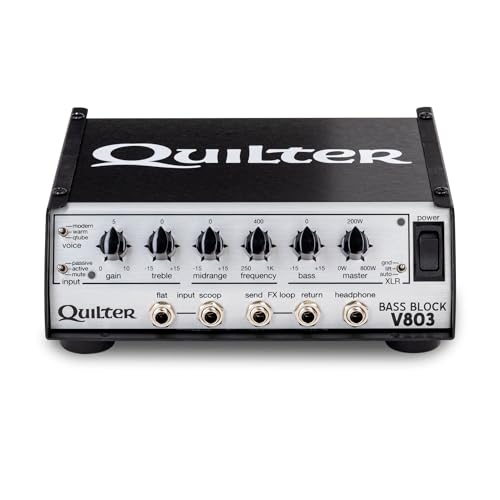
- TWO INPUT JACKS: 1meg, Flat and Scoop, 4V peak INPUT SWITCH: Mute, Active, Passive GAIN AMP VOICE SWITCH: Modern, Warm & Q-Tube profiles 4-KNOB EQ: Bass +/- 15dB at 100Hz, Mid +/- 15dB with 250-1K...
What to Consider Before Buying a Bass Guitar Amplifier Head
A Bass Guitar Amplifier Head is more than just an item; it’s the heart of your signal chain and a key solution for translating the subtle nuances of your playing into room-filling sound. Whether you are practicing at home, recording in a studio, or headlining a festival, the amp head dictates your dynamic range and tonal character. Choosing the wrong one can leave your low-end sounding “mushy” or your high-end sounding “brittle,” which is why understanding the technical specs is vital. You aren’t just buying volume; you are buying headroom, which is the amp’s ability to stay clean and punchy even at high output levels.
The ideal customer for this type of product is the working professional or serious enthusiast who needs a reliable, high-output rig that can fit in a gig bag. It’s for the player who values versatility—someone who might need a clean, modern “slap” tone for one song and a vintage, tube-like growl for the next. However, it might not be suitable for those who are strictly bedroom players and never plan to leave their practice space; for them, a 5-watt mini-head or high-end headphones might be more cost-effective. If you are chasing a 100% pure analog tube experience with no digital components whatsoever, you may still prefer the weight of a traditional transformer-heavy amp, but for everyone else, the modern Class-D revolution has arrived.
Before investing, consider these crucial points in detail:
- Power Output and Impedance: Look for an amp that provides enough wattage for your largest gigs. Ensure the amp is compatible with your cabinet’s impedance (ohms). For instance, the Quilter Bass Block V803 800-Watt Bass Head delivers a massive 800 watts at 4 ohms, which is plenty for almost any stage, but drops to 450 watts at 8 ohms.
- Tonal Versatility and EQ: Check if the EQ section allows for precise frequency tailoring. A semi-parametric mid-control is a huge advantage, as it lets you “sweep” through frequencies to find the sweet spot for your specific bass or to “cut” through a dense mix of guitars and drums.
- Connectivity and DI Quality: A professional amp should have a high-quality XLR Line Out. Look for features like “Cab Sim” (Cabinet Simulation) and Ground Lift, which ensure your signal sounds great when sent directly to the PA system or a recording interface without annoying hum or buzz.
- Portability and Build Quality: Consider the weight and dimensions. If you are touring, the amp needs to be rugged enough to withstand road vibrations while remaining light enough to carry in a backpack. Look for metal chassis construction and high-quality knobs that don’t feel “flimsy” or loose.
Once you understand these core requirements, you can better appreciate how a specific model like the Quilter Bass Block V803 800-Watt Bass Head stacks up. It aims to bridge the gap between “micro” convenience and “stadium” power. Before we dive into the specifics of this unit, it’s worth seeing how it compares to other top-tier options currently on the market.
While the Quilter Bass Block V803 800-Watt Bass Head is an excellent choice, it’s always wise to see how it stacks up against the competition. For a broader look at all the top models, we highly recommend checking out our complete, in-depth guide:
- 500 Watt portable micro bass head amplifier for stage and studio

First Impressions: The Quilter Bass Block V803 800-Watt Bass Head Out of the Box
When the Quilter Bass Block V803 800-Watt Bass Head first arrived at our studio, the first thing we noticed was the surprisingly small footprint. Weighing in at a mere 4.5 pounds, it feels more like a piece of high-end rack gear than a traditional amplifier. The black metal chassis feels incredibly sturdy, and the industrial aesthetic suggests a “no-nonsense” tool for serious musicians. Unboxing it was straightforward, and within minutes, we had it connected to a 4×10 cabinet. You can see its full feature set and user reviews to get a sense of why this compact design is creating such a buzz.
The layout is intuitive. Unlike some modern amps that clutter the front panel with dozens of tiny switches, Quilter has opted for large, easy-to-grip knobs and clearly labeled toggles. The 3-position Voice switch (Modern, Warm, and Q-Tube) is the centerpiece of the interface, promising three distinct sonic identities in one box. Our initial “plug and play” test revealed an amp that is dead quiet—no hiss, no hum, and as one user noted, a fan that is virtually silent compared to rivals like the Aguilar TH500 or EBS Reidmar. This silence is a massive plus for studio work or quiet practice sessions.
Key Benefits
- Incredible power-to-weight ratio (800W at only 4.5 lbs)
- Versatile three-voice preamp (Modern, Warm, and Q-Tube)
- Ultra-quiet fan operation, ideal for recording environments
- Comprehensive connectivity including XLR out with Cab Sim
Limitations
- No built-in compressor, which some players prefer for slap styles
- The “Q-Tube” setting might be too subtle for those seeking heavy distortion
A Deep Dive into the Performance of the Quilter Bass Block V803 800-Watt Bass Head
Massive Headroom and Power Management
The standout feature of the Quilter Bass Block V803 800-Watt Bass Head is undoubtedly its massive 800-watt power section. In our testing, we found that this isn’t just a “peak” rating—the amp has incredible sustained headroom. When playing at high volumes, many Class-D amps tend to “compress” or feel like they are hitting a ceiling, resulting in a loss of low-end punch. With the V803, we experienced the opposite. The “Master” control acts more like a power governor, allowing you to scale the output from zero to 800 watts without losing the tonal integrity of the preamp. This makes it just as effective for a small coffee house gig as it is for a large outdoor stage. We found that the 450 watts available at 8 ohms was more than enough to drive a standard 1×12 or 2×10 cabinet to ear-splitting levels while remaining crystal clear. For those who need maximum volume, you can check the latest price and availability to see how this power compares to your current rig.
Three Distinct Voices for Total Tonal Control
The Quilter Bass Block V803 800-Watt Bass Head features a three-way “Voice” switch that fundamentally changes the character of the amplifier. We spent several hours A/B testing these settings. The “Modern” setting is wide-open and transparent, very much in the vein of high-end boutique amps like Aguilar. It’s punchy and fast, making it the perfect choice for fusion, gospel, or slap bass where every note needs to pop. Switching to “Warm” rolls off some of the aggressive high-end and rounds out the low-mids, giving a more “vintage solid-state” feel. Finally, the “Q-Tube” setting introduces subtle even-order harmonics that mimic a tube power section being pushed. While it won’t replace a dedicated fuzz pedal, it adds a “velvet” texture to the notes that feels great under the fingers. We found this versatility to be one of the strongest selling points, as it allows the user to adapt to different genres instantly. To understand the nuances of these settings, many players read through the technical documentation and user experiences to see how it fits their specific playing style.
Precision EQ and the Frequency Sweep
The 4-knob EQ section on the Quilter Bass Block V803 800-Watt Bass Head is deceptively simple but incredibly powerful. The “Mid” control is the real star here; it features a frequency sweep from 250Hz to 1kHz. In our evaluation, we found this to be critical for “fixing” rooms with bad acoustics. If the stage was boomy, we could find the offending frequency (usually around 250-400Hz) and cut it. If the bass was getting lost behind the guitars, a slight boost at 800Hz brought back all the clarity. The “Bass” and “Treble” controls are centered at 100Hz and 1kHz respectively, providing +/- 15dB of gain. We found that even extreme settings remained musical. Unlike cheaper amps where a bass boost makes everything muddy, the V803 remains tight and focused. This level of control is a feature that really sets it apart from more basic “plug-and-play” heads that offer only fixed EQ points.
Professional Connectivity and “Silent” Features
For the modern bassist, the amp is often just one part of the signal chain. The Quilter Bass Block V803 800-Watt Bass Head excels in its “utility” features. The XLR Line Out includes a high-quality “Cab Sim” (Cabinet Simulation), which we found to be remarkably accurate. When sending the signal straight to our DAW (Digital Audio Workstation), the bass sounded like it was being miced up through a high-quality 15-inch speaker, removing that “thin” sound often associated with DI signals. Additionally, the headphone jack is a godsend for touring musicians in hotel rooms. We also noted that the “Active/Passive” switch is more than just a pad; it properly matches the impedance of your instrument, ensuring that your 18V active bass doesn’t clip the input stage while keeping your vintage passive P-bass sounding full and vibrant. This attention to detail in the input/output section makes it a true pro-level tool. You can find more details on the buffered effects loop and line-out specs here.
What Other Users Are Saying
The general sentiment from the bass community regarding the Quilter Bass Block V803 800-Watt Bass Head is overwhelmingly positive, particularly concerning its noise floor and tonal range. One user, who previously struggled with the loud fans of other major brands, noted that this is a “perfect amplifier” because of its compact size and silent operation. They specifically praised the responsiveness of the EQ, mentioning that you can really “feel” the change in sound with every degree of the knob’s rotation.
Users have also compared the different voices to industry standards, with the “Modern” mode being likened to the punchy Aguilar sound, while the “Warm” and “Q-Tube” modes are compared favorably to the “Ampeg style”—round, warm, and musical without becoming “mushy.” The only minor criticisms we’ve encountered involve users wishing for an onboard compressor or a more aggressive overdrive in the “Q-Tube” section. However, most agree that for the price and weight, the Quilter Bass Block V803 800-Watt Bass Head is a class leader. This feedback is highly relevant because it confirms that Quilter has successfully addressed the two biggest complaints about micro-amps: poor thermal management (loud fans) and “sterile” digital tone.
Comparing the Quilter Bass Block V803 to Top Alternatives
1. HOTONE Thunder Mini Bass Amp

- Inspired by the ampeg SVT, high quality tone with volume and gain controls
- 3 Band eq controls for shaping your tone
The HOTONE Thunder Mini Bass Amp is an entirely different beast compared to the Quilter. It is a 5-watt “nano” head designed almost exclusively for home practice or recording. While it lacks the 800-watt power needed for a gig, it offers a surprisingly rich sound for its size. We would recommend this alternative for the beginner on a tight budget or the hobbyist who wants a cool-looking desktop amp for low-volume jamming. However, if you have any intention of playing with a drummer, the HOTONE simply won’t have the volume or the headroom that the Quilter Bass Block V803 800-Watt Bass Head provides.
2. Behringer ULTRABASS BXD3000H 2 Channel Bass Amplifier Head

- Clean channel with dedicated gain control
- Revolutionary class-d amplifier technology: enormous power, incredible sonic performance and ultra-lightweight
The Behringer ULTRABASS BXD3000H is a feature-packed alternative for those who need a 2-channel setup on a budget. It offers 300 watts of power and includes a dedicated “Ultrabass” sub-harmonics processor and an integrated compressor. While it provides more “bells and whistles” than the Quilter, it is significantly larger and heavier, and the build quality is more consumer-grade. The Behringer is a solid choice for a local band needing a reliable rehearsal amp, but it lacks the refined “boutique” tone and the extreme portability of the 4.5-pound Quilter. The Quilter Bass Block V803 800-Watt Bass Head is much more suited for the touring professional who demands high-fidelity audio.
3. VOX VGH Series Bass Amplifier Headphones

- Plug and Play: Simply plug your VOX VGH Amplifier Headphones into your Guitar and practice straight away with great amp sounds and effects. If you want to just listen to music simply switch the...
- ROCK: The VGH BASS headphone model has an amplifier that provides a wide dynamic range for all Bass Guitar styles at enough volume to suit all bass players
The VOX VGH Series Bass Amplifier Headphones represent the ultimate in “stealth” bass playing. These are not an amp head, but rather a set of headphones with a built-in bass amp circuit. This is the perfect alternative for someone who lives in an apartment with thin walls and only needs a way to hear themselves play. It offers zero stage volume and cannot drive an external cabinet. While it solves the problem of quiet practice, it cannot compete with the Quilter Bass Block V803 800-Watt Bass Head in any professional performance or recording scenario where a real physical amplifier is required.
Final Verdict: Is the Quilter Bass Block V803 800-Watt Bass Head Worth It?
After extensive testing, our conclusion is that the Quilter Bass Block V803 800-Watt Bass Head is one of the most impressive bass amplifiers released in the last few years. It successfully combines the raw power of a high-wattage touring rig with the portability of a tablet. Its main strengths lie in its massive headroom, its exceptionally quiet operation, and a preamp section that offers three distinct, usable voices that aren’t just “gimmicks.” While it lacks a built-in compressor and the “Q-Tube” grit is subtle, these are minor trade-offs for an amp that sounds this good and weighs this little.
We highly recommend this amp to any gigging bassist who is tired of compromising their tone for the sake of their back. It is a professional-grade tool that handles everything from the studio to the stadium with ease. If you are ready to upgrade your rig to a setup that is light enough for a backpack but powerful enough to shake the foundations of a venue, we suggest you pick up the Quilter Bass Block V803 800-Watt Bass Head today and experience the future of bass amplification for yourself.
Last update on 2026-10-25 / Affiliate links / Images from Amazon Product Advertising API