
Quilter Tone Block 202 Head Review: The Ultimate High-Power Solution for the Gigging Pro
If you have ever spent a long night hauling a sixty-pound tube head up a narrow flight of stairs after a three-hour set, you know exactly why the Quilter Tone Block 202 Head has become such a hot topic in the musician community. For years, we were told that to get professional-grade “punch” and “warmth,” we had to sacrifice our backs and our trunk space. The struggle is real: you want the headroom to compete with a loud drummer, but you also need something that fits in your backpack for “fly dates” or tight stage setups. Failing to find a compact solution often means settling for mediocre digital “modeling” that lacks physical feel, or continuing the cycle of heavy lifting that eventually takes a toll on your body. We searched for a “Swiss Army Knife” of amplification—something that could handle a funk band, a jazz trio, and a studio session without breaking a sweat. After extensive testing, we found that the Quilter Tone Block 202 Head aims to solve these exact complications, offering a 200-watt platform that weighs less than a standard laptop.

- Power Output: 0 to 200 watts, 4-8 ohms
- AC Power Req.: 100-240Vac, 50-60Hz, 250W
What to Consider Before Buying a Bass or Guitar Amplifier Head
A Bass Guitar Amplifier Head is more than just an item; it’s a key solution for any performer who needs consistent, reliable sound across varying environments. Whether you are plugging into a 4×12 cabinet at a rock club or sending a direct signal to a front-of-house mixer at a church gig, the head is the brain of your operation. It dictates your dynamic range, how your pedals react, and ultimately, how you feel while playing. Choosing the wrong head can result in a “sterile” sound that lacks inspiration, or worse, a piece of gear that fails under the rigors of the road.
The ideal customer for this type of product is someone facing a busy schedule of diverse gigs—someone who might play a wedding one night and a recording session the next. It is perfect for the professional who demands high headroom and “tube-like” feel without the maintenance of actual vacuum tubes. However, it might not be suitable for those who are “tube purists” and refuse to use anything without a glowing glass bottle, or for bedroom players who never plan to leave their house and don’t need 200 watts of power. For those people, a small 5-watt practice amp might be a more logical investment.
Before investing, consider these crucial points in detail:
- Dimensions & Space: In the modern era of touring, space is a premium commodity. You want a head that can easily fit into a gig bag pocket or a small carry-on. A compact footprint allows you to keep your entire rig on your pedalboard if necessary, reducing setup and teardown time significantly.
- Capacity/Performance: Wattage isn’t just about volume; it’s about “headroom.” A 200-watt head like the Quilter Tone Block 202 Head provides the clean overhead needed to ensure your notes don’t distort prematurely, which is essential for bassists and clean-tone guitarists alike. Look for “play anywhere” power supplies that can handle international voltages (100-240V).
- Materials & Durability: Since this gear will be transported frequently, it must be rugged. Look for stainless steel or high-grade aluminum enclosures. The knobs should feel “chunky” and resistant to accidental bumps, ensuring that your settings stay put during a chaotic stage move.
- Ease of Use & Maintenance: Solid-state and digital-hybrid heads require far less maintenance than tube amps. There are no tubes to bias or replace, and they are generally less sensitive to vibration. Ensure the interface is intuitive enough that you can make adjustments on a dark stage without needing a manual.
Once you understand these requirements, it becomes clear why specialized heads are taking over the market. To help you navigate the sea of options, it’s vital to compare the best of the best.
While the Quilter Tone Block 202 Head is an excellent choice, it’s always wise to see how it stacks up against the competition. For a broader look at all the top models, we highly recommend checking out our complete, in-depth guide:
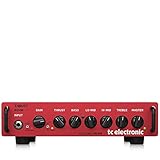
- 500 Watt portable micro bass head amplifier for stage and studio

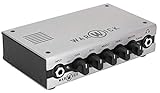
First Impressions and the “Unboxing” Experience
When the Quilter Tone Block 202 Head first arrived at our studio, the first thing we noticed was the weight—or rather, the lack of it. At only 3 lbs, it felt almost impossible that this tiny black box could push 200 watts of power. The stainless steel enclosure feels incredibly industrial and “road-ready,” lacking the flimsy plastic feel of many modern digital modelers. We immediately appreciated the layout; the controls are front-facing and clearly labeled, which is a breath of fresh air compared to heads that hide half their features on the back panel.
Comparing it to previous versions like the original Tone Block 200, the 202 is a massive step forward. It adds a dedicated “Voice” switch and a much-needed master volume that allows you to see its full feature set and user reviews in action. The addition of the XLR direct out with cab-sim is a game-changer for anyone who does hybrid stage/direct setups. It looks sleek, professional, and fits perfectly on top of a 1×12 or 2×12 cabinet, though it’s small enough to sit on your pedalboard beside your favorite drive pedals.
Key Benefits
- Massive 200W power platform in a 3 lb package
- Highly versatile 3-way voicing switch (FullQ, Vintage, FR)
- Studio-quality XLR Direct Out with Cab-Sim
- Universal power supply works anywhere in the world
Drawbacks
- Single-channel design may require pedals for high-gain sounds
- Included reverb is functional but basic compared to dedicated pedals
Deep Dive: Why the Quilter Tone Block 202 Head is a Modern Masterpiece
Unrivaled Power and “Play Anywhere” Reliability
The core of the Quilter Tone Block 202 Head is its 200-watt power section. In our testing, we found that this isn’t just “marketing wattage.” This head has a physical “thump” that rivals much larger Class A/B amplifiers. Whether we were running it into an 8-ohm 1×12 or a 4-ohm 4×10 cabinet, the response was immediate and authoritative. One of the most impressive features we discovered was the universal power supply. For touring musicians, the ability to check the latest price and availability and then take this unit from New York to London without needing a voltage transformer is a massive relief. We tested the noise floor in a studio environment and found it to be exceptionally quiet, even when the Gain was pushed to its limits. This makes it an ideal companion for high-gain pedal users who need a clean, stable platform that won’t add unwanted hiss to their signal chain.
The Magic of the 3-Way Voicing Switch
We spent several days exploring the “Voicing” control, and it is truly what sets this head apart from standard solid-state amps. The Quilter Tone Block 202 Head offers three distinct modes: FullQ, Vintage, and FR (Flat Response). In “FullQ” mode, the amp takes on a traditional Quilter “warmth” with a slight mid-bump that helps guitars cut through a dense mix. Switching to “Vintage” provides a more scooped, “blackface” style tone that is perfect for blues and jazz. However, the “FR” mode was the real surprise. This mode provides a tight, solid-state damping that is specifically designed to work with modelers like the Helix or Kemper. We found that by using the FR mode, the 202 becomes a transparent power amp that lets your modeler’s personality shine through without coloration. This versatility is a feature that really sets it apart from competitors that are locked into a single “baked-in” sound.
Advanced Connectivity for Stage and Studio
Modern gigging often requires sending a signal to multiple places at once, and the Quilter Tone Block 202 Head excels here. The front-panel signal out jack allows you to send a 1/4″ line to a mixer while keeping the amp volume turned down—perfect for silent stages. During our evaluation, we were particularly impressed by the XLR Direct Out. Unlike many cheaper heads that provide a “fizzy” direct signal, Quilter’s built-in Cab-Sim sounds remarkably organic. We recorded several tracks directly into an interface, and with a little EQ, it was difficult to distinguish the direct signal from a miked cabinet. This makes the 202 a formidable studio tool. Furthermore, the pre/post signal option for the headphone jack means you can practice silently with the full EQ and Gain of the amp, or monitor a clean signal if you’re using outboard processing. For those looking for a “do-it-all” hub, you should definitely consider adding this to your rig.
The “BlockDock” Ecosystem and Portability
While the head is fantastic on its own, its compatibility with the Quilter BlockDock 12 speaker cabinet creates a seamless “combo” experience. The head slides into the back of the cabinet, locking into place without the need for tools. In our field tests, we found this setup to be the ultimate solution for the “walking musician.” You can carry your guitar in one hand and your entire 200W rig in the other. Even without the BlockDock, the 3 lb weight of the Quilter Tone Block 202 Head means you can literally keep it in your gig bag as a “backup” amp. We’ve been at gigs where the house amp failed, and having the 202 ready to go in under 60 seconds saved the night. The peace of mind that comes with this level of portability cannot be overstated, and it’s why we recommend you grab one before your next tour.
What Other Users Are Saying
The general sentiment among users confirms our own expert findings: the Quilter Tone Block 202 Head is a professional tool that over-delivers on its promises. One professional musician who plays in everything from funk bands to jazz trios noted that they found perfect settings for every musical situation, praising its ability to adapt to different guitar configurations seamlessly. This echoes our experience with the Voicing switch.
Another user, specifically a pedal steel player, highlighted its value as a lightweight preamp for “fly dates.” This is a crucial endorsement, as pedal steel players are notoriously demanding when it comes to clean headroom and tonal transparency. While most feedback is overwhelmingly positive, one user mentioned they “wished it had a bit more headroom” for their specific needs, though they still rated it as a “quality piece of gear.” We found that for most applications, the 200 watts are more than enough, but it is a relevant point for players in exceptionally loud “doom metal” or high-volume bass settings who might need 500+ watts. Overall, users love how “quiet” the head is and how easy it is to get a great sound quickly without menu-diving.
Comparing the Quilter Tone Block 202 Head to Top Alternatives
While we believe the 202 is a leader in its class, different players have different budgets and needs. Here is how it compares to three popular alternatives in the bass and guitar amplifier head market.
1. HOTONE Thunder Mini Bass Amp

- Inspired by the ampeg SVT, high quality tone with volume and gain controls
- 3 Band eq controls for shaping your tone
The Hotone Thunder Bass is an “ultra-mini” head. At only 5 watts, it is obviously not designed to compete with the 200-watt Quilter Tone Block 202 Head in a live stage environment. However, for bedroom practice or desktop recording, it is a fun and affordable alternative. It captures a “SVT-style” growl quite well. We would recommend this for beginners or hobbyists who don’t need to play with a drummer but want a tiny, cool-looking head for their desk. It lacks the professional XLR out and the massive headroom of the Quilter, but for the price, it’s a great practice tool.
2. Behringer ULTRABASS BXD3000H 2-Channel Bass Amplifier Head

- Clean channel with dedicated gain control
- Revolutionary class-d amplifier technology: enormous power, incredible sonic performance and ultra-lightweight
The Behringer BXD3000H offers 300 watts of power and two channels, making it a “spec-heavy” competitor. It includes a compressor and a FBQ spectrum analyzer, which are great features for bassists who like to visualize their EQ. Compared to the Quilter Tone Block 202 Head, the Behringer is much larger and heavier. While it offers more “bells and whistles,” the build quality and “feel” of the Quilter are significantly higher. The Behringer is an excellent choice for a bassist on a budget who needs raw power for a local club gig, but it lacks the “boutique” tonal refinement and extreme portability of the Quilter.
3. VOX VGH Series Bass Amplifier Headphones

- Plug and Play: Simply plug your VOX VGH Amplifier Headphones into your Guitar and practice straight away with great amp sounds and effects. If you want to just listen to music simply switch the...
- ROCK: The VGH BASS headphone model has an amplifier that provides a wide dynamic range for all Bass Guitar styles at enough volume to suit all bass players
The VOX VGH Series isn’t a “head” in the traditional sense; it’s a pair of headphones with a bass amp built directly into them. This is the ultimate “zero-footprint” solution. If your primary goal is to practice in a dorm room or on a bus, the VOX is fantastic. However, it cannot drive a speaker cabinet and it cannot be used for a live performance with a band. We view this as a complementary tool rather than a direct competitor to the Quilter Tone Block 202 Head. If you need a gigging amp, stick with the Quilter; if you only need to hear yourself while your roommate sleeps, the VOX is a clever alternative.
Final Verdict: Is the Quilter Tone Block 202 Head Right for You?
After weeks of testing the Quilter Tone Block 202 Head in various environments—from a quiet home studio to a loud rehearsal space—our verdict is clear: this is one of the most versatile and reliable pieces of gear a modern musician can own. Its strengths lie in its incredible power-to-weight ratio, its studio-quality direct connectivity, and its “intelligent” voicing options that allow it to act as both a vintage tube-style amp and a modern, transparent power platform. While it is a single-channel amp and sits at a professional price point, the build quality and 2-year warranty make it a “buy once, cry once” investment that will likely stay in your rig for a decade.
We highly recommend the Quilter Tone Block 202 Head for gigging professionals, session guitarists, and pedal steel players who are tired of heavy gear but refuse to compromise on their tone. It is a reliable, high-performance “workhorse” that solves the most common problems of the traveling musician. If you are ready to reclaim your back and simplify your setup without losing your “punch,” you should order the Quilter Tone Block 202 Head today and experience the future of portable amplification.
Last update on 2026-10-25 / Affiliate links / Images from Amazon Product Advertising API