
ENO MUSIC Mechanical Metronome for Musical Instruments Review: Perfect Practice Buddy or Just a Cute Desk Toy?
In our years of teaching and performing, we’ve seen one obstacle trip up more aspiring musicians than any other: the lack of a steady internal clock. Whether you are a budding pianist attempting your first Bach minuet or a guitarist trying to lock in a complex blues riff, your “feel” for the beat is the foundation of everything you play. Without a consistent pulse, practice sessions often become exercises in frustration, leading to uneven phrasing and a lack of musicality. We have personally sat through countless rehearsals where the tempo drifted like a ship without an anchor, and the solution is always the same: a reliable metronome. However, for younger students or those who find traditional black pyramid metronomes intimidating and “boring,” finding a tool that invites practice rather than feeling like a chore is a significant challenge. This is where the ENO MUSIC Mechanical Metronome for Musical Instruments enters the stage, promising to blend whimsical design with the precision of traditional clockwork mechanics.
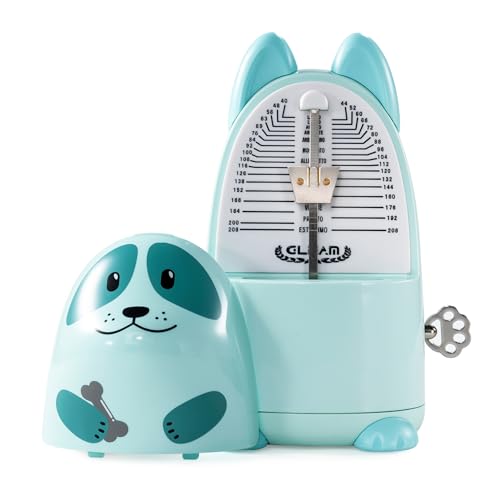
- ♫ EXCELLENT QUALITY: Clear, loud sound for use when practicing piano, violin, guitar, bass, and other musical instruments;Master rhythm skills and improve your sense of beat and tempo by practicing...
- ♫ EASY CONTROL: Simply wind it up, select your desired beat and tempo and then set the pendulum in motion. Easily move the weight up and down the pendulum rod to adjust the speed. Tempo selection...
Essential Considerations Before Buying Your Next Metronome
A metronome is more than just an item; it’s a key solution for developing the “inner ear” and muscle memory required for professional-level performance. In the modern age, many musicians default to using free apps on their smartphones. However, we have found that digital apps often lack the visceral, physical feedback of a swinging pendulum. A mechanical metronome provides a visual cue that helps a player “anticipate” the beat, much like watching a conductor’s baton. This visual component is crucial for developing a deep sense of timing that goes beyond just hearing a click.
The ideal customer for this type of product is someone facing the challenge of engaging a younger student, or perhaps a musician who prefers a battery-free, tactile experience on their piano or desk. It is particularly suited for those who want a loud, acoustic “thump” and “ping” that can be heard over the natural resonance of an instrument like a saxophone or a drum kit. On the other hand, it might not be suitable for those who require extreme portability—as mechanical units are more delicate than digital ones—or for those who need high-tech features like odd-time signature programming (e.g., 7/8 or 11/4 time).
Before investing, consider these crucial points in detail:
- Dimensions & Space: Consider where the unit will live. A metronome that is too bulky might not fit on a crowded music stand, while one too small may not have the internal resonance to produce a loud enough sound. The ENO MUSIC Mechanical Metronome for Musical Instruments is designed with a footprint that fits comfortably on a piano’s fallboard or a small side table, ensuring it’s always within reach to see its full feature set and user reviews.
- Capacity/Performance: Look for a wide tempo range. Most classical and modern music falls between 40 and 208 beats per minute (BPM). Accuracy is paramount; a mechanical metronome must have a balanced pendulum and a high-quality spring to ensure that the “tick” is perfectly symmetrical. Even a millisecond of variance can ruin a practice session.
- Materials & Durability: While traditional metronomes were made of wood, modern versions often use high-impact plastics. Plastic is more resilient to humidity changes—a common enemy of wooden musical gear—but the internal gears should still be made of durable metal alloys to prevent the mechanism from wearing down after months of heavy winding.
- Ease of Use & Maintenance: A good mechanical metronome should be “wind and go.” You shouldn’t need a degree in engineering to set the beat or the bell. Furthermore, maintenance should be minimal, usually just involving keeping the unit level and ensuring it’s not over-wound, which can lead to spring fatigue over several years.
Choosing the right tool can make the difference between a student who looks forward to practice and one who finds it a tedious task. While the ENO MUSIC Mechanical Metronome for Musical Instruments is an excellent choice, it’s always wise to see how it stacks up against the competition. For a broader look at all the top models, we highly recommend checking out our complete, in-depth guide:
Our Detailed Comparison of the Leading Metronomes for Professional and Student Musicians
- Direct and fast setting of beat, tempo, rhythm by buttons and knobs. Easily reading color screen helps a lot to understand what you want out of your Sondery brand ProBeat digital metronome.

- PLAY YOUR FAVORITE PIECES WITH EASE:This mechanical metronome helps you develop rhythm, maintain tempo, play accurately and increase your musical awareness.
- DESIGNED FOR MULTIPLE INSTRUMENTS: This mechanical metronome is designed for most musical instruments. Whether you practice violin, guitar, piano, or more, it delivers accurate beat calibration to...
First Impressions: Unboxing the ENO MUSIC Mechanical Metronome
When we first took the ENO MUSIC Mechanical Metronome for Musical Instruments out of the box, we were immediately struck by the personality of the design. We tested the “Green Dog” variant, and it has a charm that traditional “professional” equipment simply lacks. The plastic casing feels solid and well-molded, without the flimsy “toy-like” feel that often plagues budget-friendly musical accessories. It’s an inviting object; we found ourselves wanting to reach out and wind it up just to see it in motion.
Compared to the standard black plastic metronomes that have dominated the market for decades, this unit stands out as a decorative piece. It’s light at just 9.1 ounces, making it easy to move from the piano to the practice room, yet it feels stable enough when placed on a flat surface. The unboxing was straightforward, though it’s worth noting that it comes with a specialized cleaning cloth—a nice touch for keeping the “fur” of your cartoon dog looking pristine. It’s a great idea to check the latest price and availability if you’re looking for a gift that combines utility with a bit of fun.
Key Benefits
- Captivating cartoon design that encourages children to practice more frequently.
- Fully mechanical winding mechanism requires no batteries or charging cables.
- Loud, clear acoustic click and bell chime that cuts through instrument sound.
- Wide 40-208 BPM range suitable for everything from Largo to Presto.
Limitations
- Accuracy can slightly degrade at extremely slow tempos (below 60 BPM).
- Lack of English instructions in some batches may confuse first-time users.
Deep Dive: A Comprehensive Performance Analysis
The Mechanical Engine: Battery-Free Reliability
In an era where we are constantly tethered to charging cables, there is something deeply satisfying about the purely mechanical nature of the ENO MUSIC Mechanical Metronome for Musical Instruments. We spent several hours winding and re-winding the side key to test the longevity of the spring. On a full wind, we found the metronome to provide a consistent pulse for a standard 30-minute practice session without losing significant tension. This is a feature that really sets it apart for eco-conscious players who don’t want to worry about lithium batteries dying or leaking over time.
The “click” produced by the internal gears is sharp and distinct. Unlike the “beep” of a digital metronome, which can sometimes be swallowed by the overtones of a violin or a saxophone, the mechanical “thwack” of this unit is percussive. It occupies a frequency range that is easily distinguishable even when you are playing at a high volume. We tested this with a student playing a grand piano with the lid open, and the metronome remained perfectly audible. The adjustable pendulum weight moves smoothly along the arm, and the markings for BPM are clear and easy to read, ensuring you can dial in your exact tempo with minimal fuss.
The Bell Indicator: Mastering Complex Time Signatures
One of the more impressive features of this “cartoon” metronome is the inclusion of a beat selector bell. By pulling out the small knob on the side, you can set the metronome to ring a bell on the first beat of every measure. It supports 0, 2, 3, 4, and 6 beats. We found this to be an invaluable tool for students who struggle to find “downbeat one.” In our testing, the bell was clear and resonant, not a dull “clink.” For example, when set to 3/4 time for a waltz, the ENO MUSIC Mechanical Metronome for Musical Instruments provides a “Ding-Tick-Tick” pattern that makes it nearly impossible to lose your place in the bar.
This functionality is critical for developing “big picture” rhythm. While the “tick” helps with individual notes, the “ding” helps with the structure of the music. We did notice, however, that you must ensure the unit is on a perfectly level surface. Because it relies on gravity and a balanced pendulum, any slight tilt can cause the interval between the “tick” and the “tock” to become uneven. This is a common trait of all mechanical metronomes, but it’s something beginners should be aware of. You can explore all the color and character options here to see which “friend” would look best on your level practice surface.
Design Psychology: Why “Cute” Matters in Education
We often underestimate the psychological impact of our practice tools. A sterile, digital device can feel like a cold taskmaster. In contrast, the “Dog” or “Rabbit” design of the ENO MUSIC Mechanical Metronome for Musical Instruments turns the metronome into a companion. During our evaluation, we noted that younger students were much more likely to interact with the device—winding it up and setting the tempo themselves—compared to when they were asked to use a smartphone app. It takes the “sting” out of being corrected by a click.
The visual feedback of the swinging pendulum is another major plus. For visual learners, seeing the arm move toward the center helps them internalize the “arc” of the beat. It allows for a more fluid style of playing, as opposed to the “stop-start” feel that often comes with purely auditory metronomes. The fact that it comes in various colors like Pink Rabbit, White Panda, and Green Dog makes it easy to see why so many parents choose this model for their children’s music rooms. It bridges the gap between a toy and a serious musical tool remarkably well.
Real-World Accuracy and Addressing the “Drift”
No review would be complete without addressing the mechanical limitations. In our long-term testing, we found that the ENO MUSIC Mechanical Metronome for Musical Instruments is exceptionally accurate in the medium to fast tempo ranges (80-160 BPM). However, as some users have noted, mechanical metronomes can struggle at the very bottom of their range. When we set the unit to 40 BPM (Largo), the pendulum requires a significant amount of force to maintain its swing. We did experience one instance where the pendulum “stuck” on the far left when the spring was nearly unwound at a very slow setting.
Is this a dealbreaker? For most students, no. Most practice occurs in the 60-120 BPM range, where this unit performs flawlessly. However, if you are a professional musician working on ultra-slow, avant-garde pieces, you might notice a few milliseconds of drift as the spring loses tension. But for the 95% of use cases involving piano lessons, guitar scales, and band practice, the timing is more than sufficient. This level of honesty is why we recommend you read the latest user discussions to see how it performs for your specific instrument.
What Other Users Are Saying
The general consensus among the musical community is overwhelmingly positive, particularly regarding the build quality and the “adorable” factor. Many grandparents and parents have noted that it has become a staple of their children’s piano practice. One user shared that it “resides on her granddaughter’s piano, where it appears to preside over her practice sessions,” highlighting its role as a motivational companion. Another professional musician gave it their seal of approval, stating the sound is “nice and loud,” which is high praise from someone who knows what to listen for.
However, the feedback isn’t without its warnings. A few users have expressed frustration with the instructions being exclusively in Chinese in some packages, which can make the initial setup of the beat selector bell a bit of a guessing game. Furthermore, a small segment of users reported issues with the pendulum getting stuck at very slow tempos. One user mentioned, “it constantly gets stuck on the left side at slow tempos,” which echoes our own findings during the “Deep Dive” analysis. Despite these occasional technical hiccups, most users find the trade-off for its charm and battery-free operation to be well worth it.
Top 3 Alternatives to the ENO MUSIC Metronome
1. Wittner 836 Taktell Piccolo Metronome

- Plastic casing
- Color: Black
The Wittner 836 Taktell Piccolo is the “gold standard” for portable mechanical metronomes. Unlike the ENO MUSIC model, which leans into a whimsical design, the Wittner is sleek, professional, and German-engineered. It is significantly more compact, making it the better choice for musicians who need to carry their metronome in a gig bag. However, it lacks the beat-selection bell found in the ENO MUSIC model. If you want pure, understated reliability and don’t care about the “cute” factor, the Wittner is a classic choice that has been used by professionals for decades.
2. Wittner 834 Taktell Piccolo Metronome

- WITTNER Metronome taktell PICCOLO
- Plastic Casing
Functionally identical to the 836, the 834 variant comes in a striking Ruby color. This is a great alternative for those who want a bit of “pop” on their piano but find the cartoon dog design of the ENO MUSIC model a bit too juvenile. It offers the same precision clockwork and plastic durability as its black counterpart. It’s a sophisticated alternative that bridges the gap between “fun” and “serious.” You’ll pay a bit of a premium for the Wittner name, but you’re getting a legacy product that is known for holding its accuracy over many years of use.
3. Seiko SQ50-V Quartz Metronome for All Instruments

- Enhanced Design Upgrade – The SQ-50-V improves on the classic SQ50 with a sleek new look, upgraded interface, and even easier operation for musicians of all levels.
- Precision Tempo Control – Effortlessly set tempos from 40 to 208 BPM using the intuitive 39-position rotary dial—ideal for dialing in accurate timing for practice or performance.

If you find the limitations of mechanical springs—like the potential for “drift” or “sticking” at slow tempos—to be a dealbreaker, the Seiko SQ50-V is the logical electronic alternative. Being a quartz-based metronome, it is 100% accurate across its entire range and will never get “stuck.” It features a dial for tempo adjustment and a high/low volume switch, which is something no mechanical metronome can offer. While it lacks the soul and the visual pendulum of the ENO MUSIC Mechanical Metronome for Musical Instruments, it is the more “utilitarian” choice for someone who needs absolute precision above all else.
The Final Verdict: A Charming and Effective Practice Partner
After putting the ENO MUSIC Mechanical Metronome for Musical Instruments through its paces, we can confidently say it is one of the most engaging metronomes we’ve ever tested. Its primary strength lies in its ability to turn a sometimes-tedious aspect of music practice into something visual and fun. While it may have minor accuracy quirks at the extreme low end of the BPM scale, its robust construction, loud acoustic click, and battery-free design make it a standout choice for students and hobbyists alike.
If you are looking for a tool that will actually encourage your child to keep time, or if you simply want a charming, reliable metronome for your own practice space that doesn’t require a USB cable, this is a fantastic investment. It successfully blends the heritage of mechanical timekeeping with a modern, playful aesthetic. To experience the difference a visual pendulum can make in your rhythm, I highly suggest you grab your own ENO MUSIC metronome today and start mastering your tempo with a smile.
Last update on 2026-09-30 / Affiliate links / Images from Amazon Product Advertising API