
Pigtronix Single Electric Guitar Effect Review: The Ultimate Analog Octave Fuzz for Vintage Tones
For years, I found myself on a seemingly endless quest for that elusive “ghost in the machine” tone. You know the one—that searing, slightly glitchy, harmonically rich lead sound popularized by Jimi Hendrix on “Band of Gypsys” and “Purple Haze.” I tried digital modelers, multi-effects units, and cheap knock-offs, but they all lacked the organic “sag” and unpredictable character of a true analog circuit. The problem is that many modern octave pedals feel sterile; they track too perfectly, losing the grit and character that makes blues-rock so compelling. Without a high-quality analog octave-up effect, your solos can sound thin and your power chords lack that “wall of sound” weight. This frustration led me to the Pigtronix Single Electric Guitar Effect, a pedal that promised to pack legendary analog textures into a footprint that wouldn’t dominate my entire board.
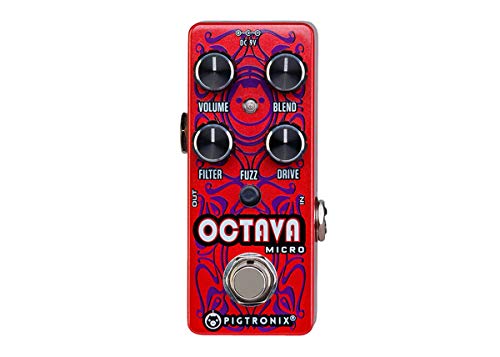
- Analog Octave Up
- Variable Low Pass Filter; Variable Front-end Drive
What to Consider Before Buying Electric Guitar Pitch & Octave Effects
An Electric Guitar Pitch & Octave Effects unit is more than just an item; it’s a key solution for guitarists looking to expand their sonic palette beyond the standard six strings. These devices allow you to emulate bass lines, create 12-string textures, or, in the case of the Pigtronix Single Electric Guitar Effect, add high-frequency harmonic overtones that make lead lines jump out of a mix. Solving the “thin tone” problem is crucial for power trios or solo performers who need to fill more frequency space without adding another band member.
The ideal customer for this type of product is someone facing a stale creative block or a professional gigging musician who needs classic “Octavia” tones without the bulky chassis of vintage 1960s gear. It is perfect for stoner metal, psychedelic rock, and blues enthusiasts. However, it might not be suitable for those who require polyphonic pitch shifting—the ability to play full chords and have every note shifted perfectly—as analog octave-up circuits are inherently monophonic and “glitchy” by design. For those users, a digital shifter might be a better alternative.
Before investing, consider these crucial points in detail:
- Dimensions & Space: In the modern era of crowded pedalboards, every square inch matters. A “Micro” footprint allows you to squeeze essential effects into tight spaces. When you see its full feature set and user reviews, you’ll notice how Pigtronix managed to fit five knobs into a tiny chassis, which is an engineering feat that saves you from buying a larger, more expensive board.
- Capacity/Performance: Look for the voltage requirements. Many pedals run on 9V, but the Pigtronix Single Electric Guitar Effect operates at 18V. This higher voltage provides significantly more headroom and a clearer, more defined “clang” to the octave effect. If your power supply doesn’t support 18V, you’ll need to account for that.
- Materials & Durability: Since these effects are literally stepped on, a rugged metal enclosure is non-negotiable. Look for high-quality potentiometers (the knobs) that don’t feel “wobbly.” A pedal that uses true bypass switching is also vital to ensure your core tone remains unsullied when the effect is turned off.
- Ease of Use & Maintenance: While many octave pedals are “one-knob wonders,” having control over the blend and filter is essential for long-term satisfaction. Maintenance is usually minimal, but ensuring the 1/4-inch jacks remain tight and clean will prevent signal loss during a performance.
Choosing the right octave effect involves balancing vintage character with modern reliability. While the Pigtronix Single Electric Guitar Effect is an excellent choice, it’s always wise to see how it stacks up against the competition. For a broader look at all the top models, we highly recommend checking out our complete, in-depth guide:

- [Octave/Pitch shifter Pedal] With 7 shift types and 3 tone mode toggles, Harmonic Square guitar pedal gives you 21 options of semitonal, octave and detune sounds

- Industry-Standard Octave Pedal: The updated version features enhanced capabilities for modern guitarists


- Three shift modes: up, down or dual
First Impressions: Unboxing the Pigtronix Single Electric Guitar Effect
When I first pulled the Pigtronix Single Electric Guitar Effect out of its packaging, I was immediately struck by its weight. Despite its diminutive 3 x 8 x 10-inch dimensions, it feels incredibly substantial—not like a toy, but like a piece of high-end studio equipment. The “Red” finish is vibrant and professional, making it easy to spot on a dark stage. Setting it up was a breeze; I plugged it into my 18V power brick and immediately noticed how quiet the noise floor was compared to vintage clones I’ve used in the past.
What sets this apart from market leaders like the EHX POG or the classic Dunlop Octavio is the sheer amount of control. Most micro pedals sacrifice knobs for size, but here we have Volume, Blend, Filter, Drive, and a Fuzz switch. Before I even hit the first chord, I knew this was going to be a versatile beast. You can check the latest price and availability to see why this has become a staple for board-conscious professionals.
Key Benefits
- Authentic analog octave-up tracking that captures the “Hendrix” vibe perfectly.
- Incredibly small footprint fits easily on mini-boards like the Pedaltrain Mini.
- Variable Low Pass Filter allows you to tame harsh high-end frequencies.
- The 18V operation provides massive headroom and a very quiet signal path.
Limitations
- Requires an 18V power source, which might not be standard on basic power supplies.
- The knobs are very small and close together, making mid-song adjustments tricky.
Deep Dive: Why the Pigtronix Single Electric Guitar Effect Dominates the Micro Pedal Market
The Tonal Versatility of the Drive and Fuzz Circuits
We found that the most surprising aspect of the Pigtronix Single Electric Guitar Effect isn’t just the octave, but the quality of the dirt circuit itself. Many octave pedals are “on or off” affairs—you either have a screaming fuzz or a clean octave. Pigtronix has given us a variable front-end drive and a switchable high-gain fuzz. When we tested this with the octave rolled off, the pedal transformed into a standalone distortion that reminded us heavily of a vintage ProCo RAT, but with more “bloom.”
The “Drive” knob is exceptionally responsive. At lower settings, it adds a touch of grit that pushes a tube amp into a sweet break-up. When you engage the “Fuzz” switch, the pedal enters stoner metal territory. We were able to achieve ungodly heavy, borderline synth-like tones that felt thick and “chewy.” Using this feature is a game-changer for players who don’t want to stack multiple pedals just to get a usable lead tone. For a deeper look at these sounds, read the technical specifications to understand the analog signal format that makes this possible.
Mastering the Blend and Filter Controls
One of the biggest complaints with vintage Octavia pedals is that the octave-up effect can be “ice-pick” sharp and overwhelming. The Pigtronix Single Electric Guitar Effect solves this beautifully with its Master Blend and Variable Low Pass Filter. In our studio sessions, we found that setting the blend to about 50% allowed the original dry signal to maintain the note’s fundamental punch while the octave “haloed” around it. This is a feature that really sets it apart from more primitive designs.
The Low Pass Filter is the “secret sauce” here. By rolling back the filter, we could remove the harsh “clatourous” clang that sometimes plagues analog octave circuits. This allowed us to dial in a smoother, more violin-like lead tone. Conversely, opening the filter all the way up allowed for those ring-modulation-style glitches that are perfect for experimental noise or avant-garde jazz. We were consistently impressed by how the filter interacted with the 18V headroom, never sounding muffled or muddy, even at extreme settings. You can see more user photos and control layouts to get a sense of how these knobs are positioned.
Analog Tracking and the “Glitch” Factor
We must address the tracking, as this is where analog pedals live or die. Unlike digital pitch shifters that use algorithms to “calculate” the note, the Pigtronix Single Electric Guitar Effect uses analog frequency doubling. This means it tracks best above the 12th fret on the neck pickup. When we played high-up on the neck, the tracking was surprisingly stable, but it retained that charming, slightly unstable character that defines the classic psychedelic sound.
We found that as you move down the neck toward the open strings, the pedal starts to “fight” with itself, creating interesting harmonic artifacts. This isn’t a bug; it’s a feature. It adds a “human” element to your playing that digital pedals often lack. As one user noted, these glitchy effects are part of the charm of analog. We also noticed that it stacks incredibly well with other pedals. Placing a wah-wah pedal in front of the Octava Micro resulted in some of the most vocal, “crying” lead tones I’ve ever recorded. To experience this level of responsiveness, check out the available deals for this specific model.
Build Quality and Professional Integration
Finally, we evaluated how the Pigtronix Single Electric Guitar Effect integrates into a professional rig. The true bypass switching is silent, with no audible “pop” when engaged. The build quality is top-tier; the 1/4-inch jacks are chassis-mounted and feel very secure. We’ve seen many micro pedals fail because the jacks are only soldered to the PCB, but Pigtronix seems to have built this to survive a tour.
The 18V power requirement is a double-edged sword. While it necessitates a specific power output, the result is a pedal that is remarkably quiet. Even at high-gain fuzz settings, the “hiss” is minimal. This makes it a viable option for studio recording where noise floors are a major concern. We also found that the pedal’s small size allows it to fit on the narrowest of rails on a Pedaltrain board. For the gigging musician, this is a massive win. If you’re looking for a professional-grade tool that doesn’t compromise on sound due to its size, you should explore the full product details.
What Other Users Are Saying
The general sentiment among the guitar community regarding the Pigtronix Single Electric Guitar Effect is overwhelmingly positive, especially among those who value vintage “vibe.” Many users confirm our findings that this pedal punches way above its weight class. One user mentioned that they replaced an “authentic Chicago Ironworks Tychobrahe” (which costs three times as much) with this Pigtronix unit because the tones were just as good, if not better, and the flexibility was superior. This echoes our expert assessment of its value proposition.
Another common theme in user feedback is the “Hendrix Band of Gypsys” tone. Players are consistently finding the exact screaming, singing lead sound they’ve searched for in larger units. On the negative side, some users pointed out the “glitchy” tracking high on the neck, though most agree this is “part of the charm of analogue.” One practical critique was the desire for the fuzz to be on a separate footswitch, but as a user rightly pointed out, “then it could never be so small!” Overall, the consensus is that for the price and size, it’s the “Octavia pedal you want and need on your board.” Before making a decision, we suggest you read more real-world experiences to see how it fits different genres.
Comparing the Pigtronix Single Electric Guitar Effect to Top Alternatives
1. DigiTech DROP Compact Polyphonic Pitch-Shifter

- Polyphonic drop tune allows you to drop tune from 1 semi-tone to a full octave
- Momentary or latching mode footswitch
The DigiTech DROP is a completely different beast compared to the Pigtronix Single Electric Guitar Effect. While the Pigtronix is an analog octave-up fuzz designed for vintage character, the DigiTech is a digital polyphonic down-tuner. If you are looking to drop your guitar’s tuning from E-standard to B-standard without touching your tuning pegs, the DigiTech DROP is the industry standard. It tracks full chords perfectly and has no “glitch.” However, it lacks the fuzz circuit and the harmonic “scream” of the Pigtronix. Choose this if you’re a metal player needing to change tunings mid-set, rather than a blues-rock player looking for lead textures.
2. DigiTech Whammy (5th Gen) 2-Mode Pitch Shift Effect

- Classic Whammy Sound
- Chordal Whammyv-01 Pitch Shifting
The DigiTech Whammy is a legendary pedal that offers much more than just a simple octave. With its expression pedal, you can do dive-bombs, 2-octave shifts, and even harmony bends. Unlike the Pigtronix Single Electric Guitar Effect, the Whammy is large, power-hungry, and digital. It’s perfect for players like Tom Morello or Jack White who want to use pitch shifting as a primary “instrument” rather than a subtle tonal enhancement. While it’s more versatile in terms of pitch range, it doesn’t provide the same “analog warmth” or built-in fuzz that makes the Pigtronix so special for classic rock tones.
3. Donner Octave Guitar Pedal Harmonic Square Pitch Shifter
- [Octave/Pitch shifter Pedal] With 7 shift types and 3 tone mode toggles, Harmonic Square guitar pedal gives you 21 options of semitonal, octave and detune sounds
- [3 Tone Modes]: 3 tone modes including Sharp, Flat, and Detune; Sharp: Pitch up; Detune: Adjustable pitch signal shifted by 10 cents; Flat: Pitch down
If you’re on a very tight budget, the Donner Harmonic Square is a popular digital alternative. It’s a micro-sized pedal like the Pigtronix, but it offers 7 different shift types, including octaves and thirds. Because it’s digital, it tracks more cleanly than the Pigtronix but sounds significantly more “processed” and “thin.” It lacks the drive, filter, and blend controls that make the Pigtronix such a professional-grade tool. We recommend the Donner for beginners who want to experiment with pitch shifting for the first time, but the Pigtronix Single Electric Guitar Effect is the clear winner for serious tone-chasers and professional musicians.
The Final Verdict: Is the Pigtronix Single Electric Guitar Effect Worth It?
After extensive testing, the Pigtronix Single Electric Guitar Effect has proven itself to be a heavyweight in a lightweight division. It successfully captures the erratic, soulful, and harmonically rich nature of vintage analog octave-up circuits while offering modern refinements like a blend knob and an 18V signal path for maximum clarity. Its primary strengths lie in its versatility—acting as a fuzz, a distortion, or a classic Octavia—and its remarkably small footprint. While the 18V requirement and the tiny knobs are minor inconveniences, they are small prices to pay for this level of tonal quality.
I would recommend this pedal to any guitarist who wants to inject some psychedelic magic into their solos or any stoner-rock player looking for a “wall of synth” fuzz tone. It is a professional-grade tool that solves the problem of board space without sacrificing the “mojo” of vintage gear. If you’re ready to take your lead playing to the next level and capture those legendary tones of the late 60s, I highly encourage you to purchase the Pigtronix Single Electric Guitar Effect today and hear the difference for yourself.
Last update on 2026-09-26 / Affiliate links / Images from Amazon Product Advertising API