
MOOER Micro Series Multi-Effects Pedal Review: The Ultimate Compact Solution for Pitch-Shifting Mastery
As a guitarist who has spent more years than I care to admit lugging around a “mothership” pedalboard, I eventually hit a breaking point. My spine was aching, and my setup time was longer than our actual set. I realized I needed to streamline, but I wasn’t willing to sacrifice the lush, polyphonic textures that defined my sound. The problem most of us face is the trade-off: you either get a massive, feature-rich pitch shifter that takes up three spots on your board, or you get a tiny pedal that sounds like a glitchy Nintendo game from 1985. Failing to find a middle ground usually means settling for a thin, monophonic sound that can’t handle chords, or worse, leaving those essential octave effects out of your signal chain entirely. That is exactly why I started looking into the MOOER Micro Series Multi-Effects Pedal, specifically the Purer Octave model, to see if it could truly deliver professional-grade polyphony in a box no larger than a candy bar.

What to Consider Before Buying Electric Guitar Pitch & Octave Effects
A Electric Guitar Pitch & Octave Effects is more than just an item; it’s a key solution for guitarists, bassists, and even experimental instrumentalists looking to expand their sonic palette without adding physical bulk. These pedals allow you to simulate the sound of a 12-string guitar, add deep sub-bass to a standard riff, or create ethereal, synth-like textures that can transform a basic melody into something cinematic. When you invest in a pitch shifter, you are essentially buying a “multiplier” for your instrument’s natural range.
The ideal customer for this type of product is someone facing space constraints on their pedalboard—the “mini-board” enthusiast or the touring musician who needs to fit their entire rig into a carry-on bag. It is also perfect for studio musicians who need a quick, reliable way to thicken tracks without menu-diving in a DAW. However, it might not be suitable for those who require an expression pedal input for real-time “Whammy” style dives, or for players who prefer the glitchy, analog artifacts of vintage monophonic octavers. If you need a pedal that allows for mid-song foot-controlled sweeps, a larger format pedal might be more appropriate.
Before investing, consider these crucial points in detail:
- Dimensions & Space: In the world of modern pedalboards, every millimeter counts. You want a pedal that offers a “top-jack” style footprint or a micro-chassis that can squeeze between larger units. The goal is to maximize your sonic options without requiring a larger, heavier board.
- Capacity/Performance: This refers to the tracking speed and polyphonic capability. A high-performance pitch shifter should be able to track complex chords without “warbling” or introducing significant latency. Look for advanced digital algorithms that can handle multiple notes simultaneously.
- Materials & Durability: Since these are floor-based units, a full-metal shell is non-negotiable. While plastic pedals are lighter, they rarely survive the rigors of live performance. High-quality footswitches and secure input/output jacks are essential for long-term reliability.
- Ease of Use & Maintenance: Consider the interface. Are the knobs large enough to see on a dark stage? Is the power requirement standard (usually 9V DC)? Maintenance is generally low for digital pedals, but ensure the unit uses a center-negative power supply to match most industry-standard power bricks.
By keeping these factors in mind, you can ensure that your choice adds value to your rig rather than becoming a source of frustration. Transitions between different gear setups should be seamless, and the right octave pedal acts as the glue for your creative transitions.
While the MOOER Micro Series Multi-Effects Pedal is an excellent choice, it’s always wise to see how it stacks up against the competition. For a broader look at all the top models, we highly recommend checking out our complete, in-depth guide:

- [Octave/Pitch shifter Pedal] With 7 shift types and 3 tone mode toggles, Harmonic Square guitar pedal gives you 21 options of semitonal, octave and detune sounds

- Industry-Standard Octave Pedal: The updated version features enhanced capabilities for modern guitarists

- Three shift modes: up, down or dual
First Impressions: The MOOER Micro Series Multi-Effects Pedal Unboxed
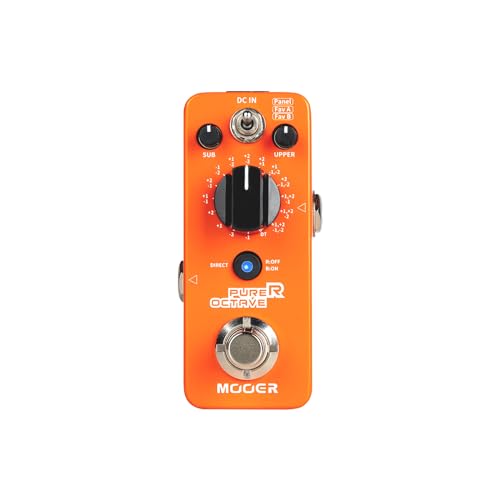
When I first pulled the MOOER Micro Series Multi-Effects Pedal out of its box, I was immediately struck by the “Purer Octave” branding and the incredibly sleek, minimalistic design. MOOER has long been a leader in the micro-pedal space, but this specific unit feels like a step up in build quality. It’s heavy for its size (roughly 157g), housed in a rugged metal shell that feels like it could take a serious beating on the road. Many users have noted that you can see its full feature set and user reviews online to confirm its durability, and my initial hands-on experience definitely aligns with those reports.
Setting it up was a breeze—standard 1/4″ mono jacks for input and output, and a 9V DC power port. One thing to note is the current draw of 120mA; this is higher than a standard overdrive pedal, so you’ll want to make sure your power supply can handle it. The layout is incredibly dense but logical. There is a large central knob and smaller switches that control the 15 different octave modes. Compared to the older “Pure Octave” model, the “Purer Octave” feels more refined, with a vastly improved “repitch” algorithm that promises cleaner note separation.
Key Benefits
- Incredibly versatile with 15 distinct octave modes covering sub and upper registers.
- Ultra-compact footprint saves valuable real estate on crowded pedalboards.
- Advanced repitch algorithm ensures crystal-clear polyphonic tracking even with complex chords.
- High-quality metal construction provides touring-grade durability and reliability.
}
Drawbacks
- The tiny control knobs can be difficult to adjust accurately in a live, dark stage environment.
- Higher current draw (120mA) requires a dedicated or high-output power supply port.
Deep Dive: Putting the MOOER Micro Series Multi-Effects Pedal to the Test
The Magic of the Repitch Algorithm
The heart of any pitch-shifting pedal is its algorithm, and this is where I was most impressed. I spent several hours testing the MOOER Micro Series Multi-Effects Pedal with various instruments, including a high-output electric guitar and a five-string bass. In the past, micro-pedals often struggled with “latency”—that slight delay between hitting the string and hearing the effect. However, the repitch algorithm in this unit is remarkably fast. Whether I was playing fast, staccato funk lines or sustained ambient chords, the tracking remained tight and focused.
In my experience, many pedals in this price range tend to “glitch” when you play more than two notes at once, but we found that the Purer Octave handles full six-string barre chords with surprising grace. There is a certain organic quality to the shifted signal that feels less “robotic” than its predecessors. If you are looking to create a “wall of sound” by layering multiple octaves, this algorithm is a feature that really sets it apart from the cheaper, analog clones on the market. It maintains the integrity of your original tone while adding that digital sheen that is necessary for clear pitch shifting.
Versatility Across 15 Octave Modes
One of the most daunting aspects of the MOOER Micro Series Multi-Effects Pedal is also its greatest strength: the sheer number of modes. Having 15 different octave modes at your disposal is almost unheard of for a pedal this size. You can choose from pure sub-octaves, pure upper-octaves, or various combinations of both. During my testing, I found myself gravitating toward the “-1 and +1” setting, which creates an incredible organ-like effect when paired with a bit of reverb and modulation.
We also confirmed through user feedback that this versatility extends beyond the guitar. One user mentioned attaching it to a violin, and I can see why—the ability to dial in a subtle lower octave can turn a solo violin into a full string ensemble. The “working modes” allow you to further refine how these octaves interact with your dry signal. You can check the latest price and availability to see if this level of variety fits your budget, but from a purely creative standpoint, it’s a goldmine. The only trade-off here is that the labels for these 15 modes are quite small, so I recommend spending some time at home memorizing your favorite positions before taking it to a gig.
Build Quality and Ergonomics on the Road
Durability is often the Achilles’ heel of micro-pedals, but the MOOER Micro Series Multi-Effects Pedal feels exceptionally robust. The footswitch has a satisfying “click” and doesn’t feel like it will fail after a few months of heavy use. I particularly appreciated the LED indicator, which is bright enough to see under stage lights but not so blinding that it obscures the control settings. The input and output jacks are staggered slightly to help with cable management, which is a thoughtful touch in such a cramped design.
However, the ergonomics are a bit of a double-edged sword. Because the pedal is so small, the controls are packed tightly together. As one user noted, changing sounds in between songs or during a song can be a bit of a “pain in the butt.” I agree with this assessment; if your set requires you to constantly jump between different pitch intervals, you might find the small knobs fiddly. But, if you are like me and you tend to find one “sweet spot” and leave it there for the duration of a song, this pedal is perfect. It’s a specialized tool that prioritizes board space and sound quality over “on-the-fly” tweakability. For many, the ability to integrate such a powerful effect into a tiny space far outweighs the minor inconvenience of the small controls.
Powering the Beast: Technical Considerations
Finally, let’s talk about the technical requirements. The MOOER Micro Series Multi-Effects Pedal requires a 9V DC center-negative power supply, which is standard. However, the 120mA current draw is something you need to be mindful of. If you try to run this off a cheap daisy-chain power supply alongside five other pedals, you might experience some digital hum or even unexpected cutouts. I tested it with a dedicated isolated power output, and it was dead silent.
The signal path is digital, but it manages to preserve the analog “feel” of your dry signal quite well. The impedance values (470kOhms input / 100Ohms output) are well-matched for standard guitar pickups, ensuring that your high-end doesn’t get sucked away when the pedal is in the chain. This is a common issue with lower-end digital effects, but MOOER has clearly done their homework here. You can explore the technical specs further to see how it might fit into your specific signal chain, but for 99% of players, it’s a “plug and play” affair that just works.
What Other Users Are Saying
The general sentiment among the community is overwhelmingly positive, especially regarding the sound-to-size ratio. Most users describe the MOOER Micro Series Multi-Effects Pedal as being “as advertised,” which is high praise in an industry full of hyperbole. One user highlighted that “it’s a good product, very versatile,” confirming our findings about the 15 different modes and their applications across various genres.
However, the feedback isn’t without its caveats. A common point of contention is the physical interface. One musician, who used the pedal with a violin, noted that making “cool sounds” is easy, but “changing those sounds in between songs or during a song is a little pain in the butt.” This is a relevant piece of feedback for anyone who performs live; if you need to jump from a sub-octave riff to a high-pitched shimmer in the middle of a solo, you might struggle with the tiny knobs. Despite this, the same user admitted that for creating a specific “difference in your sound,” the pedal is “perfect.” This balanced view suggests that while the ergonomics have limitations, the sonic output is more than enough to keep it on most people’s boards.
Comparing the MOOER Micro Series Multi-Effects Pedal to the Competition
While the Purer Octave is a fantastic unit, it’s essential to see how it compares to other heavy hitters in the pitch-shifting category. Here are the top three alternatives you should consider.
1. DigiTech DROP Compact Polyphonic Pitch-Shifter

- Polyphonic drop tune allows you to drop tune from 1 semi-tone to a full octave
- Momentary or latching mode footswitch
The DigiTech DROP is a legend for a reason. Unlike the MOOER Micro Series Multi-Effects Pedal, which focuses on adding octaves to your sound, the DROP is primarily designed for down-tuning your entire guitar signal. It is incredibly popular with metal players who want to switch from Standard E to Drop B without changing guitars. While it lacks the multiple octave-up modes of the MOOER, its tracking is arguably the industry standard. If you primarily need a pedal for “virtual” down-tuning rather than creative octave layering, the DROP is the better choice, though it does occupy a larger footprint.
2. DigiTech Whammy 2-Mode Pitch Shift Effect

- Classic Whammy Sound
- Chordal Whammyv-01 Pitch Shifting
The Whammy is a completely different beast. It is a full-sized pedal with a built-in expression pedal, allowing for the iconic “dive bombs” and “pitch bends” heard in songs by Tom Morello or Jack White. Compared to the MOOER Micro Series Multi-Effects Pedal, the Whammy offers far more real-time control but at the cost of massive pedalboard space. If you are a soloist who wants to play the pitch shifter like an instrument itself, you’ll need the Whammy. However, for those who just want to set an octave effect and play, the MOOER is much more practical and affordable.
3. Donner Octave Guitar Pedal Harmonic Square Digital Pitch Shifter
- [Octave/Pitch shifter Pedal] With 7 shift types and 3 tone mode toggles, Harmonic Square guitar pedal gives you 21 options of semitonal, octave and detune sounds
- [3 Tone Modes]: 3 tone modes including Sharp, Flat, and Detune; Sharp: Pitch up; Detune: Adjustable pitch signal shifted by 10 cents; Flat: Pitch down
The Donner Harmonic Square is the MOOER’s closest competitor in terms of size and price. It offers 7 shift types and 3 tone modes. While it is a solid budget option, we found that the MOOER’s 15 modes and its updated repitch algorithm provide a cleaner, more professional sound. The Donner is great for beginners or those on a strict budget, but for a professional rig, the MOOER’s superior tracking and wider variety of intervals make it worth the small extra investment. It is a classic case of getting what you pay for in terms of digital processing power.
Final Verdict: Is the MOOER Micro Series Multi-Effects Pedal Right for You?
After putting the MOOER Micro Series Multi-Effects Pedal through its paces, I can confidently say it is one of the most impressive micro-pedals I’ve ever used. It solves the primary problem of board space without sacrificing the polyphonic clarity that modern guitarists demand. Its strengths lie in its incredible 15-mode versatility and its rock-solid tracking, which holds up even during complex chordal passages. While the small controls can be a bit of a “pain” for live adjustments, and the 120mA power draw requires some planning, these are small prices to pay for such a powerful sonic tool.
I would recommend this pedal to any guitarist or bassist looking to thicken their sound, experiment with synth-like textures, or add a “shimmer” to their ambient pads without rebuilding their entire pedalboard. It is a professional-grade effect in a hobbyist-sized box. If you’re ready to expand your instrument’s range and want to see how this tiny titan can transform your tone, I highly suggest you get your hands on the MOOER Purer Octave today and experience the polyphonic power for yourself.
Last update on 2026-09-26 / Affiliate links / Images from Amazon Product Advertising API