
Eventide Knife Drop Suboctave Fuzz Synth Pedal Review: Unleashing Cinematic Chaos and Fuzz-Drenched Synths
As guitarists, we are constantly chasing “that sound”—the one that doesn’t just fill the room but command it. For many of us, the journey begins with a simple fuzz pedal, yet we quickly realize that standard clipping often lacks the harmonic complexity needed for modern, experimental textures. I’ve spent years trying to stack overdrives, octavers, and synthesizers to achieve a specific kind of “ripping” synth-fuzz tone, only to be met with a messy signal chain and inconsistent tracking. The frustration of wanting a Jack White-inspired growl without needing a literal refrigerator-sized rack of gear is a common struggle in the pedal community. When you can’t find that perfect balance between a monophonic synth and a crushing fuzz, your creativity can feel boxed in. This is exactly where the Eventide Knife Drop Suboctave Fuzz Synth Pedal enters the conversation, promising to bridge the gap between traditional grit and futuristic synthesis.
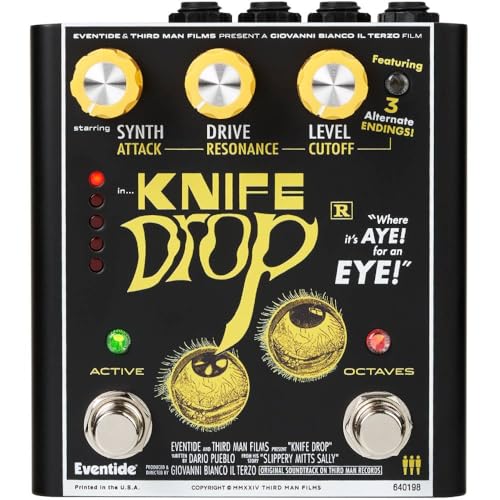
- Octave Guitar Pedal with Level
- Multimode LED Switches
Choosing the Right Electric Guitar Pitch & Octave Effects: A Detailed Buyer’s Guide
An Electric Guitar Pitch & Octave Effects pedal is more than just an item; it’s a key solution for players looking to expand their instrument’s frequency range and tonal identity. Whether you are looking to thicken a power trio’s sound or create otherworldly textures that sound more like a Moog than a Stratocaster, these pedals are the gateway to sonic expansion. The right pitch effect can turn a standard six-string into a bass-heavy monster or a shimmering 12-string simulation, providing versatility that standard EQ or gain pedals simply cannot match.
The ideal customer for this type of product is someone facing the limitations of traditional genres—think shoegaze, industrial, or experimental rock players who need reliable tracking and bold characters. It’s perfect for the “power duo” guitarist who needs to fill the sonic space of a missing bassist. Conversely, it might not be suitable for those who prefer the subtle, transparent “always-on” drive sounds or purists who find digital tracking artifacts distracting. If you are looking for a simple “blues breaker” style tone, you might consider a dedicated analog overdrive instead.
Before investing, consider these crucial points in detail:
- Dimensions & Space: Pedalboard real estate is precious. You should look for a pedal that offers a balance between a small footprint and accessible controls. The Eventide Knife Drop Suboctave Fuzz Synth Pedal manages this well, but always ensure your power supply can handle the 200mA draw alongside your other effects.
- Capacity/Performance: In the world of pitch shifting, tracking is king. You need to decide if you require polyphonic tracking (playing chords) or monophonic tracking (single notes). Monophonic synths often provide a more “glitchy” and authentic vintage synth feel, which is a hallmark of the Eventide Knife Drop Suboctave Fuzz Synth Pedal.
- Materials & Durability: Since these units are literally designed to be stepped on, the housing must be robust. Look for metal enclosures and high-quality switches. A 2-year warranty, like the one offered here, is a strong indicator of a manufacturer’s confidence in their hardware’s longevity.
- Ease of Use & Maintenance: Some pedals are “plug and play,” while others require deep diving into software. Consider whether you prefer physical knobs for every parameter or if you are comfortable using MIDI and external software to unlock secondary features.
While the Eventide Knife Drop Suboctave Fuzz Synth Pedal is an excellent choice, it’s always wise to see how it stacks up against the competition. For a broader look at all the top models, we highly recommend checking out our complete, in-depth guide:

- [Octave/Pitch shifter Pedal] With 7 shift types and 3 tone mode toggles, Harmonic Square guitar pedal gives you 21 options of semitonal, octave and detune sounds

- Industry-Standard Octave Pedal: The updated version features enhanced capabilities for modern guitarists


- Three shift modes: up, down or dual
First Impressions: Unboxing the Eventide Knife Drop Suboctave Fuzz Synth Pedal
When I first pulled the Eventide Knife Drop Suboctave Fuzz Synth Pedal out of its packaging, the first thing that struck me was the aesthetic. It’s sleek, black, and feels incredibly industrial—almost like a piece of gear pulled from a dystopian film set. Weighing in at just under half a kilogram, it feels substantial without being a brick. Comparing it to previous Eventide offerings like the H9, this feels much more focused. While the H9 is a “Swiss Army Knife,” the Knife Drop is a specialized scalpel designed for one thing: aggressive, synth-driven fuzz.
The layout is intuitive at first glance, featuring standard 1/4-inch jacks and a clear LED interface. We found that the initial setup was a breeze—plugging in a 9V power source and hitting that first note instantly revealed the pedal’s aggressive DNA. It doesn’t hide its personality; it’s loud, bold, and ready to disrupt your signal chain in the best way possible. Before you even tweak a knob, you can see its full feature set and user reviews to understand the pedigree of Jack White’s influence on this design.
Key Benefits
- Incredible monophonic synth tracking that feels organic and “alive.”
- Six versatile presets designed in collaboration with Jack White and Third Man Hardware.
- Highly tweakable secondary controls like Attack, Resonance, and Cutoff for synth-shaping.
- Expression pedal and MIDI compatibility for real-time performance control.
Drawbacks
- Accessing secondary functions via software can be fiddly for some users.
- The monophonic nature means it won’t handle complex chords as cleanly as polyphonic pedals.
A Deep Dive into the Eventide Knife Drop Suboctave Fuzz Synth Pedal’s Performance
The Heart of the Beast: Monophonic Synth & Suboctave Tracking
The defining characteristic of the Eventide Knife Drop Suboctave Fuzz Synth Pedal is its monophonic synth engine. When we put this pedal through its paces, we noticed that the tracking is remarkably fast for a monophonic circuit. Unlike older analog octavers that tend to “burp” or glitch out when you play too fast, the Knife Drop holds onto the note with a tenacious grip. It provides a suboctave that is thick, chocolatey, and incredibly percussive. We found that it excels when playing lead lines or heavy, single-note riffs, creating a wall of sound that feels like a bass guitar and a synth are doubling your every move.
In our testing, the “Sub” and “Octave” modes offered distinct flavors. The suboctave isn’t just a volume addition; it’s a re-synthesis of your guitar’s signal. This means you get a consistent, powerful low-end that doesn’t get flabby. It’s a feature that really sets it apart from simple pitch shifters. If you’ve ever wanted to turn your Telecaster into a floor-shaking synthesizer, this is the tool. To get a better sense of how this tracking handles different pickups, you might want to check the latest price and availability and see what other lead guitarists are saying about its responsiveness.
Fuzz Architecture and Gain Staging
The fuzz side of the Eventide Knife Drop Suboctave Fuzz Synth Pedal is not an afterthought. It is a ripping, aggressive distortion that feels like it’s on the verge of exploding. We discovered that the interaction between the fuzz and the synth filter is where the magic happens. You aren’t just adding hair to your tone; you are saturating the synth engine. This creates a “velvety” yet “stinging” texture that reminds us of classic industrial records. The level multimode LED switches allow you to quickly jump between different gain intensities, making it versatile for both subtle grit and total sonic annihilation.
One aspect we particularly enjoyed was how the fuzz sustains. It doesn’t just fizzle out; it blooms. When combined with the suboctave, the fuzz creates a massive “doom” tone that would make any stoner-rock fan weep with joy. We found that by rolling back the volume on the guitar, you can slightly clean up the fuzz, but let’s be honest—this pedal was built to be played wide open. For those looking to achieve that specific Third Man Hardware “grit,” the Eventide Knife Drop Suboctave Fuzz Synth Pedal is arguably the most efficient way to get there without a complex multi-pedal setup.
The Filter Section: Attack, Resonance, and Cutoff
If the fuzz is the soul, the filter section is the brain of the Eventide Knife Drop Suboctave Fuzz Synth Pedal. Having control over Attack, Resonance, and Cutoff turns this from a simple stompbox into a legitimate synthesizer. During our deep-dive sessions, we spent hours tweaking the Attack control to create “swell” effects where the note blooms after you hit the string. This is perfect for cinematic soundscapes or adding a brass-like character to your guitar lines. The Cutoff and Resonance knobs behave exactly like they would on an analog synth, allowing you to dial in those “squelchy” filter sweeps that cut through a mix like a hot knife through butter.
We did find that the filter is very sensitive. A small turn of the Resonance knob can take you from a smooth low-pass sound to a self-oscillating scream. This level of control is rare in a pedal of this size. While some users might find the secondary functions (accessed through the PC software) to be a bit of a hurdle, the physical knobs provide enough immediate gratification for most live scenarios. You can read more about the control layout to see if it fits your workflow.
Presets and Performance Utility
The inclusion of six presets, curated by Jack White, is a massive value add. We found that these presets cover a wide ground—from “classic” sub-fuzz to weird, oscillating textures that sound like a malfunctioning computer. Having these at your fingertips is vital for live performance where you don’t have time to crouch down and twist knobs. However, we should note that some users have found switching between multiple sounds “on the fly” to be a bit challenging without an external MIDI controller. If you are a “set it and forget it” player, the presets are a godsend. If you are a “tweaker” who wants to change sounds every four bars, you’ll definitely want to take advantage of the expression pedal input.
We tested the Eventide Knife Drop Suboctave Fuzz Synth Pedal with an external expression pedal and found that it transforms the unit. Mapping the filter cutoff to an expression pedal essentially gives you a “synth-wah” that is far more powerful than any standard wah-pedal. This level of expandability is a hallmark of Eventide’s design philosophy. To see how this pedal integrates with a modern MIDI-controlled board, you can explore the technical specifications here.
What Other Users Are Saying
The consensus among the community is that the Eventide Knife Drop Suboctave Fuzz Synth Pedal is a “quality-first” device with a bit of a learning curve. One user mentioned that while the sounds are “high quality” and the build is “very solid,” they found it difficult to switch between sounds rapidly during a live set. They noted, “You can’t just flip-flop through multiple sounds easily; it requires some intention.” This sentiment is common for pedals that pack this much technology into a small housing.
On the positive side, another user praised it as a “great pedal for guitar and bass,” highlighting its ability to mimic expensive H9 patches at a fraction of the cost. They specifically loved the “nice fuzz tones” and the “harmonies” it produces. While they admitted the PC software for secondary controls can be “fiddly,” they concluded that the sound quality justifies the price tag. We agree with this assessment—it’s a professional-grade tool that rewards those who take the time to master its interface.
Comparing the Eventide Knife Drop Suboctave Fuzz Synth Pedal to Top Alternatives
To help you make the best choice, we’ve compared the Eventide Knife Drop Suboctave Fuzz Synth Pedal to three other heavy hitters in the pitch-shifting world.
1. DigiTech DROP Compact Polyphonic Pitch-Shifter

- Polyphonic drop tune allows you to drop tune from 1 semi-tone to a full octave
- Momentary or latching mode footswitch
The DigiTech DROP is a very different beast. While the Eventide Knife Drop Suboctave Fuzz Synth Pedal focuses on synth-fuzz and monophonic textures, the DigiTech DROP is a polyphonic powerhouse designed primarily for drop-tuning. It allows you to drop your entire guitar’s pitch by semi-tones without touching your tuning pegs. It’s perfect for the metal player who needs to switch from E-standard to Drop B instantly. However, it lacks the fuzz, the filters, and the “synth” character of the Eventide. If you want a utility tool for tuning, get the DigiTech; if you want a creative instrument for sound design, the Eventide is the clear winner.
2. DigiTech Whammy (5th Gen) 2-Mode Pitch-shift Effect

- Classic Whammy Sound
- Chordal Whammyv-01 Pitch Shifting
The DigiTech Whammy is a legend for a reason. Its built-in expression pedal makes it the king of pitch-bending and “dive bomb” effects. Compared to the Eventide Knife Drop Suboctave Fuzz Synth Pedal, the Whammy is much larger and focuses more on smooth pitch shifting rather than synth-fuzz synthesis. The Whammy is polyphonic, meaning you can play chords through it with ease. However, it doesn’t offer the aggressive, built-in fuzz or the deep filter controls that the Eventide provides. Players who want classic pitch shifting will choose the Whammy, while those looking for the Jack White “rip” will gravitate toward the Knife Drop.
3. Donner Octave Guitar Pedal Digital Octave Mini Pitch Shifter
- [Octave/Pitch shifter Pedal] With 7 shift types and 3 tone mode toggles, Harmonic Square guitar pedal gives you 21 options of semitonal, octave and detune sounds
- [3 Tone Modes]: 3 tone modes including Sharp, Flat, and Detune; Sharp: Pitch up; Detune: Adjustable pitch signal shifted by 10 cents; Flat: Pitch down
For those on a strict budget or with a tiny pedalboard, the Donner Octave is a solid entry-level choice. It’s a digital mini-pedal that offers basic octave-up and octave-down effects. It is surprisingly versatile for its size, but it cannot compete with the Eventide Knife Drop Suboctave Fuzz Synth Pedal in terms of sound quality, tracking speed, or features. The Donner is a “flavor” pedal, whereas the Eventide is a professional workstation. If you are just dipping your toes into octave effects, the Donner is fine, but for serious recording or touring, the Eventide is worth the investment. You can compare the value for yourself here.
Final Verdict: Is the Eventide Knife Drop the Right Choice for You?
After extensive testing and comparing the Eventide Knife Drop Suboctave Fuzz Synth Pedal to the market leaders, we have reached a clear conclusion. This pedal is an absolute powerhouse for the modern guitarist who isn’t afraid to get their hands dirty with experimental tones. Its strengths lie in its incredible synth tracking, its curated presets, and its deep, resonant filters. While it has a slight learning curve—particularly regarding its secondary controls and monophonic limitations—the sounds it produces are world-class and unique.
We recommend the Eventide Knife Drop Suboctave Fuzz Synth Pedal to any player who wants to stand out from the crowd. Whether you are chasing the gritty blues-rock of Jack White or the industrial soundscapes of Nine Inch Nails, this pedal provides the tools to get you there in a single, robust box. It’s a high-performance piece of gear that earns its spot on any professional pedalboard. If you’re ready to take your sound to the next level and explore the boundaries of what a guitar can do, we highly suggest you click here to see the best current deals and bring this sonic monster home.
Last update on 2026-09-26 / Affiliate links / Images from Amazon Product Advertising API