
DigiTech Whammy 2-Mode Pitch-shift Effect Review: The Legendary Pitch-Shifter Perfected for the Modern Board
I remember the first time I heard the solo in “Killing in the Name” by Rage Against the Machine. That soaring, almost alien-sounding pitch shift sent chills down my spine. Like many guitarists, I immediately went on a quest to figure out how Tom Morello achieved those otherworldly squeals. The answer, of course, was the red box. However, the problem many of us face isn’t just about recreating iconic sounds; it’s about the practical limitations of the guitar itself. Carrying three different guitars to a gig just to handle different tunings is a logistical nightmare. Tuning down a half-step mid-set kills the momentum and risks throwing your intonation out of whack. We search for a solution like the DigiTech Whammy 2-Mode Pitch-shift Effect because we need a tool that expands our sonic palette while simplifying our lives on stage. Without a high-quality pitch shifter, you’re either stuck in one tuning or stuck with digital artifacts that make your chords sound like a muddy mess.

- Classic Whammy Sound
- Chordal Whammyv-01 Pitch Shifting
What to Consider Before Buying Electric Guitar Pitch & Octave Effects
An Electric Guitar Pitch & Octave Effect is more than just a novelty item; it’s a key solution for creative expansion and practical utility. For the modern player, these pedals act as “digital capos” and orchestral simulators. They allow a single instrument to transform into a bass, a 12-string, or a synth-like lead machine. The main benefit is the ability to break free from the physical constraints of six strings and standard scale lengths. Whether you are looking to add a subtle sub-octave for a blues riff or a two-octave jump for a dramatic solo, the right pedal provides the stability and “tracking” necessary to keep your performance professional.
The ideal customer for this type of product is the versatile session player, the experimental rocker, or the gigging musician who needs to cover multiple tunings without switching instruments. It’s also perfect for solo performers who want to “loop” a bassline using an octave-down setting. Conversely, it might not be suitable for the absolute purist who refuses any digital processing in their signal chain, or those who only play traditional genres where pitch manipulation would be seen as a distraction rather than an enhancement. If you only need a simple “drop tune” without the expression pedal movement, you might find a dedicated drop pedal more space-efficient.
Before investing, consider these crucial points in detail:
- Dimensions & Space: Pitch pedals, especially those with built-in expression treadles, tend to be larger than your average overdrive. You need to evaluate your pedalboard real estate carefully. A pedal that is too large might force you to remove two other essential effects, so check if the footprint matches your current setup.
- Capacity/Performance (Tracking): This is the “make or break” metric for pitch effects. You should look for “polyphonic” capabilities, which means the pedal can process entire chords without the notes “warbling” or glitching. Monophonic pedals are great for single-note leads but fail when you strum a G-major chord.
- Materials & Durability: Since these pedals often feature an expression treadle that you’ll be stepping on repeatedly, the chassis must be rugged. All-metal construction is the gold standard. Look for a heavy-duty pivot point on the pedal to ensure it won’t become loose or “squeaky” after a few months of heavy touring.
- Ease of Use & Maintenance: While many digital pedals have deep menus, a performance tool should be intuitive. You want a clear interface that allows you to switch modes quickly between songs. Additionally, consider the power requirements; many high-end pitch shifters require high milliamps (mA), which might necessitate a dedicated power supply rather than a simple daisy chain.
While the DigiTech Whammy 2-Mode Pitch-shift Effect is an excellent choice for those seeking the industry standard, it’s always wise to see how it stacks up against the competition. For a broader look at all the top models, especially if you’re a low-end enthusiast, we highly recommend checking out our complete, in-depth guide:

- [Octave/Pitch shifter Pedal] With 7 shift types and 3 tone mode toggles, Harmonic Square guitar pedal gives you 21 options of semitonal, octave and detune sounds

- Industry-Standard Octave Pedal: The updated version features enhanced capabilities for modern guitarists


- Three shift modes: up, down or dual
First Impressions: Unboxing the DigiTech Whammy 2-Mode Pitch-shift Effect
When I first pulled the DigiTech Whammy 2-Mode Pitch-shift Effect out of its packaging, the weight was the first thing that struck me. At 3.6 pounds, it feels like a tank. It’s significantly more substantial than the previous 4th generation, and that extra heft translates to stability on the floor. The classic red finish is iconic, but the 5th generation introduces some much-needed modernizations. The most significant update is the “Classic/Chords” toggle switch. This small addition completely changes the game, allowing you to choose between the vintage, slightly “glitchy” Whammy sound of the 90s and a smooth, polyphonic shift that handles complex chords with ease. Before you plug it in, you can see its full feature set and user reviews to understand just how much technology is packed into this chassis.
Setting it up was a breeze. Unlike some older versions that required specific AC power, this one runs on a standard 9V DC power source (included), making it much friendlier for modern isolated power supplies. The treadle action felt incredibly smooth right out of the box—not too loose that it flops around, but not so stiff that you have to fight it for a subtle vibrato. Comparing it to earlier versions, the inclusion of True Bypass is a massive win; your dry signal remains pure when the effect is off, solving the “tone-sucking” complaints of the past.
Key Benefits
- Superior polyphonic tracking that handles full chords without glitching.
- True Bypass switching ensures no signal degradation when the pedal is inactive.
- Incredibly rugged all-metal construction built for professional touring.
- Versatile 2-mode operation (Classic vs. Chords) for both vintage and modern sounds.
Drawbacks
- Larger footprint than modern “mini” pedals, requiring significant board space.
- High power draw (300mA) requires a robust power supply.
Deep Dive: Performing with the DigiTech Whammy 2-Mode Pitch-shift Effect
The Dual-Mode Logic: Classic vs. Chords
The standout feature we evaluated was the toggle between “Classic” and “Chords” modes. In “Classic” mode, you get the monophonic tracking that defined the sound of the 1990s. When you try to play more than one note, the pedal “hunts” for the pitch, creating a charming, rhythmic warble that artists like Jack White have turned into an art form. It’s evocative, nostalgic, and perfect for single-note lead lines where you want that signature “Whammy” character. We found that in this mode, the pedal responds almost instantly to your touch, providing that visceral connection between your foot and the sound.
Switching over to “Chords” mode is where the DigiTech Whammy 2-Mode Pitch-shift Effect truly justifies its spot on a professional board. This is full polyphonic pitch shifting. We tested this by strumming complex jazz chords—major 7ths and suspended 4ths—while sweeping the pedal. The result was stunningly clean. There was no “mush” or digital confusion. It sounded like a studio-grade pitch shifter in real-time. For guitarists who want to drop their tuning by a fourth or fifth to play a specific song without changing guitars, this mode is a lifesaver. As one user noted, “it doesn’t get confused by different notes in chords like other pitch shifters,” and our testing confirmed this. It’s a feature that really sets it apart from the budget alternatives. If you want to dive deeper into how this tracking holds up, you should check the latest price and availability for this polyphonic powerhouse.
Mastering the Treadle: Expression and Response
The heart of any Whammy pedal is the treadle. On the DigiTech Whammy 2-Mode Pitch-shift Effect, the expression pedal is optical rather than using a mechanical potentiometer. This is a massive upgrade for longevity because there are no physical parts to wear out or get “scratchy” over time. During our testing, we found the sweep to be incredibly linear and predictable. Whether we were performing slow, mournful dives or rapid-fire octave jumps, the pedal followed our foot precisely. This is critical for techniques like “fluttering” the pedal to create a vibrato effect.
We also appreciated the improved calibration of the 5th generation. In older models, sometimes the “toe-down” position wouldn’t quite reach the full octave, leaving you slightly flat. With this version, the “up” and “down” positions are rock solid. The physical resistance of the treadle is just right—it stays where you leave it if you want to use it for a “parked” pitch shift, but it’s smooth enough for dynamic performance. This level of control is why the Whammy remains the “top dog” in the industry; it gives the player a level of expressive nuance that a simple button-press pedal cannot match. To see this treadle in action and read more about its mechanical reliability, you can explore the technical specifications here.
The Harmonic Palette: Detune and Harmony Modes
Beyond the headline “Whammy” effects, we spent considerable time exploring the right side of the dial: the Harmony and Detune settings. The Detune section is often overlooked, but it is one of our favorite features. It offers two settings—Shallow and Deep. This acts as a high-fidelity chorus but without the “warble” of an LFO. It creates a lush, doubled sound that makes a single guitar sound massive. In a recording environment, the “Deep” detune mode provides a thickness that rivals expensive rack processors from the 80s.
The Harmony modes are equally impressive. You have 9 different harmony settings, ranging from seconds and thirds to octaves. While one user mentioned it’s “not the best for harmonizing modal melodies” (as it is a chromatic shifter, not an intelligent “key-sensing” harmonizer), we found it incredibly useful for creating “thick” riffs. If you set it to a 5th down, you can play single-note lines that sound like power chords. This versatility makes the DigiTech Whammy 2-Mode Pitch-shift Effect more than just a “squeal box”; it’s a comprehensive sound design tool. For a detailed breakdown of all 21 settings, head over to the product page and look at the control layout.
Build Quality and Professional Integration
Finally, we must discuss the professional-grade build and connectivity. The DigiTech Whammy 2-Mode Pitch-shift Effect includes a MIDI input, which is a feature often ignored by casual players but loved by professionals. MIDI allows you to control the pitch shifts and mode changes via an external controller or a DAW. If you’re performing to a click track and want your pitch shifts to happen automatically at specific moments in the song, this pedal can do that. This level of integration is rare in the pedal world.
The true bypass switching is the “cherry on top.” We tested the signal chain with the pedal in and out of the loop, and the transparency is excellent. Previous generations were known for a slight “dullness” when bypassed, but the Gen 5 remains crystal clear. The 6-year warranty (parts and labor) offered by DigiTech is a testament to their confidence in this product’s durability. It’s built to be used and abused on the road. For anyone serious about their gear, the durability and warranty details are a significant part of the value proposition here.
What Other Users Are Saying
The general sentiment surrounding the DigiTech Whammy 2-Mode Pitch-shift Effect is overwhelmingly positive, with most users praising its transition to polyphonic shifting. Many guitarists, like myself, have noted that the 5th generation feels like the “definitive” version of the pedal. One touring professional mentioned, “I use the 2-octave settings… it’s such a foreign-sounding guitar effect but super cool.” This highlights the “wow factor” that the Whammy brings to live performances.
However, we always look for a balanced perspective. Some users noted that because it is a digital pedal, the sound can feel “a bit unnatural” in certain settings, especially when pushing the harmony modes to their extremes. This is a common characteristic of all pitch shifters—nature didn’t intend for a guitar to sound two octaves higher—but it’s something to be aware of if you’re seeking a perfectly organic tone. Another common piece of feedback is the size; as one user put it, “it takes up space… but you can’t have everything.” Overall, the consensus is that the benefits of its unmatched features far outweigh the minor inconvenience of its footprint. It remains the industry standard for a reason.
Comparing the DigiTech Whammy 2-Mode Pitch-shift Effect to Top Alternatives
While the Whammy is a legend, it’s not the only way to shift your pitch. Let’s look at how it compares to three other popular options to see which fits your specific needs.
1. DigiTech DROP Compact Polyphonic Pitch-Shifter

- Polyphonic drop tune allows you to drop tune from 1 semi-tone to a full octave
- Momentary or latching mode footswitch
If you love the polyphonic tracking of the Whammy but find the expression pedal too bulky, the DigiTech Drop is the perfect alternative. It essentially takes the “Chords” algorithm from the DigiTech Whammy 2-Mode Pitch-shift Effect and puts it into a compact, single-switch pedal. It’s specifically designed for “drop tuning” your guitar. We recommend this for metal players who need to switch from E-standard to Drop B instantly but don’t need the “sweep” effects or the wild two-octave jumps of the full Whammy. It’s a specialized tool for a specific problem.
2. Donner Octave Guitar Pedal Digital Octave Mini Pitch Shifter
- [Octave/Pitch shifter Pedal] With 7 shift types and 3 tone mode toggles, Harmonic Square guitar pedal gives you 21 options of semitonal, octave and detune sounds
- [3 Tone Modes]: 3 tone modes including Sharp, Flat, and Detune; Sharp: Pitch up; Detune: Adjustable pitch signal shifted by 10 cents; Flat: Pitch down
For those on a strict budget or with a very crowded pedalboard, this Donner mini pedal offers a basic pitch-shifting experience. It features 7 different shift types and is remarkably small. While it cannot compete with the DigiTech Whammy 2-Mode Pitch-shift Effect in terms of tracking speed or “treadle” expression, it’s a solid entry-level choice for adding simple harmonies. We found that it struggles more with complex chords (tracking jitter), but for single-note “sub-octave” riffs, it’s surprisingly capable for the price. It’s best for hobbyists who want to experiment with the effect without a large investment.
3. Behringer ULTRA OCTAVER UO300 3-Mode Octave Effects Pedal
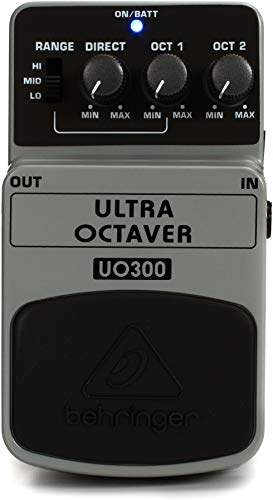
- Create a monster sound by adding 2 additional tones using your guitar—1 and 2 octaves below the original tone
- Dedicated volume controls for all 3 tones for awesome sound shaping
The Behringer UO300 is an ultra-affordable option that focuses purely on octave-down effects. Unlike the Whammy, which uses digital DSP for varied pitch shifting, the Behringer is an analog-style sub-octave generator. It creates a very “fat” sound but is strictly monophonic—if you play more than one note, it will glitch significantly. We suggest this for guitarists who want to emulate that “OC-2” synth-bass sound on a budget. However, it lacks the expression control, polyphony, and high-octave capabilities that make the DigiTech so famous. It’s a “one-trick pony,” but it does that trick for very little money.
The Final Verdict: Is the DigiTech Whammy 5th Gen Right for You?
After hours of testing and comparing, we can confidently say that the DigiTech Whammy 2-Mode Pitch-shift Effect remains the gold standard for a reason. It bridges the gap between vintage character and modern precision more effectively than any other pedal on the market. The addition of the “Chords” mode was the final piece of the puzzle, making it a viable tool for serious session work and live performance where tuning accuracy is paramount. While it requires a bit of space on your board and a decent power supply, the sonic possibilities it opens up are virtually endless.
Whether you want to channel your inner Tom Morello, simplify your rig by eliminating multiple guitars, or create lush, detuned textures, this pedal delivers. It is a professional-grade instrument that is built to last a lifetime. If you are ready to transform your sound and join the ranks of the world’s most innovative guitarists, we highly recommend that you pick up the DigiTech Whammy 2-Mode Pitch-shift Effect today and start exploring the edges of what your guitar can do.
Last update on 2026-09-26 / Affiliate links / Images from Amazon Product Advertising API