
Behringer CS400 Ultimate Compressor Pedal Review: The Giant-Killer That Rewrites the Budget Playbook
We’ve all been there: you’re playing a gig or recording a track, and your tone just feels… thin. Your lead lines disappear into the mix the moment you stop digging in, and your rhythmic strumming is a chaotic mess of volume spikes that makes your sound engineer give you the “stink eye.” For years, I struggled with this inconsistency, chasing a professional, “polished” sound that seemed reserved for those with thousand-dollar racks. The missing link is often dynamic control—specifically, a high-quality compressor. But when top-tier boutique pedals cost more than some entry-level guitars, many of us hesitate. That’s where the Behringer CS400 Ultimate Compressor Pedal enters the conversation, promising professional-grade sustain and leveling at a price point that seems almost too good to be true. In this Behringer CS400 Ultimate Compressor Pedal Review, I’m going to share our hands-on experience to see if this plastic powerhouse can truly compete with the industry legends.
An Electric Guitar Compression Effects unit is more than just an item; it’s a key solution for the inherent “wildness” of an electric instrument. In the world of signal processing, a compressor acts like an invisible hand on your volume knob. It “squashes” the loudest peaks and boosts the quietest whispers, creating a uniform, professional signal that sits perfectly in a mix. Without it, your notes die out prematurely, and your clean tones lack that “chime” and “snap” that defines genres from country to funk to modern pop. When you don’t solve these dynamic issues, your playing can sound amateurish and disconnected, regardless of how fast your fingers move or how expensive your amplifier is.
The ideal customer for this type of product is someone facing inconsistent volume levels or a lack of sustain during solos, while it might not be suitable for those who strictly play high-gain metal where the amp’s natural saturation already provides heavy compression. If you are a bedroom recorder, a worship leader, or a gigging musician on a budget, this category of pedal is your secret weapon. For those who demand a metal chassis for heavy touring, you might consider more expensive alternatives, but for most applications, the performance of the Behringer CS400 Ultimate Compressor Pedal offers a compelling argument against spending four times as much elsewhere. You can see its full feature set and user reviews to understand why it has become a staple on so many boards.
Before investing, consider these crucial points in detail:
- Dimensions & Space: In the world of pedalboards, real estate is premium. You want a pedal that provides a standard footprint without being so bulky it forces you to buy a larger board. The Behringer CS400 fits the standard “stompbox” dimensions, making it easy to swap in and out of most setups.
- Capacity/Performance: Look for a pedal that offers at least four controls: Level, Tone, Attack, and Sustain. This level of granularity allows you to move from a subtle “always-on” sweetener to a heavy “squished” sound used in 80s pop or country chicken-pickin’.
- Materials & Durability: While metal is the gold standard for road-worthiness, modern high-impact ABS plastic can be surprisingly resilient. Consider whether your pedal will be “always-on” (requiring less stomping) or if it’s a tool you’ll be engaging frequently during high-energy performances.
- Ease of Use & Maintenance: A good compressor should be intuitive. You want knobs that have a smooth travel and clear indicators. Additionally, consider how easy it is to power the unit; compatibility with standard 9V center-negative power supplies is a must for any modern rig.
While the Behringer CS400 Ultimate Compressor Pedal is an excellent choice, it’s always wise to see how it stacks up against the competition. For a broader look at all the top models, we highly recommend checking out our complete, in-depth guide:

- Get super-smooth compression and endless sustain
- This BEHRINGER product has been designed to compete head to head with leading products on the market

First Impressions and Unboxing the Behringer CS400 Ultimate Compressor Pedal
When we first pulled the Behringer CS400 Ultimate Compressor Pedal out of its box, the immediate talking point was the housing. It’s finished in a vibrant, “classic compressor green” that clearly pays homage to the legendary Boss CS-3. While it’s made of ABS plastic rather than die-cast metal, the weight of 11.2 ounces gives it a solid, non-toy-like feel in the hand. The knobs are well-spaced and offer a nice resistance, which is vital for making those minute adjustments to your attack and sustain curves. Before plugging it in, we were curious about the blue status LED, which is a nice touch—bright enough to see on a sunny outdoor stage but not blinding.
Setting it up was a breeze. We connected it to a standard 9V power brick, and the 1/4-inch jacks felt secure. One thing we noticed right away is that this pedal is designed for players who want to shape their dynamics without a steep learning curve. It doesn’t try to reinvent the wheel; it provides the four essential controls you need to get the job done. For those looking for a plug-and-play solution that looks great on a board, you can check the latest price and availability to see just how accessible this entry point is.
Key Benefits
- Incredible value-to-performance ratio, often 1/4 the price of competitors.
- Exceptional sustain that rivals boutique pedals.
- Four-knob interface allows for precise tone and attack shaping.
- Clean, analog signal path that preserves the character of your guitar.
Limitations
- Plastic enclosure may concern heavy-footed touring musicians.
- The battery compartment (located under the footswitch) can be tricky to access.

- Compact Design: Compression/Sustainer pedal with high-quality circuitry in a compact form factor
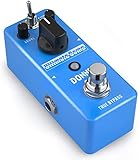
- 【Advanced Compressor Pedal】Donner’s comprehensive pedal can smoothen out dynamics between the high and low frequencies without degrading the original sound, offering you a more even and robust...

- 【Pure Analog, Pure Tone】All-analog circuit delivers everything from subtle dynamic smoothing to that classic squish and long sustain. Whatever clean country picking and thick blues leads, this...
A Deep Dive into the Performance of the Behringer CS400 Ultimate Compressor Pedal
The Magic of the Sustain Control
In our testing, the “Sustainer” part of the name isn’t just marketing fluff. When we cranked the Sustain knob on the Behringer CS400 Ultimate Compressor Pedal, notes that usually died out in three or four seconds held on for double that time. This is achieved through a high-quality analog circuit that boosts the tail end of your signal as it naturally decays. We found this particularly useful for “Gilmour-esque” solos where you want those long, soaring bends to hang in the air without needing a high-gain distortion pedal to do the heavy lifting.
One user review we encountered mentioned using this pedal specifically for recording, and we have to agree. In a studio setting, where the pedal isn’t being kicked around, the transparency of the sustain is a real gem. It adds a “weight” to the notes that makes even a budget S-style guitar sound like a premium instrument. By smoothing out the decay, the CS400 allows you to convey more emotion in your music, as you’re no longer fighting your gear to keep the sound alive. It truly provides a feature that really sets it apart from other pedals in this price bracket.
Tone Shaping and High-Frequency Clarity
Many budget compressors have a bad habit of “darkening” your tone, making it sound like someone threw a heavy blanket over your amp. During our evaluation of the Behringer CS400 Ultimate Compressor Pedal, we were pleasantly surprised by the effectiveness of the Tone knob. This control is specifically designed to add back the “jangle” and “shimmer” that can sometimes be lost during heavy compression. We found that setting the Tone knob to around 2 o’clock brought back the high-end sparkle that is essential for funk rhythms and country lead lines.
We tested this with both single-coil and humbucker-equipped guitars. With a Stratocaster, the CS400 accentuated the “quack” in the 2 and 4 positions beautifully. With a Les Paul, it helped tighten up the low-end mud, giving the neck pickup more definition. This versatility is a hallmark of the CS400’s design. It doesn’t just squash the sound; it enhances the existing character of your instrument. For players who are meticulous about their “sparkle,” we found the tone circuit to be remarkably musical and low-noise for an analog device.
Attack Control: From Subtle Leveling to Percussive Snap
The Attack knob is often the most misunderstood control on a compressor, but on the Behringer CS400 Ultimate Compressor Pedal, its impact is clear and tactile. The Attack control determines how quickly the compressor reacts to your initial pick strike. We found that turning the Attack up (clockwise) allows more of the initial “thump” of the pick to pass through before the compression kicks in. This creates that percussive, “poppy” sound famous in Nashville-style playing.
Conversely, turning the Attack down provides a very smooth, studio-like feel where the volume is leveled almost instantly. This is perfect for tapping techniques or for smoothing out uneven fingerstyle playing. Our experience showed that the CS400 has enough range in the Attack knob to satisfy both the subtle player and the one looking for a highly stylized “squish.” Supporting this, several users have noted how easy it is to dial in a “classic squished sound” that matches single-coil pickups perfectly. If you want to see how this control works in real-world settings, you should see its full feature set and user reviews.
Build Quality and The Plastic Enclosure Debate
We cannot write a Behringer CS400 Ultimate Compressor Pedal Review without addressing the elephant in the room: the plastic casing. In our time with the pedal, we intentionally gave it some “rough love” to see how it would hold up. The ABS plastic used here is high-impact and surprisingly thick. While we wouldn’t recommend driving a truck over it, for the average player, it is more than adequate. We found that the rubber padding on the bottom keeps it from sliding around on the floor, and the footswitch has a satisfying, albeit silent, engagement.
As one professional user with 40 years of experience pointed out, if the pedal is “always on”—which is how many guitarists use a compressor—the housing material becomes almost irrelevant. You set your levels, tuck it away on your board, and let it do its job. For recording enthusiasts, the plastic housing is a non-issue entirely. The internal circuitry is what matters, and the analog signal format here is top-notch. It’s a trade-off that allows Behringer to offer this level of sonic performance at a fraction of the cost of boutique brands. To get a better sense of its physical footprint, you can check its dimensions and weight here.
What Other Users Are Saying
The general sentiment surrounding the Behringer CS400 Ultimate Compressor Pedal is overwhelmingly positive, with a focus on its incredible value. Many users confirm our findings that it is a faithful clone of more expensive industry standards. One veteran musician mentioned, “I’ve been playing professionally for over 40 years… Wow! It sounded so amazing I ordered another one.” This sentiment is common; once people get past the “plastic” stigma, they realize the sound quality is undeniable. Another user highlighted its utility in the studio, calling it a “real gem” for recording purposes due to its outstanding sustain and friendly price point.
However, no product is perfect, and transparency is key. A common minor complaint involves the battery compartment. As one reviewer noted, replacing the 9V battery can be a bit of a “puzzle” because you have to depress the hinge pins of the footswitch. Most users, including ourselves, recommend using a dedicated 9V power adapter to avoid this hassle altogether. Additionally, a few users mentioned that at extreme Sustain settings, the noise floor can rise. As one expert user correctly pointed out, “You add noise to your chain with ANY compressor because they elevate quiet signals.” This isn’t a flaw of the CS400 specifically, but rather a characteristic of compression itself. For the price of a couple of pizzas, most users agree that the minor inconveniences are well worth the trade-off for such professional tone.
How the Behringer CS400 Compares to Its Top 3 Alternatives
While we love the CS400, it’s important to see how it fits into the wider market of Electric Guitar Compression Effects. Here is how it compares to three other popular options.
1. Keeley Compressor Plus Pedal
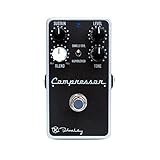
- The first true advancement in our 2 and 4 knob compressor line. The new features are simple and straight forward
- There is a simple Release Switch that is tuned for single coils or humbuckers. No more wondering if you have the attack or release set right
The Keeley Compressor Plus is widely considered the gold standard of stompbox compressors. Unlike the Behringer CS400 Ultimate Compressor Pedal, the Keeley features a rugged metal enclosure and a “Blend” knob, which allows you to mix your dry signal with the compressed signal. This is a “boutique” feature that provides even more transparency. However, the Keeley is significantly more expensive. If you are a touring professional who needs the absolute best and a metal chassis, the Keeley is the winner. But for the average player, the CS400 provides 90% of the tone for 25% of the price. You can compare the CS400 features here to see if you really need the extra bells and whistles.
2. JOYO JF-10 Dyna Compressor Pedal for Electric Guitar & Bass
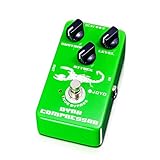
- TRANSPARENT, STUDIO-STYLE ANALOG COMPRESSION: The JF-10 delivers smooth, natural compression that subtly polishes your sound without squashing your tone. Players describe it as "very transparent" and...
- 3-KNOB CONTROL – SUSTAIN, ATTACK & LEVEL: Sustain adjusts compression amount, Attack controls how quickly it engages, and Level compensates output volume. The Attack knob is especially useful for...
The JOYO JF-10 is another strong budget contender. It features an aluminum alloy casing, which some players prefer over the Behringer’s plastic. It is based on the classic Ross Compressor circuit, which has a slightly different “flavor” than the Boss-style circuit of the CS400. The JOYO is simpler, with only three knobs (Sustain, Level, Attack), lacking the dedicated Tone control found on the CS400. If you have a naturally bright amp and don’t need a Tone knob, the JOYO is a solid, durable alternative. However, we found the Behringer’s Tone control to be a vital tool for preventing a “muddy” sound, giving the CS400 the edge in versatility.
3. Rowin Compressor Effect Pedal for Guitar

- 【PURE ANALOG COMPRESSOR EFFECTS】Based on classic studio grade compressor, produces a smooth, sustained sound for clean tone or soaring leads
- 【3 FUNCTION KNOB】Level ,Comp,Tone knobs allow you to dial in your desired sound.【2 MODES】Normal and Treble.
The Rowin Compressor is all about size. It is a “mini” pedal, meaning it takes up half the space of the Behringer CS400 Ultimate Compressor Pedal. It also features a zinc alloy shell and a “Normal/Treble” toggle switch. While the small size is great for cramped pedalboards, the tiny knobs can be difficult to adjust mid-gig. Furthermore, it lacks the deep “Sustainer” capabilities of the CS400. We recommend the Rowin for players who just need a tiny bit of leveling on a crowded board, but for those who want that “endless sustain” and granular control, the Behringer CS400 remains the superior choice for tone shaping.
The Final Verdict: Is the Behringer CS400 Ultimate Compressor Pedal Right for You?
After putting the Behringer CS400 Ultimate Compressor Pedal through its paces in both practice and recording environments, our conclusion is clear: this is arguably the best “bang-for-your-buck” pedal in the world of dynamics. It delivers on its promise of super-smooth compression and endless sustain, all while providing the necessary controls to keep your tone bright and articulate. While the plastic housing might be a deterrent for some, its performance in the studio and on “always-on” pedalboards is indistinguishable from pedals costing four times as much. It bridges the gap between amateur and professional sound without requiring a professional’s budget.
If you are looking to level out your volume, add some “pop” to your rhythms, or make your solos sing for days, this pedal is a no-brainer. Don’t let the price tag fool you; the CS400 is a serious tool for serious musicians. Whether you’re a beginner looking for your first effect or a veteran wanting to fill a gap in your rig, this pedal will not disappoint. We highly recommend you check the latest price and grab one for yourself to see how it can transform your playing today.
Last update on 2026-09-26 / Affiliate links / Images from Amazon Product Advertising API