
Diitao Voice Playback Module Board Review: Powerful 5W Audio and Unmatched Trigger Versatility
If you have ever spent hours building a custom cosplay helmet, a vintage mini jukebox, or an interactive museum exhibit, you know the exact frustration of trying to give your project a voice. For years, embedded audio required a frustrating web of separate microcontrollers, external digital-to-analog converters (DACs), bulky pre-amps, and delicate speaker drivers. Nothing breaks the immersion of a beautifully crafted prop faster than tinny, quiet sound that stutters or requires an external speaker system tacked onto the side. When we began looking for an all-in-one hardware solution capable of pushing room-filling sound directly to a speaker without extra amplifier boards, we decided to thoroughly test the Diitao Voice Playback Module Board. In this hands-on evaluation, we put its integrated amplifier, versatile trigger interfaces, and serial control features to the test to see if it lives up to the hype for DIY electronics makers.
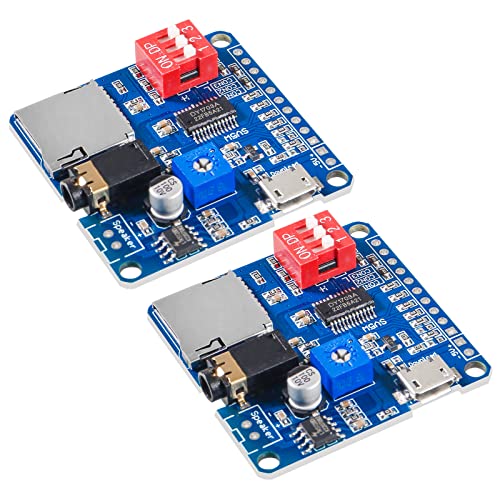
- DY - SV5W voice playback module, support MP3, WAV decoder formats, support for sampling rate (KHz) : 8/11.025/12/16/22 05/24/32/44.1/48.
- Function:The serial adapter has functions of controlling playback, pause, music selection, volume increase or decrease, etc.
What to Consider Before Buying an Embedded Sound Module
A Sound Modules is more than just an item; it’s a key solution for giving physical hardware an interactive voice, bringing static props, industrial warning systems, custom toys, and arcade builds to life. Rather than forcing you to write complex low-level audio decoding code on a primary microcontroller, a dedicated sound board handles the heavy lifting of MP3 and WAV decompression, storage management, and signal amplification in a localized unit.
The ideal customer for this type of product is someone facing complex physical interaction challenges—such as DIY prop makers, woodworkers, scale modelers, or Arduino developers who need reliable, loud, and instant sound effects triggered by switches, sensors, or serial commands. Conversely, it might not be suitable for those who want an out-of-the-box consumer product with a microphone built-in for quick voice memos, as this module requires basic wiring, component soldering, and file management on a computer.
Before investing, consider these crucial points in detail:
- Dimensions & Space: When embedding sound into tight spaces like armor, handheld props, or small wooden boxes, board footprint matters. You must evaluate whether the board includes onboard mounting holes and if the connector layout allows for clean cable routing.
- Capacity/Performance: Look closely at how the audio files are stored and decoded. Modules that support removable TF/MicroSD cards formatted in FAT32 offer vastly superior track capacity (thousands of files) compared to boards restricted to tiny onboard flash memory. Additionally, check the amplifier wattage—an onboard 5W Class D amp provides significantly more punch than standard 0.5W onboard audio chips.
- Materials & Durability: Circuit board construction, solid solder pads, robust terminal blocks, and dependable DIP switches are vital. A flimsy PCB with weak pin headers will fail under thermal stress or repeated installation inside moving props.
- Ease of Use & Maintenance: Consider how you upload new sounds. A module that permits direct computer connection via Micro-USB to drag and drop MP3 files saves immense time compared to boards that require dedicated SPI programmers or constant removal of microscopic memory cards.
Before buying any module, you should weigh whether your project needs standalone push-button operation or advanced microcontroller logic via UART serial control. To make sure you select the perfect hardware for your specific build, check the latest price and availability for this dual-pack board to see how its feature set matches your budget.
While the Diitao Voice Playback Module Board is an excellent choice, it’s always wise to see how it stacks up against the competition. For a broader look at all the top models, we highly recommend checking out our complete, in-depth guide:

- 8M MEMORY CAPACITY: Features 8 megabytes of storage space allowing you to record up to 10 minutes of personalized audio messages, music, or voice greetings for your DIY projects

- 16-Minute Recording Module :This 16-minute recording sound module is nice for personalizing greeting cards, music boxes, or other creative presents. Embed it in a greeting card to bring your wishes...
- 【DIY Greeting Card】DIY light sensor sound module is equipped with a 0.5W speaker and a 3.7V battery. The sound module is an ideal choice for mother's day and father's day DIY recordable greeting...
First Impressions and Unboxing the Diitao Voice Playback Module Board
Upon unboxing the package, we were immediately impressed by the fact that you receive two complete DY-SV5W units in a single set. Each board comes packed in anti-static shielding, revealing a clean, dark blue PCB layout with clearly labeled silk-screened pinouts on both sides. Measuring compactly, the board manages to squeeze an impressive array of hardware onto its surface: a MicroSD slot, a Micro-USB port for direct PC connectivity, robust DIP switches for selecting operational modes, and clear pin rows for all 8 I/O lines, serial TX/RX, and speaker outputs.
Unlike basic voice chips that feel fragile or under-engineered, the physical build quality here feels substantial. The soldered component leads are neatly trimmed, and the board features integrated mounting holes that make securing it inside an enclosure straightforward. Comparing it to older MP3 modules like the legacy DFPlayer Mini, the presence of an integrated 5W amplifier and dedicated hardware DIP switches instantly signals that this module is built for higher output and far greater operational flexibility. You can see its full feature set and hardware specifications to inspect the component layout in detail.
Advantages
- Powerful onboard 5W Class D amplifier drives 4Ω speakers directly with crisp volume
- Supports up to 32GB MicroSD cards formatted in FAT16/FAT32 for vast audio libraries
- 7 distinct hardware operating modes configured via simple onboard DIP switches
- Direct USB file updating allows simple drag-and-drop audio transfers without card readers
Limitations
- Documentation and spec sheet can be confusing for absolute hardware beginners
- Requires a hard reset/power cycle every time DIP switch modes are modified
In-Depth Performance Analysis: Stress Testing the Diitao Voice Playback Module Board
Audio Output and Onboard Class D Amplifier Performance
The standout feature during our real-world testing of the Diitao Voice Playback Module Board was undeniably its integrated 5W Class D power amplifier. Most compact audio trigger boards rely on low-power DAC outputs that output line-level signals, forcing you to solder an auxiliary amplifier board into your circuit just to hear sound across a room. This board completely eliminates that requirement. We wired the speaker terminals directly to a 2-inch, 4-ohm driver installed inside a custom enclosure. The acoustic power produced by this tiny PCB is remarkable—reaching high volume levels without the harsh distortion or clipping typical of unamplified sound chips.
Underneath the hood, the module utilizes a 24-bit DAC paired with an impressive 90dB dynamic range and an 85dB signal-to-noise ratio. What this translates to in practical use is crystal-clear voice lines, punchy sound effects, and clean background music playback. Higher sampling rates (from 8kHz up to 48kHz WAV and MP3 files) are decoded flawlessly. When testing sound effects featuring deep low-end rumbles alongside high-frequency synth chirps, the Diitao Voice Playback Module Board maintained clear separation across the frequency spectrum. You can explore current user ratings and setup reviews to read more about how this amplifier performs in physical prop builds.
Trigger Interface Options and Multi-Mode Flexibility
One of the most impressive aspects of the Diitao Voice Playback Module Board is its versatility in taking control inputs. The module features 8 independent I/O pins (IO0 through IO7) that can be configured into 7 distinct working modes using the 3-position onboard DIP switches. In its simplest configuration—Standard I/O Trigger mode—each pin directly corresponds to one of 8 audio files. Grounding pin IO0 triggers the first track, IO1 triggers the second, and so on. This makes it trivially simple to build physical props with up to 8 distinct push buttons without writing a single line of software code.
However, for advanced creators needing to play a wider variety of sounds, the module supports binary combination triggering across those same 8 I/O lines. By utilizing binary matrix logic, you can trigger up to 255 unique tracks using combinations of low states on the input pins. In addition, the board supports a “One-Line” single-bus mode as well as full 9600 baud UART serial control. During our testing with an external microcontroller, sending serial commands to trigger specific track numbers, adjust volume levels, or set equalizer modes was responsive and accurate. It is a feature that really sets it apart from standard modules that only allow basic play/pause button actions.
Storage Architecture, File Naming, and Micro-USB Management
Managing audio files on the Diitao Voice Playback Module Board is wonderfully straightforward thanks to its dual storage capability and direct computer interface. The module houses a MicroSD (TF card) slot capable of reading cards up to 32GB formatted in FAT16 or FAT32. This provides enough room to hold up to 65,535 audio tracks, making it suitable for ambient background soundscapes, endless voice line banks, or entire album discographies.
Where many budget sound boards fall short is requiring you to physically remove the MicroSD card and plug it into a computer adapter every time you want to add or rename a file. The Diitao Voice Playback Module Board solves this hassle by featuring an onboard Micro-USB port. When you connect the module to a Windows or Mac computer via USB cable, the onboard storage mounts directly as a standard removable flash drive. You can simply drag and drop your MP3 or WAV files right onto the card. Tracks should be named with numerical prefixes (e.g., 0001.mp3, 0002.mp3) to ensure predictable triggering across button modes. The convenience of updating sounds while the module remains permanently wired inside a costume or chassis cannot be overstated.
Programming Nuances, Reset Requirements, and Hardware Considerations
While the hardware capability of the Diitao Voice Playback Module Board is top-tier, navigating its setup requires an understanding of a few key operational quirks. First and foremost, any time you alter the 3-position DIP switches to switch between operating modes (such as moving from standard button mode to UART serial mode), the module must be power-cycled or hard reset. The onboard microprocessor only reads the DIP switch states during its initial power-on sequence. If you flip switches while the board is powered, the new mode will not activate, which frequently leads first-time users to believe the module is malfunctioning.
Secondly, while serial control is powerful, the documentation provided by the manufacturer can be somewhat cryptic regarding command byte structures. In our serial communication tests using a custom microcontroller, sending clear commands required framing bytes properly (such as sending high/low sync pulses for One-Line mode or exact hexadecimal command sequences for 9600 baud UART). Additionally, when utilizing the built-in hardware shuffle mode, we observed a minor quirk: upon powering on, the board consistently starts by playing the first track on the card before initiating a true random shuffle of the remaining files. While not a dealbreaker for most projects, it is an important detail to keep in mind when designing interactive exhibits. If you are ready to tackle your next electronics project, you can grab a pair of these playback boards for your next build.
What Other Users Are Saying
Feedback from the maker and electronics community strongly reinforces our own expert laboratory observations regarding the performance of the Diitao Voice Playback Module Board. Makers consistently praise the onboard 5W Class D amplifier, with one custom jukebox creator highlighting: “I paired it up with a 4 ohm 2″ speaker in a jukebox and it plays every MP3 file I tried on it… the sound quality is very crisp.” Users frequently express delight that the module eliminates the need for extra external sound amplifier boards while driving small speakers at surprising volume levels.
On the technical side, experienced developers noted that while the manufacturer’s datasheet can be confusing at first glance, the board’s flexibility is unmatched once configured correctly. Several reviewers noted that understanding the DIP switch reset requirement was the breakthrough moment in their projects, explaining that the module must be reset after making switch changes for a new mode to become active. Some makers who implemented microcontroller control shared custom code snippets to help others get started with the One-Line single-bus interface. The minor quirk regarding shuffle mode always playing the first song before randomizing was also confirmed by users, though almost all agreed that the combination of crisp audio, direct USB file drag-and-drop, and dual-board value makes it a go-to choice. You can verify current stock and deal options to see what fellow builders are creating with these boards.
Comparing the Diitao Voice Playback Module Board to Top Alternatives
1. EZSound 10 inch Extension Play Button
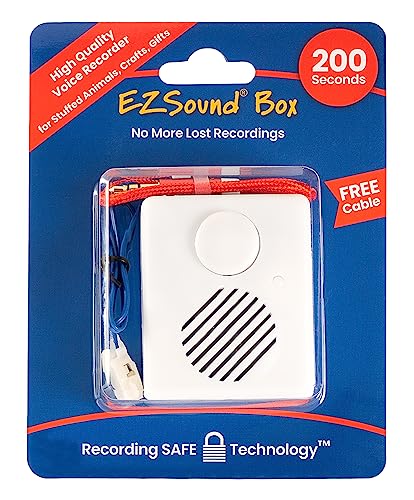
- ✅ [RECORDING SAFE TECHNOLOGY] Whether you are using our sound recorder as teddy bear voice recorder or as sound module for toys or for any other recording purpose, we know that your recordings are...
- Recordable Sound Box is ideal for adding sound effect to plush toys, stuffed animals, interactive school projects, photo frames, personalized gifts, kid activities, paints, hobbies, craft projects...
The EZSound 10 inch Extension Play Button is tailored toward crafters, plush toy makers, and hobbyists who want a simple, recordable audio button without dealing with raw circuit boards, DIP switches, or microcontrollers. Featuring an extended play button cable and a simple audio jack interface for recording up to 200 seconds of audio directly from a phone or computer, it excels in low-complexity craft projects like stuffed animals or memory boxes. However, compared to the Diitao Voice Playback Module Board, the EZSound unit is strictly a single-message, fixed-memory recorder. It lacks an onboard high-power 5W amp, MicroSD expansion, MP3 decoding capabilities, and serial control interfaces, making it unsuitable for complex interactive props or multi-track jukebox builds.
2. Talking Products Personalised Sound Module

- Ideal for creating your own talking gifts, cards and crafts. Perfect for adding sound effects to train sets, models, photo frames and Cosplay Accessories
- Download your own MP3 files via the USB socket. Add speech, music or sound effects
The Talking Products Personalised Sound Module offers a self-contained solution complete with an integrated AAA battery box, push button, and 4MB of onboard flash memory. Designed primarily for greeting cards, personalized gifts, and basic cosplay accessories, it lets users transfer MP3 files directly via USB cable. While it is far easier to deploy out of the box for non-technical users, it is significantly limited compared to the Diitao Voice Playback Module Board. With only 4MB of storage (compared to 32GB TF card support) and a tiny built-in speaker driver, it cannot produce the rich, room-filling audio or provide the 255-track trigger matrix and serial control options that expert makers demand.
3. XLW Voice Recorder Sound Box

- 16-Minute Recording Module :This 16-minute recording sound module is nice for personalizing greeting cards, music boxes, or other creative presents. Embed it in a greeting card to bring your wishes...
- Download and Record and Delete Music :Long press the button for 3 seconds to start recording, and release the button to stop automatically. The maximum recording time is 16 minutes. Can download...
The XLW Voice Recorder Sound Box is a compact, plastic-enclosed voice recording box aimed at plush bears, pillows, and holiday gifts. It features a simple built-in microphone for instant voice recording and battery-powered playback. It is wonderfully user-friendly for parents and kids looking to leave quick custom messages inside customized presents. However, for technical DIY builds, arcade cabinets, or prop making, it cannot compete with the Diitao Voice Playback Module Board. The XLW recorder lacks standard audio file loading from a PC, high-fidelity MP3/WAV decoding, multi-pin button triggering, external speaker drive capacity, and programmable microcontroller integration.
Final Verdict: Is the Diitao Voice Playback Module Board Worth It?
The Diitao Voice Playback Module Board is an exceptional, highly capable hardware tool that bridges the gap between simple audio push-buttons and complex, expensive audio decoding systems. By combining a clear 24-bit DAC, support for up to 32GB MicroSD cards, direct computer USB file updating, and a surprisingly loud onboard 5W Class D amplifier into a dual-pack bundle, it delivers unmatched value for DIY builders. While absolute beginners may experience a short learning curve when deciphering the DIP switch modes and reset requirements, its ability to execute everything from direct 8-button sound activation to full 255-track UART serial control makes it an indispensable component for any workshop.
Whether you are outfitting a cosplay costume with dynamic voice lines, building a custom mini jukebox, or engineering an interactive display, this module offers the raw power and versatility you need. Don’t settle for quiet, tinny sound on your next build—pick up the Diitao Voice Playback Module Board here and bring your custom electronic projects to life with crystal-clear audio.
Last update on 2026-10-19 / Affiliate links / Images from Amazon Product Advertising API