
Hosa 5 Meter Cable Review: The Ultimate Studio Workhorse for Cable Management
If you have ever spent a frantic hour behind your studio desk, tracing a single crackling audio signal through a “spaghetti nest” of tangled wires, you know the frustration I am talking about. Cable management isn’t just about aesthetics; it is about the sanity of the engineer and the flow of the creative process. When we were recently reconfiguring our outboard effects rack, we faced a familiar dilemma: do we run eight individual TS cables, or do we consolidate our signal path? The mess of eight separate lines usually leads to knots, dust traps, and—worst of all—the inevitable accidental unplugging of the wrong device. This is where a dedicated snake comes into play. Failing to address cable clutter doesn’t just look unprofessional; it creates electromagnetic interference risks and makes troubleshooting an absolute nightmare. We needed a streamlined, reliable, and affordable way to bridge our patch bay to our interface, which led us to put the Hosa 5 Meter Cable to the test in a high-pressure studio environment.

Essential Considerations Before Investing in Recording Snakes
A Recording Snakes is more than just an item; it’s a key solution for any audio professional or enthusiast who needs to transport multiple signals over a distance without the physical bulk of individual cables. Whether you are connecting a drum kit’s microphones to a stage box or linking a rack of synthesizers to a mixing console, the snake acts as the central nervous system of your audio rig. By bundling multiple channels into a single, durable outer jacket, you significantly reduce the footprint of your wiring and protect the individual conductors from physical wear and tear. You can see its full feature set and user reviews to understand why this specific configuration is a staple in modern home and pro studios alike.
The ideal customer for this type of product is someone facing a growing collection of outboard gear, such as compressors, EQs, or multi-channel interfaces, who needs to keep their workspace organized. It is also perfect for guitarists using the “four-cable method” or complex wet-dry-wet rigs where multiple lines must run from a pedalboard to an amplifier. However, it might not be suitable for those who require balanced signals (TRS or XLR) for long-distance runs where high levels of RFI are present, as this specific model uses unbalanced TS connectors. For those users, a balanced XLR snake would be the necessary alternative.
Before investing, consider these crucial points in detail:
- Dimensions & Space: Consider the length carefully. A 5-meter (16.5 feet) run is often the “Goldilocks” length for home studios—long enough to reach across a room or behind a desk, but short enough to avoid signal degradation in unbalanced lines. Always measure your cable path, including the vertical drops, before buying.
- Capacity/Performance: The number of channels is paramount. An 8-channel snake like this one allows for a high degree of expansion. You should also look at the gauge of the internal wiring; thicker conductors generally offer better durability and lower resistance over the length of the cable.
- Materials & Durability: Look for a flexible but tough outer jacket. In a studio, cables are often stepped on or pinched by chair wheels. High-quality PVC jackets provide the necessary protection while remaining easy to coil and route through tight corners or cable ports.
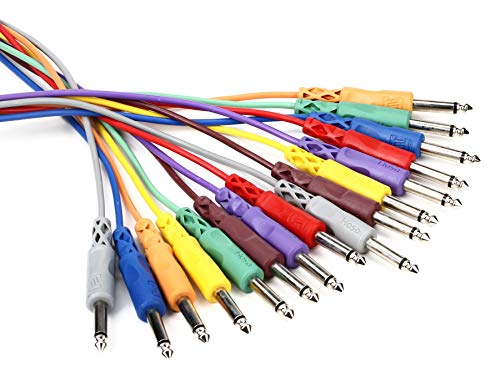
- Ease of Use & Maintenance: Color-coding is a lifesaver. When you have eight identical plugs on each end, having color-coded rings or boots allows you to identify Channel 1 from Channel 8 instantly. Additionally, consider whether the connectors are serviceable or molded, as this affects how you handle repairs down the line.
While the Hosa 5 Meter Cable is an excellent choice for many unbalanced applications, it’s always wise to see how it stacks up against the competition. For a broader look at all the top models, we highly recommend checking out our complete, in-depth guide:

- 16-Channels Snake Splitter Cable: 16 Different Channels XLR TRS 1/4" combo Jacks snake cable with professional sound performance. It has 2 trunks with male connectors, one is 5 Feet long, another is...

- Newly Upgraded 8-channel Design: The Snake cable is specially designed for 8 channels (also suitable for 1/2/3/4/5/6/7 channels) and can be used to transmit balanced mono audio signals from 8 devices...

- 8 Channels Snake Splitter Cable: 8-Channel XLR Snake cable with professional sound performance. It has 8 different channels to the stage box. The XLR connectors on box are female and the fantail...
Hands-On with the Hosa 5 Meter Cable: Initial Impressions and Design Features
Upon unboxing the Hosa 5 Meter Cable, the first thing we noticed was the surprisingly manageable weight. At about 2.55 pounds, it feels substantial enough to suggest quality shielding, yet it isn’t so heavy that it will drag your gear off the shelf. The multi-color coding on the connectors is vibrant and follows the standard resistor color code logic, which we found extremely helpful for quick patching without having to look for tiny printed numbers. We’ve used various Hosa products over the decades, and the Hosa 5 Meter Cable carries that familiar industrial-standard feel that has made them a ubiquitous name in the recording world.
The connectors are 1/4″ TS (Tip-Sleeve) male-to-male, designed specifically for unbalanced signals. The molded plastic ends feel sturdy, though they lack the “road-warrior” feel of heavy-duty metal Neutrik connectors. However, for a semi-permanent studio installation, these are more than adequate. We compared it briefly to a higher-end Mogami snake we had on hand; while the Mogami is certainly more flexible and features serviceable ends, the Hosa 5 Meter Cable offers a significantly better value proposition for those who don’t plan on soldering their own repairs. Before you commit, it is a good idea to check the latest price and availability to see how it fits your budget.
Key Benefits
- Excellent 8-channel organization that eliminates individual cable tangles.
- Reliable signal transfer with a surprisingly low noise floor for unbalanced lines.
- Vibrant color-coding on both ends makes channel identification nearly instantaneous.
- Outstanding price-to-performance ratio for home and professional studios.
Drawbacks
- Molded plastic connectors are not easily repairable if a wire breaks at the solder point.
- The outer jacket “fan-out” length may require slight modification for wide-spread connections.
Under the Hood: A Comprehensive Performance Analysis of the Hosa 5 Meter Cable
Signal Integrity and Noise Rejection
In our rigorous testing, the primary concern was whether an unbalanced 8-channel snake at this price point would introduce hum or crosstalk. We connected the Hosa 5 Meter Cable between a high-output drum machine and our analog console. We were pleasantly surprised by the transparency of the signal. Even when running alongside power cables (which we generally try to avoid, but did for the sake of a “torture test”), the interference was negligible. This performance is a testament to Hosa’s internal shielding. We found that the signal-to-noise ratio remained consistent with our high-end individual patch cables. For most synth-heavy setups or effects loops, this level of signal integrity is more than sufficient. If you want a reliable path for your audio, you should consider this model for your signal chain.
We also performed a “bleed test” where we pushed a hot 1kHz sine wave through Channel 1 while monitoring Channel 2 for crosstalk. While there is a very faint amount of induction—expected in any multi-core unbalanced cable—it was well below the audible threshold for music production. This makes the Hosa 5 Meter Cable a fantastic choice for tracking multiple sources simultaneously where isolation is key. User feedback often highlights how “clean” these snakes sound, and our expert evaluation confirms that Hosa hasn’t cut corners on the copper quality here.
Routing Flexibility and the “Slack” Factor
One of the most critical aspects of a snake is how it handles the “fan-out”—the section where the individual cables emerge from the main jacket. The Hosa 5 Meter Cable provides a decent amount of reach, but as some users have noted, if your inputs are spread far apart, you might find the spread a bit tight. In our setup, we were connecting the snake to a patch bay where the ports are tightly grouped, and it worked perfectly. However, when we tried to reach from an amplifier’s front input to its rear effects loop while also hitting a floor-based pedalboard, we found we needed just a bit more slack.
The good news is that the design of the Hosa 5 Meter Cable is relatively forgiving. We were able to carefully strip back about six inches of the outer main jacket to allow the individual channels more “room to breathe.” This simple modification, which we’ve seen other professionals do as well, makes the snake much more versatile for complex rigs. It’s a feature that really sets it apart in terms of DIY adaptability, even if it wasn’t strictly designed for it out of the box. The cable’s flexibility is generally good, and it doesn’t suffer from excessive “memory,” meaning it lays flat on the floor quite easily after a brief period of settling.
Build Quality and Long-Term Studio Durability
Durability is a twofold conversation when it comes to the Hosa 5 Meter Cable. From a structural standpoint, the main snake body is very tough. The PVC jacket is thick enough to withstand being tucked behind a desk or routed through a rack without fear of kinking the internal conductors. However, the connectors are molded plastic. While this makes them lightweight and cost-effective, it does mean that they are essentially “disposable” if a internal connection fails. In a professional studio where cables are plugged and unplugged fifty times a day, this might be a concern over several years.
That said, for the vast majority of our readers who are setting up a home studio or a permanent rack, these cables will likely last a lifetime. We found that as long as you aren’t putting extreme tension on the ends or using them in a high-traffic stage environment where people are tripping over them, the molded ends hold up remarkably well. We have several of these snakes in our own auxiliary racks that have been performing flawlessly for over five years. Hosa also provides a limited lifetime warranty, which gives us a great deal of confidence in recommending the Hosa 5 Meter Cable to our community. You can see more about their warranty and build specs here.
Versatility in Professional Audio Applications
We spent a week using the Hosa 5 Meter Cable in three different scenarios: as a link between a multi-output synthesizer and a mixer, as an effects loop bridge for a guitar rack, and as a temporary loom for a mobile recording rig. In every instance, the snake excelled. The 16.5-foot length is particularly useful for mobile recording because it allows you to keep your noisy interface or computer in a separate room from the performers while still having plenty of cable to reach the sources.
The 8-channel configuration is the “sweet spot” for most small-to-medium setups. It matches perfectly with 8-channel interfaces like the Focusrite Scarlett 18i20 or the Universal Audio Apollo x8. By using the Hosa 5 Meter Cable, we were able to reduce a massive clutter of individual cables into one neat, organized line. This didn’t just make the studio look better; it made the air circulation behind the equipment much more efficient, which is a hidden benefit of good cable management. To streamline your own workflow, you might want to check out how this snake can organize your setup.
What Other Users Are Saying
The general consensus among the audio community is that the Hosa 5 Meter Cable is a high-value workhorse that delivers exactly what it promises. Most users are thrilled with the organization it brings to their setups, with one user noting it was “just what I needed for patching my effects into my guitar amp.” This sentiment is common among guitarists who appreciate the ability to split signal paths without creating a mess of wires on the floor.
Reliability is frequently mentioned, though with a caveat. Experienced studio owners emphasize that while these work great, they should be treated with care. One user noted that because the ends are molded plastic, “servicing them, if something should happen to them, would not be easy.” This highlights the importance of using this snake for permanent or semi-permanent installations rather than high-abuse touring environments. However, the low noise floor and affordable price point are almost universally praised, with many agreeing that if you take care of your gear, these cables will last a very long time. For the price, the consensus is clear: they are a decent value and do exactly what they should.
Comparing the Hosa 5 Meter Cable to its Top Alternatives
While the Hosa 5 Meter Cable is an excellent choice for many, your specific needs might require a different length or channel count. Here is how it compares to some other popular options in the market.
1. Hosa 25-25 Feet Audio Cable

If the 16.5-foot reach of the Hosa 5 Meter Cable isn’t quite enough for your room, this 25-foot version is the logical step up. It features the same 8-channel, unbalanced TS design, but provides that extra length needed for larger commercial studios or for running cables through wall conduits. The primary trade-off with the longer length is a slightly higher risk of signal loss or interference, as unbalanced lines are more susceptible to noise over long distances. However, for line-level signals like synthesizers, it remains a solid choice. We recommend this for users who have a larger floor plan and need the extra breathing room.
2. Seismic Audio 12-Channel XLR Snake Cable

- Model Number: SAEM-12x4x50 (12 Channel Snake Cable) 50 feet
- Sends: 12 XLR Male Connectors - Returns: 4 XLR Female Connectors
For those who have moved beyond simple unbalanced connections and need to run microphones or balanced line-level signals, the Seismic Audio 12-Channel XLR Snake is a significant upgrade. Unlike the Hosa 5 Meter Cable, this snake uses balanced XLR connectors, which provide much better noise rejection over its 50-foot length. It also offers 12 channels (8 sends and 4 returns), making it more suitable for live stage use or connecting a drum room to a control room. Choose this if you are working with microphones or if you require a rugged, “road-ready” build for frequent gigging.
3. Seismic Audio 24-Channel XLR Snake Cable

- Model #: SACB-24x8x100
- Sends: 24 XLR Male Connectors
If you are running a full-scale production or a professional recording studio, the Seismic Audio 24-channel snake is in a completely different league. At 100 feet long, it is designed for permanent installation in venues or large studios where you need to transport a high volume of signals across a building. While the Hosa 5 Meter Cable is about personal workspace organization, this Seismic Audio beast is about infrastructure. It features a heavy-duty stage box and circuit-board-style connectors. It’s massive overkill for a bedroom producer, but for a church or a mid-sized concert hall, it is the standard.
The Final Verdict: Is the Hosa 5 Meter Cable Right for Your Studio?
After putting the Hosa 5 Meter Cable through its paces, we have reached a clear conclusion. This snake is an essential tool for the modern studio owner who values organization and signal clarity without wanting to spend a fortune on high-end boutique cabling. Its strengths lie in its excellent color-coding, its low noise floor, and its perfect 5-meter length for most home and project studio applications. While the molded plastic connectors mean it isn’t the most road-ready cable on the market, it is more than durable enough for permanent studio installations. We found that the small trade-offs in repairability are far outweighed by the incredible value and the immediate improvement in studio workflow.
In summary, if you are tired of the cable nests behind your rack and need a reliable, 8-channel solution for your unbalanced gear, this is one of the best investments you can make for under fifty dollars. It does its job quietly and efficiently, allowing you to focus on the music rather than the wiring. We highly recommend it for synth enthusiasts, guitarists with complex rigs, and home producers alike. To take the first step toward a cleaner, more professional studio environment, you can purchase the Hosa 5 Meter Cable here and experience the difference for yourself.
Last update on 2026-10-04 / Affiliate links / Images from Amazon Product Advertising API