
Fat Toad 10ft ShieldedPRO XLR Snake Cable Review: The Ultimate Solution for Studio Cable Chaos
If you have ever spent more than five minutes behind a studio rack or a digital mixer, you know the literal “rat’s nest” that forms within seconds of plugging in your gear. We’ve all been there: reaching for a specific mic line only to realize it’s tangled around three power cables and a stray headphone extension. It’s not just an aesthetic mess; it’s a workflow killer and a potential source of signal interference. For home studio owners and live sound engineers alike, managing 16 individual XLR cables is a recipe for frustration. This is where a high-quality multicore system becomes an absolute necessity. Without a centralized “snake,” you risk cable failure from tension, increased setup times, and the nightmare of troubleshooting a dead channel in the middle of a session. We recently integrated the Fat Toad 10ft ShieldedPRO XLR Snake Cable into our setup to see if it could truly streamline our signal path without sacrificing the audio fidelity we demand.
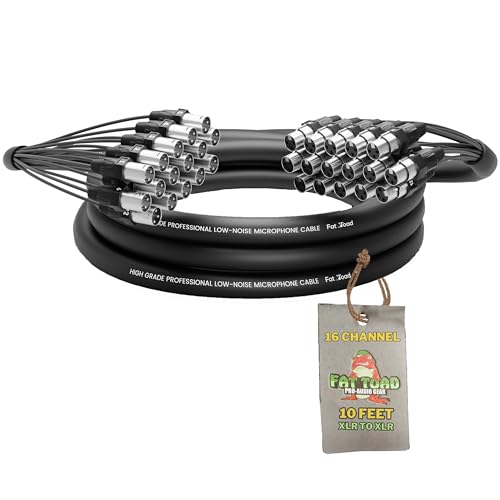
- GET YOUR XLR INTERFACE AND STAGE MICROPHONE TO WORK WITH THE BEST STAGE SNAKE CABLE: Designed for pro-audio performance, this 16 channel, audio female XLR to male XLR snake cables are perfect for use...
- POWERFUL, CLEAN SIGNAL TO YOUR XLR MIXER: Being some of the highest quality, most affordable multicore cables in the market, these XLR snakes will deliver a powerful, clean, and detailed signal for...
What to Consider Before Buying a Recording Snake
A Recording Snake is more than just an item; it’s a key solution for signal organization and audio integrity in any multi-channel environment. Essentially, a snake consolidates multiple individual cables into a single, thick trunk, which then “fans out” into individual connectors at both ends. This solves the problem of “cable clutter” by reducing the number of long, trailing wires across your floor. Beyond organization, a good snake provides a layer of protection for your signal. By grouping cables together under a heavy-duty jacket, you minimize the risk of individual wires being stepped on, pinched, or tangled. The main benefits are a cleaner workspace, faster setup and teardown times, and often, better shielding against external electronic interference because the entire bundle is frequently double-shielded.
The ideal customer for this type of product is someone facing a growing input list, such as a drummer mic’ing up a full kit, a church media team running a livestream, or a project studio owner connecting a rack of outboard preamps to an interface. It’s perfect for those who need a fixed or semi-permanent installation where cables don’t need to be moved constantly. However, it might not be suitable for those who require extreme, heavy-duty touring resilience—such as professional road crews who need metal mesh reinforcements and ruggedized stage boxes for nightly abuse. For those users, more expensive, armored snakes would be the better, albeit significantly pricier, alternative.
Before investing, consider these crucial points in detail:
- Dimensions & Length: The length of your snake is the most permanent decision you will make. You must measure your cable run, including the “slack” needed to route around corners or through rack ears. A 10ft cable like the Fat Toad 10ft ShieldedPRO XLR Snake Cable is perfect for rack-to-desk connections but may be too short for a stage-to-FOH run.
- Capacity and Channel Count: Determine exactly how many inputs and outputs you need now, and then add a few for future expansion. A 16-channel snake is a “sweet spot” for many, as it handles a full drum kit (8-10 mics) plus room for several vocal or instrument lines without being overly bulky.
- Materials & Durability: Look at the conductor gauge and the jacket material. A 22 AWG copper conductor is standard for professional audio, providing low resistance. The outer jacket should be flexible yet thick enough (like the 19mm rubber on this model) to protect the internal pairs from being crushed.
- Ease of Use & Labeling: When you have 16 identical ends, labeling is everything. Check if the channels are numbered on the connectors and the cables themselves. Poor labeling can turn a 10-minute setup into an hour-long guessing game, so clear, legible numbering is a major performance factor.
Once you understand these requirements, you can better appreciate how a specific model fits into your workflow. While the Fat Toad 10ft ShieldedPRO XLR Snake Cable is an excellent choice, it’s always wise to see how it stacks up against the competition. For a broader look at all the top models, we highly recommend checking out our complete, in-depth guide:

- 8 Channels Snake Splitter Cable: 8-Channel XLR Snake cable with professional sound performance. It has 8 different channels to the stage box. The XLR connectors on box are female and the fantail...


- 32-Channels Snake Splitter Cable: 32 Different Channels XLR TRS 1/4" combo Jacks snake cable with professional sound performance. It has 2 trunks with male connectors, one is 5 Feet long, another is...

- Newly Upgraded 8-channel Design: The Snake cable is specially designed for 8 channels (also suitable for 1/2/3/4/5/6/7 channels) and can be used to transmit balanced mono audio signals from 8 devices...
First Impressions: Unboxing the Fat Toad 10ft ShieldedPRO XLR Snake Cable
When we first pulled the Fat Toad 10ft ShieldedPRO XLR Snake Cable out of its packaging, the first thing we noticed was the sheer weight and “heft” of the cable. At 4.3 pounds for a 10-foot run, it feels substantial. The 19mm black rubber jacket is impressively flexible; it doesn’t have that stiff, “plastic-y” feel that cheaper cables often exhibit, which is a good sign for those who need to coil and uncoil it frequently. We were also pleased to see that you can see its full feature set and user reviews reflected in the physical build—the XLR connectors felt secure, and the “fan-out” length was generous enough to reach across a standard 19-inch rack without straining the wires.
Compared to some of the entry-level snakes we’ve used in the past, the Fat Toad feels like a significant step up in build quality. While it doesn’t feature the expensive metal “strain relief” springs found on high-end touring snakes, the plastic molded boots on the connectors seem rugged enough for studio and light-duty live use. The matte finish of the rubber jacket also makes it easy to handle and less likely to slide around on a slick stage floor. Initial impressions suggest a product that punches well above its price point.
Key Benefits
- Incredible value for a full 16-channel balanced XLR configuration.
- High-quality 22 AWG copper conductors ensure transparent signal transmission.
- Highly flexible 19mm rubber jacket makes routing and coiling effortless.
- Individual channel numbering on both the cable and the connector boots.
Limitations
- Channel numbering can be difficult to read in low-light environments.
- Lack of metal mesh reinforcement makes it less ideal for heavy-touring abuse.
Deep Dive: Performance and Field Testing the Fat Toad 10ft ShieldedPRO XLR Snake Cable
Signal Integrity and Professional Grade Shielding
The most critical aspect of any multicore cable is how well it preserves the signal from Point A to Point B. In our testing, the Fat Toad 10ft ShieldedPRO XLR Snake Cable performed exceptionally well. We used it to connect a rack of high-end preamps to our primary audio interface, and the results were indistinguishable from using individual boutique XLR cables. This is largely thanks to the 22 AWG (American Wire Gauge) copper conductors. In the world of audio, the gauge of the wire matters; thicker copper provides lower resistance, which is vital for maintaining the “punch” and “detail” of your audio, especially over longer runs (though 10ft is relatively short, quality still counts).
Furthermore, the internal shielding is top-notch. We purposely ran the snake across a cluster of power strips and near a large power amplifier to check for electromagnetic interference (EMI). We found no perceptible hum or “buzz” in the recordings, which confirms that the heavy-duty insulation and internal shielding are doing their job. This level of noise protection is a feature that really sets it apart from unshielded or poorly shielded alternatives that often plague budget-conscious studios. Whether you are tracking a quiet vocal or a loud drum kit, the signal remains clean and high-fidelity.
Build Quality: The Balance Between Flexibility and Durability
One of the biggest complaints with “budget” snakes is that they are often stiff and difficult to manage. However, the 19mm flexible rubber jacket on the Fat Toad 10ft ShieldedPRO XLR Snake Cable is a dream to work with. During our setup, we had to weave the cable through a tight opening in the back of a rack case. The cable took the bends beautifully without kinking. This flexibility is also a safety feature; a cable that lays flat on the ground is far less of a trip hazard than one that retains its “coil memory” and loops up.
We found that while the snake is marketed as professional grade, there is a nuance to its durability. As several users have pointed out, this is an excellent choice for “light duty” or permanent installs. If you are a traveling band playing a different club every night, throwing your gear into a van, you might eventually want something with metal-mesh strain relief. But for our studio needs—and for most church or local venue setups—this build quality is more than sufficient. You can check the latest price and availability to see why so many choose this for their fixed racks. The connectors fit snugly into both male and female XLR ports with a satisfying “click,” and the solder points inside the connectors (which we checked on a few channels) were clean and secure.
Usability and the Challenge of Organization
Organization is the primary reason to buy a snake, and Fat Toad has made a concerted effort to make this 16-channel beast user-friendly. Each of the 16 channels is numbered on two different locations: on the plastic strain relief boot of the XLR connector and imprinted on the cable jacket itself every few inches. This redundancy is fantastic because even if a boot eventually gets scuffed or replaced, you still know which channel is which by looking at the wire. In our workflow, this allowed us to map out our 16-track interface in record time.
However, we must address one small “expert” observation: the legibility of the numbers. In a dimly lit studio or the back of a dark stage rack, the black-on-black or dark-gray-on-black imprinting can be hard to see. As one user noted, you may want to go over the numbers with a white paint marker or silver Sharpie if you plan on doing a lot of re-patching in the dark. We found this to be a minor inconvenience in an otherwise stellar design, but it’s something to keep in mind for your setup. Despite this, having 16 channels clearly fanned out and color-coded (black with white markings) is a massive upgrade over a tangle of mismatched individual cables.
Versatility Across Different Audio Environments
While we primarily tested this in a studio environment, the Fat Toad 10ft ShieldedPRO XLR Snake Cable is incredibly versatile. We also evaluated its performance in a live sound context, using it as a “sub-snake” for a drum kit. By placing the “fan-out” end at the drum riser and running the 10ft trunk to the main stage box, we were able to keep the drum area incredibly clean. This is also an ideal solution for church livestream setups where you might be running a mix from a digital console into a multi-channel USB interface.
The 10ft length is specifically designed for these types of short-range “patch” applications. It’s long enough to bridge the gap between a rack and a console but short enough that you don’t have 40 feet of extra cable coiled up on the floor taking up space. This makes it a specialized tool for specific problems. If you’ve been looking for a way to tidy up your DAW inputs, you should definitely consider this snake for your next upgrade. It simplifies the signal chain in a way that makes you wonder why you waited so long to buy one.
What Other Users Are Saying
The general sentiment among audio professionals and hobbyists who have used the Fat Toad 10ft ShieldedPRO XLR Snake Cable is overwhelmingly positive, particularly regarding its “value-to-performance” ratio. Many users have echoed our findings that for the price, the signal quality is “excellent” and the cables “get the job done” without any fuss. One user specifically mentioned using it for a church livestream setup into a DAW, highlighting that it met their needs “just fine” for controlling 15 channels. This reinforces our view that this cable is a workhorse for modern digital-audio-workstation environments.
On the flip side, some users have pointed out the numbering issue, with one person noting that the numbers are “almost impossible to read” without highlighting them manually. Another frequent piece of advice from the community is to use this for “light duty” or rack connections rather than high-impact touring. The consensus is clear: if you need a reliable, high-fidelity connection for your studio or a stable live setup and you don’t want to spend hundreds of dollars on “name brand” snakes, this is the way to go. It’s a “no regerts” purchase for those who understand what they are buying. You can read more user experiences here to see how it might fit your specific setup.
Comparing the Fat Toad 10ft ShieldedPRO XLR Snake Cable to Its Top Alternatives
1. Seismic Audio 12-Channel XLR Snake Cable

- Model Number: SAEM-12x4x50 (12 Channel Snake Cable) 50 feet
- Sends: 12 XLR Male Connectors - Returns: 4 XLR Female Connectors
The Seismic Audio 12-channel model is a strong contender if you need a longer run than 10 feet, as this specific version offers 50 feet of length. It features 12 sends and 4 XLR returns, making it a “true” stage snake rather than just a patch cable. While it has fewer total channels (12 vs 16) for the main sends, the color-coding and numerical labeling are often cited as being slightly more legible than the Fat Toad. This is the better choice for someone who needs to run a signal from the center of a stage back to a mixing board, whereas the Fat Toad is superior for high-density, short-distance rack patching.
2. Seismic Audio 24-Channel XLR Snake Cable

- Model #: SACB-24x8x100
- Sends: 24 XLR Male Connectors
If the 16 channels of the Fat Toad aren’t enough, the Seismic Audio 24-channel snake is a massive step up in capacity. With 100 feet of length and a low-profile circuit board stage box, this is designed for professional venues and large-scale performances. However, it is significantly more expensive and much more cumbersome to transport. We recommend this alternative only if you are outfitting a permanent venue or a large touring act. For a home studio or a small band’s rack, the 100ft length of this Seismic model would be overkill and physically difficult to manage compared to the streamlined Fat Toad.
3. Hosa 25-25 Feet Audio Cable

- XLR Female-XLR Male
- 8-channel Snake
Hosa is a household name in audio cables, and their “Little BRO” series offers a middle ground. This 8-channel snake is 25 feet long, offering more reach than the Fat Toad but with only half the channel capacity. Hosa cables are known for their extreme reliability and are widely available, but you pay a premium for the brand name per channel. If you only need 8 channels and want the peace of mind that comes with the Hosa brand, this is a solid pick. However, for sheer channel density and value, the Fat Toad provides twice the connectivity at a very competitive price point.
Final Verdict: Is the Fat Toad 10ft ShieldedPRO XLR Snake Cable Right for You?
After putting the Fat Toad 10ft ShieldedPRO XLR Snake Cable through its paces, we can confidently say it is one of the best investments you can make for a growing studio or a semi-permanent live rack. It effectively solves the problem of cable clutter while providing the high-fidelity, low-noise performance that professional audio demands. While it may not be the choice for a world-touring rock band that needs armored cabling, it is perfectly suited for the 90% of us who need reliable, high-quality signal paths in a studio or local venue environment. The 22 AWG copper and the 16-channel density are the standout features here, providing a professional sound at a fraction of the cost of boutique alternatives.
If you are tired of untangling a mess of wires every time you want to record or if you’re looking to upgrade your church or studio’s organization, this is the tool for the job. It’s durable, flexible, and sounds great. Don’t let cable chaos slow down your creativity any longer. We highly recommend that you pick up the Fat Toad 10ft ShieldedPRO XLR Snake Cable today and experience a cleaner, more efficient audio workflow for yourself.
Last update on 2026-10-06 / Affiliate links / Images from Amazon Product Advertising API