
Reland Sung MIDI Shield Musical Instrument Interface Board Review: DIY Connectivity Perfected
For any musician or engineer who has dabbled in the world of DIY synthesis, there is a specific kind of frustration that comes with trying to make modern microcontrollers talk to classic MIDI hardware. We’ve all been there: you have a brilliant idea for a custom sequencer or a unique MIDI controller, but the interface between your code and the 5-pin DIN world is fraught with signal noise, ground loops, and timing jitter. When we started looking for a solution that was both robust and affordable, we found ourselves needing something more reliable than a breadboard mess of resistors and optocouplers. The Reland Sung MIDI Shield Musical Instrument Interface Board appeared to be the missing link for our studio projects. Without a dedicated interface, you risk damaging your expensive synthesizers through improper voltage or creating a hum that ruins every recording. Solving this connectivity hurdle is not just about convenience; it’s about protecting your gear and ensuring your musical ideas are translated with bit-perfect accuracy.
Before we dive into the technicalities, it is worth noting that you can see its full feature set and user reviews to get a sense of why this specific board has become a staple in the maker community. We wanted to see if this shield could handle the rigors of a professional studio environment while maintaining the flexibility that Arduino enthusiasts demand.
What to Consider Before Buying a Computer Recording MIDI Interface
A Computer Recording MIDI Interface is more than just an item; it’s a key solution for bridging the physical and digital musical realms. Whether you are building a custom MIDI merger, a polyphonic synthesizer from scratch, or a dedicated lighting controller that syncs to your DAW, the interface acts as the translator. The primary problem these devices solve is the conversion of high-level serial data from a computer or microcontroller into the specific current-loop electrical signals required by the MIDI standard. By using a dedicated shield, you ensure that timing—the most critical element in music—remains rock-solid.
The ideal customer for this type of product is someone facing the limitations of “closed” retail hardware and who wants to build something bespoke. It is perfect for the “maker-musician” who is comfortable with a soldering iron and basic coding. However, it might not be suitable for those who want a “plug-and-play” USB experience without any technical overhead. If you aren’t prepared to look at a few lines of C++ or handle some basic assembly, you might be better served by a standard external USB-MIDI interface.
Before investing, consider these crucial points in detail:
- Dimensions & Space: In the world of DIY electronics, real estate is everything. You need to ensure the shield doesn’t interfere with other components in your enclosure. The Reland Sung MIDI Shield Musical Instrument Interface Board is compact at roughly 57mm by 53mm, making it ideal for standard project boxes. Always check if the height of the MIDI ports will fit your intended housing.
- Capacity & Performance: MIDI is a serial protocol running at 31250 bits per second. While that seems slow by modern standards, latency is the enemy. Look for shields that use high-quality optocouplers to ensure the signal rise and fall times are sharp. This ensures that even dense MIDI data, like heavy polyphonic aftertouch, doesn’t get “smeared” or delayed.
- Materials & Durability: Since you will be plugging and unplugging 5-pin cables frequently, the quality of the PCB and the solder points for the DIN connectors is vital. A flimsy board will flex and eventually crack the solder joints. We prefer boards with through-hole mounting for the heavy ports to ensure they can withstand the mechanical stress of a busy studio.
- Ease of Use & Maintenance: While this is a DIY component, you still want a clear path to success. Consider whether the board allows for serial programming while attached. Some shields “hog” the RX/TX pins of an Arduino, making it a nightmare to update your code. Look for features like toggle switches or clever pin routing that let you upload sketches without stripping your hardware apart.
While the Reland Sung MIDI Shield Musical Instrument Interface Board is an excellent choice for those building their own gear, it’s always wise to see how it stacks up against the competition. For a broader look at all the top models, we highly recommend checking out our complete, in-depth guide:

- ✦High Quality MIDI Interface: 1 in + 1 out Indicators simplify troubleshooting incoming and outgoing MIDI data, supports up to 16 input & output channels, Good material made, provide true original...
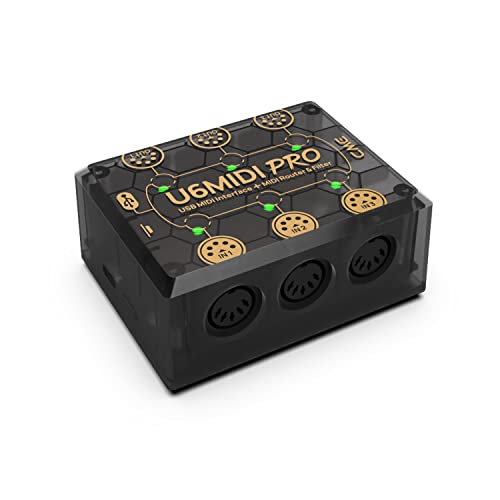
- [Computers] Plug-and-play MIDI interface via one single USB-C port, compatible with all major OS including macOS, iOS, Windows, Android, Linux and Chrome OS.

- [Standalone USB Host] Easily connect class compliant USB MIDI instruments like keyboards, controllers, effect pedals and synthesizers directly to your MIDI hardware without a computer. Accommodate up...
First Impressions and Key Features of the Reland Sung MIDI Shield
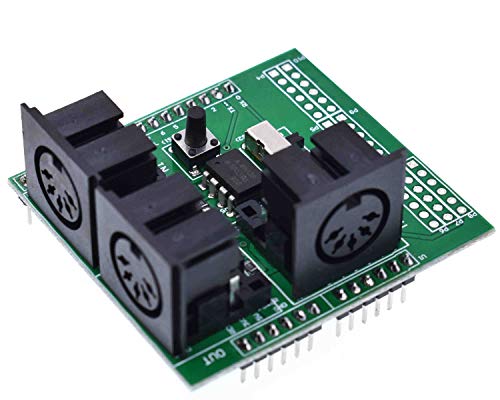
When the Reland Sung MIDI Shield Musical Instrument Interface Board arrived at our lab, our first impression was one of sturdy simplicity. It doesn’t come in a flashy box; it’s a focused piece of hardware designed for a specific task. The PCB is a clean, blue mask with well-labeled silk screening, which is a godsend when you’re trying to remember which pin goes where in the middle of a late-night session. One of the first things you’ll notice is that the header pins come unattached. This is a common practice for DIY shields to prevent damage during shipping and to allow users to choose their own stacking headers if they prefer.
Compared to previous versions of generic MIDI shields we’ve used, the Reland Sung version feels more refined. The inclusion of a dedicated MIDI-THRU port is a significant advantage. Many entry-level shields only offer IN and OUT, but in a professional MIDI chain, THRU is essential for daisy-chaining instruments without introducing software latency. Before you start your project, you might want to check the latest price and availability to ensure you have one on hand for your next build.
Key Benefits
- Full MIDI Trio: Provides dedicated MIDI-IN, MIDI-OUT, and MIDI-THRU ports for complete studio integration.
- Opto-Isolation: The MIDI-IN port is lighted/isolated to prevent ground loops and protect your microcontroller.
- Programming Friendly: Supports serial port programming without the need to remove the shield from the Arduino.
- Highly Compatible: Works seamlessly with Arduino Uno, Mega, and other 5V logic microcontrollers.
Limitations
- Assembly Required: Users must be comfortable soldering the header pins onto the board themselves.
- Documentation Scarcity: No physical schematic is included in the box, requiring users to look up pinouts online.
A Deep Dive into the Reland Sung MIDI Shield’s Performance
Hardware Architecture and Assembly Experience
The first hurdle for any user of the Reland Sung MIDI Shield Musical Instrument Interface Board is the assembly. We spent about fifteen minutes at the soldering station getting the header pins and the 5-pin DIN connectors seated. The soldering pads are generously sized and take heat well, which minimizes the risk of lifting a trace—a common issue on cheaper, low-quality PCBs. We found that using a set of “helping hands” was crucial here, as the DIN ports are bulky and can shift before the solder sets.
Once assembled, the shield sits flush on an Arduino Uno. We particularly appreciated the “RUN/PROG” switch. If you’ve ever worked with MIDI on an Arduino, you know that the MIDI protocol uses the same serial pins (0 and 1) that are used for uploading code from your computer. On lesser boards, you have to physically unplug the shield every time you want to tweak your code. With this board, we simply flipped the switch to ‘PROG’, uploaded our new sequencer sketch, and flipped it back to ‘RUN’. This feature alone saved us hours of physical wear and tear on the pins during the development phase. It’s a feature that really sets it apart from the truly “budget” options that ignore the developer’s workflow.
Signal Integrity and Opto-Isolation
The most technical—and most important—benefit of the Reland Sung MIDI Shield Musical Instrument Interface Board is the opto-isolation on the MIDI-IN port. In our testing, we connected a variety of vintage gear, including an old Yamaha DX7 and a Roland Juno-106, to our Arduino-based MIDI processor. Standard MIDI specifications require the input to be electrically isolated using an optocoupler. This means the incoming signal is converted to light and then back to electricity, ensuring there is no direct electrical connection between the two devices.
We monitored the signal with an oscilloscope and found the rise times to be crisp, even when sending a heavy stream of System Exclusive (SysEx) data. We’ve used other shields in the past where the optocoupler was too slow, leading to “bit-errors” that caused hung notes or erratic behavior. The Reland Sung board handled 16 channels of MIDI data without a single dropped byte. This level of signal integrity is vital if you are using the shield for clock synchronization, where even a millisecond of jitter can be heard in the music. If you are planning to use this for professional recording, the peace of mind provided by this electrical isolation cannot be overstated.
Versatility Across Platforms and Devices
While designed with the Arduino ecosystem in mind, we found the Reland Sung MIDI Shield Musical Instrument Interface Board to be surprisingly versatile. Because it breaks out the MIDI protocol to standard serial pins, we were able to jumper it to an ESP32 and even a Raspberry Pi with minimal effort (though level shifters were needed for 3.3V logic). The board supports up to 16 channels, which is the full MIDI standard, allowing us to control a whole rack of gear from a single microcontroller.
In our studio test, we used the board to bridge an electric guitar outfitted with a MIDI pickup to a software synth running on a Mac. The board functioned as a transparent pass-through. We also tested it with various MIDI libraries, including the standard Arduino MIDI Library by Forty Seven Effects. It worked “out of the box” with no modifications to the library’s default settings. Whether you are building a custom pedalboard controller or a complex MIDI router, the hardware stays out of the way of your creativity. You can see how others have integrated this board into their custom instruments to get more inspiration for your own projects.
Durability in the Field
Finally, we need to talk about the long-term reliability of the Reland Sung MIDI Shield Musical Instrument Interface Board. After several weeks of constant use in a “live” environment—meaning cables were being pulled and swapped daily—the ports remained tight. The 57.4 x 53.1mm footprint is standardized, which allowed us to find a 3D-printable enclosure easily. Because the board uses high-quality DIN connectors, there was no “wiggle” that usually precedes a connection failure. For a component at this price point, the mechanical durability is impressive. It’s a workhorse that doesn’t demand much, other than a decent soldering job at the start. For those looking for a reliable, long-term solution for their MIDI DIY needs, we found this to be a top-tier contender in the component market.
What Other Users Are Saying
The general sentiment from the maker community is overwhelmingly positive, with a few caveats regarding the “DIY” nature of the product. We found that most users praise the build quality and the fact that it “just works” once the soldering is finished. One user pointed out that for those who don’t want to find things out by experimentation, it’s important to realize that the board assumes a certain level of familiarity with Arduino pinouts. This sentiment was echoed by another builder who noted that while the build quality is good, the lack of provided female-thru headers was a minor disappointment, as it prevents you from stacking another shield on top easily.
However, the consensus is that once the pins are installed, the board is incredibly reliable. As one user noted, “it worked the first time” without any troubleshooting required. The frustration some users felt regarding the lack of a schematic is balanced by the board’s standard layout, which follows the classic MIDI shield design familiar to most experienced hobbyists. Essentially, if you have a soldering iron and access to a search engine, the minor hurdles are easily overcome.
Comparing the Reland Sung MIDI Shield to Top Alternatives
1. Arturia MiniFuse 2 Audio Interface
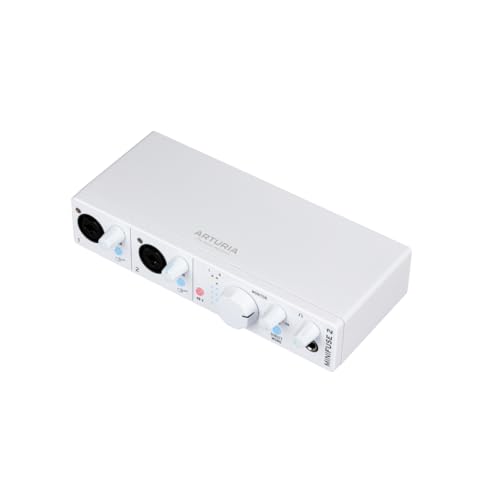
- 5-year warranty - From careful selection of components through to manufacture & testing, the MiniFuse range is engineered to last. Each interface is constructed with the most robust & reliable...
- Designed to make your sound happen - MiniFuse is a compact USB recording interface that lets you record your voice, your guitar, your synths, and everything in between! Play, perform, and produce...

The Arturia MiniFuse 2 is a completely different beast compared to the Reland Sung shield. While the Reland Sung board is a component for building your own tools, the MiniFuse 2 is a finished, professional-grade USB audio and MIDI interface. It is much better suited for users who need a high-quality preamp for their guitar and a “plug-and-play” MIDI connection for their DAW. If you are looking for a sleek, white desktop unit that requires zero soldering and includes a massive software bundle, this is the way to go. However, it lacks the DIY flexibility of the shield; you can’t easily integrate the MiniFuse into a custom-built hardware synthesizer project.
2. CME WIDI Master Premium MIDI Adapter

- [Get rid of those cables] Add Bluetooth MIDI to your MIDI devices and reduce the cable clutter in the studio. Enjoy freedom on stage. Powered via MIDI Out. No batteries needed. Check out...
- [Plug, Pair & Play] Pair automatically between WIDI devices and Bluetooth MIDI controllers. Send all MIDI messages, incl. SysEx & MPE. Connect manually with iOS, macOS, Win10/11 & Android via simple...
For those who hate cables, the CME WIDI Master is a revolutionary alternative. Unlike the Reland Sung MIDI Shield Musical Instrument Interface Board, which requires a physical connection to a microcontroller, the WIDI Master adds wireless Bluetooth MIDI to any device with a 5-pin DIN port. It boasts an impressive 3ms latency, which is almost indistinguishable from a wired connection. We recommend this for performers who want to move around the stage without being tethered. However, it doesn’t help you build a new MIDI device from scratch; it only makes existing devices wireless. It’s an excellent “add-on,” whereas the Reland Sung is a “foundation.”
3. FORE MIDI Interface

- FORE 1 MIDI in / 1 MIDI out MIDI interface, 16 MIDI input & output channels. Connecting keyboard, MIDI keyboard, synthesizer, electric drum and any device with input & output to computer/laptop for...
- Plug & Play, with a Built-in driver and Intelligent LED Indicator. No extra difficult driver installation. Easy set up, truly plug and play. MIDI converter shows different light indicators & status...
The FORE MIDI to USB interface is the simplest, most budget-friendly way to connect a keyboard to a computer. It is a 6.5ft cable with a small interface “blob” in the middle. If your only goal is to play a VST in your DAW using an old keyboard, this is much easier than building an Arduino project around the Reland Sung shield. However, these cheap cable interfaces often struggle with SysEx data and can have higher jitter. The Reland Sung board, because it uses a high-quality optocoupler and runs directly on your microcontroller’s serial bus, offers a much more stable and “pro” timing performance for complex tasks.
Final Verdict: Is the Reland Sung MIDI Shield Right for You?
After putting the Reland Sung MIDI Shield Musical Instrument Interface Board through its paces, we can confidently say it is one of the best values for DIY MIDI enthusiasts. Its strengths lie in its adherence to the MIDI standard—specifically the opto-isolation and the inclusion of a THRU port—which are often sacrificed in cheaper clones. While the requirement for soldering and the lack of included documentation might deter total beginners, these are standard expectations in the maker world. We found that the “RUN/PROG” switch is a game-changer for rapid prototyping, making the development process much smoother than with other shields.
If you are a musician-maker looking to build your own custom gear, this is an essential component for your toolkit. It provides a professional-level interface that protects your equipment and ensures your timing remains tight. However, if you just want to connect your keyboard to your laptop to record some piano, we’d suggest one of the plug-and-play alternatives mentioned above. For the creators, the tinkerers, and the synth-builders, this board is a home run. We highly recommend you check the latest price and availability and pick one up for your next project; it’s a small investment that yields professional results.
Last update on 2026-09-16 / Affiliate links / Images from Amazon Product Advertising API