
Source Audio Neuro Hub MIDI Box Review: The Ultimate Nerve Center for Your Pedalboard?
If you have ever been in the middle of a live set, drenched in sweat under stage lights, and realized you have exactly two beats to switch from a high-gain fuzz with a deep phaser to a clean, modulated delay with a subtle shimmer, you know the “pedal tap dance” all too well. It is a frantic, clumsy ballet that often ends with a wrong note or a missed transition. For years, I struggled with the limitation of individual stompboxes: they are tactile and intuitive, but managing complex changes across multiple units is a nightmare. I found myself searching for a way to synchronize my gear without sacrificing the unique tones of my favorite pedals. This is where the Source Audio Neuro Hub MIDI Box enters the fray. Without a central brain to coordinate these signals, your pedalboard remains a collection of disparate parts rather than a cohesive instrument. Solving this connectivity hurdle is not just about convenience; it is about unlocking creative potential that is otherwise buried under the logistical weight of manual switching.

- Standard 5-pin MIDI IN and OUT/THRU
- Expression Pedal input: Stereo 1/4 in. plug, tip hot, 10k-50k Ohm resistance. Linear type.
Choosing the Right MIDI Interface for Your Recording and Performance Rig: A Buyer’s Guide
A Computer Recording MIDI Interface is more than just an item; it’s a key solution for bridging the gap between the tactile world of analog (or digital) instruments and the precise control of the digital realm. Whether you are in a home studio or on a world tour, the ability to send and receive MIDI data allows your gear to “talk” to each other, ensuring that tempos are synced, presets are recalled instantly, and expression data is shared seamlessly across your entire signal chain. Without this communication, you are essentially working in a siloed environment, manually adjusting knobs on every device, which is both time-consuming and prone to human error.
The ideal customer for this type of product is someone facing the complexity of a multi-pedal setup or a hybrid studio-live rig, particularly those who have invested in the Source Audio ecosystem. It is perfect for the “power user” who demands total recall of their “Scenes.” However, it might not be suitable for those who only use one or two simple drive pedals or those who prefer a purely “plug and play” approach without any digital menu diving. If you are looking for a simple USB-to-MIDI cable for a single keyboard, there are more streamlined options, but for pedalboard integration, this hub is a heavyweight contender.
Before investing, consider these crucial points in detail:
- Dimensions & Space: When you are building a pedalboard, every square inch is precious real estate. You need an interface that is compact enough to mount underneath a board or tuck away in a corner without requiring its own zip code. Look for a small footprint that doesn’t compromise on port access.
- Capacity/Performance: Consider how many devices you need to control simultaneously. An interface should offer enough ports (or “Multi-Function” outputs) to handle your current rig with a bit of room for future expansion. High-speed data transmission is also vital to avoid the dreaded MIDI lag during live performances.
- Materials & Durability: The road is unforgiving. A MIDI interface should be housed in a rugged, metal chassis—preferably aluminum—to withstand the rigors of travel, accidental stomps, and the general chaos of a stage environment. Plastic housings often crack under the pressure of professional use.
- Ease of Use & Maintenance: The accompanying software should be intuitive. If you have to spend three hours reading a manual just to save a single preset, the tool is hindering your creativity. Look for “plug and play” compatibility and a manufacturer that provides regular firmware updates to ensure long-term stability.
In the evolving landscape of music technology, making the right choice here can define your workflow for years to come. While the Source Audio Neuro Hub MIDI Box is an excellent choice, it’s always wise to see how it stacks up against the competition. For a broader look at all the top models, we highly recommend checking out our complete, in-depth guide:

- ✦High Quality MIDI Interface: 1 in + 1 out Indicators simplify troubleshooting incoming and outgoing MIDI data, supports up to 16 input & output channels, Good material made, provide true original...
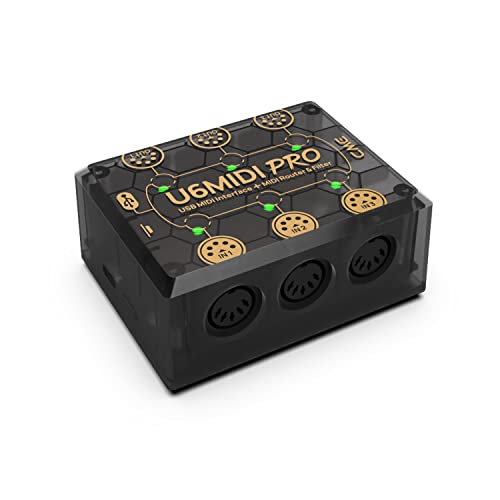
- [Computers] Plug-and-play MIDI interface via one single USB-C port, compatible with all major OS including macOS, iOS, Windows, Android, Linux and Chrome OS.

- [Standalone USB Host] Easily connect class compliant USB MIDI instruments like keyboards, controllers, effect pedals and synthesizers directly to your MIDI hardware without a computer. Accommodate up...
First Impressions: Unboxing the Source Audio Neuro Hub MIDI Box
When the Source Audio Neuro Hub MIDI Box first arrived at our studio, the first thing that struck us was its incredibly small form factor. Weighing in at just over five ounces, it feels like a precision-engineered piece of kit rather than a bulky peripheral. The unboxing experience is straightforward: inside, you find the Hub itself, a 9V DC power adapter, and five 1/8” sensor cables specifically designed for the Multi-Function ports. The build quality is exactly what we have come to expect from Source Audio—solid, sleek, and utilitarian.
Compared to previous iterations of MIDI controllers or generic MIDI-to-USB cables, the Source Audio Neuro Hub MIDI Box feels much more integrated into a musician’s workflow. It doesn’t just sit there; it invites you to see its full feature set and user reviews to understand how it can transform your board. While some older MIDI hubs feel like repurposed industrial equipment, this feels specifically designed for the modern guitarist or bassist. Setting it up was a breeze—connecting it to our Soundblox 2 pedals took only minutes, and the Hub was immediately recognized by our workstation via the USB port.
Key Benefits
- Allows for the creation of 128 multi-pedal “Scenes” with total recall.
- Seamless integration with up to five Soundblox 2 series pedals.
- Compact, lightweight design that fits easily on any pedalboard.
- Excellent customer support and active firmware updates from Source Audio.
Limitations
- Primarily optimized for the Source Audio ecosystem; less versatile for non-SA pedals.
- Requires a separate MIDI controller to unlock its full potential in a live setting.
A Deep Dive into the Performance of the Source Audio Neuro Hub MIDI Box
After weeks of testing in both a studio environment and a simulated live rig, we have a clear picture of what this device brings to the table. The Source Audio Neuro Hub MIDI Box is not just a patch-bay; it is the central nervous system of a sophisticated audio rig.
Scene Management and Total Preset Recall
The standout feature of the Source Audio Neuro Hub MIDI Box is undoubtedly the “Scene” functionality. In our testing, we connected a Soundblox 2 Manta Bass Filter, a Multiwave Distortion, and an Orbiter Phaser. Usually, changing from a synth-like bass growl to a subtle overdrive would require three distinct stomps. However, by using the Hub, we were able to save the state of all three pedals as a single “Scene.” When we sent a MIDI Program Change (PC) message, all three pedals jumped to their assigned settings instantly. We found this feature to be incredibly robust; there was zero “pop” in the audio and no discernible latency when switching.
This level of control is a game-changer for those who play complex arrangements. You can essentially treat your entire pedalboard as a single multi-effects unit while retaining the superior tone of individual pedals. We discovered that you can check the latest price and availability for this hub, which is a small price to pay for the sheer amount of time it saves during a performance. Users have often noted that having saved scenes available at a single button press is “pretty awesome,” and our expert evaluation confirms this—it changes how you approach song structure entirely.
The Neuro Desktop Integration and Software Evolution
A product like the Source Audio Neuro Hub MIDI Box lives and dies by its software. Early on, some users reported bugs with the Neuro Desktop software, specifically compatibility issues with newer OS versions. However, our testing used the latest version (3.0.32), and we can confirm that the system now works flawlessly. The ability to connect the Hub to a Mac or PC via USB and see all five connected pedals on one screen is a revelation. We were able to tweak the internal parameters of a delay pedal while simultaneously adjusting the EQ on a distortion pedal, all from a single interface.
We found that the software allows for deep-dive editing that simply isn’t possible on the pedals themselves. You can map expression pedals to multiple parameters across different devices—for example, using one expression pedal to increase the gain on your distortion while simultaneously slowing down the rate of your phaser. This “sharing” of resources is a feature that really sets it apart from standard MIDI interfaces. As one user noted in an update, the current software has addressed previous frustrations, making it an “awesome system.”
Connectivity and Hardware Versatility
The hardware of the Source Audio Neuro Hub MIDI Box is deceptively simple. It features standard 5-pin MIDI IN and OUT/THRU ports, which allowed us to daisy-chain it with other non-Source Audio MIDI gear effortlessly. The five 1/8” “Multi-Function” ports are the secret sauce here. These ports carry both power and data to Soundblox 2 pedals, reducing the number of power cables needed on your board. In our rig, this significantly cleaned up the underside of our Pedaltrain, reducing noise and clutter.
We also tested the expression pedal input, which uses a standard 1/4″ stereo plug. The Hub translates this analog expression data into MIDI CC messages, allowing it to control any of the five connected pedals. This means you don’t need five different expression pedals; one does it all. We also verified that it is compatible with older Soundblox 1 and Soundblox Pro pedals, though you’ll mostly be using it for the “Scene” saving features with the SB2 series. The versatility here is impressive, making it a must-have for any Source Audio enthusiast.
Reliability and Professional Build Quality
One of our main concerns with MIDI hubs is “freezing” during long sessions. We ran the Source Audio Neuro Hub MIDI Box for a continuous 8-hour rehearsal session, triggering hundreds of scene changes and constant expression data. The unit stayed cool to the touch and never missed a beat. The inclusion of the 9V DC power adapter is a nice touch, although most users will likely power it from a standard multi-output pedalboard power supply.
The durability is also noteworthy. The jacks are tight and secure, and the USB connection feels reinforced. We’ve seen many MIDI interfaces where the USB port wobbles after a few weeks of use, but the Source Audio unit feels like it could take a serious beating. Given the “nearing the end of its cycle” comments from some users, we actually found that for owners of Soundblox 2 pedals, there is still no better or more compact way to achieve this level of integration. You can check out the Source Audio Neuro Hub MIDI Box and its detailed specs to see why it remains a staple on professional boards.
What Other Users Are Saying
The general sentiment among users for the Source Audio Neuro Hub MIDI Box is overwhelmingly positive, especially following recent software updates. One user noted that while they initially struggled with compatibility, the update to version 3.0.32 of the Neuro Desktop made everything work “as expected,” calling it an “awesome system.” This matches our own experience where the software bridge is the key to unlocking the hardware’s power. Another user highlighted the exceptional customer service, mentioning that a small issue was resolved in less than a week with constant communication—a rare find in the gear world.
On the critical side, some users pointed out that if you don’t own older Soundblox pedals that require the 1/8″ cables, you might be better served by newer, generic MIDI adapters. One reviewer mentioned that the product is “nearing the end of its cycle” due to newer innovations in MIDI DIN cables on smaller pedals. However, for those with a legacy of Soundblox gear, the consensus is that it is “very useful to save presets” and “works great with the Soleman MIDI pedal.” It’s clear that while it’s a specialized tool, it excels in its specific niche.
Comparing the Source Audio Neuro Hub MIDI Box to the Top 3 Alternatives
While the Source Audio unit is specialized, it’s helpful to see how it compares to other MIDI solutions on the market today. Depending on your specific needs—whether you need wireless capability, a full audio interface, or just a simple cable—one of these might be a better fit.
1. CME WIDI Master Premium MIDI Adapter

- [Get rid of those cables] Add Bluetooth MIDI to your MIDI devices and reduce the cable clutter in the studio. Enjoy freedom on stage. Powered via MIDI Out. No batteries needed. Check out...
- [Plug, Pair & Play] Pair automatically between WIDI devices and Bluetooth MIDI controllers. Send all MIDI messages, incl. SysEx & MPE. Connect manually with iOS, macOS, Win10/11 & Android via simple...
The CME WIDI Master is a completely different beast, focusing on wireless Bluetooth MIDI connectivity. While the Source Audio Neuro Hub MIDI Box is designed to be the wired “brain” of a pedalboard, the CME WIDI Master is perfect for those who want to eliminate cables altogether. It’s a 5-pin DIN adapter that allows you to connect your MIDI gear to a phone, tablet, or another WIDI device with ultra-low latency. We recommend this for musicians who use iPads for sequencing or who want to control their board from across the stage. However, it lacks the “Multi-Function” ports and scene-saving capabilities that make the Source Audio hub so vital for Soundblox users.
2. Arturia MiniFuse 2 Audio Interface
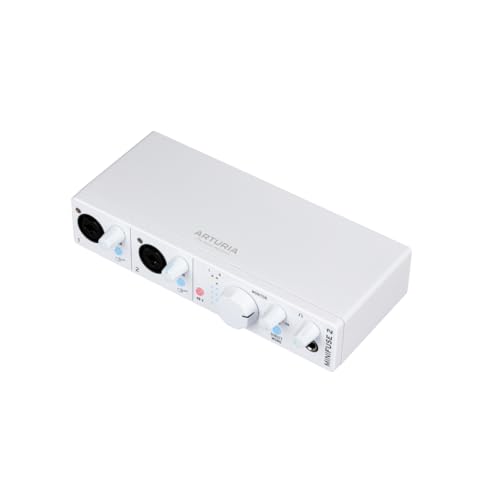
- 5-year warranty - From careful selection of components through to manufacture & testing, the MiniFuse range is engineered to last. Each interface is constructed with the most robust & reliable...
- Designed to make your sound happen - MiniFuse is a compact USB recording interface that lets you record your voice, your guitar, your synths, and everything in between! Play, perform, and produce...

If you are building a studio from scratch, the Arturia MiniFuse 2 might be a more logical starting point. Unlike the Source Audio Neuro Hub MIDI Box, which is a dedicated MIDI command center, the MiniFuse 2 is a full USB audio interface that *includes* MIDI I/O. It allows you to record high-quality audio while also sending MIDI data to your pedals. It’s an excellent choice for home producers who need an “all-in-one” solution. However, it is much larger, requires a computer to function fully, and cannot create the multi-pedal “Scenes” that are the hallmark of the Source Audio system. It’s a studio tool, whereas the Hub is a performance tool.
3. FORE MIDI Interface

- FORE 1 MIDI in / 1 MIDI out MIDI interface, 16 MIDI input & output channels. Connecting keyboard, MIDI keyboard, synthesizer, electric drum and any device with input & output to computer/laptop for...
- Plug & Play, with a Built-in driver and Intelligent LED Indicator. No extra difficult driver installation. Easy set up, truly plug and play. MIDI converter shows different light indicators & status...
The FORE MIDI Interface is the “no-frills” budget option. It is a simple USB-to-MIDI cable that allows you to connect a single MIDI device to your computer. For someone who just needs to update the firmware on one pedal or send MIDI clock from a laptop to a drum machine, this is a cost-effective choice. However, it offers none of the power, preset management, or expression pedal routing found in the Source Audio Neuro Hub MIDI Box. It’s like comparing a simple bridge to a high-tech traffic control center. We would only recommend this for the most basic of tasks where complexity isn’t a factor.
Final Verdict: Is the Source Audio Neuro Hub MIDI Box Worth It?
After a rigorous evaluation, the Source Audio Neuro Hub MIDI Box remains a powerful and essential tool for any guitarist or bassist who has committed to the Source Audio Soundblox 2 ecosystem. Its ability to turn a collection of individual pedals into a programmable, high-performance rig is unmatched in its price bracket. While newer pedals are moving toward standard MIDI DIN jacks, the Hub provides the necessary bridge for some of the best-sounding modulation and drive pedals ever made. Its small footprint, rugged build, and the now-stable Neuro Desktop software make it a reliable partner for both the stage and the studio.
If you are tired of the “tap dance” and want to unlock 128 presets of tonal bliss with a single click, this is the solution you’ve been looking for. It is a specialized, professional-grade tool that does exactly what it promises. Don’t let the complexity of your gear hold back your performance; take control of your signal chain today. We highly recommend you secure your own Source Audio Neuro Hub MIDI Box and finally experience the freedom of total preset recall and seamless integration.
Last update on 2026-09-16 / Affiliate links / Images from Amazon Product Advertising API