
Ashdown Geezer Butler Bass Head 600W Review: Heavy Metal Thunder and Sonic Versatility
For decades, bassists have chased a specific kind of “phantom” tone—the elusive mixture of earth-shaking low end and articulate, aggressive harmonic grit. We’ve all been there: you plug into a standard solid-state head, and it’s either too clean and sterile, or you engage a drive pedal and your low-end fundamental completely disappears. This struggle is precisely what leads players toward a professional-grade solution like the Ashdown Geezer Butler Bass Head 600W. Finding an amplifier that can handle the massive requirements of a touring stage while maintaining the soul of a vintage tube-driven rig is no small feat.
The problem is compounded for those of us who play in loud bands. You need headroom, but you also need character. Most amps give you one or the other. Without the right gear, your bass becomes a muddy wash that gets lost behind the guitars and drums. Solving this sonic puzzle is crucial because the bass is the bridge between rhythm and melody; if that bridge is weak, the whole song collapses. This is why I was so eager to see its full feature set and user reviews and put this “Head of Doom” through its paces in a real-world environment.

- Slave Input/Transfmer-isolated Slave Outputs
- 600-watt Bass Head with Tube Preamp
What to Consider Before Investing in Professional Bass Guitar Amplifier Heads
Choosing a bass amplifier head is more than just a purchase; it’s a foundational decision for your entire musical identity. A professional head like the Ashdown Geezer Butler Bass Head 600W serves as the brain of your rig, dictating how your instrument interacts with the air in the room. This category of gear is designed to solve the problem of insufficient volume and lack of tonal flexibility. For the serious performer, these heads provide the necessary wattage to drive large cabinets and the EQ precision to “carve out” a space in a dense mix, ensuring your lines are felt as much as they are heard.
The ideal customer for this type of product is the dedicated gigging bassist or recording professional who requires “unbreakable” headroom and specific tonal shaping tools. It’s for the player who isn’t satisfied with “plug-and-play” simplicity and wants to master their gain structure. Conversely, it might not be suitable for the casual bedroom hobbyist or those who only play at low volumes, as 600 watts of tube-preamp power is designed to be pushed. Those looking for extreme portability might also find the weight of a professional metal-enclosure head a bit daunting compared to modern D-class “micro” amps.
Before investing, consider these crucial points in detail:
- Power Output and Headroom: When looking at a 600W head, you are buying headroom. This means you can play at high volumes without the power section clipping in an ugly way. We found that this is vital for maintaining a clean, punchy low-end fundamental even when your preamp is screaming.
- Preamp Type (Tube vs. Solid State): The Ashdown Geezer Butler Bass Head 600W features a tube preamp. This is important because tubes provide a natural, musical compression and “warmth” that solid-state circuits often struggle to emulate. If you want that vintage growl, a tube preamp is a non-negotiable requirement.
- Connectivity and Routing: For the modern pro, a DI output is just the beginning. You should look for transparent FX loops, tuner outputs, and specialized features like “Slave” outputs if you plan on running multiple heads. These features allow the amp to grow with your rig as you move to larger stages.
- Build Quality and Durability: Since this is a piece of touring gear, the enclosure material matters. A heavy-duty metal chassis is preferred over plastic components. A long warranty, like the 5-year coverage offered here, is a significant indicator of a manufacturer’s confidence in their craftsmanship.
While the Ashdown Geezer Butler Bass Head 600W is an excellent choice, it’s always wise to see how it stacks up against the competition. For a broader look at all the top models, we highly recommend checking out our complete, in-depth guide:
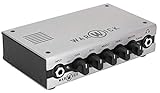

- 250 Watt portable micro bass head amplifier for stage and studio

First Impressions: Unboxing the “Head of Doom”
When the Ashdown Geezer Butler Bass Head 600W arrived at our studio, the first thing we noticed was its formidable presence. This is not a “toy” amp. Encased in a rugged black metal enclosure with the iconic Ashdown dual VU meters, it looks like it was pulled straight off a Black Sabbath stage. The “Head of Doom” branding is subtle but cool, signaling that this amp was built to Geezer’s exact specifications. Unlike many modern amps that feel like lightweight computers, this unit has a reassuring “heft” that speaks to its high-quality transformers and tube circuitry.
Setting it up was straightforward, though there is a learning curve to the front panel sliders. The 9-band EQ is more comprehensive than your standard three-knob setup, which we found incredibly useful for dialing out specific room resonances. Compared to previous Ashdown ABM models, the Ashdown Geezer Butler Bass Head 600W feels more focused. It doesn’t try to be everything to everyone; it tries to be the ultimate rock and metal machine, and a feature that really sets it apart is the dedicated “Doom” control, which we will dive into shortly.
Key Benefits
- Massive 600-watt power section with immense headroom.
- Dedicated “Doom” control for rich, harmonic distortion.
- Versatile 9-band EQ for precision tone sculpting.
- Tube preamp (12AX7) providing authentic vintage warmth.
Drawbacks
- At roughly 31 lbs, it is heavier than many modern D-class alternatives.
- Requires specific Pro Co S12NN or similar high-quality SpeakON cables for optimal performance.
Deep Dive Performance Analysis: The Ashdown Geezer Butler Bass Head 600W in Action
The Power of “Doom”: Harmonic Distortion Done Right
The centerpiece of the Ashdown Geezer Butler Bass Head 600W is undoubtedly the “Doom” control. In my testing, I’ve used countless overdrive and fuzz pedals, but there is something fundamentally different about gain that is integrated directly into the preamp stage. When you engage the Doom circuit, you aren’t just adding “noise”; you are adding rich, even-order harmonics that thicken the signal without turning it into a muddy mess. We found that the Doom control works harmoniously with the tube preamp to provide a “saturated” feel that is incredibly responsive to your playing dynamics. If you dig in hard, the amp growls back; if you play softly, it remains relatively clean but with a perceptible “edge.”
This feature is footswitchable, which makes it a godsend for live performances. You can set your base tone for verses and then “kick in the doom” for choruses or solo sections. During our evaluation, we noted that unlike many other high-gain bass heads, the Ashdown Geezer Butler Bass Head 600W maintains its low-end integrity even at the highest Doom settings. This is likely due to the sophisticated internal routing that ensures the fundamental frequency remains present beneath the distortion. If you check the latest price and availability, keep in mind that you are essentially getting a world-class overdrive pedal built directly into a professional amp head.
Tone Sculpting: The 9-Band EQ and Shape Control
Precision is the name of the game with the EQ section of the Ashdown Geezer Butler Bass Head 600W. While many bassists are used to a simple Bass/Mid/Treble setup, the 9-band sliders allow for a level of control that is usually reserved for studio outboard gear. We spent several hours tweaking the 180Hz and 340Hz sliders to find the “sweet spot” for our test cabinets, and the result was a clarity we haven’t experienced with lesser heads. The EQ is bypassable, allowing you to quickly A/B your “flat” tone against your sculpted tone.
Additionally, the “Shape” button provides a pre-set EQ curve that scoops the mids and boosts the lows and highs—perfect for that modern “clank” or slap style. However, we found that the real magic happens when you use the Shape control in conjunction with the 9-band sliders. This allows you to have a “global” tone shift while still being able to fine-tune specific problem frequencies. Whether you are playing a vintage passive P-bass or a modern active 5-string, the Ashdown Geezer Butler Bass Head 600W provides enough flexibility to accommodate any instrument. I personally found that the high sensitivity input was excellent at handling my hotter active pickups without clipping the preamp prematurely.
Connectivity and Pro-Level Features: More Than Just a Loud Box
The back panel of the Ashdown Geezer Butler Bass Head 600W is a testament to its professional pedigree. One of the most interesting features we evaluated was the Slave Input and Transformer-isolated Slave Outputs. Geezer Butler is famous for his massive “wall of sound,” and this feature allows you to run multiple Head of Doom units from a single input source. While most of us won’t need four heads for a local club gig, having the option to chain units without impedance issues or ground loops is a major plus for touring professionals.
We also put the “Sub-harmonic Generator” to the test. This circuit tracks your fundamental and adds an octave below. While this can be a gimmick on some amps, on the Ashdown Geezer Butler Bass Head 600W, it feels musical and solid. It’s perfect for those “bottom-heavy” moments in a bridge or for adding a synth-like quality to your lines. The transparent FX loop also worked flawlessly with our pedalboard, and the balanced DI output remained noise-free even when the Doom gain was cranked. This reliability is why the Ashdown Geezer Butler Bass Head 600W is a powerhouse for both stage and studio.
Visual Feedback and Real-World Use: The Dual VU Meters
Beyond the “cool factor,” the dual VU meters on the Ashdown Geezer Butler Bass Head 600W are highly functional tools. One meter monitors your input level, ensuring you are hitting the tube preamp with enough signal to get it working, while the second meter monitors the output level. During a loud soundcheck, it’s incredibly helpful to have a visual representation of your gain stages. We found that this helps prevent accidental clipping of the power section, which can be damaging to speakers over time.
In a live setting, the output muting for silent tuning was a feature we used constantly. The build quality of the switches and sliders feels robust; they have a “stiff” resistance that suggests they won’t easily break or move if bumped during transport. One minor quirk we discovered, which was also echoed by other users, is the importance of using high-quality SpeakON cables. Because of the sheer power being pushed, a standard or “cheap” cable simply won’t cut it. To ensure the best connection, we recommend the Pro Co S12NN series. When you grab your own unit here, make sure to budget for a high-end cable to match.
What Other Users Are Saying
The general sentiment among users who have purchased the Ashdown Geezer Butler Bass Head 600W is one of high satisfaction, particularly regarding its “beastly” tone. One user noted, “Sounds Great, you need a Pro Co S12NN speak on to speak on cable, not all speak on cables are the same.” This is a crucial observation; many players try to use generic cables and find the connection is loose or intermittent. Using the correct gauge and brand of SpeakON cable ensures that the full 600 watts reach your speakers safely.
Other users frequently praise the “Doom” control, calling it the “most musical distortion they’ve ever used in a bass head.” On the flip side, some users have mentioned that the weight is a bit much for those used to “lunchbox” style amps. However, most agree that the trade-off in weight is worth it for the massive, authentic tube tone and the physical reliability of the metal chassis. The consensus is clear: this is a pro-level tool that delivers on its promise of legendary rock tone.
Comparing the Ashdown Geezer Butler Bass Head 600W to Top Alternatives
While the Ashdown Geezer Butler Bass Head 600W is a titan in the 600W category, it’s worth looking at how it compares to other solutions on the market, ranging from ultra-portable mini-heads to budget-friendly powerhouses.
1. HOTONE Thunder Mini Bass Amp Head

- Inspired by the ampeg SVT, high quality tone with volume and gain controls
- 3 Band eq controls for shaping your tone
The HOTONE Thunder Mini is at the opposite end of the spectrum from the Ashdown. At only 5 watts, it’s designed for home practice and recording rather than stadium tours. While it surprisingly captures a decent “SV-style” growl at low volumes, it obviously lacks the headroom, 9-band EQ, and “Doom” circuit of the Ashdown Geezer Butler Bass Head 600W. If you are a bedroom player looking for a “toy” version of a big rig, this is great. If you are a gigging professional, there is no comparison; the Ashdown is the clear winner for performance needs.
2. Behringer ULTRABASS BXD3000H 2 Channel Bass Amplifier Head

- Clean channel with dedicated gain control
- Revolutionary class-d amplifier technology: enormous power, incredible sonic performance and ultra-lightweight
The Behringer BXD3000H offers 300 watts and two channels at a much lower price point. It includes a built-in compressor and a sub-harmonics processor similar to the Ashdown. However, the Behringer is a fully solid-state unit, missing that critical tube preamp warmth found in the Ashdown Geezer Butler Bass Head 600W. While it is lightweight and great for a budget-conscious bassist, it feels and sounds significantly more “sterile” than the Head of Doom. For those who need a professional touring rig that can survive a decade of abuse, the Ashdown’s build quality and tonal depth justify the higher investment.
3. VOX VGH Series Bass Amplifier Headphones

- Plug and Play: Simply plug your VOX VGH Amplifier Headphones into your Guitar and practice straight away with great amp sounds and effects. If you want to just listen to music simply switch the...
- ROCK: The VGH BASS headphone model has an amplifier that provides a wide dynamic range for all Bass Guitar styles at enough volume to suit all bass players
The VOX VGH Series isn’t a head at all, but a set of headphones with a built-in amp. This is a specialized tool for silent practice. Comparing this to the Ashdown Geezer Butler Bass Head 600W is like comparing a bicycle to a tank. The VOX is perfect for late-night sessions where you don’t want to wake the neighbors, but it offers zero utility for live performance or rehearsal with a band. If you already own the Ashdown for your “real” work, the VOX headphones make a sensible companion for private practice, but they cannot replace a 600W powerhouse.
The Final Verdict: Is the Ashdown Geezer Butler Bass Head 600W Worth It?
After weeks of testing and pushing this amp to its limits, I can confidently say that the Ashdown Geezer Butler Bass Head 600W is one of the most characterful and capable bass amplifiers on the market today. It perfectly bridges the gap between vintage “vibe” and modern reliability. The 9-band EQ and “Doom” control provide a tonal palette that is both deep and intuitive, and the 600-watt power section provides more than enough volume for any stage we could throw it at. While it is heavier than some competitors, that weight translates to a “solid” sound that lightweight D-class amps often struggle to reproduce.
If you are a rock or metal bassist looking for an amp that carries the DNA of a legend while providing the modern features required for a professional career, look no further. Whether you are chaining heads for a stadium or just want the best DI tone for your next studio album, this head delivers. Don’t hesitate to pick up this legendary amp head today and finally achieve the “Doom” tone you’ve been chasing.
Last update on 2026-09-10 / Affiliate links / Images from Amazon Product Advertising API