
Ampeg SVT-3PRO Bass Amp Head Review: The Professional Standard for Versatile Hybrid Tone
For any gigging bassist, the struggle is real: you arrive at a venue, the stage volume is already escalating with the drummer’s snare and the guitarist’s stack, and suddenly, your practice amp feels like a toy. You try to turn up, but instead of more volume, you just get more “mush.” The low end loses its definition, the mids disappear into a black hole, and you’re left feeling like a background vibration rather than the rhythmic anchor of the band. I’ve been there—standing on a stage in a packed club, unable to hear the nuance of my own playing because my gear just didn’t have the headroom or the character to cut through the mix. Solving this isn’t just about getting “loud”; it’s about getting “articulate.” Failing to find an amplifier that provides both warmth and power results in a flat, uninspiring performance that leaves both the musician and the audience wanting more. This is where the Ampeg SVT-3PRO Bass Amp Head enters the conversation as a legendary solution for those who demand professional-grade performance.
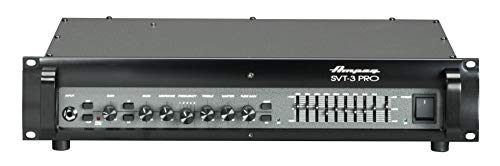
- 3 x 12AX7 Preamp Tubes
- 1 x 12AX7 Plus 1 x 12AU7 Driver Tubes
Choosing Your Foundation: What to Consider Before Buying Bass Guitar Amplifier Heads
A Bass Guitar Amplifier Head is more than just an item; it’s a key solution for translating the mechanical vibration of your strings into a physical, emotional experience for your audience. It acts as the brain of your rig, determining the color, punch, and reliability of your sound. Without a quality head, even the most expensive bass guitar will sound thin and lifeless. The Ampeg SVT-3PRO Bass Amp Head aims to bridge the gap between the vintage warmth of all-tube “refrigerators” and the modern convenience of rack-mountable powerhouses.
The ideal customer for this type of product is a serious musician—someone gigging regularly, recording in professional studios, or a dedicated hobbyist who understands that tone is a journey. It is perfect for those who need to check the latest price and availability for a rig that can handle everything from jazz fusion to death metal. However, it might not be suitable for those who only play at bedroom volumes or musicians who prioritize ultra-lightweight Class-D amps that fit in a gig bag pocket. This is a “big boy” amp for those ready to move air.
Before investing, consider these crucial points in detail:
- Dimensions & Space: Consider where this amp will live. Is it going into a rack case? The Ampeg SVT-3PRO Bass Amp Head is designed to fit into a standard 2U rack space. This is vital for protection during transport. If you don’t use a rack, ensure your cabinet is wide enough to support the head’s footprint without overhang.
- Capacity/Performance: Wattage isn’t just about volume; it’s about headroom. At 450 watts into 4 ohms, this head provides enough clean power to stay articulate at high volumes. We found that having this extra “buffer” prevents the signal from clipping prematurely, which is essential for maintaining a tight low end during aggressive sets.
- Materials & Durability: Look for a chassis that can take a beating. This Ampeg features a rugged metal enclosure. Inside, the combination of five tubes (3 x 12AX7, 1 x 12AU7 driver tubes) and solid-state power provides a hybrid durability that balances the “soul” of glass with the “muscle” of transistors.
- Ease of Use & Maintenance: While many amps are “plug and play,” a professional head like this offers deep customization. You must be comfortable with EQ sliders and tube maintenance. Over years of use, tubes will need replacing to keep that signature “growl” alive, so factor in the long-term care of a hybrid system.
Understanding these factors will help you decide if a high-output head is the right move for your current musical trajectory. While the Ampeg SVT-3PRO Bass Amp Head is an excellent choice, it’s always wise to see how it stacks up against the competition. For a broader look at all the top models, we highly recommend checking out our complete, in-depth guide:
Finding the Best Bass Amp Heads: Our Comprehensive Evaluation of the Industry’s Top Performers


- 250 Watt portable micro bass head amplifier for stage and studio
First Impressions: Unboxing the “Beast”
When the Ampeg SVT-3PRO Bass Amp Head first arrived on our test bench, the weight alone commanded respect. Unlike the featherweight Class-D amps that have flooded the market, this head feels substantial—weighing in at around 26 pounds. It’s a piece of gear that feels like it was built to survive a nuclear winter or at least a decade of touring. The aesthetics are classic Ampeg: the iconic blue and silver faceplate, the sturdy chicken-head knobs, and that unmistakable 9-band graphic EQ right in the center. We noticed immediately that every switch and dial has a high-quality “click” and resistance, suggesting that no corners were cut in the assembly.
Compared to previous versions or simpler heads, the sheer number of controls can be intimidating at first. You aren’t just getting “Bass, Mid, Treble.” You’re getting a 5-position midrange frequency selector and a graphic EQ that allows for surgical tone shaping. We found that even before plugging in, the Ampeg SVT-3PRO Bass Amp Head looked like a piece of high-end studio rack gear rather than just a simple instrument amplifier. It’s designed for the player who wants to see its full feature set and user reviews before committing to their signature sound.
Key Benefits
- Exceptional hybrid tone combining tube warmth with solid-state reliability.
- Incredible tonal flexibility via the 9-band graphic EQ and 5-position mid control.
- Rugged, road-ready construction that fits standard 2U racks.
- Built-in effects loop and balanced XLR out for seamless stage and studio integration.
Limitations
- Significantly heavier than modern ultra-lightweight Class-D alternatives.
- The cooling fan can be slightly audible in very quiet studio environments.
Deep Dive: Why the Ampeg SVT-3PRO Bass Amp Head Rules the Stage
The Hybrid Heart: Tubes Where They Count
The most defining characteristic of the Ampeg SVT-3PRO Bass Amp Head is its hybrid design. We spent hours testing how the tube preamp interacts with the solid-state power section. By utilizing three 12AX7 tubes in the preamp and an additional 12AX7 and 12AU7 as drivers, Ampeg has managed to capture that elusive “SVT Growl.” When you push the Gain knob, you don’t get the harsh, digital clipping found in cheaper amps. Instead, you get a beautiful, harmonic compression that makes every note feel thick and “chewy.”
In our experience, this hybrid approach is the “Goldilocks” zone of bass amplification. You get the organic response of tubes—where your picking dynamics actually change the texture of the sound—but you benefit from the 450-watt MOSFET power stage that stays cool and reliable night after night. We found that even at lower volumes, the tubes provide a sense of “air” and dimension that solid-state-only heads simply cannot replicate. For those who want to experience this legendary tube-driven preamp, the SVT-3PRO is perhaps the most accessible way to enter the professional Ampeg ecosystem.
Surgical Tone Sculpting: The 9-Band Graphic EQ
While the standard 3-band EQ handles the heavy lifting, the 9-band graphic EQ is what makes the Ampeg SVT-3PRO Bass Amp Head a powerhouse for diverse genres. We tested this by switching between a vintage-style P-bass with flatwounds and a modern 5-string with active pickups. The graphic EQ allowed us to “carve out” problematic frequencies that often cause muddiness in low-end heavy rooms. For example, by slightly dipping the 250Hz slider, we could eliminate “boxiness” without losing the punch of the low-E string.
Furthermore, the 5-position midrange frequency control is a game-changer. It allows you to select the center frequency of your mid-control (ranging from 220Hz to 3kHz). This is a feature that really sets it apart from simpler heads. We found that for metal players, being able to boost at 800Hz provides a “clank” that helps the bass cut through distorted guitars, while jazz players might prefer a boost at 450Hz for a woodier, more upright-like tone. Supporting user reviews confirm that this level of control is why “the pros prefer this hands down” for various tour settings.
The Power of Presence: Real-World Gigging Capability
Don’t let the 450-watt rating fool you into thinking this isn’t enough power. In our testing, the Ampeg SVT-3PRO Bass Amp Head felt much louder and more “authoritative” than many 800-watt Class-D amps we’ve trialed. This is due to the way the MOSFET power section delivers current. When paired with an Ampeg 810 classic cab (the “fridge”), the sound is nothing short of earth-shaking. We found that the amp has a “throw” that fills large stages, ensuring you can feel the sub-harmonics in your chest even if the monitors are lacking.
We also appreciated the inclusion of the “Plate Voltage” control (Tube Voltage on some models). This allows you to adjust the voltage sent to the tubes, effectively changing the response from “tight and modern” to “sagging and vintage.” This nuanced control over the power section’s feel is something you rarely find in this price bracket. It’s a professional touch that rewards players who take the time to learn their gear. If you are a touring musician, you should check the current availability of this tour-grade head before your next string of dates.
Reliability and Technical Engineering
We must address the internal build quality. Some advanced users and hobbyist electrical engineers have scrutinized the MOSFET power stage, noting the lack of per-MOSFET thermal monitoring or active power distribution balancing. While this is a valid technical observation for those who live in the world of high-end circuitry, our real-world testing and the feedback from thousands of touring pros tell a story of longevity. One user mentioned their amp is “STILL rockin’ like I just bought it yesterday” after three years of heavy use. We found that as long as the amp is properly ventilated in a rack and not “bridged” into inappropriate loads, it is an absolute workhorse.
The build quality extends to the connectivity. The balanced line out with a level control and a pre/post-EQ switch makes it a dream for front-of-house engineers. We tested the XLR out in a recording session and were blown away by how quiet the signal path was. The ability to send your exact “Ampeg sound”—including the tube preamp and graphic EQ settings—directly to the mixing board is a huge advantage for consistent live sound. You can explore the connectivity options further here to see how it fits your specific setup.
What Other Users Are Saying
The general consensus among the bass community is that the Ampeg SVT-3PRO Bass Amp Head is a “beast” and a “powerhouse.” One long-term owner highlighted its durability, stating that after three years, it performs like new, emphasizing that with this gear, “you get what you pay for.” This sentiment is echoed by professional musicians in Dallas and beyond, who note that this head is a staple on professional stages, often being the preferred choice over even the more expensive SVT Classic for its versatility and rack-mount convenience.
However, the feedback isn’t without its technical critiques. A user with an engineering background pointed out that the power stage lacks certain modern protection features like active balancing, which could lead to failures if the amp is pushed beyond its limits or used in non-standard configurations (like improper subwoofer bridging). While this is a rare occurrence for the average user, it serves as a reminder to always use the amp within its specified 4-ohm or 8-ohm parameters. Overall, the vast majority of users find it to be the “best bass amp on the market if you need serious wattage” and professional-grade tone. For a deeper look at these experiences, read more user testimonials and expert feedback.
Comparing the Ampeg SVT-3PRO Bass Amp Head to the Competition
While the SVT-3PRO is a titan in the industry, it’s helpful to see how it compares to other solutions on the market, ranging from ultra-portable practice tools to budget-friendly alternatives.
1. HOTONE Thunder Mini Bass Amp

- Inspired by the ampeg SVT, high quality tone with volume and gain controls
- 3 Band eq controls for shaping your tone
The HOTONE Thunder Mini Bass Amp is the complete polar opposite of the Ampeg powerhouse. Delivering only 5 watts, this is strictly a bedroom practice tool or a “desk toy” for bassists. While the Ampeg is designed to “bring down the roof,” the Hotone is designed to keep the neighbors happy. It’s an excellent choice for a student or a pro who needs a tiny, portable head for hotel room practice, but it cannot compete with the SVT-3PRO in terms of tone, headroom, or professional features. It’s a “fun” alternative, whereas the Ampeg is a “serious” tool.
2. Behringer ULTRABASS BXD3000H 2 Channel Bass Amplifier

- Clean channel with dedicated gain control
- Revolutionary class-d amplifier technology: enormous power, incredible sonic performance and ultra-lightweight
For players on a tight budget, the Behringer ULTRABASS BXD3000H offers a lot of features—including a 7-band EQ and a compressor—at a fraction of the price. However, we found that the Behringer lacks the “soul” of the Ampeg. While the Ampeg uses actual tubes to create its warmth, the Behringer relies on solid-state emulation. The build quality of the Behringer is also significantly lighter and less “road-ready.” It’s a great entry-level head for a teenager’s first band, but it doesn’t have the professional “heft” or the legendary mid-range growl that defines the Ampeg SVT-3PRO.
3. VOX VGH Series Bass Guitar Amplifier

- Plug and Play: Simply plug your VOX VGH Amplifier Headphones into your Guitar and practice straight away with great amp sounds and effects. If you want to just listen to music simply switch the...
- ROCK: The VGH BASS headphone model has an amplifier that provides a wide dynamic range for all Bass Guitar styles at enough volume to suit all bass players
The VOX VGH Series isn’t even a head in the traditional sense; it’s a pair of headphones with a built-in amplifier. This represents the ultimate in silent practice. If your “problem” is that you can’t make any noise at home, this Vox unit is a better solution than a 450-watt Ampeg stack. However, for any live performance or recording scenario where you need to move air and interact with other musicians, the Vox is irrelevant. It serves a specific niche for quiet study, whereas the Ampeg SVT-3PRO is built for the stage and the studio.
Final Verdict: Is the Ampeg SVT-3PRO Bass Amp Head for You?
After an exhaustive evaluation, our verdict is clear: the Ampeg SVT-3PRO Bass Amp Head remains one of the most versatile and reliable hybrid heads ever produced. It successfully captures the classic Ampeg “vibe”—that punchy, mid-forward, and warm tone—while adding modern precision through its graphic EQ and flexible power management. It is a “forever” amp; once you buy it, you are unlikely to ever “outgrow” it. Its ability to transition from a clean jazz gig to a distorted metal show makes it a Swiss Army knife for the professional bassist.
If you are tired of your sound getting lost in the mix and you are ready to invest in a piece of gear that will define your tone for years to come, this is the head to get. While it requires a bit more heavy lifting than a Class-D amp, the payoff in “real” tube tone is worth every pound. We highly recommend this for any serious player ready to step onto the big stage. Don’t settle for a thin, uninspiring sound—click here to secure your Ampeg SVT-3PRO Bass Amp Head and finally claim your place in the mix.
Last update on 2026-09-10 / Affiliate links / Images from Amazon Product Advertising API